
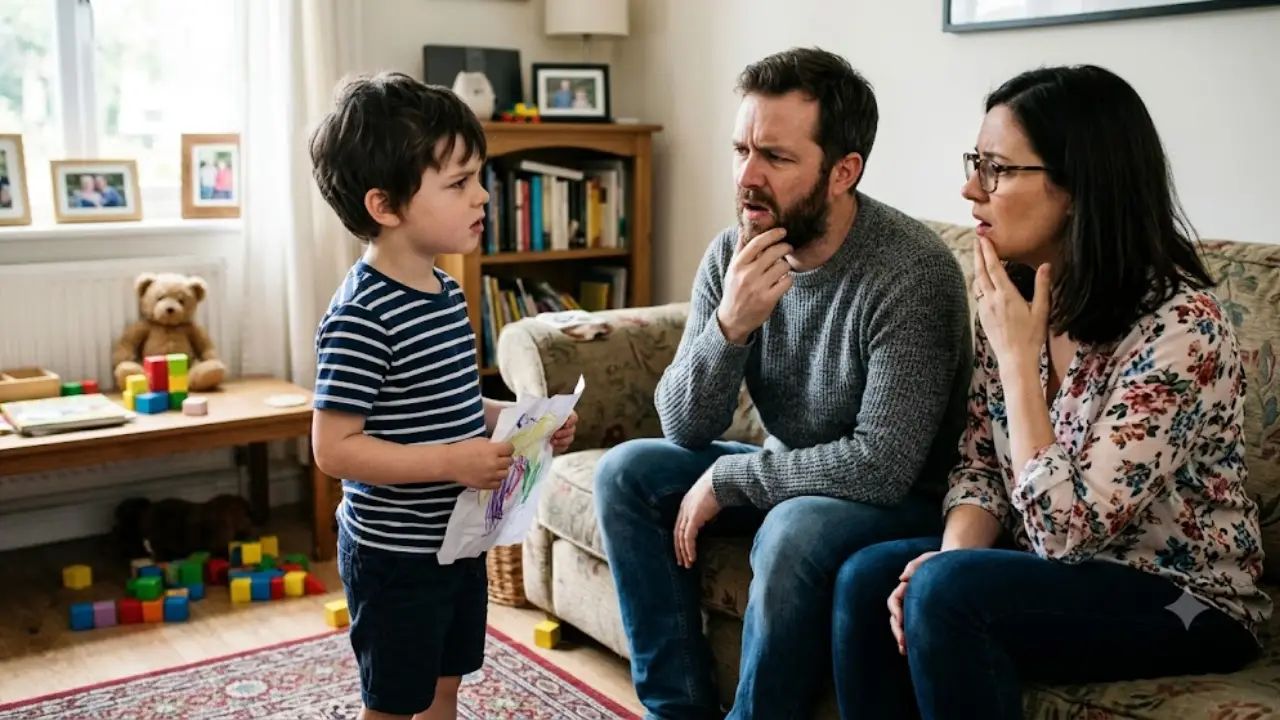
There is a particular kind of silence that parents eventually learn to recognise.
You have answered a child’s question.
The answer was perfectly reasonable.
Perhaps even correct.
But the child is still staring at you.
Not satisfied.
Not angry.
Just thinking.
Then comes the sentence:
“But how do you know?”
You explain.
The child waits.
Then:
“What if you’re wrong?”
It is an astonishing little question.
Adults often hear it as argument.
Sometimes it is argument.
But something more important may be happening underneath.
The child has just discovered that being an adult and being right are two different things.
That sounds embarrassingly obvious to grown-ups.
For a five-year-old, it is an intellectual earthquake.
For years, adults occupy a strange position in the child’s universe. They provide food, explanations, rules, answers, warnings and names for things. They know where the moon goes. They know why thunder happens. They know which mushrooms are dangerous. They know whether the monster under the bed exists.
Then, slowly, the child catches an adult making a mistake.
A parent forgets something.
A teacher corrects another teacher.
A doctor checks a reference.
Two adults disagree.
A child asks Google.
And suddenly the architecture of authority begins to crack.
Not collapse.
Reorganise.
That distinction matters.
Because developmental psychology suggests that children are not simply moving from trusting adults to distrusting adults.
They are learning something much more sophisticated:
Trust is not a switch. It is a calculation.
And perhaps one of childhood’s most important intellectual achievements is learning who deserves to be believed, about what, and why.
The Child’s First Problem Is Not “Who Is Right?”
It is:
“Who should I learn from?”
Imagine being three years old.
Almost everything you know has come from somebody else.
You did not personally discover that fire burns.
You did not measure gravity.
You did not invent language.
You did not travel around the planet to establish that other countries exist.
You were told.
Human civilisation depends on this arrangement.
Much of what humans know is testimony information acquired from other people.
Researchers studying children’s learning from testimony have found that the foundations of this ability appear surprisingly early. Infants can respond differently to people who have demonstrated more or less reliable behaviour, while children’s evaluation of informants becomes considerably more sophisticated during the preschool years.
This creates an extraordinary evolutionary problem.
A child who believes everything is vulnerable to misinformation.
A child who believes nothing cannot learn efficiently.
So nature appears to have given children a third option:
selective trust.
Not:
“Believe adults.”
Not:
“Believe nobody.”
But:
“Work out whom to believe.”
That is a much more complicated mental job.
The Hidden Skill: Trusting the Right Person for the Right Question
Suppose a child wants to know how a bicycle works.
Dad may know.
Grandmother may not.
A bicycle mechanic probably does.
A five-year-old YouTuber confidently explaining quantum mechanics probably does not.
The interesting part is that mature reasoning does not ask:
“Who is the most important person here?”
It asks:
“Who has relevant knowledge?”
Research synthesising 101 studies of children’s selective trust identifies several recurring cues children use when evaluating informants, including previous accuracy, expertise, access to information, reasoning ability and in some situations social characteristics.
A separate meta-analysis covering 51 studies and 88 experiments involving 3- to 6-year-olds found that children generally preferred knowledgeable informants, and that older preschoolers increasingly prioritised epistemic characteristics over purely social characteristics when the two conflicted.
That is a profound developmental transition.
The child is slowly learning that:
Popularity is not evidence.
Confidence is not evidence.
Age is not evidence.
Status is not evidence.
And even:
being an adult is not evidence.
They may be useful clues.
They are not proof.
The Fascinating Part: Children Track Your Record
Imagine two adults.
The first answers:
“The red box contains the ball.” Correct.
“The blue box contains the toy.” Correct.
“The yellow box is empty.” Correct.
The second answers incorrectly three times.
Then both adults make a new claim.
Who does the child believe?
The first.
This sounds obvious until you realise what the child has done.
The child has kept a mental reliability record.
Research reviewed across developmental studies shows that children can track an informant’s history of accuracy and use it when deciding whether to trust later testimony. Evidence of sensitivity to informant accuracy appears very early and becomes increasingly explicit during the preschool period.
The child is therefore doing something surprisingly adult-like:
updating a belief based on previous performance.
In statistical language, it resembles a crude version of Bayesian reasoning.
The child does not need to calculate percentages.
The brain is doing something simpler:
“Last time you knew what you were talking about. I’ll listen again.”
That is not blind trust.
It is earned trust.
But Then Comes the Really Difficult Question: What About Power?
Here childhood psychology becomes unexpectedly political—not in the partisan sense, but in the ancient human sense of power and authority.
Humans have always lived in hierarchies.
Parents tell children what to do.
Teachers tell students what is required.
Leaders issue instructions.
Experts are deferred to.
Titles, uniforms, age and status can all signal authority.
But authority creates a dangerous shortcut:
“Important person says it → therefore it must be true.”
Children have to learn whether that shortcut works.
A striking 2026 study of 539 children aged 4–6 examined precisely this problem. Researchers varied both the informant’s social power and the accuracy of the information they provided. At ages four and five, children showed substantial sensitivity to high-power informants. But when a high-power person was only 25% accurate and a low-power person was 75% accurate, six-year-olds shifted toward the more accurate source, while four-year-olds were more likely to continue favouring the dominant informant.
Think about what that means.
The child is gradually learning to replace:
“Who has power?”
with:
“Who has evidence?”
That is not a small cognitive upgrade.
It is the psychological foundation of intellectual independence.
The Child Discovers That Confidence Can Lie
There is another trap.
Adults often sound certain.
That makes children and adults more likely to believe them.
But certainty and accuracy are different variables.
Someone can say:
“I’m absolutely sure.”
and still be wrong.
Scientific thinking is almost built around this uncomfortable fact.
A claim becomes stronger not because its speaker sounds confident, but because the evidence supporting it survives scrutiny.
Children gradually encounter this distinction.
They discover that one person can be:
confident but wrong,
uncertain but correct,
knowledgeable but mistaken,
inexperienced but accidentally right.
That produces a much richer concept of reliability.
The question is no longer simply:
“Was this person right?”
It becomes:
“Why were they right?”
That is a major leap.
“You Were Wrong” Does Not Necessarily Mean “You Are Untrustworthy”
This is one of the most important distinctions adults can teach.
Suppose a father tells his daughter that a shop is open.
It is closed.
Was Dad lying?
No.
He may simply have remembered the opening hours incorrectly.
Now imagine another person invents the answer despite having no idea.
Both predictions were wrong.
But they are not epistemically equivalent.
One was an honest mistake.
The other was unsupported confidence.
Children’s developing understanding of testimony increasingly incorporates these distinctions.
Research shows that children can evaluate not merely whether an informant was correct but aspects of the circumstances surrounding the claim, including whether the person had access to relevant information and what could reasonably be inferred from their situation.
This matters because reliability is not perfection.
A reliable person can occasionally be wrong.
An unreliable person can occasionally be right.
That is precisely why a track record is more informative than a single event.
The Most Important Sentence a Parent Can Say
It may be:
“I don’t know.”
Adults sometimes worry that admitting ignorance weakens authority.
In reality, it can teach a child what authority actually looks like.
Imagine two responses.
Version A:
“Because I said so.”
Version B:
“I’m not completely sure. Let’s check.”
The first teaches the child that authority can substitute for evidence.
The second teaches the child that evidence can improve an answer.
And there is another subtle lesson:
Changing your mind is allowed.
That may be more valuable than knowing the answer immediately.
The Question That Adults Accidentally Punish
Children ask an extraordinary number of questions.
Why is the sky blue?
Why do people die?
Why can’t I stay awake?
Why does the moon follow the car?
Why do adults have to work?
Why?
Why?
Why?
And eventually:
Why are you telling me this?
At that point, some adults become tired.
Understandably.
But research suggests that the social environment surrounding questions matters.
A 2026 Child Development study involving 440 children aged 5–6 found that children who overheard positive comments about another child’s question-asking subsequently asked about twice as many questions as children exposed to neutral comments. Negative comments about questioning reduced question-asking by roughly half. The sample consisted of middle-class Chinese children, so the findings should not automatically be generalised to every culture or family, but the experimental effect is striking.
In other words:
A child may not lose curiosity.
The child may learn to hide it.
That distinction is enormous.
The Child Is Also Learning When a Question Is “Allowed”
Questioning is not only about curiosity.
It is also social.
Children must learn:
When should I ask?
Whom should I ask?
Is this person busy?
Will they answer?
Will I look foolish?
Research published in 2024 found that children as young as four or five already reason about whether a particular moment is appropriate for asking a question. Older children and adults were more sensitive to whether the person being questioned was busy, while younger children were more willing to interrupt. The researchers also found that parental responses and individual differences influenced children’s question-asking behaviour.
So the decline in children’s questions as they grow is not necessarily a simple decline in curiosity.
Some of it may be social calibration.
The child learns the rules of the room.
That can be useful.
It can also become dangerous.
If “don’t interrupt” quietly becomes “don’t challenge,” curiosity has been replaced by compliance.
The Difference Between Disobedience and Intellectual Independence
This distinction is routinely blurred.
A child says:
“Why can’t I cross the road?”
That is a question.
The adult explains.
The child understands.
The child still has to obey the safety rule.
Questioning the rule and following the rule are not mutually exclusive.
Similarly, a student can ask:
“Why is this answer correct?”
without refusing to learn.
A healthy educational environment therefore does not have to choose between:
discipline
and
curiosity.
It can teach both.
The deeper objective is not to produce children who challenge every instruction.
It is to produce children who can distinguish:
“I disagree.”
from
“I want to understand.”
Those are not the same thing.
Then Something Unexpected Happens: Children Start Comparing Sources
Imagine a child hears:
Teacher: “Dinosaurs disappeared because of a massive environmental catastrophe.”
Then the child hears someone online say:
“Scientists don’t actually know what happened.”
Now the child has a problem.
Two sources.
Two claims.
Which one?
This is where mature epistemic reasoning becomes much harder.
The child must consider:
expertise,
evidence,
access to information,
track record,
reasoning,
agreement with other experts,
possible motives,
and the quality of the source.
The 2018 review of children’s learning from testimony describes this increasingly sophisticated evaluation process: children do not merely detect inaccurate claims; they increasingly reason about what an informant could reasonably know given the situation.
That is essentially the beginning of source criticism.
Historians use it.
Scientists use it.
Journalists use it.
Investigators use it.
And now children have to use it on a scale previous generations never encountered.
Because the Internet Has Destroyed the Old Information Hierarchy
For most of human history, information was scarce.
If you wanted to know something, you asked someone who knew.
Perhaps your parents.
Perhaps a teacher.
Perhaps a priest.
Perhaps a craftsman.
Perhaps a book.
The modern child lives in a different universe.
One search can produce:
a Nobel Prize winner,
a university professor,
an anonymous blogger,
a teenager,
an advertiser,
a conspiracy theorist,
a professional communicator,
and an AI chatbot.
All may speak with complete confidence.
This creates a new developmental problem.
The challenge is no longer:
“Can children obtain information?”
Information is everywhere.
The challenge is:
“Can children distinguish information from reliable knowledge?”
That is much harder.
And Now There Is a New Adult in the Room: AI
This problem has acquired another layer.
Children are increasingly encountering conversational artificial intelligence.
That raises a question developmental psychology has only just begun seriously exploring:
What happens when the “speaker” sounds knowledgeable but is not human?
A 2026 paper on children’s epistemic deference explicitly identifies generative AI as a new kind of epistemic actor entering children’s environments, while noting that children already use characteristics such as familiarity, past accuracy and attributed expertise when deciding whom to trust.
This changes the old parent-child equation.
Once, the child could ask:
“Dad, is this true?”
Now the child might ask:
“Dad says this. My teacher says that. Google says something else. The chatbot says another thing. Who is right?”
The answer cannot simply be:
“Trust the expert.”
Because the child now needs to determine who the expert is, what evidence they have, whether the source is current, and whether the claim can be independently checked.
The ancient problem of epistemic trust has acquired a digital costume.
The Most Dangerous Mistake: Teaching Children That Doubt Means Nobody Knows Anything
There is a bad version of skepticism.
It sounds sophisticated.
It says:
“Everyone has an opinion.”
“Nobody really knows.”
“Scientists are always changing their minds.”
“You can’t trust the media.”
“Adults are usually wrong.”
This is not critical thinking.
It is epistemic nihilism.
If every source is equally unreliable, evidence becomes meaningless.
A mature thinker does something harder.
They assign different levels of confidence.
For example:
Very strong evidence:
Earth is approximately spherical.
Strong but revisable scientific conclusion:
A particular explanation is best supported by current evidence.
Weak evidence:
Someone online claims something happened.
Pure speculation:
Someone says something might be true because it feels possible.
This ability to calibrate confidence is more useful than simply “questioning authority.”
The 2026 Lesson: Disagreement Can Be Educational
There is another fascinating development in the newest research.
A 2026 study involving children aged 6–11 and adults found that people often preferred learning from someone who agreed with them rather than someone who disagreed. Yet when asked what other people should do, they were more likely to recommend learning from disagreement. Explicitly teaching participants about the learning benefits of disagreement reduced this tendency to seek agreement.
That exposes one of the strangest features of human reasoning.
We know disagreement can teach us.
We simply don’t always enjoy learning from it.
Children therefore need another intellectual habit:
“Someone disagreeing with me is not necessarily someone attacking me.”
Sometimes disagreement is simply additional information.
That may become increasingly important in a world where algorithms can surround people with opinions they already agree with.
What Parents Can Do Without Turning Home Into a Philosophy Seminar
The solution is surprisingly ordinary.
Instead of “Because I said so…”
Try:
“Here’s why.”
Instead of hiding mistakes…
Say:
“I checked again, and I was wrong.”
Instead of rewarding only correct answers…
Ask:
“How did you work that out?”
Instead of treating disagreement as disrespect…
Ask:
“What evidence makes you think that?”
Instead of saying “Don’t believe everything online…”
Teach a better checklist:
Who said it?
What do they know?
How do they know it?
Can we check it somewhere else?
What evidence would prove them wrong?
These are not merely academic questions.
They are tools for navigating modern life.
The Real Developmental Milestone Is Not “Adults Are Wrong”
That would be too simplistic.
The deeper milestone is:
“Adults can be wrong, but some adults are more reliable than others, and I need reasons for deciding whom to trust.”
That is a much more mature position.
It preserves respect without demanding obedience.
It preserves skepticism without producing cynicism.
It allows expertise without turning experts into prophets.
And it allows children to become independent thinkers without pretending they can know everything themselves.
That last point matters.
A child does not become intellectually independent by refusing to depend on anyone.
Nobody can do that.
We all depend on other people’s knowledge.
Scientists depend on previous scientists.
Doctors depend on research.
Engineers depend on mathematics developed centuries ago.
Journalists depend on sources.
Parents depend on teachers.
Adults depend on other adults.
The real achievement is therefore not independence from knowledge networks.
It is becoming better at navigating them.
The Child Who Says “What If You’re Wrong?” May Be Asking the Right Question
Return to that moment.
The child is standing there.
You have answered.
The child is unconvinced.
“What if you’re wrong?”
There are two ways to hear it.
The first is:
“My child is challenging my authority.”
The second is:
“My child is discovering that authority and truth are not identical.”
The second interpretation is often more interesting.
Because eventually the child will leave the house.
They will encounter teachers.
Friends.
Employers.
Politicians.
Advertisers.
Influencers.
Doctors.
Scientists.
Algorithms.
AI systems.
People who are confident.
People who are charismatic.
People who are powerful.
People who are completely wrong.
The child will need to decide whom to believe.
No parent can make every decision for them.
At some point, the child needs an internal compass.
Not:
“Believe adults.”
Not:
“Distrust adults.”
But:
“Look at the evidence. Consider the source. Check the context. Remember the track record. Stay willing to revise your belief.”
That is a far more difficult lesson.
It is also one of the most valuable.
The Strange Paradox of Growing Up
There is a beautiful paradox here.
Children begin life needing adults because adults know more.
They gradually discover that adults do not know everything.
Then, if development goes well, they discover something even more important:
They themselves do not know everything either.
That is the final twist.
The mature thinker does not end childhood saying:
“Adults are wrong.”
They eventually arrive somewhere much less dramatic and much wiser:
“Everybody can be wrong. So let’s look at the evidence.”
That sentence sounds less rebellious.
It is also much more powerful.
Because the goal of childhood was never to manufacture a person who obeys perfectly.
Nor was it to manufacture a person who distrusts everyone.
It was to build a mind capable of learning.
And learning requires a strange combination of qualities:
trust enough to listen,
skepticism enough to question,
humility enough to admit uncertainty,
and
courage enough to change your mind.
Perhaps that is what the child’s first serious challenge to an adult really means.
Not:
“I don’t believe you.”
But:
“Show me how you know.”
And that is where a child stops merely receiving knowledge
and begins learning how knowledge itself works.
The Evidence at a Glance
| What changes | What research suggests |
| Early trust | Children depend heavily on testimony because much knowledge cannot be directly observed. |
| Selective trust | Children track characteristics such as accuracy, expertise and access to information. |
| Preschool development | Meta-analysis of 51 studies/88 experiments found age-related increases in prioritising knowledgeable informants. |
| Power vs accuracy | A 2026 study of 539 children aged 4–6 found developmental changes in how social power and accuracy were weighed. |
| Questioning | In a 2026 experiment involving 440 Chinese children aged 5–6, positive comments about questioning doubled question-asking while negative comments roughly halved it. |
| Disagreement | 2026 research found that teaching children about the learning value of disagreement reduced their tendency to seek only agreement. |
| Digital challenge | Researchers are beginning to examine AI as a new epistemic source in children’s lives. |
What This Means for Parents and Teachers
The practical objective is not to raise a child who automatically challenges authority.
It is to raise one who can distinguish authority from evidence.
A useful five-question habit is:
Who is making the claim?
What do they actually know about it?
How did they find out?
What evidence supports the claim?
What could make us change our minds?
That five-step habit is more durable than memorising thousands of facts.
Facts become outdated.
The ability to evaluate claims does not.
Frequently Asked Questions
At what age do children realise adults can be wrong?
There is no single “switch” age. Research shows that children begin tracking reliability surprisingly early, with increasingly sophisticated evaluation of expertise, accuracy, evidence and informant characteristics developing throughout childhood.
Does questioning authority mean a child is becoming rebellious?
Not necessarily. Questioning can be a normal part of developing independent reasoning. The important distinction is between questioning an explanation and refusing a legitimate instruction.
Should parents encourage children to question everything?
No. The goal is not permanent suspicion. It is calibrated skepticism knowing when evidence is strong, when uncertainty remains and which sources have relevant expertise.
Why do children sometimes believe powerful people?
Social status and power can influence children’s trust, particularly in younger children. Recent evidence suggests that as children mature, accuracy can increasingly override power when the difference is substantial.
Does admitting “I don’t know” weaken parental authority?
It can instead model a valuable form of intellectual honesty. The adult demonstrates that uncertainty is compatible with competence and that checking evidence is normal.
Why might children stop asking questions?
Part of the decline may reflect social development: children learn when questions are appropriate and how adults may respond. Recent experimental evidence also shows that social comments about questioning can significantly affect children’s willingness to ask.
The Child Does Not Need Fewer Questions
Perhaps the wrong question is:
“How do we make children respect authority?”
A better one is:
“How do we teach children to recognise trustworthy authority?”
Those are very different educational projects.
The first can produce obedience.
The second produces judgment.
And judgment is what children eventually need when there is nobody nearby to tell them what to believe.
The child who asks “What if you’re wrong?” is not necessarily trying to defeat the adult.
They may be discovering that truth does not become true merely because someone older says it.
That is a tiny moment.
It can also be the beginning of a lifetime habit:
Listen carefully.
Check the source.
Look at the evidence.
Respect expertise.
Question confidently but fairly.
And remain humble enough to discover that you, too, can be wrong.
That is not rebellion.
That is the beginning of intellectual adulthood.
Sources and Further Reading
Harris, P. L., Koenig, M. A., Corriveau, K. H., & Jaswal, V. K. Cognitive Foundations of Learning from Testimony. Annual Review of Psychology. A major synthesis of children’s learning from testimony and their developing evaluation of informants.
Li, E. et al. Epistemic trust: A comprehensive review of empirical insights and implications for developmental psychopathology. The review synthesises 101 studies concerning children’s selective trust and identifies recurring epistemic cues including accuracy, expertise, informativeness and reasoning.
Tong, Y., Wang, F., & Danovitch, J. The role of epistemic and social characteristics in children’s selective trust: Three meta-analyses. Developmental Science. The quantitative synthesis covered 51 unique studies and 88 experiments involving children aged 3–6.
Zhao, Q., Zhang, X., & Wang, H. (2026). The effect of social power and information accuracy on selective trust in 4- to 6-year-old children. Acta Psychologica. Study sample: 539 children.
Zhao, L., Zhu, S., & Peng, J. (2026). Overhearing adults’ side comments influences young children’s question-asking. Child Development. Three studies involving 440 children aged 5–6.
Blakey, K. H. & Ronfard, S. (2026). How to Increase Children’s and Adults’ Interest in Learning From Disagreement. Developmental Science. Four preregistered studies examining children aged 6–11 and adults.
National Library of Medicine / PubMed — indexed records for the developmental studies cited above.








Leave a Reply