

Bennu samples and the search for life
There is a moment in every treasure hunt when the treasure is finally opened.
For NASA, that moment came not on another planet, but inside a laboratory in Texas.
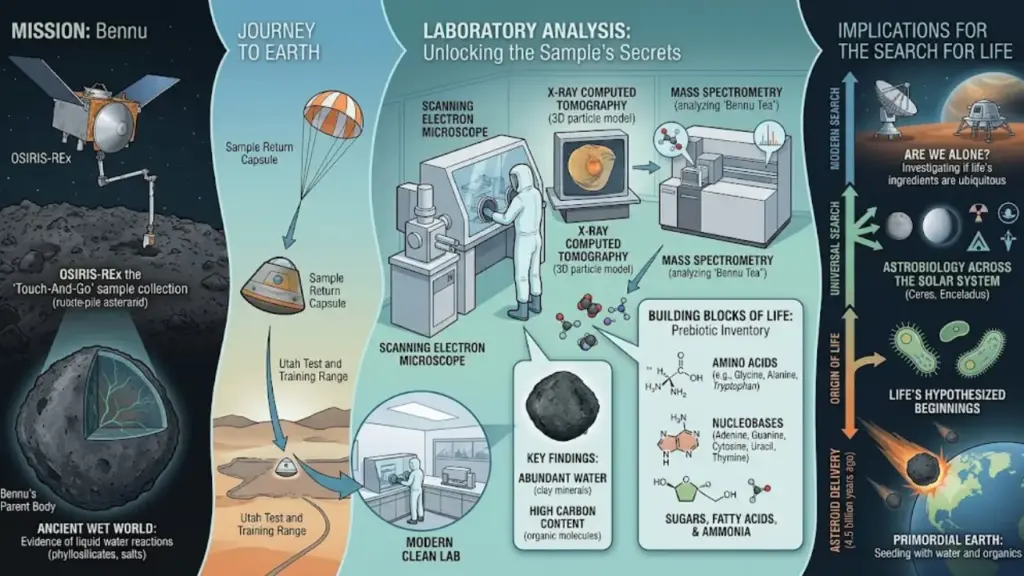
The treasure was almost absurdly small: 121.6 grams of rocks and dust collected from the asteroid Bennu.
Four ounces.
Something that could fit in the palm of a hand.
Yet those grains had been travelling through the Solar System for billions of years, carrying chemical evidence from an era before Earth looked anything like the blue planet we know today.
When the first analyses began, scientists were not looking for gold.
They were looking for something much more valuable.
Clues.
Clues about how planets formed.
Clues about where Earth’s water and organic chemistry came from.
And perhaps, hidden somewhere among those grains, clues about why chemistry on Earth eventually crossed the mysterious border between non-living matter and life.
The results were startling.
Bennu contained 14 of the 20 amino acids used by life on Earth to build proteins and all five nucleobases found in DNA and RNA. Later studies found evidence of sugars including ribose and glucose, along with a remarkable diversity of nitrogen-bearing compounds. NASA says the samples also preserve evidence of ancient water-related chemistry.
And yet, after all that excitement, scientists delivered a strangely disappointing sentence:
They had not found life.
That sentence is precisely why Bennu may be one of the most important scientific treasure hunts of our time.
Because the real question is no longer simply whether life exists elsewhere.
The deeper question is:
How far can chemistry travel toward life before something extraordinary happens?
The asteroid that carried a secret from a lost world
Bennu looks unimpressive from a distance.
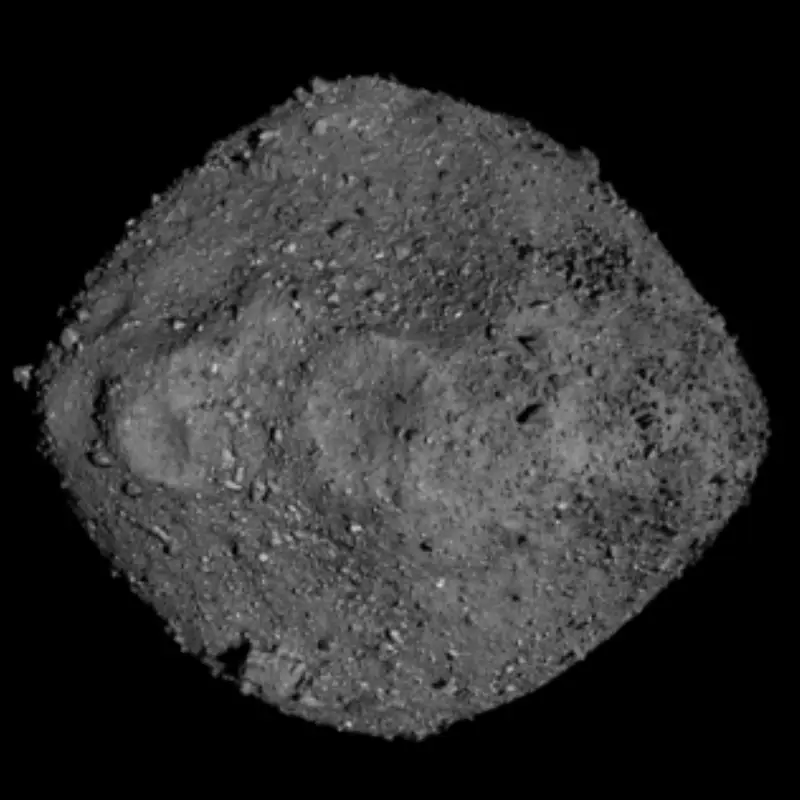
It is a dark, roughly diamond-shaped near-Earth asteroid, only about 500 metres across.
But it is not an ordinary space rock.
Bennu is believed to be a fragment of a much larger ancient parent body. That parent body formed in the early Solar System, and at some stage its materials interacted with water.
Then something happened.
The parent body was broken apart.
Bennu inherited some of its debris.
And eventually, billions of years later, a spacecraft from Earth arrived to collect a piece of it.
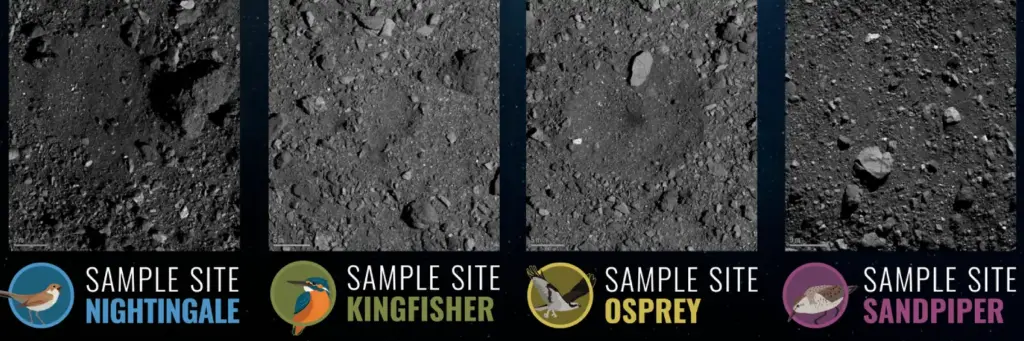
NASA’s OSIRIS-REx mission launched on September 8, 2016, reached Bennu in December 2018, collected material on October 20, 2020, and delivered its capsule to Earth on September 24, 2023. The spacecraft travelled about 2.2 billion miles during its round trip.
The mission had been designed to collect at least 60 grams.
It returned 121.6 grams.
More than twice the requirement.
That extra material turned out to be scientifically precious.
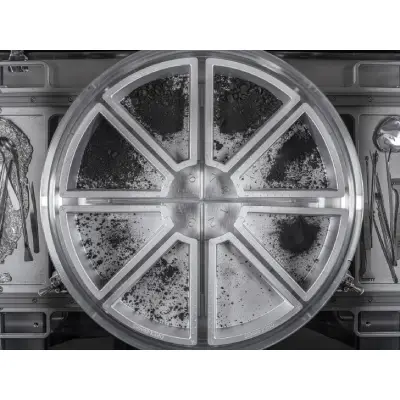
Because scientists could now divide the sample among laboratories, repeat measurements, preserve portions for future technology and examine the same ancient material using instruments that would never fit inside a spacecraft.
The treasure hunt had begun.
What was hiding inside those 121.6 grams?
The first major surprise was chemical.
Scientists found amino acids.
Not one or two.
Fourteen of the 20 amino acids used by terrestrial life to build proteins.
They found all five canonical nucleobases associated with DNA and RNA.
They found ammonia and numerous other organic compounds.
And one analysis identified approximately 10,000 nitrogen-bearing chemical species in the material.
Then came another surprise.
Researchers detected ribose and glucose.
Ribose is particularly intriguing because it forms part of RNA.
But there is a trap here.
It is tempting to look at this inventory and imagine that scientists had discovered a primitive cell waiting to be awakened.
They did not.
There was no bacterium.
No fossil organism.
No DNA sequence from an alien creature.
No biological colony.
NASA explicitly stresses that the sugars and other organic compounds are not evidence of life. Instead, they strengthen the case that important chemical building blocks of biology were widespread in the early Solar System.
And that may actually be the more profound discovery.
The ingredients were everywhere. So why did life happen here?
Imagine finding an ancient kitchen.
There are flour, salt, water, vegetables and spices everywhere.
But there is no evidence that anyone ever cooked a meal.
Bennu is somewhat like that.
It contains many of the chemical ingredients associated with terrestrial biology.
But ingredients are not recipes.
And recipes are not meals.
Scientists now have stronger evidence that the young Solar System possessed an impressive inventory of prebiotic chemistry.
That raises an uncomfortable question for anyone hoping that Earth is cosmically unique:
If the ingredients were common, was life itself inevitable?
Perhaps not.
Maybe the transition from chemistry to biology is extremely difficult.
Perhaps the right ingredients need the right temperature, water, energy sources, minerals and environments.
Perhaps millions of failed chemical pathways occurred before one finally became self-sustaining.
Or perhaps life emerges quite easily whenever suitable conditions exist.
Bennu cannot answer that question by itself.
But it has made the first part of the question much harder to dispute:
The raw materials were not necessarily unique to Earth.
Then scientists found evidence of ancient water
The story becomes stranger when water enters it.
Bennu itself is not a world of rivers and oceans.
Yet its minerals preserve evidence that water once interacted with the material from which it formed.
Scientists detected hydrated minerals and a surprising abundance of magnesium phosphate, a phosphorus-bearing mineral that had not been identified from Bennu’s remote observations before the sample was returned.
Why does phosphorus matter?
Because phosphorus is deeply embedded in terrestrial biology.
It is part of DNA and RNA.
It plays a major role in cellular energy transfer.
It is therefore one of the elements scientists care about when reconstructing prebiotic chemistry.
The discovery does not mean Bennu once had life.
It means something perhaps more useful:
Bennu’s parent body possessed conditions in which chemically important ingredients could interact with water.
And that gives scientists a glimpse of the kind of chemical laboratory that existed long before Earth became biologically rich.
The strangest clue may be the one nobody expected
There is another remarkable feature of the Bennu story.
Some amino acids can exist in two mirror-image forms, often described as left-handed and right-handed.
Life on Earth overwhelmingly uses the left-handed forms of amino acids.
But Bennu’s amino acids show an approximately equal mixture of the two forms.
That is important because it raises an ancient question:
Why did life on Earth choose one molecular handedness?
NASA notes that Bennu’s roughly equal mixture suggests early Earth may also have started with both forms before biology developed its strong preference for one side.
Scientists call this phenomenon homochirality.
It is one of those details that sounds technical until one realises what it is asking.
Why does life have a preference?
Why left rather than right?
Was the preference caused by physics?
Chemistry?
Sunlight?
Minerals?
Chance?
Or something that happened before life itself began?
Bennu has not solved that mystery.
It has simply carried a piece of the puzzle back to Earth.
Why bringing the sample home changes the game
This is where asteroid missions become something much more profound than sightseeing expeditions.
A spacecraft can perform chemistry on another world.
But spacecraft laboratories are severely constrained.
Their instruments must survive launch.
They must operate autonomously.
They must consume limited power.
They must survive radiation and temperature extremes.
They have limited mass.
And once the spacecraft is millions of kilometres away, scientists cannot simply install a better machine when an unexpected result appears.
Earth is different.
A returned grain can be examined under an electron microscope.
Then a mass spectrometer.
Then an isotope instrument.
Then another laboratory’s instrument.
Scientists can cut it.
Dissolve it.
Heat it.
Preserve another piece.
Compare it with meteorites.
Reanalyse it years later.
And when technology improves, they can examine it again.
This is the hidden power of sample return.
A rover gives scientists data.
A sample gives scientists options.
NASA and ESA have repeatedly emphasised this advantage for Mars: returned material can be analysed with sophisticated Earth-based laboratory equipment, independently examined and potentially reanalysed as new technologies emerge.
The spacecraft’s mission may end.
The sample’s scientific life can continue for decades.
Bennu is therefore more than an asteroid mission
It is tempting to divide space exploration into categories.
Planet missions.
Asteroid missions.
Rover missions.
Sample-return missions.
But there is another way to see it.
These are increasingly becoming chemistry missions.
The photographs are spectacular.
The engineering is extraordinary.
But beneath everything lies a quieter investigation:
What chemicals existed before life?
Bennu has provided a remarkable inventory.
| Bennu finding | What it tells scientists |
| 14 of 20 protein-building amino acids | Many biological building blocks formed naturally |
| All 5 canonical nucleobases | Chemistry related to DNA/RNA was present |
| Ribose | An important RNA-related sugar existed |
| Glucose | Another biologically important sugar existed |
| Ammonia | Nitrogen chemistry was abundant |
| Phosphates | Phosphorus-bearing chemistry existed |
| Hydrated minerals | Water altered Bennu’s parent material |
| ~10,000 nitrogen-bearing chemical species | Prebiotic chemistry was remarkably diverse |
| Left/right amino-acid mixture | Earth’s molecular handedness remains an open question |
These are not separate curiosities.
Together, they form a chemical landscape.
And the landscape is beginning to look surprisingly familiar.
Now imagine doing the same thing on Mars
This is where the treasure hunt becomes much more dangerous and much more exciting.
Bennu can tell us about chemistry before life.
Mars could potentially tell us about life after chemistry.
Billions of years ago, Mars was not the cold, dry desert we see today.
There were rivers.
Lakes.
Sedimentary environments.
Groundwater.
Perseverance is exploring Jezero Crater, where NASA says a river once flowed into a lake more than 3.5 billion years ago.
That matters because sediments can preserve evidence of ancient environments.
And if microbial life ever existed on Mars, an ancient lakebed is exactly the kind of place scientists would want to investigate.
Perseverance has already collected and cached carefully selected samples.
But the samples are still on Mars.
That is the crucial difference.
Bennu came home. Mars has not.
NASA currently describes Mars Sample Return as a future mission concept, not an accomplished sample-return mission. The agency continues to work on the architecture needed to bring Perseverance’s samples to Earth.
The Mars treasure hunt is much harder
Getting to an asteroid is difficult.
Getting a sample from Mars back to Earth is another level entirely.
The basic chain sounds almost absurd:
Land on Mars.
Find the cached samples.
Collect them.
Launch a rocket from Mars.
Meet another spacecraft in Mars orbit.
Transfer the sample.
Send it toward Earth.
Capture it safely.
Return it through Earth’s atmosphere.
Every arrow in that chain represents an engineering problem.
NASA announced in January 2025 that it would pursue two potential landing architectures during formulation in an effort to reduce cost and schedule risks.
By 2026, NASA’s public Mars Sample Return page continues to describe the programme as a future, multi-mission campaign.
That means headlines suggesting that Mars rocks are “coming home soon” should be treated cautiously.
The scientific treasure has been selected.
The treasure has not yet been delivered.
But what exactly would scientists be looking for?
This may be the most important question of all.
Suppose the first Mars sample is opened in an Earth laboratory.
Scientists discover organic molecules.
That would be exciting.
But it would not prove life.
Why?
Because Bennu has already demonstrated the problem.
Nature can manufacture complex organic chemistry without biology.
Suppose Mars contains an amino acid.
Interesting.
But Bennu has them.
Suppose scientists find an organic molecule associated with cells.
Still not definitive.
Suppose they find a structure resembling a fossil.
Still not enough.
Minerals can create structures that look surprisingly biological.
This is why the search for life must be built around converging evidence.
What would actually count as convincing evidence of ancient Martian life?
There probably will not be one magic molecule that scientists can point to and say:
“Life.”
Instead, the strongest case would involve several independent clues.
For example:
| Evidence | Why scientists would care | Main problem |
| Organic molecules | Life uses them | Geology creates them too |
| Cell-like structures | Could preserve organisms | Minerals can mimic cells |
| Isotopic fractionation | Biology can alter isotope ratios | Abiotic processes can also do this |
| Complex molecular patterns | May indicate biological processing | Complex chemistry can be non-biological |
| Repeating structures | Could indicate organised biology | Physical processes can create patterns |
| Multiple biosignatures together | Stronger than one clue | Must still eliminate abiotic explanations |
| Same result reproduced by independent labs | Greatly strengthens confidence | Reproducibility alone does not prove biology |
The strongest scenario would be something like this:
A sample contains a microscopic structure.
It occurs in a geological context consistent with ancient habitability.
It contains organic compounds with unusual characteristics.
Those compounds show isotopic patterns difficult to reproduce through known abiotic chemistry.
The structure is associated with several independent chemical indicators.
Multiple laboratories reproduce the observations.
Researchers test every plausible non-biological explanation.
And the alternatives begin to collapse.
That would be vastly more convincing than a single spectacular discovery.
The real scientific treasure is the elimination of alternatives
This is something popular science often gets wrong.
Science rarely proves an extraordinary claim by finding one dazzling object.
It becomes convincing by eliminating competing explanations.
Imagine discovering a strange fossil-like shape on Mars.
One scientist says:
“Life.”
Another says:
“Crystal.”
A third says:
“Chemical precipitation.”
A fourth says:
“Radiation damage.”
The scientific investigation begins there not ends there.
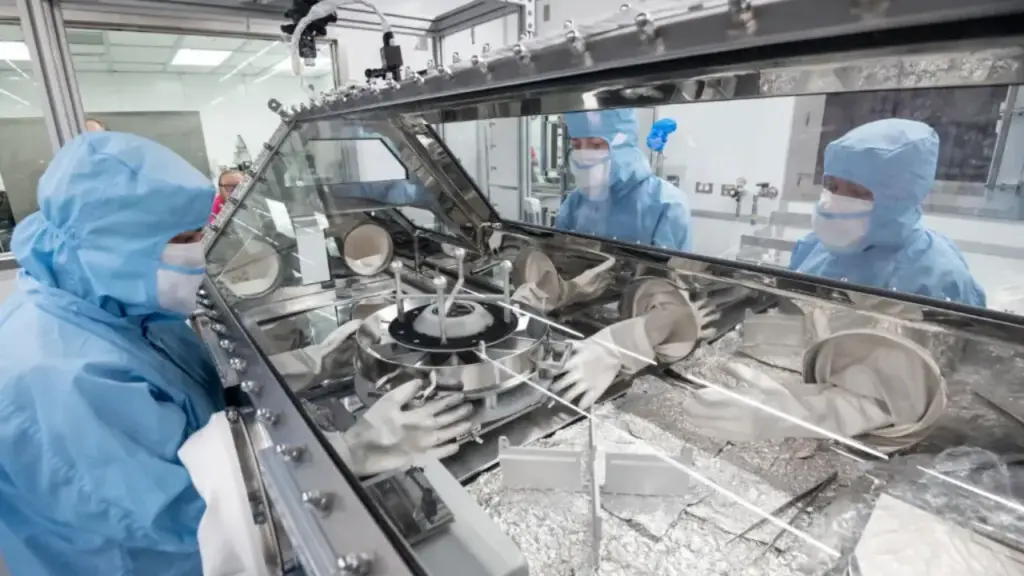
The returned sample allows researchers to attack the question from multiple directions.
That is precisely why sample return matters.
Earth laboratories can argue with the sample for years.
And if the evidence survives that argument, confidence grows.
Bennu may have quietly prepared us for the Mars question
There is an elegant sequence emerging.
Bennu asks:
Were life’s chemical ingredients widespread?
The answer is increasingly:
They appear to have been.
Mars asks:
Did those ingredients ever become biology somewhere else?
We do not know.
And that uncertainty is scientifically precious.
Because if Mars once hosted life, Bennu helps explain how the ingredients might have been available.
But if Mars was habitable and still remained lifeless, that result could be even more revealing.
It would suggest that having water and organic chemistry is not enough.
Perhaps the transition from chemistry to biology is extraordinarily difficult.
Perhaps Earth passed through a rare chemical bottleneck.
Or perhaps life emerged on Mars and disappeared before it could leave obvious traces.
Every possibility changes the story.
The chemistry treasure hunt is moving outward
Bennu is unlikely to be the end.
It may be the beginning of a new style of planetary exploration.
First, scientists studied distant worlds through telescopes.
Then spacecraft photographed them.
Then rovers touched them.
Now spacecraft are becoming couriers, carrying pieces of other worlds back to Earth.
The next logical targets become even more tantalising.
Mars has ancient rocks.
Europa has a subsurface ocean.
Enceladus sprays material from an underground ocean into space.
Asteroids preserve primitive Solar System chemistry.
Each target offers a different chapter in the same investigation:
How common is the chemistry that makes life possible?
And eventually:
How common is life itself?
The most mysterious thing Bennu brought home was not a molecule
It was a question.
Amino acids existed there.
Nucleobases existed there.
Sugars existed there.
Phosphorus existed there.
Water had interacted with the material.
Complex nitrogen chemistry existed there.
Yet there was no evidence that the asteroid had crossed the line into life.
That is the mystery.
Perhaps the universe is overflowing with chemical ingredients and almost empty of biology.
Perhaps biology is common, but our search has been too limited.
Perhaps life requires a rare combination of chemistry and environment.
Perhaps Earth was lucky.
Or perhaps the transition from molecules to organisms is not as miraculous as we imagine.
We simply do not know.
And that is why the tiny capsule that landed in Utah in 2023 matters so much.
It did not bring extraterrestrial life to Earth.
It brought something almost as valuable:
a piece of the question.
The future could depend on a handful of Martian grains
One day, perhaps, another capsule will descend through Earth’s atmosphere.
It will not come from Bennu.
It will come from Mars.
Inside will be carefully selected rocks and sediments collected by Perseverance or a future mission.
The world may watch.
Scientists will open them under strict containment procedures.
The first measurements will begin.
And somewhere inside one of those grains may be something that changes the history of science.
Or there may be nothing.
Both outcomes would matter.
If scientists find evidence of ancient life, humanity will have to confront the possibility that biology began more than once.
If they find no convincing evidence, the result will tell us something equally profound about how difficult the transition from chemistry to biology may be.
Either way, the sample will not merely be a rock.
It will be a time capsule.
A frozen argument from Mars.
And unlike a photograph or a distant signal, scientists will be able to hold the evidence in their laboratories and ask it the same question again and again.
The final treasure is not life, it is certainty
The most exciting thing about modern space exploration may therefore be happening beneath the headlines.
Not the rocket launch.
Not the spectacular image.
Not even the discovery of another strange world.
It is the gradual transformation of space exploration into evidence collection.
Bennu has shown what happens when we stop merely looking at another world and bring a physical piece of it home.
A spacecraft can tell us what it sees.
A laboratory can ask what the material actually is.
That distinction is enormous.
And it may determine how humanity eventually answers the oldest question in astronomy:
Are we alone?
The answer may not arrive as a radio message.
It may not arrive as an alien photograph.
It may arrive as a microscopic structure inside a grain of Martian rock.
A pattern in its isotopes.
A chemical signature.
A fossilised trace.
Something tiny enough to miss and important enough to change everything.
Until then, Bennu remains a kind of cosmic treasure chest.
Not because it contained life.
But because it showed us something almost as unsettling:
The universe seems to know how to make many of life’s ingredients without life being present at all.
And somewhere between those ingredients and the first living cell lies perhaps the greatest unsolved chemical mystery in the universe.
That is the treasure humanity is really hunting.
Timeline: From Bennu to the Search for Martian Life
| Year | What happened |
| 2016 | OSIRIS-REx launched toward Bennu. |
| 2018 | Spacecraft arrived at Bennu. |
| 2020 | OSIRIS-REx collected asteroid material. |
| 2021 | Spacecraft began its return journey. |
| 2023 | Capsule returned 121.6 g of Bennu material to Earth. |
| 2024 | Scientists reported hydrated minerals and a surprising phosphate discovery. |
| 2025 | Amino acids, nucleobases and extensive nitrogen-rich organic chemistry were reported; later, ribose and glucose were detected. |
| 2026 | Bennu samples continue to be analysed while NASA develops the future Mars Sample Return architecture. |
| Future | Carefully selected Martian samples could eventually be returned to Earth for laboratory analysis. |
Bennu vs Mars: Why the next sample matters more
| Question | Bennu | Mars |
| Sample returned to Earth? | Yes | No, not yet |
| Organic chemistry | Extensive | Organic compounds detected by Mars missions |
| Evidence of water | Ancient water-related alteration | Strong evidence of ancient rivers/lakes |
| Evidence of life | None demonstrated | Unknown |
| Main scientific question | How widespread was prebiotic chemistry? | Did life ever emerge? |
| Laboratory advantage | Already available | Depends on future sample return |
| Stakes | Understanding life’s ingredients | Potentially determining whether life arose independently |
Frequently Asked Questions
Did Bennu contain life?
No. The Bennu results reveal a rich inventory of organic and prebiotic chemistry, but NASA does not consider them evidence of life.
How much Bennu material came back?
121.6 grams, or about 4.29 ounces. That was more than twice the mission’s 60-gram requirement.
What are the most important discoveries?
Scientists have identified 14 of the 20 amino acids used by terrestrial life, all five canonical nucleobases, and later ribose and glucose.
Why are amino acids not proof of life?
Because amino acids can form through non-biological chemical processes. Bennu demonstrates precisely why organic chemistry must not automatically be interpreted as biology.
Why is ribose important?
Ribose is a sugar component of RNA. Finding it in Bennu adds another biologically important molecule to the asteroid’s inventory, although its presence is not evidence of life.
Why is physical sample return so valuable?
Earth laboratories can use far more powerful, flexible and diverse instruments than spacecraft can carry, and scientists can preserve material for future techniques.
Are Mars samples already coming back to Earth?
No. NASA currently describes Mars Sample Return as a future mission concept, and the architecture remains under development.
What would constitute strong evidence of ancient Martian life?
Scientists would want multiple independent biosignatures that survive rigorous testing against plausible abiotic explanations. A single organic molecule or fossil-like shape would not normally be enough.
Could Mars have had life billions of years ago?
It is scientifically plausible because ancient Mars had environments that were once warmer and wetter, including lake and river systems. But no confirmed evidence of ancient Martian life has yet been established.
Topics you may Like
- AI Can Now Help Identify People in Historical Photographs
- Derinkuyu: The Underground City That Turned History Upside Down
The Unfoldings
- NASA’s OSIRIS-REx returned 121.6 grams of pristine Bennu material to Earth.
- Bennu contains 14 of the 20 amino acids used by terrestrial life and all five canonical DNA/RNA nucleobases.
- Later analyses found ribose and glucose, adding important sugars to the growing inventory of prebiotic chemistry.
- Researchers identified approximately 10,000 nitrogen-bearing chemical species in the Bennu material.
- Bennu’s parent material experienced ancient water-related alteration and contains phosphate minerals.
- None of these discoveries constitutes evidence that Bennu ever contained life.
- The biggest scientific advantage of sample return is that Earth laboratories can repeatedly interrogate the same physical evidence with increasingly sophisticated technology.
- Mars Sample Return remains a future mission concept as of 2026.
- The strongest evidence for ancient Martian life would probably require multiple independent biosignatures, not a single molecule.
- The deepest question is no longer simply whether the ingredients of life exist beyond Earth. Bennu strongly suggests that many do. The question is what makes those ingredients cross the invisible boundary into biology.
Authentic Sources & Government Links
- NASA — OSIRIS-REx Mission
- NASA — Bennu Sample Findings
- NASA — Bennu Phosphate Discovery
- NASA — Bennu Sugars and “Gum” Discovery
- NASA — Bennu Sample Mass
- NASA Technical Reports Server — Bennu Organic Chemistry
- NASA — Mars Sample Return
- NASA — Mars Sample Return Landing Options
- NASA — Mars Architecture Trade Space
- NASA — Mars Exploration Programme







Leave a Reply