
At first, there was only a missing aircraft.
Somewhere over the mountains of southern Iran, an American F-15E Strike Eagle had disappeared from the fight.
Two men had ejected.
They were alive.
But they had landed roughly five miles apart, in terrain where Iranian forces were actively searching for them.
For one airman, the wait lasted about eight hours.
For the other, it stretched to roughly 50 hours.
And somewhere between those two clocks was an extraordinary decision: send a rescue force into enemy territory in daylight, knowing that the rescuers themselves could become targets.
The number attached to the first mission sounds almost ridiculous until the machinery behind it is understood:
21 aircraft to rescue one man.
Then the second rescue became even more astonishing.
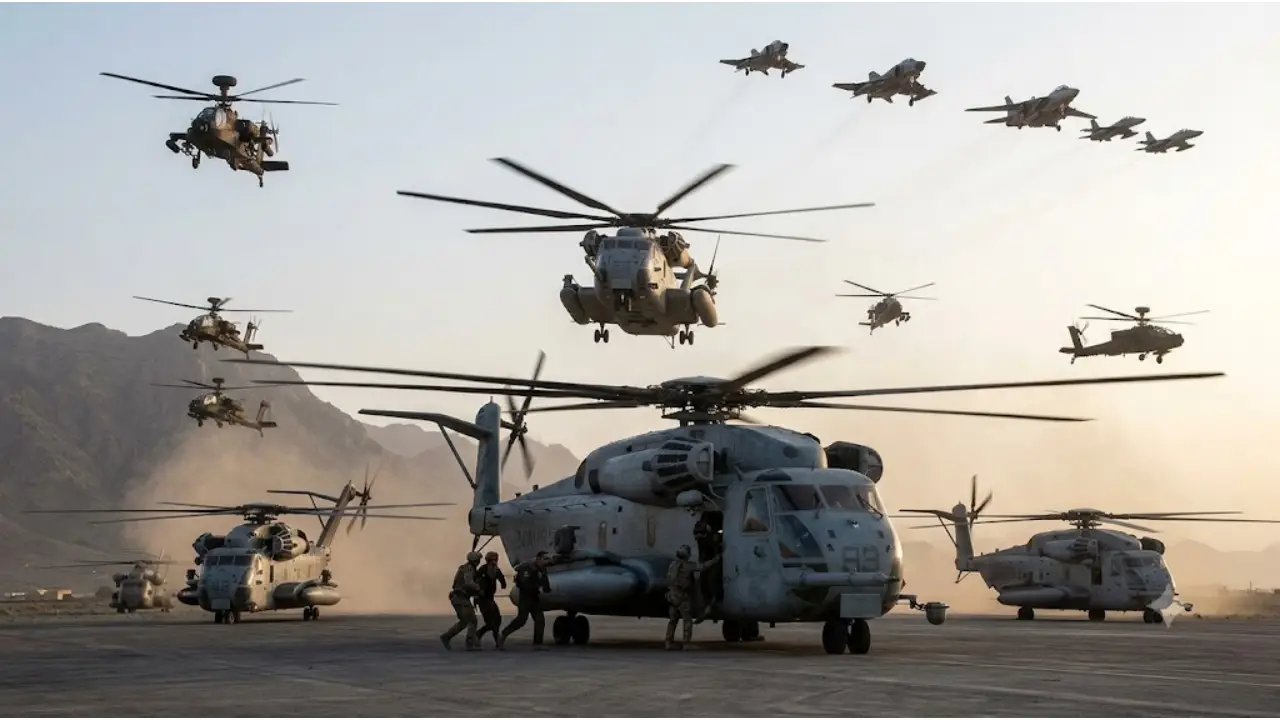
About 155 aircraft would eventually be involved in recovering the second airman.
More than 90 personnel would go onto the ground.
Several hundred would be in the air.
And somewhere between 3,000 and 5,000 people would support the wider operation.
The extraordinary part is not that America possessed that many aircraft.
It is that all of them had to solve the same tiny problem:
One injured human being was waiting on a mountain.
The First Mystery: Where Did the Two Men Go?
The F-15E was a two-seat Strike Eagle.
When it was shot down, both crew members escaped by ejection. Public reporting identifies them only by the mission call signs Alpha and Bravo, for security reasons. They came down separately in mountainous terrain south of Isfahan.
That five-mile separation transformed one emergency into two.
The military now had two survivors to find, two sets of terrain to understand and two clocks running at different speeds.
Alpha could be located sufficiently quickly to justify an immediate daylight recovery.
Bravo was badly injured and harder to locate.
This distinction is crucial.
There was not one giant rescue mission.
There were two different rescue problems created by the same shootdown.
And the first one explains why the number 21 matters.
Why Twenty-One Aircraft Were Needed for One Person
A rescue helicopter cannot simply fly into hostile territory, find a survivor and leave.
That is movie logic.
Real combat search and rescue is closer to a temporary military ecosystem.
The helicopter needs protection.
It needs fuel.
It needs intelligence.
It needs communications.
It needs people capable of treating and moving the survivor.
It needs a route into the area.
And, perhaps most importantly, it needs other aircraft making sure the enemy cannot easily turn the rescue into an ambush.
The first recovery therefore involved approximately 21 aircraft.
The package included HH-60W Jolly Green II rescue helicopters, HC-130J Combat King II aircraft and A-10C Thunderbolt IIs, among other support. The mission lasted roughly seven to eight hours, depending on the account.
The numbers reported publicly are not perfectly identical. That is unsurprising for an operation whose detailed order of battle remains partly classified.
But the central fact is solid:
The United States sent a large combat-rescue package into Iran during daylight to recover Alpha before Iranian forces could reach him.
General Dan Caine later explained the basic calculation bluntly: entering enemy territory in daylight was dangerous, but waiting could be worse.
That is the peculiar mathematics of rescue.
Sometimes the safest moment to rescue someone is also the most dangerous moment to fly.
Daylight Was the Enemy’s Advantage
Night hides aircraft.
Daylight exposes them.
For the rescuers, daylight offered visibility over mountains and landing areas.
For Iranian forces, it offered something equally useful:
eyes.
Every aircraft entering hostile airspace became a moving announcement that something important was happening below.
The rescue force therefore had to perform two contradictory tasks simultaneously:
Be visible enough to find the survivor.
Be difficult enough to attack.
That is why the supporting aircraft mattered.
A combat rescue package is designed around layers.
The rescue helicopter reaches the survivor.
Other aircraft protect it.
Tankers extend the range of aircraft that cannot simply land and refuel.
Command and intelligence elements maintain the larger picture.
The rescue is therefore less like sending an ambulance and more like temporarily constructing a moving protective bubble around one person.
Then the Rescue Started Taking Damage
The danger was not theoretical.
During the initial recovery effort, an A-10 involved in the mission was hit and its pilot eventually ejected over friendly territory. A helicopter carrying the rescued pilot also came under small-arms fire, according to contemporary reporting.
That detail changes the emotional geometry of the story.
The rescuers were not approaching a quiet crash site.
They were entering an active threat environment.
Every additional minute increased exposure.
Every aircraft represented another potential target.
Every helicopter hovering over a survivor became a vulnerable object in the sky.
And yet the rescue continued.
Alpha came home.
But the story was only half finished.
Somewhere Else, Bravo Was Still Alive
Bravo’s story is where the operation stops looking like an aircraft story and becomes a survival story.
His parachute had been damaged during ejection.
He hit the ground at an estimated 70–100 miles per hour.
He suffered serious injuries, including a broken back, broken arm and shoulder injuries, according to his later account.
And then he made a decision that sounds almost absurd until you understand the alternative.
He moved.
A badly injured man was attempting to make himself harder to find.
Eventually he climbed toward a ridgeline approximately 7,000 feet high.
The mountain became his hiding place.
It also became his prison.
He had limited food and water.
He was injured.
Iranian forces were searching.
And he had to make the most primitive calculation imaginable:
When do I hide, and when do I tell my people where I am?
That is where technology reaches its limit.
A satellite can see a signal.
A rescue aircraft can follow coordinates.
But only the survivor can decide whether transmitting that signal is worth the risk of being discovered.
The Most Important Weapon Was Uncertainty
Bravo’s survival depended partly on deception.
The CIA played a major role in the later search effort, including a deception campaign intended to confuse Iranian forces about where the American airman was located. Classified technology was also used to help pinpoint him.
This is one of the most interesting lessons from the entire operation.
A search-and-rescue mission in hostile territory is not simply a contest between:
American technology vs. Iranian technology.
It is a contest over information.
Who knows where the survivor is?
Who thinks they know?
Who can make the other side believe the wrong thing?
That means a rescue can resemble intelligence warfare as much as humanitarian recovery.
The rescuers do not merely search for the missing person.
They attempt to control the enemy’s understanding of the search.
The Second Rescue Was Almost a Different War
By the time the operation to recover Bravo began, the scale had changed dramatically.
Admiral Brad Cooper later said the second operation involved approximately:
92 people on the ground
Several hundred people in the air
3,000–5,000 people supporting the wider operation
The reported aircraft package reached approximately 155 aircraft.
A later Air Force account confirms that a 155-aircraft task force was involved and emphasizes the role of HH-60W and HC-130J crews trained specifically for extreme combat-rescue conditions.
That is not a rescue helicopter mission.
It is a miniature military campaign whose objective happens to be one person.
And this is where the headline statistic becomes misleading.
155 aircraft did not fly into Iran simply to pick up a man.
They created the conditions under which a handful of rescuers could safely reach him.
That distinction is the whole story.
The Aircraft Were Playing Different Games
Think of the rescue package as a machine with different organs.
The HH-60W Jolly Green II was the hand that could physically reach the survivor.
The HC-130J Combat King II provided long-range support and aerial-refuelling capability.
The A-10s and fighters provided combat protection.
Tankers kept other aircraft airborne long enough to do their jobs.
Intelligence and surveillance assets helped answer the question every rescue commander fears:
Where exactly is he?
And special operations forces had to turn all of this into a physical extraction.
That is why describing a combat rescue as “a helicopter rescue” is like describing a hospital as “the ambulance.”
The visible object is only the final link in a very long chain.
The Most Dangerous Part Came After Bravo Was Found
There is a deliciously cruel twist in the story.
The rescue team succeeded.
Bravo was reached.
Pararescuers got to him.
He was brought toward the extraction point.
And then the rescuers discovered that they had a problem too.
Two large MC-130J aircraft used to establish the forward landing site reportedly became stuck in the desert terrain and could not simply take off.
Now more than 90 American personnel were themselves inside Iran.
The rescue operation had become another rescue operation.
The people who had gone to retrieve one man suddenly had to get everyone out.
CBS reported that the stranded aircraft were ultimately destroyed so that sensitive equipment could not be captured.
That is perhaps the strangest scene in the entire story.
The United States went into Iran to retrieve one wounded airman.
It succeeded.
Then it had to destroy some of its own aircraft to make sure the rescue did not leave behind something more valuable than metal.
Five Aircraft Were Left Behind
The later declassified imagery makes the episode even more revealing.
Reporting on the footage identified two MC-130J Commando IIs and three Little Bird helicopters associated with the second rescue operation. Those aircraft were destroyed after they could not be recovered, according to reporting on the mission.
This is where military technology becomes strangely human.
Aircraft are expensive.
But secrets can be more expensive.
An aircraft left behind in enemy territory is not simply a lost machine.
It is potentially a collection of:
sensors,
communications equipment,
navigation technology,
electronic systems,
structural information,
tactical clues.
Destroying your own equipment can therefore be part of protecting the larger force.
The most sophisticated piece of equipment is sometimes the piece you deliberately refuse to let anyone examine.
And Then There Is the Blurred Helicopter
This may be the most intriguing detail in the newly released footage.
Viewers can see Little Bird helicopters involved in the rescue.
But one is deliberately blurred.
General Caine explained that the United States wanted to protect its most specialized capabilities so they could be used again.
That tiny blur tells us something enormous.
Declassification is not the same as transparency.
When governments release classified footage, they are not opening the entire box.
They are deciding which parts of the box can safely be seen.
The blurred helicopter is therefore almost more interesting than the visible aircraft.
The visible machines tell us what the military is comfortable showing.
The blurred machine tells us what it still believes an adversary should not know.
That is the sort of detail a written history can easily miss.
A report can say:
“Special operations helicopters participated.”
A video can show you the helicopter.
A blur can show you that the helicopter still matters.
Why Video Changes the History
Written military histories tend to flatten events.
They turn chaos into sentences.
“Aircraft entered.”
“Survivor located.”
“Extraction completed.”
Video is much less polite.
It shows distance.
Speed.
Terrain.
Aircraft movement.
Waiting.
People.
And uncertainty.
The newly released footage shows surveillance imagery of Bravo on the ridgeline and pararescuers moving toward him. It also shows elements of the wider recovery effort that were previously known largely through official statements.
That matters because military operations are spatial.
A paragraph can tell you that a helicopter was approaching a survivor.
Footage lets you understand how exposed that helicopter was.
A report can say a landing zone was improvised.
Images allow you to see the absurdity of trying to turn rough desert ground into a temporary runway inside enemy territory.
History becomes three-dimensional.
The Rescue Was Built Years Before the Missile Was Fired
Perhaps the least cinematic part of the story is also the most important.
The rescue did not begin in Iran.
It began in training.
The U.S. Air Force’s 150th Special Operations Wing says crews involved in this mission undergo months of simulator and academic preparation, culminating in 11 critical training flights.
That training includes low-level night-vision flying, contested aerial refuelling, rapid infiltration and complex crew coordination.
The instructors themselves can work 12-hour duty days, combining planning, intelligence briefings, flying and detailed post-mission analysis.
That gives us a better way to understand the spectacular rescue.
The miracle was not improvisation.
It was rehearsed improvisation.
The crews had practiced procedures so intensely that when the real world stopped behaving according to the plan, they still had something to fall back on.
That is what military training is really buying.
Not perfection.
Recovery from imperfection.
The Numbers Tell a Stranger Story Than the Headline
| Measure | Reported figure |
| Airmen recovered | 2 |
| Approx. separation after ejection | 5 miles |
| Alpha recovery | ~7–8 hours |
| Aircraft in Alpha rescue | ~21 |
| Bravo survival | ~50 hours |
| Bravo ridgeline | ~7,000 ft |
| Second rescue aircraft | ~155 |
| Ground personnel | ~92 |
| Airborne personnel | Several hundred |
| Wider support | ~3,000–5,000 |
| Second mission bombers | 4 |
| Fighters | 64 |
| Tankers | 48 |
| Rescue aircraft | 13 |
| MC-130Js left behind | 2 |
| Little Birds left behind | 3 |
These figures come from U.S. military statements and reporting based on the declassified accounts. Because the complete operational record is not public, individual aircraft counts should be treated as reported figures rather than a complete independently audited order of battle.
And the ratio is extraordinary.
Two men.
155 aircraft.
Thousands of supporting people.
That sounds inefficient until the question changes.
The military was not trying to optimize the cost of rescuing two people.
It was trying to maximize the probability that those two people would come home alive.
The Hidden Psychology of Being Rescued
There is another part of the story that technology cannot explain.
Imagine being Bravo.
You are injured.
You are alone.
You know your own military is somewhere out there.
But you cannot see it.
You hear aircraft.
You do not necessarily know whether they are coming for you.
You know the enemy is searching.
You have to decide when to move.
When to hide.
When to transmit.
When to wait.
Then, after roughly two days, two pararescuers appear.
Bravo’s response, according to his later interview, was beautifully ordinary:
“Let’s go.”
After fifty hours of survival, the most important sentence was not a military code.
It was an invitation to leave.
That moment explains why rescue operations matter beyond military doctrine.
A rescue is ultimately a promise made in advance:
If something goes terribly wrong, we will come looking.
The Real Mystery Is Not Why 21 Aircraft Were Sent
The easy question is:
Why did one person require 21 aircraft?
The better question is:
How many invisible things have to go right before one helicopter can safely reach one human being behind enemy lines?
The answer includes intelligence.
Fuel.
Weather.
Terrain.
Communications.
Air superiority.
Electronic warfare.
Medical preparation.
Navigation.
Timing.
Deception.
Training.
Leadership.
And luck.
Remove enough of those pieces and the rescue becomes impossible.
This is why the operation is more interesting than a catalogue of impressive aircraft.
It reveals something fundamental about modern warfare:
The decisive weapon is often not the machine you can see. It is the network connecting machines you cannot.
The Final Lesson of the 21-Aircraft Rescue
The F-15E went down in seconds.
Alpha came home in hours.
Bravo waited roughly two days.
The rescuers then discovered that they themselves needed rescuing.
Aircraft were damaged.
Aircraft were abandoned.
Aircraft were destroyed.
Sensitive technology was deliberately denied to the enemy.
And eventually, both airmen were home.
The newly released footage therefore does more than provide dramatic pictures.
It reveals the hidden architecture of a modern combat rescue.
The helicopter is only the last five minutes of the story.
Behind it are hundreds of decisions made by people the survivor may never meet.
And behind those decisions are years of training.
That is the part worth remembering.
When the missile hit the F-15E, the rescue did not suddenly begin.
It merely entered its final examination.
The real rescue had been rehearsed for years.
And somewhere on a mountain in Iran, two men were waiting to discover whether all that preparation would work.
It did.
The Unfoldings
Two U.S. Air Force officers survived the shootdown of an F-15E over Iran and landed about five miles apart.
Alpha was recovered during a dangerous daylight operation involving about 21 aircraft.
Bravo survived approximately 50 hours, despite serious injuries, and reached a roughly 7,000-foot ridgeline.
The later recovery involved about 155 aircraft, roughly 92 personnel on the ground, several hundred airborne and thousands supporting the mission.
The operation depended on deception, intelligence, air protection, rescue helicopters, special operators and extensive logistical support.
Two MC-130Js and three Little Birds were reportedly destroyed after becoming impossible or impractical to recover, preventing sensitive equipment from falling into Iranian hands.
One Little Bird was deliberately blurred in the newly released footage, illustrating that declassification itself is carefully controlled.
U.S. rescue crews undergo months of preparation and 11 critical training flights, including low-level night-vision flying and contested aerial refuelling.
The deeper lesson is not the number of aircraft. It is the enormous system required to bring one person home from hostile territory.
Authentic Sources
U.S. Air Force — The Crucible: How “Dude 44” Rescue Crew Was Forged
U.S. Air Force — Successful rescue of F-15E aircrew
CBS News / 60 Minutes — Newly declassified rescue footage
CBS News / 60 Minutes — Bravo’s account of the rescue
CBS News — Initial reporting on the two rescues
Air & Space Forces — Dude 44 rescue operation








Leave a Reply