
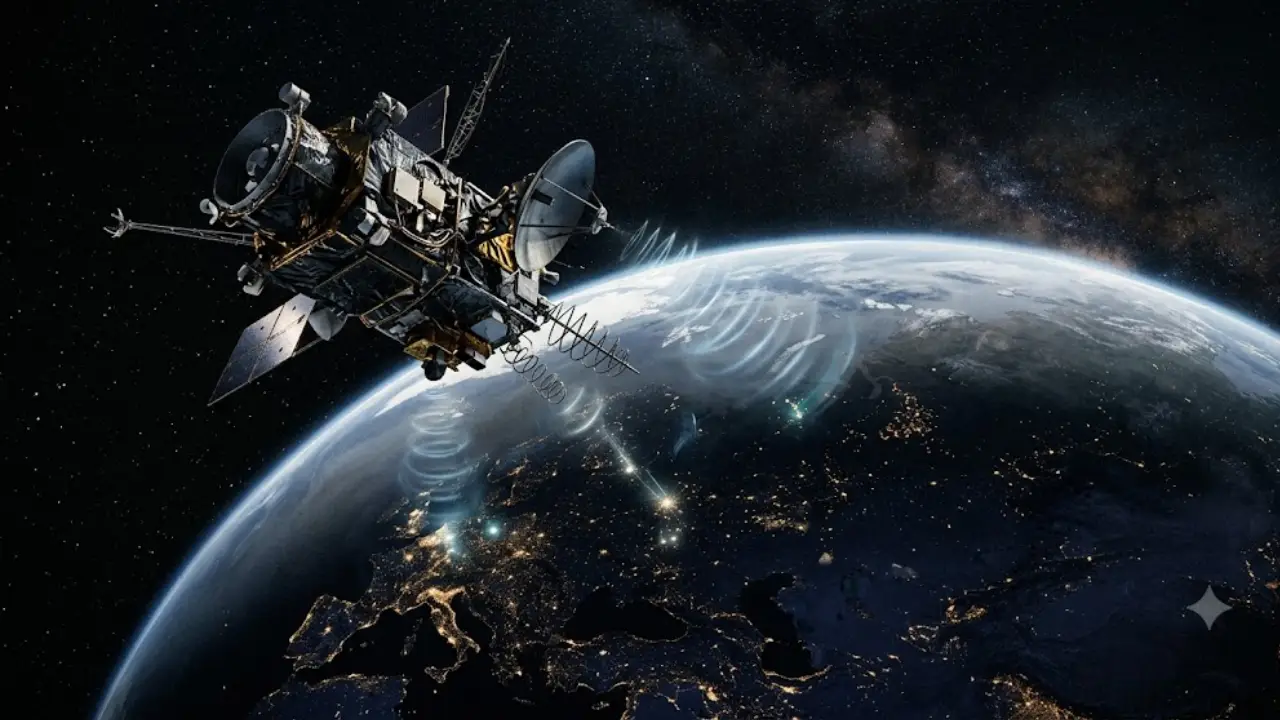
There was a space race happening above the Cold War.
The strange thing was that almost nobody was supposed to know about it.
The public version was easy to understand. The Soviet Union launched Sputnik. America answered with increasingly powerful rockets. Yuri Gagarin went into orbit. Neil Armstrong walked on the Moon. Television turned space into theatre.
But several thousand kilometres above the Earth, another kind of space race was taking place.
There were no astronauts.
No lunar footprints.
No cheering crowds.
Just machines quietly passing over a dangerous planet, collecting fragments of information from electromagnetic signals, military systems and weapons testing.
One of those machines had a remarkably unremarkable name:
JUMPSEAT.
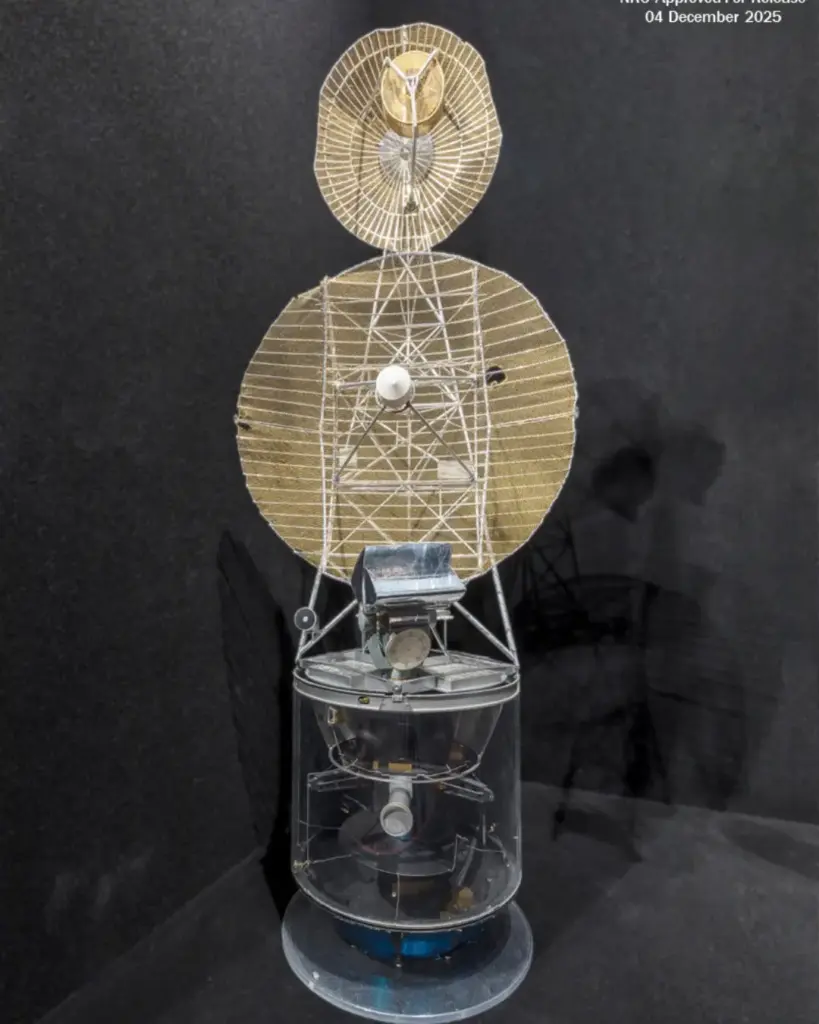
In January 2026, the U.S. National Reconnaissance Office finally acknowledged the existence of the program and released limited information about it. JUMPSEAT was America’s first-generation highly elliptical-orbit signals-collection satellite system. Eight missions were launched between 1971 and 1987, numbered 7701 through 7708, and the program remained operational until 2006.
That final date is the first clue that this story is larger than the Cold War.
The Soviet Union disappeared in 1991.
JUMPSEAT continued for another 15 years.
So perhaps the real story is not about watching the Soviet Union.
It is about the moment governments discovered that knowing what was happening above Earth could be almost as important as controlling what happened on Earth.
The Satellite Nobody Could See
Imagine being a military planner in Washington in the 1960s.
Across the ocean sits the Soviet Union.
It possesses nuclear weapons, missiles, bombers, submarines and enormous military infrastructure.
But you cannot simply walk into Soviet territory and count everything.
Human intelligence is incomplete.
Aircraft can be intercepted.
Reports can be exaggerated.
Politicians can misunderstand.
Military commanders can lie.
And in a nuclear confrontation, being wrong is not a small inconvenience.
It can be catastrophic.
This created a peculiar problem.
How do you measure an enemy you cannot physically inspect?
The answer increasingly came from space.
The United States had already developed reconnaissance satellites capable of photographing Soviet military installations. The famous CORONA program demonstrated just how transformative orbital observation could become. The CIA says CORONA helped resolve the supposed Soviet “missile gap” and “bomber gap,” eventually becoming a major source of intelligence on Soviet missile sites, air bases, submarine deployments and air defenses.
But photographs had a limitation.
They showed you what something looked like.
They did not necessarily tell you what it was doing.
For that, you needed another sense.
You needed to listen.
That was the world into which JUMPSEAT was born.
JUMPSEAT Was an Ear, Not an Eye
The NRO describes JUMPSEAT as a signals-collection system whose core mission was monitoring adversarial offensive and defensive weapons development. Its sensors collected electronic emissions, communications intelligence and foreign instrumentation intelligence. The information was transmitted to ground facilities in the United States and then provided to selected Department of Defense elements, the National Security Agency and other national-security users.
That sounds dry.
It was anything but.
Consider what a modern military produces simply by existing.
Radars transmit.
Missile systems communicate.
Weapons tests generate telemetry.
Tracking systems emit signals.
Command networks exchange information.
Electronic systems reveal characteristics through their emissions.
To an ordinary person, these may look like invisible noise.
To an intelligence analyst, they can become fingerprints.
You may not see the weapon.
But you may hear the electronic signature surrounding it.
That distinction transformed space reconnaissance.
The satellite did not have to photograph every military installation.
It could collect pieces of the electromagnetic puzzle.
And sometimes the puzzle was more informative than the photograph.
The Orbit Was the Secret Weapon
Now comes the wonderfully strange part.
JUMPSEAT did not simply circle Earth like a conventional low-orbit satellite.
It used a highly elliptical orbit, generally associated with the Molniya family of orbital designs. The NRO says the program was developed specifically to operate in a highly elliptical orbit and describes its orbital position as providing a new vantage point for signals intelligence.
Why would anyone want such an odd orbit?
Because orbital mechanics can be exploited.
A satellite in a highly elliptical orbit spends relatively little time near its closest point to Earth and much longer near the far end of its orbit.
Imagine throwing a ball upward.
Near your hand, it moves quickly.
At the top, it slows dramatically.
A highly elliptical satellite behaves in a somewhat similar way on an enormous scale.
It races through one part of its orbit and then spends a much longer period near the distant portion.
That can provide extended observation opportunities over selected high-latitude regions.
In other words:
The orbit itself becomes part of the intelligence system.
The designers were not merely asking, “How do we put a satellite into space?”
They were asking:
“Where should the satellite spend its time?”
That is a much more interesting question.
Why the Soviet North Was a Difficult Place to Watch
The geography of the Soviet Union created another problem.
A huge portion of the country stretches across northern latitudes.
For conventional geostationary satellites, high-latitude coverage is awkward because of the geometry involved.
Highly elliptical orbits offered an alternative.
The Molniya concept became especially valuable for maintaining long observation periods over northern regions.
This was not merely an engineering trick.
It was strategic geography converted into orbital mechanics.
The Earth itself had become part of the surveillance problem.
And the Americans were learning to use physics as a reconnaissance tool.
JUMPSEAT Was Not the Beginning
The secret did not start with JUMPSEAT.
The NRO’s declassified history shows that American space-based signals intelligence had earlier roots in programs including GRAB, POPPY and PARCAE, which operated in lower orbits.
The progression is fascinating.
First came experiments.
Then electronic surveillance from space became practical.
Then systems became more specialized.
Then orbital choices became part of the collection strategy.
JUMPSEAT emerged from this evolution.
The NRO says its development was undertaken through Program A, a joint U.S. Air Force–NRO effort, under the project name EARPOP.
The name sounds like something invented by a committee trying desperately to make a secret program sound boring.
That was probably useful.
Because secrecy was not an accidental feature of these systems.
It was part of their value.
Why Reconnaissance Satellites Were Once Among Earth’s Biggest Secrets
Today, satellites are almost boring.
Weather forecasts use them.
Google Earth-style imagery has made orbital observation feel ordinary.
Commercial companies sell imagery.
Space agencies livestream launches.
But during the early Cold War, revealing exactly what America could see from orbit could tell an adversary something extremely valuable:
what America could see.
If the Soviet Union knew where an intelligence satellite was, it could potentially alter behaviour.
If it knew the satellite’s orbital pattern, it could predict observation opportunities.
If it knew the sensor’s capabilities, it could design systems intended to defeat them.
And if it knew exactly what America was collecting, it could deliberately manipulate what America saw.
That is why the NRO still warns that even programs already declassified can contain remaining classified information. It says undisclosed facts may reveal capabilities that could help foreign governments or organizations interfere with current intelligence systems.
This produces a peculiar historical situation.
A program can be declassified without being completely explained.
The government can tell you:
“Yes, this existed.”
While still refusing to tell you:
“Here is exactly how it worked.”
The door opens.
The room remains dark.
The Cold War’s Most Dangerous Currency Was Uncertainty
This is where the story moves beyond satellites.
The Cold War was not simply a contest over weapons.
It was a contest over what each side believed about the other’s weapons.
Suppose Washington believed Moscow had 500 missiles.
Perhaps it had 300.
Perhaps it had 700.
Those three numbers produce three very different strategic calculations.
And the problem became even more dangerous when nuclear weapons entered the equation.
An inaccurate estimate could encourage overreaction.
A mistaken assumption could produce unnecessary military spending.
A false warning could trigger panic.
A hidden capability could create fear.
So intelligence became a form of risk management.
The purpose of reconnaissance was not always to discover frightening things.
Sometimes it was to discover that something wasn’t as frightening as previously believed.
CORONA provides an extraordinary example.
The CIA says early U.S. estimates had significantly overestimated Soviet strategic capabilities. CORONA’s imagery helped demonstrate that the Soviet Union was behind some American assumptions about workable ICBMs and strategic bombers, helping close the supposed missile and bomber gaps.
This is one of the least appreciated functions of intelligence.
Good intelligence can make a country less afraid.
That may be more valuable than discovering another weapon.
The Strange Relationship Between Spying and Arms Control
Here the Cold War becomes almost philosophical.
The United States and Soviet Union distrusted each other deeply.
Yet arms-control agreements increasingly depended upon each side being able to verify what the other was doing.
The solution involved what became known as National Technical Means of Verification.
Satellites were part of that system.
The logic was simple:
Trust us? No.
Verify us? Yes.
This was a profound change.
Instead of demanding perfect trust, the superpowers tried to create agreements that could survive mistrust.
The CIA says CORONA helped provide the confidence necessary for arms-control agreements and that by 1971 its imagery helped U.S. negotiators specify verifiable terms for the Strategic Arms Limitation Treaty.
The satellite therefore became something almost paradoxical:
A spy that helped make treaties more credible.
The machine was watching the enemy.
But by watching, it could also reduce uncertainty.
And reducing uncertainty could make an agreement easier to believe.
The Most Important Space Race Was Invisible
Think about the images normally associated with the Space Race.
A rocket rises.
An astronaut waves.
A spacecraft approaches the Moon.
A footprint appears in lunar dust.
These are spectacular moments because humans naturally remember stories with faces.
JUMPSEAT had no face.
Its operators did not appear on television.
Its purpose was not national celebration.
It existed partly because the public was not supposed to know what was happening.
This creates a historical distortion.
The public remembers the visible competition.
Intelligence history remembers the hidden competition.
And the two were happening simultaneously.
While America was trying to demonstrate that it could land humans on the Moon, it was also building systems designed to determine what its geopolitical rival was doing on Earth.
One program asked:
Can we reach another world?
The other asked:
What is the other superpower preparing to do to this one?
Both were products of the same technological revolution.
But only one became popular culture.
Eight Launches, Thirty-Five Years
The newly released JUMPSEAT record gives us a surprisingly precise skeleton.
| JUMPSEAT fact | Declassified information |
| First launch | 1971 |
| Final launch in the series | 1987 |
| Number of missions | 8 |
| Mission numbers | 7701–7708 |
| Decommissioned | 2006 |
| Approx. program span | 35 years |
| Orbit | Highly elliptical / HEO |
| Core purpose | Monitor offensive and defensive weapon development |
| Collection | Electronic emissions, communications and instrumentation intelligence |
| Development project | EARPOP |
| Program partnership | NRO / U.S. Air Force Program A |
| Ground processing | United States |
| Principal users | Selected DoD elements, NSA and national-security policymakers |
The distinction between launch period and operational life matters.
JUMPSEAT did not launch one satellite in 1971 and keep that same spacecraft alive until 2006.
The NRO records describe eight missions launched from 1971 through 1987, with the system continuing in operation until decommissioning in 2006.
That is a very different and much more interesting story.
It means the program was not one spacecraft.
It was an evolving capability.
And Then the Soviet Union Disappeared
1991
The Soviet flag comes down.
The USSR breaks apart.
The Cold War ends.
But JUMPSEAT does not immediately vanish.
It remains operational until 2006.
That raises a natural question:
What was the system doing after the enemy that helped create it had disappeared?
The public record does not provide enough information to answer that in detail.
And we should resist the temptation to invent an answer.
The NRO simply says JUMPSEAT continued operating and ultimately functioned in transponder mode before being decommissioned. It also describes the system as the progenitor of later HEO satellite programs.
That is enough to make an important point.
Technology often survives the political circumstances that created it.
The Soviet Union disappeared.
The value of high-altitude signals intelligence did not.
The Satellite Became an Invisible Infrastructure of Deterrence
This may be the deepest lesson hidden inside the JUMPSEAT story.
Deterrence is usually imagined through spectacular objects:
missiles,
bombers,
submarines,
aircraft carriers.
But deterrence also depends on information.
A weapon you cannot locate is frightening.
A weapon you can continuously monitor is still dangerous—but less mysterious.
And mystery can be strategically dangerous.
If one side believes the other has secretly deployed something new, it may respond before it understands the situation.
Intelligence satellites help turn:
“We think they may have…”
into:
“We have evidence that they have…”
That difference is enormous.
It does not eliminate conflict.
It does not guarantee correct interpretation.
Analysts can still make mistakes.
But information changes the quality of the decision.
And during the Cold War, better information could literally become a survival mechanism.
JUMPSEAT Was Listening to More Than Signals
There is a temptation to think of signals intelligence as a machine collecting radio transmissions.
The reality is broader.
The electromagnetic environment surrounding a military system can reveal patterns.
A radar can have identifiable characteristics.
A weapons test can generate instrumentation signals.
Communications networks can reveal activity.
Changes over time can indicate development.
A single signal may be meaningless.
Thousands of signals, collected repeatedly, can become a pattern.
And patterns are where intelligence becomes powerful.
The satellite therefore was not necessarily looking for one dramatic secret.
It was collecting pieces.
Then analysts assembled those pieces into a picture.
That is how much intelligence actually works.
Not like a spy movie.
More like archaeology.
A fragment here.
A fragment there.
A pattern emerging slowly.
The Public Was Watching NASA. Someone Else Was Watching Everything Else.
This is perhaps the most delicious irony of the story.
NASA’s spacecraft were built to be photographed.
JUMPSEAT was built partly so that other people’s spacecraft, weapons and electronic systems could be understood without them knowing exactly how much was being collected.
The public saw the launchpad.
The intelligence community saw the data stream.
The public celebrated the rocket.
Analysts studied the signal.
The public wanted to know:
How far can humans go?
The intelligence question was:
How much does the other side know and how much can we learn without being noticed?
These were not separate histories.
They were two sides of the same technological revolution.
What the 2026 Declassification Actually Reveals
This is where caution becomes important.
The NRO has not released the complete JUMPSEAT story.
It has released the existence of the program and limited historical information about its purpose, development, orbital concept, mission dates and eventual retirement.
The agency explicitly notes that substantial information about even declassified programs can remain classified.
So we should not turn the gaps into conspiracy.
A missing technical specification is not proof of a secret weapon.
An undisclosed target list is not evidence of extraordinary operations.
And the fact that a program remained classified for decades does not automatically mean its history contains something sensational.
Sometimes secrecy simply protects capability.
That restraint actually makes the story more interesting.
Because we can see the outline.
But parts of the machinery remain behind the curtain.
What JUMPSEAT Says About the Future
The Cold War satellite was built around a simple problem:
Collect enough information to understand a dangerous adversary.
Today, that problem has become vastly larger.
There are more satellites.
More sensors.
More commercial imagery.
More electronic signals.
More data.
And increasingly, artificial intelligence is being used to process enormous quantities of information.
The NRO says modern reconnaissance is moving toward capabilities involving artificial intelligence, quantum sensing and commercial space systems.
The old intelligence problem was scarcity.
There was not enough information.
The emerging problem is abundance.
There may be too much.
JUMPSEAT belonged to the age when getting the right signal from space was extraordinary.
Modern intelligence increasingly has to answer a harder question:
Can you distinguish the important signal from millions of other signals before the situation changes?
The satellite has evolved from an invisible ear into something closer to a distributed nervous system.
The Final Mystery Is the One JUMPSEAT Cannot Answer
Why was JUMPSEAT kept secret for so long?
Partly because intelligence systems are useful precisely when their methods remain uncertain.
Partly because revealing the capabilities of a collection system can help an adversary avoid detection.
And partly because the Cold War produced an entire culture in which information itself became a strategic asset.
The NRO still maintains that most of its historical programs remain classified, and even declassified programs can retain protected information.
So the 2026 disclosure is not the opening of the vault.
It is the opening of a small door.
Through it we can finally see the outline of a machine that spent decades doing something extraordinarily unglamorous:
watching and listening.
Eight launches.
Thirty-five years of program life.
A strange orbit.
Signals from distant military systems.
Data flowing down to Earth.
Analysts turning invisible emissions into intelligence.
And policymakers making decisions based partly on information gathered by machines the public did not know existed.
That is the hidden history of the Space Race.
We remember the spacecraft that carried people into space.
But some of the most consequential spacecraft carried no one.
They simply passed overhead.
Quietly.
Again and again.
Listening to a dangerous world.
And perhaps the strangest lesson is this:
The Cold War was built around the fear that nobody knew exactly what the other side was doing.
The satellites were built to make that fear slightly less blind.
The Unfoldings
JUMPSEAT was a first-generation U.S. highly elliptical-orbit signals-intelligence satellite system, not a NASA exploration program.
Eight JUMPSEAT missions were launched between 1971 and 1987, numbered 7701–7708.
The system remained operational until 2006, giving the program an approximately 35-year span from first launch to retirement.
Its mission included collecting electronic emissions, communications intelligence and foreign instrumentation intelligence.
Its principal strategic focus was monitoring adversarial offensive and defensive weapons development.
JUMPSEAT evolved from earlier U.S. space-based SIGINT programs such as GRAB, POPPY and PARCAE.
Highly elliptical orbits provided a different surveillance geometry from conventional low-Earth-orbit systems.
Satellite reconnaissance helped reduce uncertainty about Soviet strategic forces; CORONA, for example, helped resolve the perceived missile and bomber gaps.
Space-based reconnaissance became important to arms-control verification because it provided National Technical Means for monitoring agreements.
JUMPSEAT’s declassification is limited, and important technical and operational information remains classified.
The deeper story is not simply that satellites spied from space. It is that information gathered from space became part of the architecture through which nuclear powers managed uncertainty.
Authentic Sources
National Reconnaissance Office — Declassifying JUMPSEAT
NRO — Official JUMPSEAT Factsheet
NRO — Declassified Programs and Projects
CIA — CORONA: America’s First Imaging Satellite Program
U.S. Department of State — SALT Historical Background
NASA — Catalog of Earth Satellite Orbits








Leave a Reply