
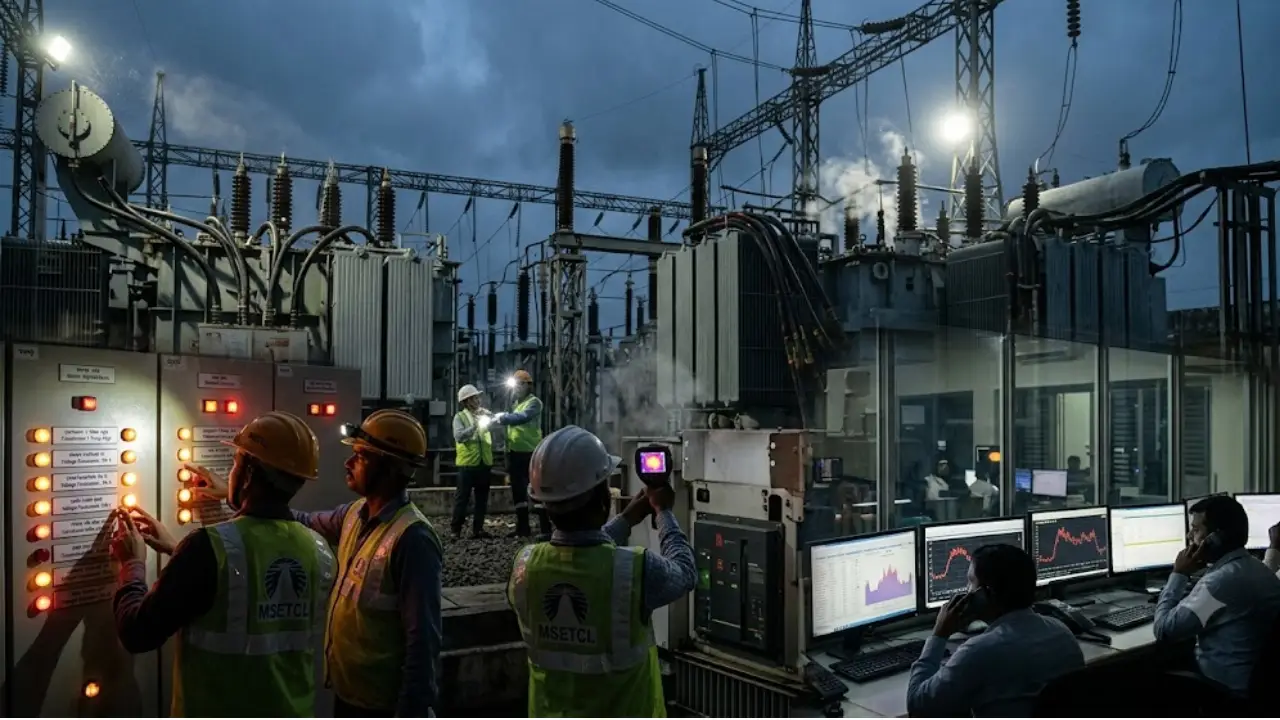
There is something deeply odd about India’s electricity system right now.
It is not summer.
The monsoon is supposed to be easing.
And yet, on September 10, 2026, India’s electricity demand climbed to 269 gigawatts, just 1 GW below the year’s summer peak of 270 GW recorded in May.
September has historically been the month when the electricity system begins to breathe out after the brutal air-conditioning season.
This year, it has been breathing harder.
The more interesting question, therefore, is not simply “Why is India using so much electricity?”
It is:
Why is the grid still behaving as though summer never ended and why is it doing so when some of the power sources India normally relies upon are becoming weaker?
That second question changes the entire story.
Because September 2026 is not really a story about one thing going wrong.
It is a story about several ordinary problems arriving at the same time.
Hotter-than-expected weather increases cooling demand.
Weak rainfall increases irrigation demand.
The same weak rainfall reduces hydropower.
Heavy rain in coal-producing regions can disrupt mining and coal evacuation.
Solar power remains abundant during the day but disappears just when evening demand begins climbing.
Coal plants compensate for the missing electricity and burn through inventories faster.
And suddenly a country with enormous generating capacity discovers an uncomfortable truth:
Having enough power somewhere is not the same as having enough electricity at the right place, at the right hour, in the right form.
That is the hidden story of India’s September power surge.
The September mystery begins with one astonishing number
According to ICRA, provisional Grid Controller of India data showed 17.6% year-on-year growth in electricity demand during the first 13 days of September 2026.
ICRA attributed the increase primarily to stronger cooling and irrigation requirements amid warm weather and below-normal rainfall.
The peak-demand figure makes the anomaly even clearer.
On September 10:
269 GW.
May’s annual peak:
270 GW.
A September peak almost indistinguishable from India’s summer maximum is unusual enough to deserve attention by itself. The Indian Express noted that September has only rarely recorded the year’s highest peak in recent years.
But the really revealing part comes next.
The country was not merely demanding more electricity.
It was demanding more electricity while some of the system’s flexible and conventional sources were becoming increasingly stressed.
That is a much more complicated problem.
The first suspect: weather
Weather sounds harmless when described as a temperature graph.
For an electricity grid, it is closer to an economic event.
A hotter afternoon means more fans.
A hotter evening means more air conditioners.
A warmer building retains heat after sunset, keeping cooling equipment running later.
And when millions of households make the same decision simultaneously, a small temperature deviation becomes a national power requirement.
This relationship is becoming increasingly important in India.
The International Energy Agency estimates that cooling already accounts for more than 10% of India’s annual electricity demand. Its analysis also found that cooling can contribute enormously to peak load, while India’s peak electricity demand has risen dramatically over the past decade.
The September episode adds another complication.
Rainfall matters twice.
When rain is weak, irrigation demand can rise because farmers need more pumping.
But rainfall is also fuel for India’s hydropower system.
So the same weather pattern can simultaneously:
increase electricity consumption + reduce one source of electricity supply.
That is a nasty little equation.
And September 2026 appears to have produced exactly that combination.
The rain that does not arrive can become electricity demand
Imagine a farmer looking at a dry field.
There are two possible outcomes.
If rain arrives, nature supplies part of the water.
If it doesn’t, an electric pump may have to do the job.
Multiply that decision across millions of agricultural users and the relationship between rainfall and electricity becomes much less poetic.
It becomes mechanical.
Less rain → more irrigation pumping → higher electricity demand.
But there is another side to the equation.
Less water in reservoirs → less hydropower generation.
And this is where India’s September story becomes particularly uncomfortable.
From April through September 9, hydropower generation was reported at 81,709.09 million units, compared with 91,652.19 million units during the comparable period of 2025—a decline of 10.85%.
At the same time, coal-based generation during September 1–9 jumped 25.30% year-on-year.
Coal generation since April was already up 10.64%.
The implication is simple:
When hydro weakened, coal had to work harder.
And coal does not work harder for free.
It consumes coal.
This is where the coal story becomes more interesting than “India is running out of coal”
Headlines about coal shortages can create the wrong mental picture.
India has not suddenly discovered that coal has vanished from the planet.
The more precise problem is coal availability at the power plant.
That distinction matters enormously.
CRISIL Intelligence reported that thermal power plant coal inventories fell about 42%, from roughly 50 million tonnes in August 2025 to 29 million tonnes in August 2026.
The average stock cover fell from 17 days to just 9 days, the lowest level in 34 months.
Yet CRISIL simultaneously argued that overall coal availability remained adequate and described the immediate problem as primarily logistical rather than structural.
That sounds contradictory until you understand the geography.
Coal can exist.
But the coal-fired power station needs coal here.
And it needs it now.
A stockpile at a mine in eastern India cannot generate one megawatt in a Delhi power plant.
The physical distance between the two is therefore part of the electricity system.
Railways become part of the power plant.
Roads become part of the power plant.
Weather becomes part of the power plant.
And suddenly a railway bottleneck can behave like a generating unit going offline.
This is why the phrase “fuel logistics” is far more important than it sounds.
The coal paradox: more generation is creating less security
The latest numbers make the paradox almost uncomfortable.
From September 1 to September 26, coal-based generation rose 15.5% year-on-year, reaching 96,718.83 million units, according to data reported by The Indian Express.
But hydropower generation during the same period fell 15.5% to 16,483.18 million units.
Coal plants were therefore doing precisely what the grid needed them to do.
They were producing more electricity.
And that very success was consuming their fuel inventories faster.
By September 27, coal stocks at domestic-coal-based power plants had fallen to approximately 19.2 million tonnes, compared with 25.4 million tonnes on September 1.
The required stock was around 53.7 million tonnes.
In other words, actual stock was roughly 64% below the normative requirement.
And at least 72 of 168 domestic-coal-based power plants were classified as having critical fuel stocks.
So the system’s emergency response to high demand was also intensifying the next problem.
Burn more coal → keep the lights on → reduce inventory → increase dependence on timely deliveries.
That is not a collapse.
But it is a shrinking safety margin.
Rain can be both the solution and the problem
Rainfall can cool the country and reduce air-conditioning demand.
That helps electricity demand.
But heavy rainfall in coal-producing areas can disrupt mining and transportation.
That hurts electricity supply.
So the grid can simultaneously experience:
too little rain where water is needed, and too much rain where coal needs to move.
This is one reason the simplistic “monsoon failed” explanation is incomplete.
Weather does not affect the electricity system through a single pipe.
It attacks different parts of the system differently.
CRISIL reported that prolonged rains in the eastern coal belt disrupted mining and coal evacuation, while coal consumption rose faster than transportation capacity. During April–August, coal consumption by thermal plants increased around 8%, while rake loading increased only about 5% and coal receipts about 3%.
That is the sort of mismatch that rarely makes television headlines.
But infrastructure systems often fail in precisely this boring-looking territory.
Not because the resource does not exist.
Because the system cannot move it quickly enough.
Then the sun sets and the electricity problem changes character
India has spent years adding solar capacity.
That has transformed the daytime electricity equation.
But solar power has an inconvenient habit:
It goes away at night.
And India’s modern electricity demand does not.
In fact, evening is increasingly becoming the dangerous part of the curve.
When offices, homes, shops and cooling systems remain active after sunset, solar output falls while demand can remain extremely high.
That forces the system to call upon dispatchable sources coal, gas, hydro, storage and other flexible resources.
This is why the September 2026 episode cannot be understood simply by asking how much renewable capacity India has installed.
The better question is:
How much electricity can the system deliver at 7 pm, 8 pm or 9 pm?
During September 9 and 10, reported nighttime supply shortfalls reached roughly 7.7 GW and 6.1 GW, respectively.
Gas-based generation rose 80.32% during September 1–9, reaching 1,088.64 million units compared with 603.70 million units a year earlier.
Gas was being used as a bridge.
Hydro was weaker.
Coal plants were near high utilization.
Solar was disappearing.
And the evening was arriving every day with impeccable punctuality.
This is India’s emerging “sunset problem”
The energy transition creates a peculiar challenge.
Solar power solves one problem spectacularly well:
daytime electricity generation.
But as solar penetration increases, the value of the hours after sunset becomes more important.
The International Energy Agency has highlighted India’s rapidly changing load profile, including increasingly important nighttime cooling demand.
Its analysis of India’s electricity system shows how cooling, appliance ownership and rising consumption are changing the timing not merely the quantity of electricity demand.
This distinction is crucial.
A power system is not a warehouse.
You cannot simply say:
“India has enough electricity capacity.”
Capacity must be available when demand occurs.
A 100-MW solar plant cannot supply 100 MW at midnight.
A coal plant can but it needs fuel.
A hydro plant can respond quickly but needs water.
A gas plant can respond but fuel costs can be much higher.
A battery can respond almost instantly but it needs to have been charged earlier.
That is why India’s next electricity challenge is increasingly about flexibility.
Not just capacity.
The price signal is already whispering the same warning
Electricity markets often reveal stress before the public notices it.
When buyers want more electricity than sellers can comfortably provide, prices rise.
ICRA reported that the average spot power tariff on the Indian Energy Exchange had reached ₹7.7 per unit by September 14, significantly above earlier comparison periods.
Reuters later reported that September spot electricity prices had averaged around ₹7.71 per unit, with prices reaching particularly high levels during periods of supply pressure.
These are wholesale market prices, not the electricity tariff every household pays.
That distinction matters.
But the price still tells us something important.
The marginal megawatt, the next unit required to balance the system is becoming more expensive.
In an electricity market, that is often one of the earliest signs that the comfortable buffer between supply and demand is becoming thinner.
Yet calling this an electricity “crisis” requires caution
This is where some coverage becomes too dramatic.
India is not facing evidence that the national power system has simply run out of generating capacity.
The data point to something subtler:
demand is unusually high, some generation sources are underperforming, coal inventories have fallen sharply, and the system has less fuel and operational cushion than it would like.
CRISIL’s assessment is especially important here.
It found that pithead coal inventories remained substantial and concluded that the immediate problem was largely about the mismatch between demand and transportation capacity rather than a structural shortage of coal.
That distinction separates a serious warning from an apocalyptic headline.
The system is under stress.
That does not mean the system is collapsing.
The government’s response tells us what officials are worried about
India has already begun pulling additional generating capacity into the system.
Under Section 11 of the Electricity Act, the government directed more than 100 captive coal-fired power plants to operate at full capacity from October 1 through the end of December.
The measure is designed to increase available electricity during a period when demand may remain elevated.
The government has also been considering the possibility of allowing or mandating limited imported-coal blending to reduce pressure on domestic supplies.
Reuters reported that discussions included blending up to 5% imported coal, although this was still at the consideration stage rather than a completed policy.
These measures are revealing.
They suggest policymakers are not waiting for a shortage to become a blackout.
They are trying to create a larger buffer before the system reaches that point.
That is exactly what a resilient electricity system is supposed to do.
India is entering a different electricity age
The September anomaly matters because it may be a preview of India’s next decade.
India’s electricity demand is no longer being driven by one giant summer air-conditioning spike.
It is becoming a combination of:
cooling;
industrial activity;
irrigation;
urbanisation;
appliances;
transport electrification;
digital infrastructure;
data centres;
rising living standards;
and increasingly electricity-dependent economic activity.
The IEA expects India’s electricity demand to grow at an average rate of around 6.4% annually between 2026 and 2030, adding more than 570 TWh of annual consumption over the period.
Cooling is expected to account for more than one-fifth of demand growth, while industry is expected to contribute roughly one-third. Agriculture and transport together account for another significant share.
That means September 2026 should not be dismissed as a strange weather month.
Weather may have triggered the event.
But the underlying system is getting larger.
And then there is the air-conditioner hiding in the future
India does not need every household to own an air conditioner for cooling to become a grid problem.
It only needs millions more households to acquire one.
The IEA has estimated that cooling could become an increasingly dominant contributor to India’s peak electricity load as appliance ownership rises.
That creates a feedback loop:
higher temperatures → more cooling → higher peak demand → more generation capacity → greater evening flexibility requirement.
Climate change potentially makes the problem harder.
Rising incomes potentially make it larger.
Urbanisation potentially makes it more concentrated.
And cheaper appliances can make electricity demand grow faster still.
This is why electricity demand is not merely an energy-sector statistic.
It is becoming a measurement of how India lives.
AI and data centres are coming but they are not the culprit
There is another popular explanation waiting in the wings:
AI.
India is building data centres.
Artificial intelligence requires enormous computing power.
Data centres consume enormous amounts of electricity.
All true.
But it would be misleading to blame September’s national power surge primarily on AI.
The evidence currently points much more strongly toward weather, cooling, irrigation, hydro weakness and elevated thermal generation as the immediate drivers.
Data centres are better understood as a future demand multiplier.
Globally, the IEA expects data-centre electricity consumption to rise dramatically this decade, with AI-focused facilities accounting for a particularly rapid increase.
For India, that means another electricity-intensive industry could increasingly compete for the same grid flexibility that homes, factories and transport already require.
The future electricity question may therefore become:
Who needs power?
followed by:
At what hour?
India’s real challenge is no longer simply “build more power”
That was the old problem.
The new problem is more sophisticated.
India needs electricity generation.
But it also needs:
storage.
transmission.
flexible generation.
fuel logistics.
demand response.
accurate weather forecasting.
better reservoir management.
stronger coal evacuation.
more efficient cooling.
and electricity markets capable of moving power to where the shortage actually occurs.
This is why battery storage is becoming increasingly important.
A battery does something a solar panel cannot:
It can move electricity through time.
Generate solar at noon.
Store it.
Release it at 8 pm.
That seemingly simple trick is one of the most valuable pieces of technology in a grid increasingly dominated by variable renewable generation.
India’s renewable-energy policy is therefore increasingly moving beyond simply adding solar panels toward storage and grid integration.
The country’s electricity transition is becoming less about replacing one generation source with another and more about redesigning the entire system around flexibility.
The hidden geography of electricity
There is a useful way to understand the episode.
Imagine India’s power system as a gigantic restaurant.
The country has plenty of food somewhere in the kitchen.
But the dining room suddenly fills with customers.
The chef needs more ingredients.
The delivery truck is delayed.
One oven is running below capacity because its fuel supply is constrained.
Another oven produces food only during daylight.
And suddenly everyone discovers that the problem is not whether the restaurant owns enough ingredients.
The problem is timing, logistics and coordination.
Electricity works much the same way.
A megawatt in Odisha is not automatically a megawatt in Delhi.
A megawatt at noon is not automatically a megawatt at 8 pm.
A coal stockpile at a mine is not the same thing as coal at a thermal plant.
A solar panel’s nameplate capacity is not the same thing as electricity available after sunset.
That is the hidden geography of the grid.
And it is why India’s electricity future will increasingly be determined by infrastructure that consumers never see.
Rail tracks.
Transmission corridors.
Storage batteries.
Reservoirs.
Coal yards.
Substations.
Weather forecasts.
Power exchanges.
And increasingly, software.
For a deeper look at how seemingly small infrastructure bottlenecks can disrupt enormous systems, see The Hidden Geography of Power: How Small Places Stop the World.
What September 2026 actually tells us
The evidence can be divided into three categories.
| What we know | What it suggests | What remains uncertain |
| September demand is unusually high | Weather and irrigation are major contributors | How quickly demand will normalise |
| Peak demand reached 269 GW | September is behaving unusually like summer | Whether this pattern becomes more frequent |
| Hydro generation is down | Weak rainfall is tightening supply | How reservoir conditions evolve |
| Coal generation is rising | Thermal plants are compensating | How quickly coal inventories can recover |
| Plant coal stocks have fallen sharply | Fuel logistics are becoming critical | Whether rail/road evacuation improves fast enough |
| Gas generation has surged | Gas is acting as an evening balancing source | How sustainable its economics are |
| Spot prices are elevated | The marginal supply cushion is thinner | How long high prices persist |
| Emergency generation orders were issued | Officials want additional reserve capacity | Whether October–December demand stays elevated |
That last column is important.
A serious analysis should not pretend that September has already revealed the entire future.
It has not.
It has revealed a stress pattern.
What happens next will depend heavily on rainfall, temperatures, coal movement, reservoir conditions, generation availability and demand.
The five numbers worth watching in October
If you want to understand whether the September episode is fading or becoming something larger, watch these five indicators.
1. Peak demand
If peak demand falls substantially as temperatures moderate, September may prove to be primarily a weather-driven anomaly.
If it remains unusually high, the structural-demand explanation becomes stronger.
2. Coal stock days
The headline number of tonnes matters less than how many days of generation those tonnes represent.
Nine days of cover is very different from a comfortable multi-week buffer.
3. Hydropower output
If hydro generation improves with rainfall and reservoir conditions, pressure on coal plants should ease.
If it does not, thermal generation may remain under pressure.
4. Evening power prices
Daytime electricity can look comfortable while the evening market becomes expensive.
That is precisely why average daily numbers can hide the real problem.
5. Coal evacuation
If railway loading and alternative transportation improve, inventories can recover even without a dramatic increase in mining output.
This is the least glamorous number on the list.
It may also be one of the most important.
The deeper lesson hiding inside
India’s electricity problem is changing shape.
For decades, the central question was:
Can India generate enough electricity?
The next version is harder:
Can India generate enough electricity exactly when millions of people and businesses need it?
Those are not the same question.
India can add hundreds of gigawatts of renewable capacity and still experience an evening supply squeeze.
It can produce enormous quantities of coal and still have a thermal plant waiting for fuel.
It can have electricity somewhere in the national grid and still need a transmission corridor to move it to a stressed region.
And it can have an apparently comfortable annual energy balance while facing a difficult two-hour window at the end of the day.
That is why the September 2026 episode deserves attention.
It is not simply a story about a hot September.
It is a stress test.
And the test is exposing the next generation of India’s energy problem:
not electricity scarcity in the old-fashioned sense, but a struggle over timing, flexibility, logistics and resilience.
The irony is almost perfect.
India is building more solar power than ever.
Yet one of its most important electricity problems increasingly begins when the sun goes down.
The country is producing more coal.
Yet the crucial question is whether enough of it can reach the power plants quickly enough.
Rainfall can reduce electricity demand.
Yet the wrong rainfall can disrupt the fuel supply.
And the economy is becoming more electrified just as the grid is being asked to become cleaner, more flexible and more reliable.
So perhaps the strangest thing about India’s September power surge is not that electricity demand stayed high.
It is that the old calendar is no longer a reliable guide to the electricity system.
Summer is no longer the only season that matters.
The real unit of measurement is becoming much smaller:
the hour.
And India’s next great electricity challenge may be decided not by how many power plants the country builds—but by what happens between sunset and bedtime.
Unleashed foldings
India’s September 2026 peak demand reached 269 GW, almost matching the 270 GW summer peak.
Electricity demand grew strongly despite September normally being a period of seasonal easing.
Cooling and irrigation are important immediate demand drivers.
Weak rainfall simultaneously increased irrigation needs and reduced hydropower availability.
Coal generation rose sharply to compensate for weaker hydro.
Thermal coal inventories have fallen dramatically, but analysts distinguish this from a fundamental national coal shortage.
The immediate coal problem is heavily connected to logistics, evacuation and inventory replenishment.
Solar helps enormously during the day but cannot directly solve evening demand after sunset.
Gas generation has become an important balancing source during evening shortages.
Elevated wholesale prices are signalling a tighter supply-demand balance.
Emergency government measures indicate that policymakers are trying to preserve a generation buffer.
India’s long-term electricity challenge is shifting from simply adding capacity to managing timing, storage, transmission and flexibility.
AI and data centres will add to future demand, but current evidence does not make them the principal explanation for the September 2026 surge.
Frequently Asked Questions
Why is India’s electricity demand unusually high in September 2026?
The strongest evidence points to a combination of warmer weather, higher cooling demand and increased irrigation requirements amid below-normal rainfall.
Why is weak rainfall a problem for electricity?
It can raise electricity demand because irrigation pumps may operate more, while simultaneously reducing hydropower generation because reservoirs and river flows are weaker.
Is India actually running out of coal?
The evidence does not support such a simple conclusion. Power-plant inventories have fallen sharply, but CRISIL describes the immediate problem largely as a logistics and replenishment challenge rather than a structural shortage of coal resources.
Why can’t solar power solve the problem?
Solar generation is strongest during daylight hours. India’s evening demand continues after the sun sets, creating a need for dispatchable generation, storage or other flexibility.
Why are gas plants suddenly important?
Gas-fired plants can respond more flexibly than some baseload sources and were increasingly used to meet evening supply pressure. Gas generation rose more than 80% during September 1–9 compared with the same period of 2025.
Is this a nationwide electricity crisis?
The available evidence is better described as significant system stress and reduced operating margins rather than proof of a complete nationwide power-system failure. Coal inventories and evening supply conditions are the major warning indicators.
Could this happen more often?
That is a possibility rather than an established fact. India’s electricity demand is structurally rising, while cooling, electrification and variable renewable generation are changing both the size and timing of demand. The frequency of similar episodes will depend on weather, infrastructure, storage, generation additions and grid management.
Primary and institutional sources
- ICRA — September 2026 electricity demand and spot-price assessment
- CRISIL Intelligence — Coal inventories at power plants fall to nine days
- Ministry of Coal, Government of India — official statistics and publications
- Ministry of Power, Government of India
- Central Electricity Authority
- Grid Controller of India
- Indian Energy Exchange
- Ministry of New and Renewable Energy
- International Energy Agency — Electricity 2026








Leave a Reply