
The Generational Culture Splinter
At 8 p.m., a 52-year-old parent opens Facebook and sees a familiar mixture: national news, political commentary, family photographs, cricket and television clips.
Their 21-year-old child opens Instagram and TikTok-style short-video feeds.
One sees a political debate.
The other sees a meme about the same political debate.
A third family member, watching videos in Bengali, may encounter an entirely different version of the story.
All three are connected to the same internet.
Yet they are not necessarily living inside the same cultural conversation.
That is the strange transformation taking place beneath the surface of modern media.
The internet did not destroy mass culture. It did something more complicated.
It turned culture into a recommendation problem.
Instead of millions of people receiving roughly the same menu of newspapers, television programmes, radio broadcasts and cinema releases, platforms increasingly assemble personalised menus for individuals.
YouTube explicitly says its recommendations use signals including watch history, searches, likes, dislikes, viewing behaviour, subscriptions, language and the interests of similar viewers. Its system is designed to produce a highly personalised viewing experience.
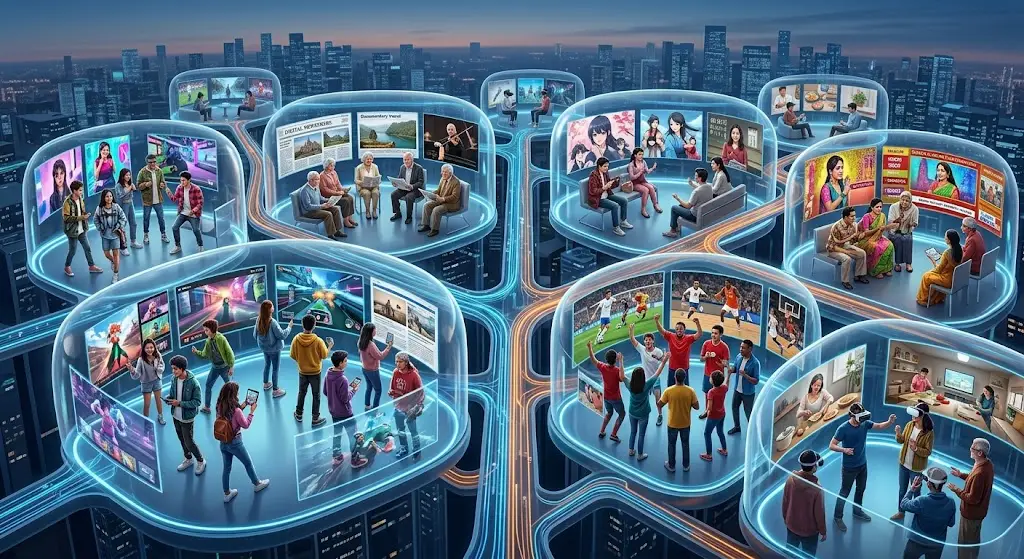
The result is not one giant cultural room.
It is a building containing millions of rooms with doors that occasionally open into one another.
And that distinction matters.
From Mass Culture To Algorithmic Culture
For much of the 20th century, cultural attention was relatively concentrated.
A handful of television channels, newspapers, radio stations, film industries and popular music outlets acted as cultural bottlenecks.
If something became enormous, there was a reasonable chance that your neighbour had seen it too.
That did not mean everyone liked the same things.
It meant many people encountered the same things.
This distinction is disappearing.
Reuters Institute research shows how dramatically the news environment has diversified. In its 2026 research, six online networks now reach more than 10% of people weekly with news, compared with only two a decade earlier. Among 18–24-year-olds, social media has overtaken online news websites and apps as the main route to news.
The shift is not merely from television to smartphones.
It is from shared distribution to personalised discovery.
That is a much bigger change.
A television channel could broadcast the same programme to ten million people.
A recommendation system can effectively ask ten million people ten million different questions:
What should this particular person see next?
The Numbers Reveal A Generational Split
The age difference is measurable.
Pew Research Center’s 2026 global survey, covering 37 countries, found median social-media usage of:
| Platform | Ages 18–34 | Ages 35–49 | Ages 50+ |
| 78% | 74% | 59% | |
| 77% | 57% | 29% | |
| TikTok | 64% | 44% | 26% |
| Snapchat | 35% | 12% | 4% |
| X | 29% | 16% | 9% |
These are not merely differences in app ownership. Different platforms expose users to different creators, formats, communities and recommendation systems.
The news gap is even more revealing.
In a 2025 Pew survey of US adults, 43% of 18–29-year-olds said they regularly got news from TikTok, compared with 25% of those aged 30–49, 10% of those aged 50–64 and just 3% of people aged 65+. Instagram showed a similar gradient: 40%, 26%, 11% and 5%, respectively.
So when an older person says, “Why haven’t I heard about this?”
The younger person’s answer may genuinely be:
“It was everywhere.”
Both statements can be true.
It was everywhere inside one recommendation environment.
India Makes The Splinter Even More Interesting
India adds another layer: language.
The country’s digital ecosystem is not one cultural market.
It is a collection of enormous linguistic and regional markets connected by smartphones.
India’s internet population reached an estimated 886 million active users in 2024, with rural users accounting for about 55% of the total. Nearly 98% of users accessed Indic-language content, according to IAMAI-Kantar findings reported by India’s public broadcaster.
Meanwhile, India’s broadband subscriber base crossed one billion in November 2025.
By March 2026, TRAI reported about 1.093 billion internet subscribers in India.
This creates a fascinating cultural equation:
Age + language + geography + interests + platform + behaviour = recommendation environment.
A Hindi-speaking 19-year-old in Delhi may inhabit one digital culture.
A Malayalam-speaking 19-year-old in Kerala another.
A Bengali-speaking student in Tripura another.
A 55-year-old English-speaking professional in Mumbai may inhabit a fourth.
They may all watch the same global football final.
But the jokes, creators, explanations, political commentary, songs and memes surrounding it can be completely different.
Global Platforms Are Simultaneously Unifying And Fragmenting Us
This is where the usual “social media divides us” argument becomes too simple.
Global platforms can create common culture.
A song can travel from Seoul to Mumbai to São Paulo in hours.
A meme can become globally recognisable.
A football celebration can become an international template.
A creator in India can attract viewers in Britain, Canada or the Gulf.
The same short-video format now exists almost everywhere.
Reuters Institute’s 2026 research shows YouTube, Instagram and TikTok have become major components of the changing global video-news ecosystem.
But the same infrastructure can simultaneously produce fragmentation.
The platform is global.
The feed is localised.
This is the paradox.
We increasingly share the same platforms without necessarily sharing the same culture.
The Rise Of The Micro-Culture
A micro-culture is not simply a small group of people with the same hobby.
It is a community with its own:
vocabulary
jokes
references
creators
music
symbols
assumptions
enemies
heroes
visual language
rituals
Consider a teenager who spends several hours a week inside football-edit communities.
Their cultural vocabulary may include specific players, editing styles, chants and memes that are almost invisible to a parent.
Another teenager may inhabit K-pop communities.
Another may follow anime.
Another follows Indian finance creators.
Another watches gaming streams.
Another lives inside regional-language comedy.
Another follows climate activism.
Another follows bodybuilding.
Another follows political commentary.
These are not isolated television channels.
They are participatory cultures.
Users do not merely consume them. They remix, comment, imitate, create and distribute them.
That makes memes particularly powerful.
A meme is cultural shorthand.
Once a community understands the reference, an image or seven-second video can communicate an entire argument without explaining anything.
To outsiders, it looks meaningless.
Inside the community, it can be perfectly precise.
Why Short Videos Accelerate The Splinter
Short-form video removes one of the traditional constraints of media: time.
A television programme needs scheduling.
A newspaper needs space.
A magazine needs an editorial cycle.
A short video needs seconds.
And recommendation systems can test thousands of pieces of content against users continuously.
The format also makes cultural transmission unusually fast.
A sound clip becomes a joke.
The joke becomes a dance.
The dance becomes a template.
The template crosses countries.
Then local creators translate it into another language.
Then another community changes its meaning.
The result is not cultural uniformity.
It is cultural mutation.
Reuters Institute found that 65% of people in its 2025 global sample consumed social video, up from 52% in 2020. Among 18–24-year-olds, 44% said social media and video networks were their main source of news.
India is particularly important in this transformation. Reuters Institute’s 2026 India report says around 58% of its primarily English-speaking survey respondents relied on YouTube for news, while more than half used social platforms for news.
This is not merely a technological shift.
It changes who becomes culturally important.
A television anchor once needed a newsroom.
A creator needs an audience.
The Creator Has Replaced The Channel For Many Young Users
Reuters Institute’s research on young audiences found that 51% of 18–24-year-olds paid more attention to individual news creators than traditional news brands, compared with 39% who paid more attention to news brands.
This is a profound change in cultural authority.
The old question was:
“Which channel are you watching?”
The new question is increasingly:
“Whose feed are you following?”
A creator becomes a gateway.
The audience may trust the personality, humour, language and perceived authenticity more than the institution behind the information.
That has benefits.
It can make complicated subjects accessible.
It can bring regional voices into national conversations.
It can allow overlooked communities to build audiences.
But it creates risks.
If the creator gets something wrong, the error may travel with the same intimacy as the original explanation.
Reuters Institute’s 2025 research found online influencers and personalities were among the leading perceived sources of false or misleading information globally.
The same mechanism that creates belonging can therefore create informational isolation.
Cultural Fragmentation Is Not The Same As Cultural Diversification
This distinction is essential.
Cultural diversification means more communities have the ability to create, preserve and share their own cultural expressions.
That can be healthy.
Cultural fragmentation occurs when communities become so separated that they stop encountering enough common information, references or experiences to understand one another.
One expands the cultural menu.
The other can remove the dining room.
A society can experience both simultaneously.
India can have more regional-language creators than ever before while also experiencing greater fragmentation between linguistic and generational communities.
The world can share TikTok-style video while disagreeing completely about what those videos mean.
So the question should not be:
“Are algorithms destroying shared culture?”
The better question is:
“Which parts of culture are becoming more shared, and which parts are becoming more separated?”
The Practical Experiment: Compare Two Recommendation Feeds
You do not need a research laboratory to see this phenomenon.
You can test it yourself.
Step 1: Choose two accounts
Use two accounts that have genuinely different histories.
For example:
Account A: primarily watches cricket, Indian news and finance.
Account B: primarily watches gaming, K-pop and comedy.
Do not deliberately manipulate the experiment after starting.
Step 2: Search for the same subject
Search exactly the same neutral topic on both accounts.
For example:
“climate change”
or
“India budget”
or
“football”
Record the first 20 recommended videos.
Step 3: Compare the results
Create a simple table:
| Measure | Account A | Account B |
| Same videos | — | — |
| Same creators | — | — |
| Same topics | — | — |
| Political content | — | — |
| Entertainment content | — | — |
| Regional-language content | — | — |
| Repeated themes | — | — |
Step 4: Repeat after 24 hours
Do not assume the first screen tells the whole story.
Recommendation systems continuously learn from behaviour.
Watch several videos from one topic, then return later.
Document what changed.
Step 5: Test a third variable
Use the same account but change language or viewing behaviour.
For example:
English searches
Hindi searches
Bengali searches
The purpose is not to prove that algorithms are biased.
It is to discover how quickly personal behaviour becomes part of the media environment you receive.
YouTube itself confirms that language consumption, viewing history, searches, likes, dislikes and similar-viewer behaviour can influence recommendations.
This experiment therefore turns an abstract debate into something observable.
Why Two People Can Watch The Same Event And Remember Different Worlds
Imagine a major election.
One user watches television coverage.
Another sees political explainers on YouTube.
A third receives short clips from influencers.
A fourth follows memes.
A fifth follows regional-language commentators.
A sixth sees almost none of it because their feed is dominated by entertainment.
All six technically experienced the same event.
But their reference libraries are different.
When they discuss it later, they may not merely disagree about the facts.
They may disagree about which facts deserve discussion.
This is a deeper form of fragmentation.
The disagreement is no longer:
“I interpret the same story differently.”
It becomes:
“We did not receive the same story in the first place.”
Do Young People Really Have Fewer Shared References?
Not necessarily.
They may simply have different shared references.
Older generations may remember:
national television programmes
famous newspaper headlines
popular film stars
radio songs
major sporting broadcasts
Younger communities may remember:
viral sounds
creators
memes
gaming events
streaming series
influencer controversies
platform-specific jokes
The difference is scale.
An old television programme could become common knowledge across a country.
A meme can become extremely important inside a community while remaining almost invisible outside it.
So today’s culture may not have fewer references.
It may have more references with smaller audiences.
That is the real generational culture splinter.
What Happens Next?
The most likely future is not the disappearance of mass culture.
It is a layered culture.
At the top will remain enormous global events: major sporting competitions, blockbuster films, elections, wars, disasters, celebrity moments and globally successful music.
Below them will sit national cultures.
Below those, regional and linguistic cultures.
Below those, platform cultures.
And below those, thousands or millions of micro-communities.
The cultural map therefore increasingly resembles a network rather than a pyramid.
AI may accelerate this further.
Recommendation systems can become better at predicting exactly what an individual wants to see. Generative AI can then create content specifically adapted to that audience.
The future cultural product may therefore become increasingly personalised.
Not:
“Here is today’s programme.”
But:
“Here is today’s version of reality, optimised for you.”
That is both extraordinarily useful and potentially dangerous.
The High-Agency Response: Build A Wider Information Diet
The answer is not to abandon recommendation systems.
They are too useful.
The answer is to stop treating the default feed as the whole world.
Try five simple habits.
1. Search outside your feed.
Do not let recommendations determine every question you investigate.
2. Follow institutions as well as personalities.
Creators are useful; primary sources and established institutions provide another layer of verification.
3. Deliberately cross languages.
If you understand more than one language, search important stories in both.
4. Periodically reset your assumptions.
Ask: What important story might I be missing because I never click on it?
5. Compare feeds.
The experiment above is surprisingly revealing.
The objective is not to create an artificially “balanced” feed containing everything.
It is to maintain enough information diversity that the recommendation system does not quietly become your editor, librarian, cultural historian and worldview manager.
Research into recommendation systems has found that interventions can influence both news exposure and diversity, showing that recommendation environments are not culturally neutral spaces.
We Are Not Losing Culture. We Are Losing A Single Cultural Centre.
The old mass-media system had a remarkable strength: millions of people could wake up knowing that millions of other people had watched the same programme, heard the same song or read the same headline.
It also had an obvious weakness.
A relatively small number of institutions decided what was worth seeing.
The algorithmic system reverses that.
More people can create.
More languages can travel.
More obscure interests can find communities.
More minorities can build audiences.
But the common cultural centre becomes weaker.
That creates a trade-off we have barely begun to understand.
Mass culture gave us common references but limited choice.
Algorithmic culture gives us extraordinary choice but weaker common references.
The future will probably contain both.
The challenge is ensuring that diversity does not become isolation.
Because a healthy culture needs two things at once:
rooms where people can be wonderfully different, and corridors that allow them to meet.
Recommendation algorithms are exceptionally good at building the rooms.
The next great challenge may be teaching them—or teaching ourselves—to build the corridors.
Practical Takeaways
| Question | What the evidence suggests |
| Are recommendation feeds personalised? | Yes. Platforms use behavioural and interest signals. |
| Does age affect media environments? | Strongly; platform use differs substantially by age. |
| Does language matter? | Yes, particularly in multilingual markets such as India. |
| Are young people consuming less culture? | Not necessarily; they consume through more fragmented channels. |
| Is fragmentation always harmful? | No. It can coexist with cultural diversification. |
| Are global platforms creating common culture? | Yes, especially around global formats, music, sport and memes. |
| Are they also fragmenting culture? | Yes, by tailoring discovery to individuals and communities. |
| Can users test this themselves? | Yes—compare identical searches across different accounts. |
| Can people regain agency? | Partly, by deliberately widening their information diet. |
The Unfoldings: The Algorithm Did Not End Mass Culture. It Multiplied It.
The great media revolution of the 20th century gave billions of people a smaller number of common cultural experiences.
The internet initially appeared to reverse that.
Then recommendation algorithms took the next step.
They did not simply give everyone access to everything.
They learned what each person was likely to watch next.
That subtle change is creating something historically unusual: a global culture connected by the same platforms but increasingly divided into overlapping micro-cultures.
The paradox is beautiful and unsettling.
We have never had more ways to find people like ourselves.
And perhaps that is precisely why encountering people unlike ourselves has become more important.
The next cultural skill may not be knowing how to find your community.
The algorithm is already exceptionally good at that.
It may be knowing when to leave it.
Related Readings
- Gen Z’s Brainrot May Not Be Brain Damage—It May Be a Rebellion — useful for the short-video/micro-culture section.
- The Hidden Sleep–Phubbing Connection — useful for the attention and behavioural consequences section.
- AI Can Now Help Identify People in Historical Photographs — useful for the emerging AI-personalisation and information-environment discussion.
Authentic sources and government references
Primary/platform evidence
- YouTube — How its recommendation system works — explains the recommendation signals, including watch history, interests, language, engagement and similar-viewer behaviour.
- Reuters Institute — Digital News Report 2026 — core evidence for changing news consumption, platforms and generations.
- Reuters Institute — Understanding Young News Audiences — particularly important for the generational analysis.
- Pew Research Center — Global Social Media Use By Age — 2026 cross-country age data.
- Pew Research Center — Young Adults and the Future of News — age-specific news-platform data.
- Ofcom — Online Nation — annual evidence on online behaviour and platform use.
India and government data
- TRAI — Telecom Subscription Reports — official Indian telecom and internet-subscription data, including 2026 releases.
- TRAI — Broadband Crosses One Billion Subscribers — official November 2025 milestone.
- Reuters Institute — India, Digital News Report 2026 — India-specific evidence on YouTube, creators, regional content and news consumption.
Research background
- Nudging Recommendation Algorithms Increases News Consumption and Diversity on YouTube — PMC — experimental evidence that recommendation environments can be altered and that this can affect news exposure and diversity.
- Mitigating Filter Bubbles: Diverse and Explainable Recommender Systems — research on filter bubbles and recommendation diversity.








Leave a Reply