
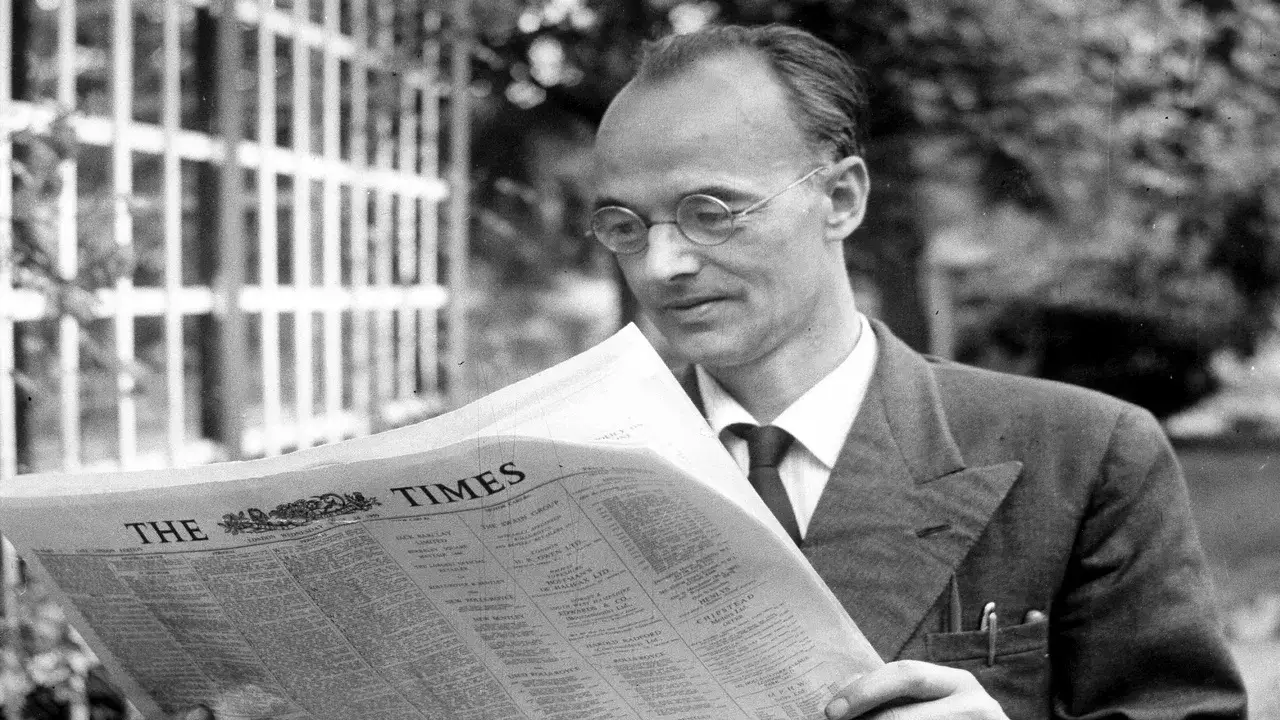
The Secret That Exploded Twice
On 29 August 1949, somewhere in the vast, dry landscape of Soviet Kazakhstan, a flash of light announced that the world had changed.
The Soviet Union had detonated its first atomic bomb.
Washington had expected this day to arrive eventually. Moscow possessed gifted physicists, enormous industrial resources and a government willing to spend whatever was necessary to acquire the weapon. But the speed of the achievement raised a question that American intelligence could not ignore.
How had the Soviets learned so much, so quickly?
The first explosion had taken place in the desert. The second was about to occur inside the intelligence services of the Western world.
Investigators began examining a disturbing possibility: the Soviet Union had not merely solved the atomic problem independently. It had received help from people who knew what the Americans were doing.
Somewhere in the chain of secrets, documents and encrypted messages was a man who had worked on the Manhattan Project itself.
He was a physicist. He was a British citizen. He had escaped Nazi Germany. He had been trusted with some of the most closely guarded scientific work of the twentieth century.
And he had been spying for Moscow.
His name was Klaus Fuchs.
There was no dramatic photograph of him slipping through a guarded tunnel with an atomic bomb under his coat. No suitcase contained the complete secret. His weapon was less visible, more portable and potentially more valuable than either.
He carried understanding.
He knew enough about the physics of the bomb to pass information that other scientists could use. While the Western Allies guarded their nuclear monopoly, Fuchs quietly helped another power close the distance.
The question that would haunt investigators was not simply how he had done it.
It was how a man trusted to help build the most secret weapon in history had decided that its secrets belonged elsewhere.
The Refugee Who Entered the Atomic Inner Circle
Klaus Emil Julius Fuchs was born in Germany on 29 December 1911. His early life unfolded in a country moving towards political catastrophe. He studied physics and joined the German Communist Party, placing himself among the political opponents of the regime that Adolf Hitler established in 1933.
Fuchs fled to Britain that year.
It was the kind of escape that could have ended his scientific ambitions. Instead, Britain gave him the opportunity to continue his education. He completed advanced work in physics and attracted the attention of scientists who recognised his mathematical ability.
Among them was Rudolf Peierls, an important figure in Britain’s wartime atomic research.
By the early 1940s, the possibility of an atomic weapon had become one of the most consequential scientific questions on Earth. Nuclear fission could release tremendous energy, but turning that discovery into a bomb demanded calculations, experiments, specialised materials and engineering on a scale few institutions could manage.
Britain had established a secret nuclear programme known as Tube Alloys. In 1943, British and American nuclear work became more closely integrated, and Fuchs joined the scientific contingent travelling to the United States.
He eventually reached Los Alamos, New Mexico, the isolated laboratory where the Manhattan Project’s scientists were developing the first atomic weapons.
The laboratory’s secrecy was formidable. The project was compartmentalised, and its participants did not automatically have access to every part of the undertaking. Yet the scientists had to exchange enough information to solve problems that no individual could resolve alone.
That necessary trust created an opportunity.
According to Britain’s security service, MI5, Fuchs had begun supplying information to Soviet intelligence in 1941, before he joined the Manhattan Project in the United States. His espionage was already under way when he entered the programme that would give him access to some of the most valuable nuclear information in existence.
His journey had taken him from Hitler’s Germany to the laboratories of an alliance fighting Hitler. But another loyalty had followed him across the border.
The man who appeared to be helping the West win the war had already decided that the Soviet Union should know about the atomic project.
A Spy Who Did Not Need to Steal a Bomb
Imagine standing outside a laboratory containing the most advanced weapon of its age.
You could steal a drawing. You could photograph a machine. You might even obtain a report full of equations.
But would you know which equation mattered?
Would you understand why one design had been chosen over another? Could you tell whether a result represented a breakthrough or a dead end?
This was where Klaus Fuchs became especially valuable.
The Manhattan Project was not simply a workshop assembling a weapon. It was a scientific system wrestling with unfamiliar problems. The project had to produce fissile material, understand how it behaved and devise mechanisms capable of producing the conditions required for a nuclear explosion.
At Los Alamos, the plutonium weapon presented a particularly demanding problem. Its implosion design required the rapid, sufficiently symmetrical compression of fissile material. The physics was difficult; the engineering was unforgiving.
Fuchs’s theoretical work brought him close to important aspects of weapon development. He could communicate technical information in a form that other physicists could understand.
That was the difference between stealing a secret and transferring the ability to make use of it.
A photograph might show a component. A report might record a result. An expert could help explain why that result mattered and what it suggested about the next stage of development.
Fuchs did not possess every secret of the Manhattan Project, and he did not single-handedly provide the Soviet Union with everything required to build a bomb. His value lay in the information he could pass about important scientific principles and design decisions.
The Soviet programme already had capable researchers. What it lacked was complete access to the experience of the American programme.
Fuchs helped bridge that gap.
The most dangerous thing he carried was not a physical object that customs officers might discover. It was knowledge that could be transmitted without moving anything heavier than a document.
The Meetings That Connected Two Worlds
Fuchs’s secret work depended on intermediaries.
His early contact with Soviet intelligence was facilitated through Jürgen Kuczynski, a German Communist who helped establish the connection. Fuchs later dealt with Ursula Beurton, known as Ruth Werner, who worked for Soviet intelligence under the codename SONYA.
After Fuchs travelled to the United States, another figure entered the story: Harry Gold, an American chemist who acted as a courier for Soviet intelligence.
Meetings in places including New York City and Santa Fe, New Mexico, provided opportunities to pass information. Fuchs supplied technical material; Gold carried it onwards through the intelligence network.
The operation was not a continuous conversation between Fuchs and the Kremlin. The people involved occupied different positions in a chain, and they did not necessarily know everyone else connected with it.
This arrangement made sense from an intelligence perspective. A courier did not need to understand nuclear physics. A physicist did not need to meet every Soviet official who might eventually read his information.
Each participant had a task.
But every additional link created another opportunity for exposure. People had to meet, messages had to travel, and information had to be handled. The network depended on secrecy, yet its continued existence generated traces that investigators could eventually connect.
Fuchs continued passing information after returning to Britain in 1946. He took up work at the Atomic Energy Research Establishment at Harwell, one of Britain’s important postwar nuclear research centres.
His career appeared to be moving forward. His secret activity continued behind it.
The eventual collapse of the operation would demonstrate the weakness of an apparently well-compartmentalised network: a secret can remain hidden for years, but it becomes vulnerable when separate pieces of evidence begin to form a recognisable pattern.
The Soviet Explosion That Started a Different Investigation
When the Soviet atomic bomb detonated on 29 August 1949, American officials had to confront a new strategic reality.
The United States no longer possessed a nuclear monopoly.
The Soviet Union’s first device, known as RDS-1, closely followed the American plutonium-bomb design. That similarity strengthened suspicions that intelligence from the Manhattan Project had helped Soviet scientists.
Yet the Soviet achievement was not simply a matter of assembling stolen instructions.
Under Igor Kurchatov’s scientific leadership and with the Soviet state mobilising enormous resources, researchers had to obtain nuclear material, develop industrial facilities and solve the practical problems required to produce a functioning weapon.
Espionage supplied valuable information. It did not supply every kilogram of material, build every factory or conduct every experiment.
How much time had Fuchs saved the Soviet Union?
Historians cannot give a definitive number. Estimates about the acceleration caused by atomic espionage depend on assumptions about what Soviet scientists would have achieved without the stolen information. The programme had considerable scientific talent and was backed by a government prepared to mobilise extraordinary resources.
The defensible conclusion is that espionage helped reduce uncertainty and accelerated important parts of the programme. It does not follow that the Soviet Union would have remained permanently unable to build a bomb without Fuchs.
That distinction is crucial. It avoids two equally misleading stories: that one spy single-handedly created a nuclear superpower, or that espionage made no meaningful difference because the Soviet Union would eventually have succeeded anyway.
The historical question is not whether the Soviet Union possessed scientific ability. It did.
The question is how much easier it became to use that ability when someone inside the rival programme supplied information about what had already been learned.
The Message That Led Investigators Towards a Physicist
For years, Fuchs’s double life remained concealed. The breakthrough came not from a missing document or an eyewitness who suddenly remembered his face, but from an intelligence operation built around intercepted communications.
During the Second World War, American intelligence had collected encrypted Soviet messages. The codebreaking project that became known as VENONA began in 1943 and continued for decades.
The system was intended to protect Soviet communications. But weaknesses in the handling of cryptographic material allowed American analysts to decipher portions of some messages.
The recovered text offered fragments of an intelligence network: references to sources, reports, meetings and the information being passed.
One source was identified by the codename REST.
The messages did not immediately produce a neat answer. Investigators had to compare intelligence reports with scientific records, identify people who possessed relevant access and determine which suspect best matched the available evidence.
Fuchs emerged as a central figure in the investigation.
There was a further complication. The codebreaking methods were so sensitive that revealing the decrypted messages in open court risked alerting Soviet intelligence to the compromise.
Investigators needed to establish the case without exposing the full source of their knowledge.
British security officer William Skardon began interviewing Fuchs. The conversations were persistent and carefully conducted. Investigators did not simply place a decrypted message in front of him and announce that the mystery was solved.
Gradually, the pressure increased.
Then came the confession.
In a statement recorded on 27 January 1950, Fuchs admitted passing information to Soviet intelligence. He described his disclosure of the principles of plutonium-bomb design as the worst thing he had done at Los Alamos.
That statement is among the most revealing documents in the entire affair. It records not just an intelligence agency’s accusation, but the scientist’s own admission of what he had done.
On 2 February 1950, Fuchs was arrested in Britain. On 1 March, he pleaded guilty to violating the Official Secrets Act and received a fourteen-year prison sentence, the maximum then available for the offence.
The spy inside the atomic project had finally been identified.
But his confession would lead investigators towards other people and turn a single case into a much wider counterintelligence investigation.
The Network Behind the Network
Fuchs’s confession helped investigators identify Harry Gold, who was arrested in the United States and admitted his role in espionage. Gold’s statements helped investigators reach David Greenglass, a former Army machinist who had worked at Los Alamos.
The inquiry also intersected with the case against Julius and Ethel Rosenberg, which became one of the most controversial espionage prosecutions of the Cold War.
It is important not to treat every person connected with these cases as interchangeable. Their roles, evidence and legal outcomes differed. Fuchs’s confession established his own conduct; it does not automatically prove every allegation made against others.
Nevertheless, the wider investigation exposed a serious weakness in the protection of nuclear secrets.
The Manhattan Project had relied on compartmentalisation, personnel screening and physical security. These measures were necessary, but they could not fully eliminate the risk that a person with legitimate access would deliberately disclose information.
Fuchs had not needed to break into Los Alamos. He had been invited to work there because he was qualified.
The problem was not simply a failure to keep outsiders away. It was a failure to detect a trusted insider who had chosen to work for another power.
The case intensified concern about political loyalties, security clearances, access to classified material and the ability of intelligence services to identify threats within their own institutions.
It also deepened distrust between the Western Allies and the Soviet Union. Wartime cooperation had already begun to give way to Cold War rivalry. The revelation that Soviet intelligence had obtained atomic secrets made the argument for tighter controls far more urgent.
The bomb had changed international politics. The Fuchs affair changed how governments thought about the people who possessed its secrets.
Was He a Traitor—or a Man Who Believed Knowledge Should Be Shared?
Fuchs’s motives are the most uncomfortable part of his story because they cannot be reduced to money or personal ambition.
He was a committed communist and believed the Soviet Union should have access to atomic information. His political convictions were central to his explanation for passing the secrets.
From his perspective, the Soviet Union had fought Nazi Germany alongside Britain and the United States. He regarded its exclusion from atomic knowledge as unjust.
But the world had changed while the scientists were working.
Nuclear physics was no longer only a subject for academic debate. Certain discoveries could be turned into weapons with consequences for entire populations. Governments regarded such information as a military capability, not simply a contribution to humanity’s shared knowledge.
Fuchs’s actions exposed the tension between scientific internationalism and wartime secrecy. Science advances through communication, yet a scientist working on a weapon may have obligations that go beyond the normal exchange of research.
The distinction is not that all secrecy is justified or that all information should be controlled by governments. Excessive secrecy can impede legitimate research, obstruct accountability and prevent independent scrutiny.
But secret transfers of restricted military information are not the same as publishing scientific results for the world to examine.
Fuchs did not create an open system of scientific exchange. He chose a covert route that deprived his employers of the right to decide how their classified information would be used.
His convictions help explain his actions. They do not erase the consequences.
The larger lesson is that technical brilliance does not automatically confer moral clarity. A scientist may understand the physics perfectly and still make a deeply consequential judgement about who should possess the knowledge.
The Man Who Could Not Make the World Forget
Fuchs was released from prison in 1959 and moved to East Germany, where he returned to scientific work. He died in Dresden on 28 January 1988.
By then, the nuclear world had become more dangerous than the one he had entered as a young physicist. The United States and Soviet Union had developed enormous arsenals. Their rivalry increasingly depended on nuclear deterrence and the fear that a conflict could escalate beyond control.
Fuchs had not created that world alone. But his case had demonstrated how information could change the balance of power long before a weapon was tested.
There is a reason his story still matters.
Today, strategically important knowledge exists in advanced computing, biotechnology, semiconductor manufacturing, artificial intelligence and other technical fields. A research programme may depend on a relatively small group of people who understand the relationship between its data, designs and practical results.
Protecting that knowledge is not simply a matter of building higher fences or locking more filing cabinets.
Institutions must decide which information genuinely requires protection, who needs access, how misuse can be detected and how legitimate collaboration can continue without exposing sensitive capabilities.
Too little security can create vulnerabilities. Too much can smother the research and exchange that make scientific progress possible.
The challenge is to recognise that knowledge is neither automatically harmless nor automatically dangerous. Its consequences depend on what it enables people to do.
Fuchs understood what the information could enable. He transferred it anyway.
Did One Scientist Change History?
Klaus Fuchs did not give the Soviet Union a ready-made atomic bomb. He helped it understand important aspects of a weapon that the United States had already developed.
His espionage reduced uncertainty, provided technical information and helped accelerate a programme that also depended on independent Soviet science, engineering and industrial mobilisation.
The exact time saved remains uncertain. The strategic consequences of the espionage do not.
The story began with a mysterious explosion in Kazakhstan. It ends with a more disturbing realisation: some of the knowledge behind that explosion had crossed international borders through the decisions of a man trusted to protect it.
The most valuable thing Fuchs carried was not a bomb component or a secret blueprint.
It was an explanation.
And once that explanation reached another team of scientists, the world could not return to the moment before they knew it.
Key dates
| Date | Event |
| 29 December 1911 | Klaus Fuchs is born in Germany. |
| 1933 | He flees Nazi Germany for Britain. |
| 1941 | He begins passing information to Soviet intelligence. |
| 1943 | He joins the British contingent working on the Manhattan Project. |
| December 1944–June 1946 | He works at Los Alamos. |
| 16 July 1945 | The United States conducts the Trinity nuclear test. |
| 29 August 1949 | The Soviet Union tests its first atomic bomb. |
| 27 January 1950 | Fuchs’s confession is recorded. |
| 2 February 1950 | He is arrested. |
| 1 March 1950 | He pleads guilty and receives a fourteen-year sentence. |
| 1959 | He is released and moves to East Germany. |
| 28 January 1988 | He dies in Dresden. |
Frequently asked questions
What did Klaus Fuchs give the Soviet Union?
He supplied information about nuclear research and bomb development, including important principles of plutonium-bomb design.
How was he caught?
Decrypted Soviet communications from the VENONA project helped investigators identify a source linked to Fuchs. British questioning eventually produced his confession.
Did he single-handedly create the Soviet atomic bomb?
No. His information helped the programme, but Soviet scientists and engineers still had to produce the necessary nuclear material, build industrial facilities and develop a working weapon.
Why did he spy?
His communist beliefs and conviction that the Soviet Union should have access to atomic knowledge were central to his stated motives.
What happened to him after prison?
He was released in 1959, moved to East Germany and returned to scientific work. He died in 1988.
Sources and further reading
- MI5 — Klaus Fuchs: Official British account of his espionage and conviction.
- The National Archives, UK — Fuchs’s confession: Primary-source evidence of his admissions.
- US Department of State, Office of the Historian: Historical documents on the case.
- US National Archives — VENONA records: Declassified records concerning Soviet intelligence and intercepted communications.
- FBI — Historical material on VENONA and Cold War counterintelligence:








Leave a Reply