
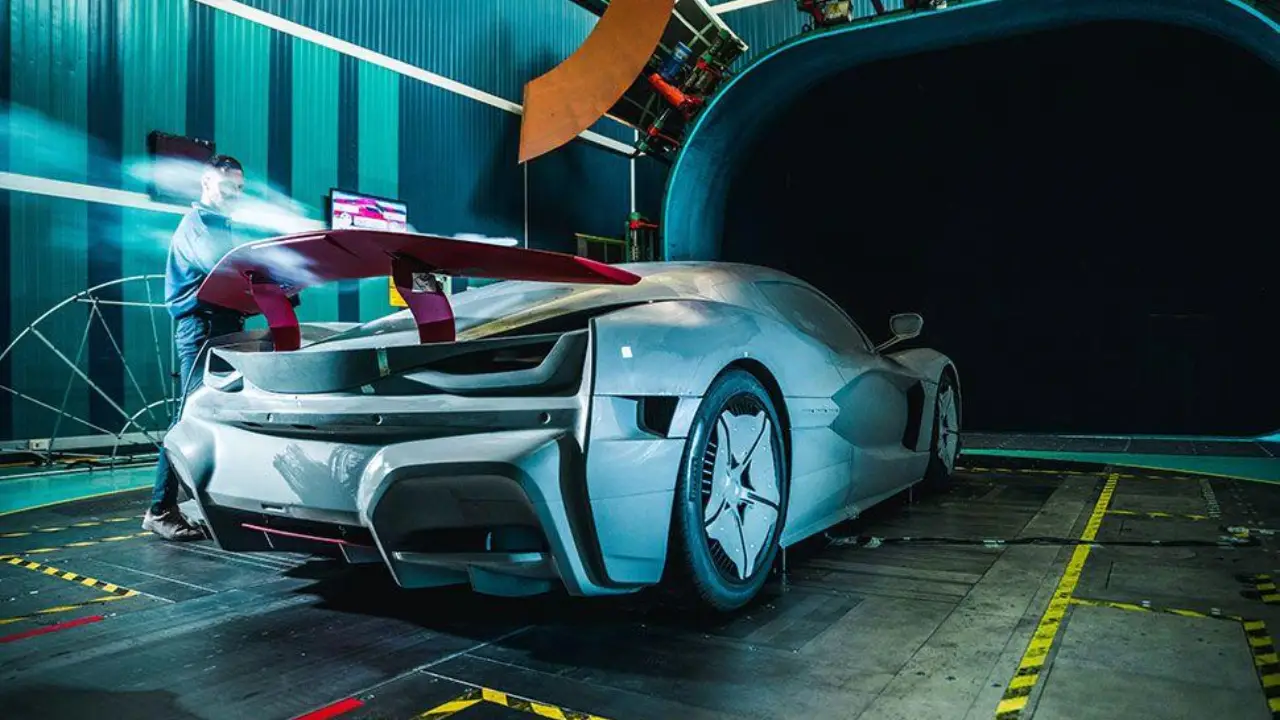
A car leaves the ground. For a few seconds, the ordinary rules of motoring seem to disappear. The machine rises, turns in midair and returns to the surface. Its wheels, which have defined the automobile for more than a century, suddenly look like an inadequate description of what a car might become.
Then the more interesting question arrives.
What, exactly, has been proved?
On 15 October 2026, Tesla unveiled a redesigned version of its long-delayed second-generation Roadster at a SpaceX testing facility in Texas. The demonstration featured cold-gas thrusters, an underbody suction system and spectacular airborne manoeuvres. Elon Musk presented the machine as a glimpse of a future in which a car might do far more than drive. Tesla is targeting production in 2028, but the final vehicle price has not been announced, and the Rocket configuration’s airborne capabilities are not approved for public-road use. Reuters and The Associated Press reported the key details of the unveiling.
It was an extraordinary demonstration. But demonstrations and deliverable products answer different questions.
The deeper story of the Roadster is not simply that Tesla has built or intends to build a remarkably fast electric sports car. It is that the company has turned the future itself into part of the product. Performance figures, rockets, artificial intelligence, software and the promise of technological reinvention now occupy the same commercial stage.
To understand what the Roadster might mean, we must investigate not only what it can reportedly do, but also what remains unknown, what earlier promises tell us, and why a machine can be technologically fascinating long before it becomes a useful product.
The First Mystery: Why Is a Nearly Decade-Old Promise Still New?
The Roadster’s history begins with a striking contradiction: a car can remain commercially important without becoming commercially available.
Tesla introduced its second-generation Roadster in November 2017. The company presented it as an electric supercar capable of reaching 60 miles per hour in 1.9 seconds, exceeding 250 mph and travelling up to 620 miles on a charge. Its advertised starting price was approximately $200,000, and deliveries were originally expected years before the current production target.
These were not insignificant claims. They challenged the assumption that electric vehicles were primarily practical appliances quiet, efficient and environmentally preferable, perhaps, but not the natural home of extreme performance.
Yet the car did not enter ordinary customer production on that original schedule.
In 2018, Musk also discussed adding approximately ten small rocket thrusters to the Roadster. The idea was not invented during the latest unveiling. The 2026 event brought an old ambition back into the spotlight, now accompanied by a physical demonstration. TechCrunch’s original reporting revisits that history.
The new production target is 2028.
That creates an important investigative question: what should nearly nine years of delay mean to a prospective buyer?
It does not automatically prove that the engineering is impossible, that the company has acted dishonestly, or that the eventual vehicle will fail. Complex products can change as technologies, priorities and production plans evolve.
But time is evidence of a different kind. It shows that the original specifications and schedules were not enough to produce a deliverable car on the anticipated timetable.
Every new promise should therefore be judged against two records: the performance Tesla says it can achieve, and the history of converting ambitious announcements into customer vehicles.
The latest reveal changes the visual story. It does not erase the delivery history.
A Flying Demonstration Is Not Yet Proof of a Flying Automobile
The word flying does much of the work in the Roadster’s publicity.
It encourages us to imagine a familiar vehicle acquiring an entirely new ability. But there is a difference between a car that can briefly lift off under controlled conditions and a vehicle that can fly safely, predictably and usefully in the world outside a demonstration facility.
The reported Roadster system uses cold-gas thrusters. These generate thrust by releasing stored pressurised gas rather than relying on combustion in a conventional rocket engine. Tesla has also demonstrated a suction system that helps the vehicle grip an inverted surface.
Both concepts have legitimate engineering foundations. Neither should be confused with proof that the complete vehicle is ready for routine public use.
Consider what a credible engineering assessment would need to establish:
How much does the complete system weigh?
How much compressed gas can it carry, and how much is consumed during a manoeuvre?
How frequently can the system operate before it must be recharged or serviced?
What happens if a valve, sensor, fan or control system fails?
How does the vehicle behave in crosswinds, rain, dust or uneven conditions?
What safety envelope protects passengers, spectators and nearby vehicles?
These are not objections invented to spoil a spectacular launch. They are the questions that separate a successful demonstration from a dependable machine.
The distinction matters because the Rocket configuration is not approved for public-road use. Reporting by The Information also noted that the demonstration vehicle operated without a human inside because of the thrusters’ noise and vibration.
That detail deserves more attention than it received in the excitement surrounding the event. If a vehicle’s most extraordinary manoeuvres cannot yet be demonstrated with a person aboard, the performance has not established the safety of a passenger-carrying system.
It has established something narrower, but still interesting: a vehicle can be engineered to perform controlled aerial movements under specific conditions.
That is a meaningful technical achievement. It is not the same achievement as a practical flying car.
The Engineering Question Hidden Inside the Spectacle
Electric vehicles already possess one major advantage in acceleration: electric motors can deliver substantial torque quickly, without the gear changes and combustion cycles associated with conventional engines.
But acceleration is not magic. It is a negotiation among power, traction, heat, weight and energy.
At launch, the tyres must transmit force to the road without losing grip. Battery cells and electrical components must supply enormous power without exceeding their operating limits. Motors, inverters and cooling systems must manage the resulting heat. Repeated acceleration places demands on the system that a single run may not reveal.
The Roadster’s latest reported claims include acceleration from zero to 60 mph in under one second for the more extreme configuration. Tesla’s event demonstration was reported at around 0.81 seconds, while the company’s configuration claims and reported figures vary by version. Those numbers should not be treated as independently verified production-car results. TechCrunch describes the different versions and their advertised capabilities.
Even if the claimed acceleration is achieved, the important question is what happens after the first run.
Can the car repeat it several times? Can it do so when the battery is hot or nearly depleted? Does the performance remain available on ordinary tyres and road surfaces? How much does it shorten tyre life? What happens to braking performance after repeated high-speed runs?
A headline acceleration time tells us how quickly a vehicle can achieve a result under particular conditions. It tells us much less about how the vehicle performs over an entire day of driving.
The same problem applies to top speed. Air resistance increases sharply as speed rises. Under simplified conditions, aerodynamic drag force increases approximately with the square of speed, while the power required to overcome that drag rises roughly with the cube of speed.
In plain English: going twice as fast can require roughly eight times as much aerodynamic power, assuming other relevant conditions remain comparable.
That is why extreme speed and long range are difficult partners. The faster a vehicle travels, the more energy it may consume simply pushing air aside.
The engineering challenge is not to produce one spectacular number. It is to make all the numbers coexist in the same vehicle.
The Battery Is the Part of the Story That Cannot Be Replaced by Drama
The original Roadster announcement promised a range of 620 miles. The latest reporting describes a new advertised range of approximately 300 miles, alongside a claimed top speed exceeding 230 mph. These figures refer to different stages and versions of the Roadster story; they should not be treated as directly comparable test results without knowing the test cycles, battery configuration and operating conditions. Reuters’ report on the unveiling provides the current reported claims.
The change is revealing, even if the figures cannot be compared like-for-like.
A car designed to accelerate violently, travel at extreme speeds and carry specialised propulsion hardware faces competing demands. A larger battery may support greater energy capacity, but it adds weight. A heavier car requires more energy to accelerate and places additional demands on tyres, suspension and braking. Rocket equipment, pressure vessels and supporting systems also occupy space and add mass.
The real question is how Tesla has balanced these compromises.
What is the usable battery capacity? What charging rate can the production car sustain, rather than briefly reach? How much range is lost at sustained high speeds? How does battery temperature affect repeated acceleration? What is the expected degradation after years of use?
Without these answers, the advertised range remains a claim whose practical meaning is incomplete.
There is also a larger industrial issue. Battery breakthroughs often look impressive in laboratories, where researchers can optimise a small cell under controlled conditions. Mass production introduces different problems: manufacturing yield, material consistency, cost, safety, quality control and long-term reliability.
A supercar can tolerate technologies that would be uneconomic in a mass-market vehicle. It can also survive as a low-volume showcase even when its engineering is too expensive or complicated to spread across an entire product line.
The Roadster’s real battery significance may therefore be less about whether it sets a new range record and more about whether its engineering produces technologies that can eventually benefit less expensive vehicles.
Tesla has not yet publicly demonstrated that outcome through the Roadster itself.
The Most Valuable Product May Be the Idea of the Product
Why would a company continue to promote an expensive, specialised sports car when the wider electric-vehicle market depends on affordability, charging access and reliable production?
One answer is that the Roadster functions as a halo car.
A halo car does not need to sell in huge numbers to influence how people perceive a brand. Its job is to make the company appear technically daring, desirable and different. The lessons and technologies associated with an exceptional vehicle may eventually reach more ordinary products, but that transfer is not automatic.
The Roadster also makes a useful public demonstration of Tesla’s association with SpaceX. The companies operate in different industrial environments, yet the collaboration invites audiences to imagine a shared technological universe in which rockets, electric vehicles and software belong to one expanding system.
This creates commercial value before the car reaches customers.
The demonstration can generate attention. Attention can strengthen brand recognition. Brand recognition can help sustain interest in a product that remains years away from production.
None of this proves that the car is merely a publicity exercise. A machine can be both a serious engineering project and a marketing instrument.
The more important question is whether the spectacle is accompanied by measurable progress.
Can Tesla show that the technology reduces weight, improves performance or solves a problem that conventional engineering cannot solve as effectively? Can the company publish test results, production milestones and safety evidence? Can the same capabilities survive the transition from a carefully controlled demonstration vehicle to a repeatable manufacturing process?
A halo car is useful when the halo illuminates real capabilities. It becomes less persuasive when the glow is easier to see than the product.
Three Roadsters, Three Different Meanings of “Performance”
The latest reported line-up divides the Roadster into Performance, Thrust and Rocket configurations.
The Performance version is presented as the road-oriented model. Thrust adds cold-gas propulsion for more extreme acceleration. Rocket is the most radical configuration, with airborne manoeuvres and a single-seat layout, and is described as invite-only. Tesla’s advertised reservation deposits include $50,000 for Performance and $250,000 for Thrust; those amounts are deposits, not the final purchase prices. The final vehicle price has not been announced. TechCrunch reports the configuration details and reservation amounts.
These versions should not be collapsed into a single set of capabilities.
A road-legal vehicle, a track-focused vehicle and a machine designed for controlled aerial demonstrations face different engineering and regulatory requirements. A claim made about Rocket does not automatically describe Performance. Nor does a spectacular demonstration prove that every configuration will be manufactured with the same equipment.
This is where product language becomes important. Terms such as road ready, race ready and air ready are useful descriptions of intended positioning, but they are not substitutes for a final specification sheet, homologation documents or independent testing.
A serious buyer needs to know what is included, what is optional, what is restricted and what may change before delivery.
The reservation process creates another distinction. Paying a deposit can secure a place in an ordering process; it does not establish that the vehicle is finished, approved for a particular market or ready for delivery.
Before committing substantial money, buyers should examine the current written reservation agreement, cancellation conditions, refund terms, delivery language and the precise version being reserved. They should not rely on a headline, a demonstration video or an informal promise.
The financial risk is not simply that a car might be expensive. It is that the buyer may be paying today for a product whose final form remains unsettled.
Software May Be the More Important Technology
The Roadster’s rockets attract attention because their operation is visible. Software is less dramatic, but it may determine whether a modern high-performance vehicle is safe and dependable.
A vehicle combining powerful electric motors, active aerodynamics, suction fans and compressed-gas thrusters requires coordination among sensors, controllers and mechanical systems. The software must decide how these systems interact, monitor their condition and respond when a component behaves unexpectedly.
That creates a difficult question: who controls the vehicle after it leaves the factory?
Over-the-air updates can improve features, correct software faults and introduce new capabilities. But software dependence can also make owners reliant on a manufacturer’s update policy, servers, cybersecurity practices and long-term support.
A vehicle is not simply a computer on wheels. It is a computer whose mistakes can produce physical consequences.
If an update changes acceleration behaviour, alters a safety system or disables a feature, what information is provided to the owner? How long will essential services remain available? Can the vehicle be repaired independently? What happens if a connected service is discontinued?
The Roadster also raises a separate issue that is often blurred in discussions of advanced vehicles: performance automation is not autonomous driving.
A computer that controls traction or coordinates a manoeuvre under tightly defined conditions has not demonstrated that it can drive safely through unpredictable traffic. Pedestrians, temporary roadworks, unusual weather and other human drivers create situations that cannot be reduced to a simple acceleration record.
A car that can leap over an obstacle has not necessarily demonstrated that it can recognise when the obstacle is a child stepping into the road.
That distinction matters far beyond Tesla. The automotive industry is increasingly defined by software, but the test of intelligence is not how impressive a machine looks when everything goes according to plan. It is how reliably it behaves when reality refuses to cooperate.
The Environmental Question: What Does an Electric Supercar Actually Save?
Electric vehicles generally avoid tailpipe emissions, but their total environmental impact depends on more than what comes out of the exhaust because there is no exhaust.
Battery production requires energy and raw materials. Mining and processing can create environmental damage. Electricity generation varies by region. Vehicle size, manufacturing methods, driving patterns and lifetime mileage all influence the final result.
The US Department of Energy has published lifecycle comparisons in which a small electric SUV produced substantially lower lifecycle greenhouse-gas emissions than a comparable petrol SUV under the study’s assumptions. That finding is useful evidence for the broader benefits of electrification, but it cannot be transferred automatically to every electric vehicle. US Department of Energy lifecycle analysis.
A high-performance electric sports car asks a different environmental question from a compact electric commuter. It is likely to be a specialised, relatively expensive product, and its value may depend heavily on performance that most drivers rarely use.
This does not make it environmentally pointless. A halo vehicle can help develop technologies, attract engineering talent and make electric propulsion desirable to people who would otherwise reject it.
But the benefit must be demonstrated, not assumed.
If a heavy battery-powered supercar uses considerable material and energy to achieve extraordinary acceleration, its environmental case cannot rest on the word electric alone. Researchers would need to consider manufacturing emissions, electricity sources, lifetime use and the environmental cost of the vehicle’s specialised components.
The larger question is whether innovations developed for an expensive sports car eventually improve the efficiency, affordability or durability of ordinary electric vehicles.
That would be a stronger contribution than simply proving that electricity can make a car extraordinarily fast.
India Is a Particularly Useful Test of the Roadster’s Relevance
For India, the Roadster’s engineering spectacle raises a practical question: which electric-vehicle problems deserve the greatest attention?
A specialist supercar operates in a world of wealthy buyers, carefully selected routes and relatively limited sales. India’s wider electrification challenge involves two-wheelers, three-wheelers, buses, commercial fleets, household charging, public infrastructure and the cost of electricity.
The needs are different.
For an Indian household considering an electric car, the decisive questions may be whether home charging is possible, whether apartment parking has a dependable electrical connection, how much public charging costs, whether service centres are accessible and how the vehicle performs during long journeys or extreme weather.
For a delivery driver or a small commercial operator, uptime, battery durability and the cost per kilometre may matter more than acceleration.
For public transport, a reliable electric bus can displace repeated fuel consumption across many journeys. For a two-wheeler user, an affordable and durable battery may be more consequential than a breakthrough in high-speed propulsion.
The Roadster may still matter to India through engineering knowledge, brand influence and the wider development of electric technology. But there is no reason to assume that the most visually spectacular EV is the most socially important one.
A useful test is simple: which innovation can move from a small number of luxury vehicles into millions of everyday journeys?
If the Roadster helps advance battery management, power electronics, cooling or manufacturing methods that later become cheaper and more reliable, its influence could extend far beyond its buyers.
If its defining technologies remain expensive, specialised and unsuitable for ordinary roads, its impact may remain largely symbolic.
Both outcomes are possible. Neither should be assumed in advance.
The Evidence Ledger: What We Know and What We Still Do Not
The Roadster’s public story becomes clearer when its claims are separated from the evidence needed to verify them.
What has been reported: Tesla unveiled a redesigned vehicle on 15 October 2026, demonstrated aerial manoeuvres using cold-gas thrusters and a suction system, and set a 2028 production target. The company has described multiple configurations and opened reservations with substantial deposits.
What remains a manufacturer claim: the ultimate production specifications, extreme acceleration figures, top speed, range and the practical capabilities of each configuration. A demonstration may support a claim, but independent, repeatable testing is needed to establish how a production vehicle performs.
What remains unresolved: the final purchase price, precise delivery schedule, production volume, market-specific regulatory approval, long-term reliability, service requirements and the practical operating limits of the Rocket system.
What would materially strengthen the evidence: independently measured acceleration and braking results; repeatability tests; verified range under a clearly identified test cycle; battery and thermal data; a detailed specification for each version; safety documentation; and a transparent record of production milestones.
The company’s own Roadster website should also be read carefully. It has carried the earlier headline specifications, including 1.9-second acceleration, a top speed above 250 mph and 620 miles of range. The coexistence of those older figures with newer reported claims is a reason to check which specifications apply to which vehicle version and announcement not to combine them into one imaginary supercar.
That is the central discipline of technological investigation: a number is not meaningful merely because it is precise. It must have a source, a test method, a defined configuration and conditions under which another party can reproduce it.
What Happens If the Roadster Arrives in 2028?
There are three plausible outcomes.
In the first, Tesla delivers a highly capable electric sports car, while the Rocket configuration remains a specialised, tightly restricted demonstration of what integrated electric and compressed-gas systems can do. The Roadster earns credibility through real-world performance, even if the most extraordinary features never become ordinary motoring technology.
In the second, the car arrives in a more limited form than the spectacle suggested. Some specifications change, delivery remains restricted, or the most dramatic capabilities prove too expensive or difficult to certify for wider use. The vehicle may still be impressive, but the gap between expectation and reality becomes part of its legacy.
In the third, production slips again. The Roadster continues to generate attention, yet the public remains unable to judge the final product because the decisive evidence customer deliveries, independent testing and sustained operation never arrives on the promised timetable.
These are scenarios, not predictions. The available evidence does not establish which will occur.
But the distinction between them offers a useful way to follow the story. Do not watch only for the next unveiling. Watch for engineering specifications that stop changing, regulatory approvals that can be checked, independently verified tests, a functioning production line and actual customer deliveries.
Those milestones will tell us more than another spectacular video.
The Unfolded Shelf: The Question Beneath the Flying Car
The Roadster invites us to imagine a future in which the automobile escapes its familiar boundaries. That is an exciting possibility. It is also an opportunity to examine how modern technology is sold.
A prototype can demonstrate possibility. A carefully staged event can communicate ambition. A reservation can measure interest. None of these, separately or together, proves that a complex product is ready for ordinary use.
The real test begins when the cameras leave.
Can the machine perform repeatedly? Can it carry passengers safely? Can it be manufactured at a known cost? Can it satisfy regulators? Can customers service it, charge it and keep it working for years? And will its most important innovations improve life beyond the small circle of people able to buy one?
Tesla’s Roadster may eventually answer many of those questions. Its 2026 unveiling has not answered all of them.
That is why the most revealing feature of the Roadster may not be its ability to leave the ground. It may be the distance between what a company can show, what it can promise and what it can reliably deliver.
For almost a century, the automobile’s basic contract with its owner has been straightforward: it must take you somewhere, safely and repeatedly. The Roadster asks us to imagine a more extraordinary contract.
Before accepting it, we should ask the oldest question in engineering.
Does it work not just once, not just on a stage, but in the world for which it was built?
That is where the future of the Roadster will actually be decided.
Sources and further reading
- Reuters — Tesla’s redesigned Roadster and its 2028 production target
- The Associated Press — Tesla’s Roadster demonstration and remaining road-use limitations
- TechCrunch — Roadster configurations, thrusters and the history of the project
- The Information — The 2026 demonstration and the Rocket configuration
- Tesla — Official Roadster page
- US Department of Energy — Vehicle Technologies Office
- US Department of Energy — Electric-vehicle lifecycle emissions comparison








Leave a Reply