
The opening mystery: Who told you what to think about the news?
At 11:47 on a Saturday night, a video appears on your phone.
A man sits in front of a camera. There is no newsroom behind him, no scrolling ticker, no panel of experts. He looks directly at the viewer and says that something about a major public event does not add up.
He has a document. He highlights a sentence. He pauses at just the right moment.
“Now ask yourself,” he says, “why haven’t they told you this?”
Within minutes, viewers begin sharing the clip. Some praise him for exposing the truth. Others accuse him of misleading the public. A second creator responds. A third extracts the most controversial sentence. By morning, the argument has escaped the original video and entered conversations among people who have never seen the document that started it.
Something remarkable has happened. An individual with a camera has helped determine which question thousands—or potentially millions of people are asking.
But has he changed what they believe?
Has he merely given existing beliefs a louder voice? Has he uncovered something journalists missed? Or has he taken an incomplete piece of evidence and wrapped it in a story so compelling that people no longer feel the need to investigate further?
These are three different possibilities. On a social-media feed, they can look almost identical.
That is where the real investigation begins.
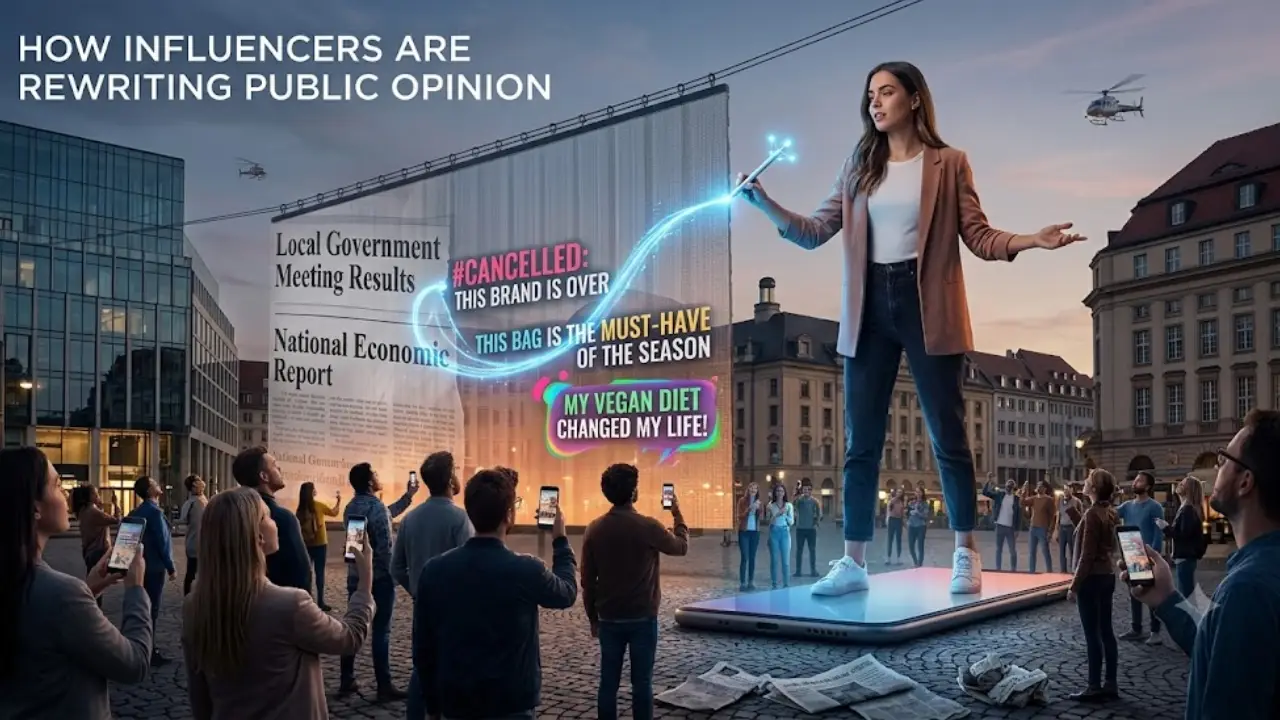
The rise of online personalities is usually described as a contest between influencers and traditional journalism. It is a convenient description, but it misses the more important change. The competition is not merely about who publishes the news. It is about who interprets it, who earns the audience’s trust and who gets to decide what an event means.
The Reuters Institute’s Digital News Report 2026 provides a revealing starting point. Across its surveyed markets, 27% of respondents encountered news from creators who focus on news, while 46% encountered news from creators of any kind. Audiences often regarded creators as more entertaining, relatable and easier to understand than traditional news providers, while tending to rate them lower on trustworthiness and impartiality. Most people consuming creator-led news also used traditional media; only 3% said they relied solely on news-focused creators for all their news needs.
The figures expose a contradiction at the heart of digital influence.
People can find a source more engaging without considering it more trustworthy. They can use a creator to understand an event without abandoning newspapers or television. They can listen to someone whose opinions they distrust because that person raises questions other sources have not addressed.
The influencer has not necessarily replaced the newsroom. The influencer may have become the person who tells the audience how to interpret what the newsroom reports.
The central question is no longer simply who supplies the information. It is who supplies the meaning.
The first clue: Trust can be transferred from the person to the claim
Traditional journalism asks the audience to trust a process. A report may have passed through an editor, a fact-checking process, a legal review or several rounds of source verification. These safeguards are imperfect, but they provide a way to examine how the story was produced.
An influencer often begins somewhere else.
The audience has watched the creator for months. It recognises the voice, humour, expressions and familiar way of explaining things. The creator may have helped viewers understand a complicated scientific discovery, exposed a misleading advertisement or explained a government decision that once seemed incomprehensible.
Gradually, the audience develops a sense of familiarity.
Then the creator discusses a new subject perhaps one outside their expertise.
The viewer is no longer encountering a completely unknown source. They are encountering someone who has already earned a place in their information habits. Trust established in one area may spill into another, even when the new claim requires different knowledge.
This is a subtle problem because the transfer can feel reasonable. If someone has explained five difficult subjects accurately, why not believe the sixth?
The answer is that credibility is not a universal qualification. Knowledge of technology does not establish expertise in medicine. A history commentator may understand historical documents but lack the evidence needed to assess a current criminal allegation. A skilled political analyst may still misunderstand a scientific paper.
The creator’s previous performance is relevant evidence about their reliability, but it is not proof that every new claim is correct.
Psychologists use the term parasocial relationship to describe a sense of personal connection that an audience member can develop with a media personality who does not know them personally. This connection need not be unhealthy or irrational. It can make explanations engaging and help people discover unfamiliar subjects. The risk emerges when familiarity becomes a substitute for checking evidence.
A particularly revealing US study from Pew Research Center found that 21% of American adults regularly got news from social-media influencers in 2024. Among those who did, 65% said the influencers had helped them better understand current events and civic issues, while 9% said they had made them more confused. The study surveyed 10,658 US adults, so its findings should not be presented as a universal estimate for every country.
That result should make us pause. Creator-led news is not simply a pipeline for falsehood. People can genuinely learn from it.
The investigative question is what they learned and whether the explanation they found useful was supported by the evidence.
Imagine two creators discussing the same government policy. One explains the legal provisions, identifies the uncertainties and shows viewers where to read the original document. The other delivers a confident account of who will benefit and who will suffer, without showing the calculations.
The second may be easier to remember. The first may be more useful when the viewer must make a decision.
The distinction becomes particularly important when a creator moves from explaining facts to assigning blame. A viewer who trusts the person may accept the interpretation before noticing that the evidence supports only part of it.
The first investigative rule is therefore simple: judge the claim on its own evidence, not solely on the history, confidence or popularity of the person making it.
The camera is not just a camera: It changes the relationship
A newspaper report places some distance between the reader and the person reporting the event. A creator speaking directly into a camera can make that distance feel smaller.
The creator looks at the lens. The viewer hears an unpolished sentence, a pause, a sigh or a laugh. Perhaps the creator says, “I spent three hours trying to understand this, so let me explain what I found.”
The presentation feels personal. Instead of receiving a finished report from an institution, the audience appears to be accompanying an individual through the process of understanding something.
That can be an enormous advantage.
Complex subjects often become easier to grasp when someone connects them to familiar experiences. An economic policy becomes the cost of groceries. A data-protection rule becomes the information an app collects. A scientific study becomes a question about something people can observe in daily life.
The problem is that an intimate style can make an argument feel more reliable than its evidence warrants.
A person who appears thoughtful may still have selected only the facts that support a conclusion. A creator who admits to being confused may be sincere, but sincerity cannot resolve a factual dispute. Even visible uncertainty can be a persuasive style rather than proof of careful research.
There is another complication: audiences often encounter the creator’s conclusion before they encounter the source material.
The creator has already selected the documents, chosen the examples, removed irrelevant details and decided where the story should end. The viewer receives the result of those decisions without necessarily seeing the alternatives that were rejected.
This does not make the explanation dishonest. Every act of communication involves selection. The important question is whether the selection helps the audience understand the subject or quietly steers it towards a predetermined verdict.
The strongest creator-led explanations make their reasoning inspectable. They show the original document, explain what it establishes and acknowledge what remains uncertain.
The weaker ones ask the audience to trust the feeling produced by the presentation.
That is the difference between using personality to illuminate evidence and using personality to replace it.
Follow the recommendation system: The invisible editor behind the creator
Imagine that two videos are published on the same day.
The first explains a complicated change in public policy. It takes eight minutes to establish the background, compare the options and explain what the evidence cannot yet tell us.
The second begins with an accusation. It promises to reveal what powerful people do not want the public to know. Within seconds, the viewer knows whom to blame.
Which video will spread further?
Nobody can answer that question from the opening alone. The first might become widely shared because it is unusually useful. The second might attract little attention if audiences find it unconvincing. Recommendation systems differ, and their decisions depend on many signals and design choices.
But there is a structural problem worth investigating: the system distributing the information is not necessarily optimising for the same outcome as a public-interest journalist.
A journalist may prioritise significance, verification and the consequences of getting a story wrong. A recommendation system can rank content according to predicted relevance and user responses, depending on its design.
These aims sometimes align. An excellent investigation can be engaging precisely because it reveals something important. But attention and public value are not identical.
A carefully qualified explanation may be less immediately exciting than an accusation. A complicated answer may be less shareable than a simple villain. The platform does not need to instruct creators to become sensational for these incentives to influence what they publish.
Creators can learn from the results. If a particular style repeatedly attracts more attention, they may use it more often. If nuance appears to reduce engagement, they may shorten it, move it towards the end or abandon it entirely.
Over time, the recommendation system becomes an indirect editor—not because it necessarily chooses the creator’s conclusions, but because it can influence which kinds of presentation receive greater distribution.
What research can and cannot tell us
In a study published in Nature in May 2026, researchers examined the effects of different feed-ranking approaches on political information and perceptions of political discourse. They randomly assigned 2,000 participants to custom feed-ranking systems for eight weeks around the 2024 US presidential election. The study investigated whether engagement-based ranking amplified intergroup, moralised and emotional content and affected how participants perceived political discussion.
This is more informative than simply observing that angry posts often go viral. A controlled experiment can compare exposure under different feed designs and investigate whether the design itself contributes to the outcome.
However, a study’s question is not automatically its answer. The findings must be assessed against the outcomes actually measured, and results from a custom research environment should not be treated as proof that every commercial platform behaves identically.
A separate 2023 research effort involving Facebook and Instagram examined what happened when users’ feeds were changed during the US election period. Its results, published in Science and Nature, complicated the simple claim that changing feed-ranking systems necessarily changes political attitudes. Altering exposure can change what people see without necessarily producing corresponding changes in political beliefs.
This is the distinction the public debate often misses.
An algorithm can influence exposure. Exposure can influence what people notice. What people notice may affect what they discuss or believe. But each step requires evidence; one does not automatically establish the next.
The practical question for readers is not whether the algorithm is secretly controlling their minds. It is whether the information reaching them is being selected in ways that narrow their perspective, exaggerate the apparent importance of certain issues or reward presentation over verification.
That is a more testable question and a more useful one.
The emotional shortcut: How a complicated event becomes a simple accusation
Consider a public controversy involving a large institution. The available evidence is incomplete. Several explanations remain possible. The institution has issued a statement, critics dispute it, and independent investigators have not yet reached a conclusion.
Now imagine a creator who presents the event in three minutes.
The creator identifies a contradiction, shows a striking image and asks why the institution has not answered a particular question. The video ends by suggesting that the explanation is obvious.
The audience is left with something the original event did not provide: a clear emotional conclusion.
The creator may have uncovered a genuine inconsistency. But the video may also have removed the uncertainty that made the issue difficult to resolve.
This is how an incomplete investigation can become a persuasive story.
Anger, fear, surprise and indignation can motivate people to share information. A person may forward an alarming claim to warn friends, not because they have verified it. Another may share it to condemn the person responsible. A third may repost it to mock the creator.
The resulting engagement can look like agreement even when the audience is divided.
Emotion itself is not the enemy. A story about genuine wrongdoing may deserve anger. A warning about a real danger should not be stripped of urgency merely to sound neutral. The problem occurs when the strength of the emotional response becomes a substitute for the strength of the evidence.
A useful way to investigate a dramatic claim is to ask what the evidence actually proves.
Suppose a video shows an official refusing to answer a question. The footage may establish that the official did not answer at that moment. It does not, by itself, establish why the official refused, whether the question had already been answered elsewhere or whether the refusal proves the allegation being made.
The difference between these statements may seem small, but it separates observation from interpretation.
A responsible creator makes that distinction visible. A careless one allows the viewer to cross the gap without noticing.
The same problem appears when a single personal experience is used to make a sweeping claim about society. A person’s story can reveal a serious failure. It cannot establish how common the failure is without additional evidence.
When a video makes you feel that a complicated question has suddenly become obvious, that is a good moment to slow down.
Ask what evidence would disprove the creator’s interpretation. Look for the missing context. Find out whether the original material supports the conclusion or merely raises a legitimate question.
The most persuasive story is not necessarily the most accurate explanation.

The money behind the message: Can a creator remain independent of the audience?
The word independent carries considerable emotional power in digital media.
An independent creator can challenge established institutions, work outside conventional editorial hierarchies and investigate subjects that receive little attention elsewhere. For audiences who feel ignored by traditional outlets, that independence can be valuable.
But independence does not mean freedom from incentives.
A creator may earn income through advertising, sponsorships, memberships, donations, affiliate links, merchandise or platform revenue. These arrangements are not inherently improper. They can make sustained reporting possible.
The investigative question is what happens when a source of income depends on the audience believing that the creator is consistently right, consistently rebellious or consistently opposed to a particular group.
Imagine a creator whose popularity rests on exposing the failures of a powerful institution. One day, new evidence shows that the institution was correct about an important part of a controversy.
The creator faces a difficult choice. Acknowledging the evidence may disappoint followers, weaken the original narrative or reduce engagement. Rejecting it may preserve the audience’s expectations, at least temporarily.
There is no need for a sponsor to issue an instruction. The pressure can arise from the creator’s understanding of what the audience expects.
This is the independence paradox: a person may escape an editor’s authority while becoming dependent on the approval of thousands of viewers.
The same pressure can affect established newsrooms, which may answer to owners, advertisers, subscribers or political relationships. The point is not that one model is automatically more compromised than another. It is that every information source operates within an incentive structure.
A serious investigation therefore asks who funds the work, whether relevant relationships have been disclosed, whether the creator distinguishes opinion from reporting and whether contrary evidence is treated fairly.
It also asks what happens when the creator is wrong.
Corrections are particularly revealing. Does the creator update the original post? Is the correction as visible as the accusation? Does the creator explain what went wrong, or simply move on to the next controversy?
A willingness to correct an error does not prove that a source is always reliable. But refusing to correct a demonstrable error is a significant warning sign.
Independence should be understood not as immunity from scrutiny, but as the ability to investigate without inappropriate control while remaining accountable for the claims one publishes.
The repetition machine: When a rumour starts looking like a fact
There is a moment in the life of an online claim when its popularity begins to look like evidence.
It starts with one post. A creator repeats it. Another account publishes a reaction. A podcast discusses it. A short-video editor extracts the most dramatic sentence. A commentator on another platform cites the growing controversy as proof that something important must be happening.
The claim now appears to have many witnesses.
But return to the beginning.
Perhaps every account ultimately relied on the same anonymous post. Perhaps nobody examined the original document. Perhaps the first creator misunderstood a statistic, and every subsequent account repeated the mistake.
The claim has travelled. The evidence has not improved.
This is one of the most important distinctions in digital investigation: repetition creates familiarity, but it does not create independent corroboration.
Psychological research on the illusory truth effect suggests that repeated exposure can increase the perceived truth of a statement under some conditions. Familiar information can feel easier to process, and that ease can be mistaken for a reason to believe it. The effect is not automatic, and people do not accept every repeated claim. But it offers a plausible mechanism through which repetition can influence judgement.
The danger becomes greater when a creator’s claim is repeated by people who appear to be independent sources.
Suppose six videos discuss the same alleged scientific discovery. If all six refer to one sensational headline rather than the original paper, they do not provide six independent confirmations. They provide six copies of one interpretation.
A proper investigation traces the claim backwards.
Find the earliest identifiable version. Locate the document or recording on which it was supposedly based. Check whether the later accounts examined that evidence independently. Then look for information that might contradict the original interpretation.
This process can be uncomfortable because it sometimes reveals that an exciting story has a much weaker foundation than its circulation suggests.
Yet it is also how an audience regains control of its own judgement.
A claim does not become more reliable because it is difficult to avoid. Sometimes it becomes difficult to avoid because repetition has made it commercially or socially valuable to keep repeating.
The comment section is not the country
A creator announces that a controversial policy has failed. The comments fill with agreement. Viewers praise the creator for saying what everyone supposedly thinks. Critics are challenged, mocked or told to leave.
A newcomer arrives and sees a wall of agreement.
What conclusion is the newcomer likely to draw?
Perhaps the policy really is widely unpopular. Perhaps the creator has gathered a community that already opposes it. Perhaps supporters of the policy have no reason to enter the discussion. Perhaps people who disagree have learned that commenting brings hostility rather than conversation.
The visible result may be identical in all four cases.
A comment section is a self-selected environment. People decide whether to watch, whether to comment and whether to return. Those who feel strongly may be more likely to participate than those who are uncertain or indifferent.
Likes and replies provide social information, but they do not tell us exactly what the wider population believes.
The distinction matters because people do not form opinions in isolation. They also consider what their peers appear to think, which positions attract approval and which opinions risk social rejection.
A community can make it easier to discuss a neglected issue. It can also create pressure to agree with its most influential members.
The investigator must therefore ask not only what people are saying, but who is speaking, who remains silent and how the community treats disagreement.
A creator’s audience may be genuinely representative of a particular group. It may also be an unusually committed minority. Without suitable evidence, the difference cannot be established from the comments alone.
If a creator claims that “the whole country agrees”, look for a properly designed survey, credible election data or another measure suited to the claim. A platform poll can be useful for understanding the people who chose to participate, but it should not automatically be presented as a national opinion survey.
The comment section tells us something about a community. It does not, by itself, tell us what an entire society believes.
The edited truth: Why genuine footage can still mislead
A video begins circulating in which a public figure appears to make a shocking admission.
The footage looks authentic. The voice sounds familiar. The subtitles match the words. Thousands of people share it as proof of wrongdoing.
Then somebody finds the full recording.
The speaker was answering a hypothetical question. The clip had removed the sentence that explained the context. Nothing in the original recording established the conclusion attached to the viral version.
No sophisticated deepfake was required. The footage was real; the interpretation was misleading.
This distinction is increasingly important in a world where artificial intelligence can generate convincing audio, images and video. Fabrication is one problem. Selective presentation is another. They require different methods of verification.
A reverse-image search might reveal that a photograph is genuine but several years old. A search for the original video might show that a speech was edited. A complete transcript might establish that a quotation was taken out of context. None of these problems requires the material itself to have been synthetically generated.
The practical investigation begins with provenance: where did the material come from, when was it recorded and what was happening around it?
For important claims, seek the original recording or document rather than relying on the version circulating on social media. Check the date and location. Compare the clip with a complete source. Look for independent records that support the interpretation.
Technical detection tools may help identify manipulated media, but their results are not universally reliable. Compression, editing, recording quality and new generation methods can complicate analysis. A detector’s result should be treated as one piece of evidence, not a final verdict.
For Indian readers, the PIB Fact Check service can help assess suspicious claims relating to the Union government. It is not a universal fact-checking authority for every political, scientific or social-media controversy. For broader guidance on digital platforms, misinformation and freedom of expression, UNESCO’s Guidelines for the Governance of Digital Platforms offer a useful institutional perspective.
The crucial habit is to distinguish what the recording shows from what somebody claims it proves.
The Indian question: Who explains public life to the next generation?
India’s information environment makes this investigation particularly relevant.
A public event may reach different audiences through television, newspapers, YouTube, Instagram, messaging applications and independent digital publishers. The same subject may be explained in English, Hindi, Bengali or another regional language, each with its own cultural references and local context.
This diversity can improve public understanding. A creator who explains a complicated government notification in familiar language may make information accessible to people who would never read the original document. A regional reporter may uncover a local problem that receives little national attention. A specialist may explain a scientific development more clearly than a general news bulletin can.
But accessibility also creates responsibility.
A genuine government notification from one state can be presented as a national rule. An old photograph can be circulated as evidence of a current event. A statistic can lose its definition when translated into a short video. A legitimate question about public policy can become an unsupported allegation about an individual.
The problem is not that regional-language creators are less reliable than English-language media. It is that claims can travel across languages and communities faster than their original context.
For a reader, the best defence is to identify the original source and establish precisely what it says.
If a video claims that a new government scheme has been announced, locate the relevant ministry or department’s announcement. Check the publication date, eligibility conditions and jurisdiction. If it cites a legal change, look for the actual notification or legislation. If it refers to a court decision, find the order or a reliable report that explains it.
Then compare the interpretation with independent reporting.
Official records are essential evidence of what an institution has formally announced or published. They do not automatically settle every question about the quality, consequences or fairness of that policy. Independent reporting and expert analysis remain important for evaluating those questions.
The goal is not to choose between government sources and independent creators as if one category must always be trusted. It is to establish which source is best placed to answer the specific question.
That is what responsible information consumption looks like: not blind trust, and not reflexive suspicion, but a method for checking claims.
The hardest question: Did the influencer actually change anyone’s mind?
A creator publishes a video that receives ten million views.
The creator announces that public opinion has shifted. Supporters celebrate the impact. Critics argue that the video merely attracted people who already agreed.
Which side is right?
The view count cannot settle the dispute.
A view may represent only brief exposure, depending on the platform’s definition. Some people may watch repeatedly. Others may have encountered the video without accepting its argument. Many may have agreed with the creator before the video appeared.
The audience may have become more aware of the issue without changing its opinion. It may have learned a new fact but retained its existing political position. It may have changed its public expression without changing its private belief.
These are different outcomes, and a serious investigation must keep them separate.
Consider what would be needed to test a creator’s claim that a video changed public attitudes towards a new policy.
First, researchers would need a credible picture of what people thought before the video appeared. Then they would need evidence about who actually encountered it. Next, they would need a suitable measurement of attitudes, knowledge or behaviour after exposure.
Finally, they would need to consider other explanations. Perhaps a major news event occurred at the same time. Perhaps the policy changed. Perhaps the creator’s audience was already unusually opposed to the policy.
Where feasible, randomised experiments can help establish whether exposure caused a change. Longitudinal surveys can track attitudes over time. Representative polling can measure wider public opinion. Each method has limitations, and no single metric answers every question.
There is also a reverse-causation problem. A creator may become popular because they express beliefs that large numbers of people already hold. Observers see the popularity and conclude that the creator persuaded the public, when the audience’s existing views may have helped produce the creator’s success.
Both directions can operate together. Creators influence audiences, while audience responses influence what creators publish.
This is why a viral video should be treated as the beginning of an investigation into influence, not its conclusion.
The correct question is not merely how many people watched. It is what changed among the people who watched, whether that change can be attributed to the content and whether it lasted.
Without evidence addressing those questions, claims of mass persuasion remain unproven.
A field investigation anyone can conduct
The next time a creator makes a claim that could change how you understand a public event, try a small experiment.
Do not begin by deciding whether you like the creator. Begin by identifying the claim.
Write down the precise statement being made. Separate the verifiable fact from the creator’s opinion. Then find the original document, full recording or research paper. Establish what it actually says.
Next, look for a source that examined the evidence independently. Be careful not to mistake several articles repeating the same claim for several independent confirmations.
Check whether the creator has disclosed relevant sponsorships or affiliations. Search for corrections or credible challenges to the claim. Finally, ask what remains uncertain.
The point is not to turn every social-media video into a forensic investigation. Most everyday content does not warrant that much effort. The level of scrutiny should reflect the importance of the claim and the potential harm of getting it wrong.
A harmless entertainment opinion may need little checking. An accusation of criminal conduct, a medical recommendation or a claim about voting procedures deserves much more.
Use the following checklist for consequential claims.
The eight-point evidence test
0 of 8
1. Identify the exact claim
Separate the factual statement from the creator’s interpretation.
2. Find the original evidence
Locate the full document, dataset, recording or research paper.
3. Check date and context
Confirm the material belongs to the event being discussed.
4. Seek independent confirmation
Look for sources that examined the evidence independently.
5. Examine relevant incentives
Check sponsorships, affiliations and potential conflicts.
6. Look for contrary evidence
Search for qualifications, corrections and credible alternative explanations.
7. Assess the correction record
See whether the creator acknowledges and corrects demonstrable errors.
8. Decide whether to share
If the evidence is incomplete, preserve the uncertainty instead of presenting the claim as fact.
ResetCopy checklist
This checklist structures an investigation. Completing it does not automatically establish that a claim is true.
What should happen next: A new standard for influence
The rise of creator-led news presents a challenge to traditional journalism, but it also presents an opportunity.
Newsrooms can learn from creators who explain complicated subjects clearly, communicate directly with audiences and make specialist knowledge accessible. Creators can learn from journalists who verify claims, distinguish evidence from interpretation and correct mistakes publicly. Platforms can make their distribution practices more transparent and support meaningful scrutiny of their effects.
Audiences have a role as well. They can reward creators who show their evidence, acknowledge uncertainty and change their conclusions when the facts change.
None of these improvements requires pretending that every source is equally reliable. Nor does it require assuming that established institutions are always right.
The standard should be consistent: important claims must be supported by evidence, and the strength of the conclusion must match the strength of that evidence.
This standard matters because influence is not always visible in the form of a dramatic change of opinion. It may begin with a question that suddenly seems important, a suspicion that becomes familiar or a particular interpretation that becomes the default way to discuss an event.
A creator can shape public conversation without persuading everyone who watches. A platform can change what people encounter without determining what they believe. A news organisation can correct a false claim without erasing the impression it initially created.
These are difficult effects to measure, but recognising the distinctions makes the investigation more precise.
The most powerful influencer may be the one you never notice
Return to the video that appeared at 11:47 on Tuesday night.
Perhaps the creator uncovered a genuine contradiction. Perhaps the document was authentic but incomplete. Perhaps the accusation was wrong. The number of views cannot decide which possibility is true.
What matters is what happened between the evidence and the audience.
Who selected the facts? Who framed the question? Which details were omitted? What incentives shaped the presentation? Did independent sources verify the conclusion? And when new information appeared, did the creator change the story?
These questions lead beyond the familiar argument about influencers versus journalists. They reveal a larger struggle over the conditions under which people form beliefs.
The digital information economy rewards attention, but public understanding requires more than attention. Trust can make an explanation easier to hear, but trust cannot replace verification. Emotion can help people recognise the significance of an event, but emotion cannot establish the facts. Popularity can demonstrate reach, but it cannot prove persuasion.
The challenge is not to stop listening to online personalities. Some of them produce valuable journalism, explain neglected subjects and make public knowledge more accessible. The challenge is to remain an active participant in the process of understanding rather than handing over the final judgement to the most compelling voice.
The real measure of an influential creator is not how many people repeat their conclusion. It is whether those people have acquired better reasons for believing it.
That is where The Unfolded Shelf leaves the investigation: not with a verdict against influencers or a defence of traditional media, but with a more demanding question for both.
When someone asks you to believe a story, will they show you how they reached their conclusion or simply make you feel that the conclusion must be true?
Sources and further reading
The article draws on the following research and institutional resources. Survey results apply to their stated samples; experimental findings should be interpreted within the conditions and outcomes of each study.
1. Reuters Institute for the Study of Journalism — Digital News Report 2026: Executive Summary. Global findings on creator-led news, audience perceptions and news consumption.
2. Reuters Institute — How news creators are impacting politics and media around the world. Research on the role of news creators in contemporary media.
3. Pew Research Center — America’s News Influencers. Survey and content analysis of news influencers and their audiences in the United States.
4. Pew Research Center — Americans’ experiences with social media news influencers. Findings on perceived understanding, usefulness and confusion.
5. Nature — Redesigning algorithms to intervene on social norm misperceptions during a national election. A 2026 experimental study of feed ranking and political discourse.
6. Nature — Influence of Facebook algorithms on political polarization tested. Research coverage on feed-ranking interventions and political polarisation.
7. Government of India — Press Information Bureau Fact Check. An official resource for claims concerning the Union government.
8. UNESCO — Guidelines for the Governance of Digital Platforms. Institutional guidance on platform governance, freedom of expression and information integrity.
Suggested Readings
- Synthetic Media and Deepfakes: How to Verify What You See Online — for media provenance and verification techniques.
- The Death of the Cookie: Who Tracks You Across the Internet? — for the economics of personalisation, tracking and digital attention.
- Smart Home Device Privacy Audit: A Practical Guide to Your Connected Home — for practical digital literacy and technology accountability.








Leave a Reply