

The Plate That Nobody Is Supposed to Eat
Late at night, after everyone has gone to sleep, imagine walking into a house where a strange meal has been prepared.
A bowl of rice sits untouched.
Beside it is water.
Perhaps there is fruit, a favourite sweet, bread, wine or a dish that someone in the family used to love.
Nobody is sitting at the table.
Nobody is expected to.
The person for whom the food was prepared has been dead for years.
Yet someone carefully cooked the meal.
Someone placed it there.
And someone believes or once believed that the dead should receive it.
Now imagine discovering the same behaviour not in one house, but in thousands of places across the world.
Ancient Egypt.
Mesopotamia.
China.
India.
Mexico.
Japan.
And archaeological sites belonging to people who lived thousands of years before written history.
Different continents.
Different religions.
Different foods.
Different ideas about the afterlife.
Yet the same haunting gesture keeps appearing:
The living prepare food for the dead.
Why?
Did our ancestors genuinely believe that a dead person could eat?
Was the food meant for a soul rather than a body?
Or did humans discover something psychologically powerful that cooking for the dead allows a relationship to continue even after death has made physical contact impossible?
The answer may be stranger than any of these explanations alone.
Because the story of food and the dead may have begun before farming, before cities and before organised religion.
The First Clue Is Buried in a Cave
Picture a world almost 13,000 years ago.
There are no supermarkets.
No restaurants.
No written recipes.
No cemeteries with marble monuments.
People live by hunting, gathering and processing wild plants.
Then someone dies.
The community gathers around the burial.
But this is not an ordinary burial.
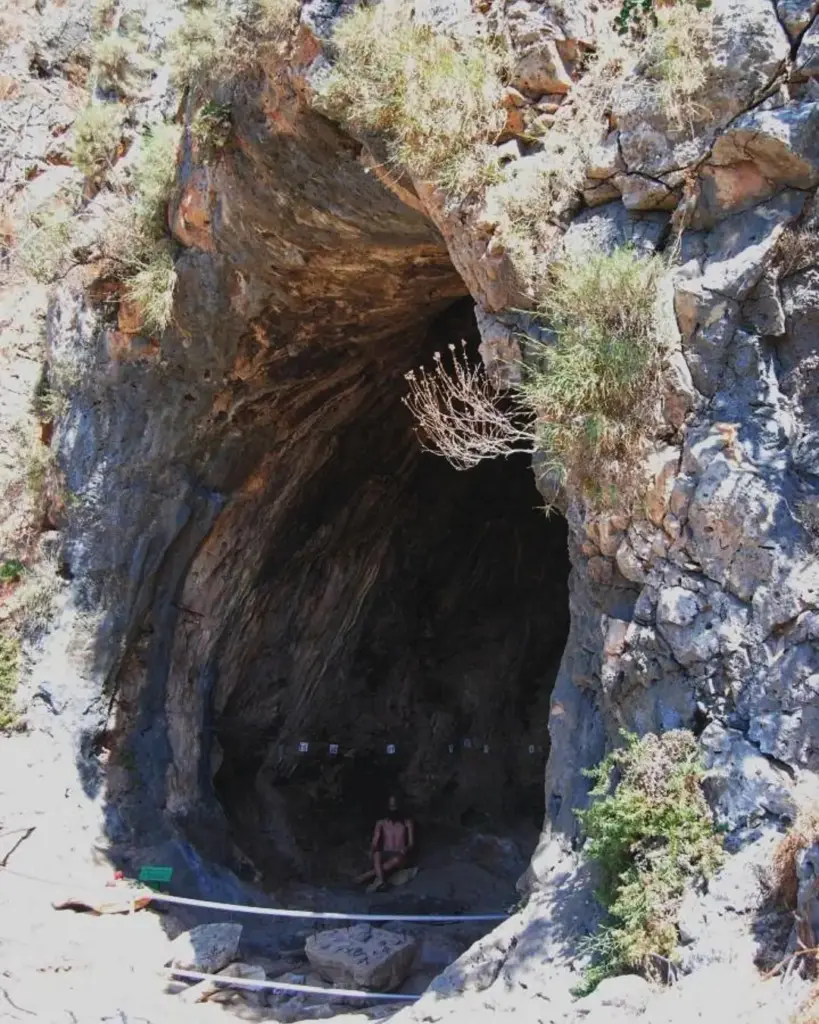
At Raqefet Cave on Mount Carmel, archaeologists found animal remains directly associated with Natufian burials. Detailed analysis concluded that these were not ordinary household rubbish. They were interpreted as intentionally gathered and deposited remains from short-lived funerary feasts. The cemetery dates broadly to the Late Natufian period, about 14,000–11,700 years ago.
And then the evidence becomes even more extraordinary.
At the same site, researchers analysed ancient stone mortars and found evidence that Natufian people processed plants and probably brewed a wheat/barley-based fermented beverage around 13,000 years ago, apparently for ritual feasting. The plants included wild cereals, oats, legumes and flax-related fibres.
Stop for a moment.
These were not farmers brewing beer in a settled city.
They were semi-sedentary foragers.
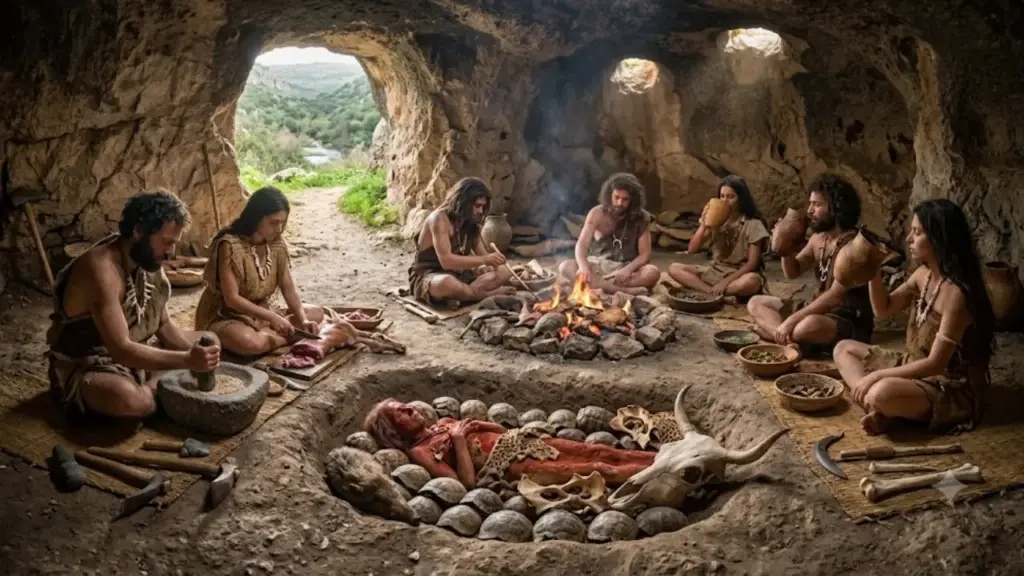
And they were apparently gathering around the dead, preparing food and perhaps making an alcoholic drink for a ritual event.
That does not prove they believed a dead person literally drank the beverage.
But it tells us something fundamental:
Food had already become part of the human conversation with death thousands of years before the great civilisations appeared.
Perhaps the Dead Were Never Eating Alone
This is where the mystery becomes deeper.
Suppose a family prepares a meal beside a grave.
Who is the meal actually for?
The dead?
The mourners?
The ancestors?
The entire community?
Archaeology cannot simply answer this from a pile of bones.
But the Natufian evidence offers an important possibility.
The food may have been part of a communal event surrounding the deceased.
Research on the Hilazon Tachtit burial site has similarly interpreted evidence of funerary feasting around 12,000 years ago. Researchers argued that such feasts could strengthen social relationships and help integrate communities during a period when human societies were becoming increasingly complex.
This produces a startling alternative to the usual ghost story.
Perhaps the first funerary meals were not primarily about feeding the dead.
Perhaps they were about keeping the living together after someone died.
The dead person became the centre of a gathering.
Food created a shared experience.
The community ate.
Stories were told.
Relationships were renewed.
The dead were remembered.
In that sense, the earliest “food for the dead” may actually have been food because of the dead.
Then Something Changed
Thousands of years passed.
Humans built villages.
Villages became cities.
Writing appeared.
Kings ruled.
Temples emerged.
And the invisible world became increasingly organised.
Now the dead were no longer simply remembered.
They had addresses.
They had rituals.
They had obligations.
And, in some cultures, they had appetites.
Egypt: The Dead Must Be Fed
Walk into an ancient Egyptian tomb and the mystery suddenly becomes much clearer.
Painted walls show the deceased sitting before offering tables covered with food.
Bread, Meat, Birds, Fish, Fruit, Drink.
The Metropolitan Museum of Art explains that Egyptian tomb imagery represented the deceased receiving nourishment through funerary offerings. Food could be physically provided, represented in images, or supported through rituals performed by the living.
The idea was astonishingly practical.
What happens if food eventually disappears?
Make the image permanent.
If a loaf of bread is painted on the wall, the representation can remain long after the physical loaf has vanished.
The Egyptians had therefore created something resembling a symbolic food-storage system for eternity.
The food did not have to remain physically fresh forever.
The ritual and its representation could continue.
Death had become an engineering problem.
And food was part of the solution.
Mesopotamia Had a Family Duty for the Dead
Travel farther east and the story becomes even more direct.
In ancient Mesopotamia, offerings known as kispu were associated with deceased relatives.
The relationship between living families and dead ancestors was not necessarily considered finished.
The dead could remain part of the family structure.
And the living had responsibilities toward them.
Food and drink could therefore become a form of continuing family duty.
The implication is profound.
A person did not simply die and disappear from society.
They could remain a member of the family just one who now lived somewhere humans could not see.
The offering was therefore not merely a gift.
It was an obligation.
And obligations are among the strongest forces humans have ever created to keep traditions alive.
Imagine the Dead Returning Home
Now travel thousands of kilometres to modern Mexico.
During Día de Muertos, families create altars containing photographs, candles, flowers, water and food.
Mexico’s National Institute of Anthropology and History explains that food and water are among the recurring elements of these offerings, prepared in the belief that deceased souls return to the altar. Favourite foods and personal objects may also be included.
The important detail is not simply that food is offered.
It is which food.
A dead person’s favourite dish may be prepared.
Their preferred drink may appear.
Their familiar objects may be placed nearby.
This transforms the ritual.
The offering is no longer merely:
“Here is food for the dead.”
It becomes:
“Here is your food.”
That tiny difference reveals something psychologically powerful.
The person is being remembered not as an abstract ancestor, but as an individual.
A father.
A mother.
A grandmother.
A child.
Someone with tastes.
Someone with habits.
Someone who once sat at the table.
India: When Food Becomes Ancestral Duty
The same mystery appears in India through traditions surrounding Pitru Paksha and Shraddha.
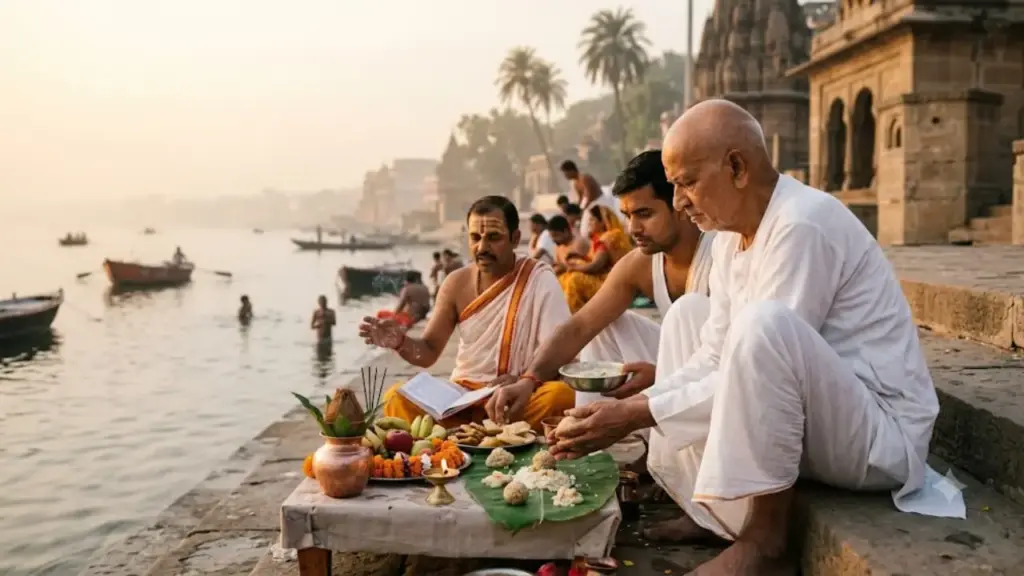
India’s Ministry of Tourism describes Pitru Paksha as a 16-day period dedicated to paying homage to ancestors, with rituals including Shraddha, Tarpan and Pind Daan.
Bihar Tourism similarly describes the 16-day tradition as a period devoted to departed ancestors and rituals performed for their peace and spiritual well-being.
Food, water and ritual offerings become part of a much larger system of remembrance.
The important point is that reducing these traditions to “feeding ghosts” misses their meaning.
The ritual expresses a relationship between:
the living → the ancestors → the family line → duty → memory → spiritual continuity.
In some traditions, offerings are also associated with feeding other beings or representatives, making the ritual a social act as well as a spiritual one.
The dead may be the reason for the ritual.
But the living are transformed by performing it.
The Most Interesting Question: What If Nobody Believes the Dead Literally Eat?
Here the ancient mystery suddenly becomes a modern psychological question.
Suppose a woman prepares her dead mother’s favourite dessert every year.
She knows perfectly well that her mother cannot physically eat it.
Yet she prepares it anyway.
Is the ritual irrational?
Not necessarily.
Psychologists studying continuing bonds have found that people can maintain meaningful relationships with deceased loved ones after death.
The relationship changes.
The person is no longer physically present.
But memories, conversations, rituals and symbolic acts can preserve a sense of connection.
Food may be particularly powerful because eating is itself a social activity.
We do not simply consume food.
We cook for people.
We invite people to eat.
We celebrate with food.
We remember childhood through food.
We recognise a grandmother’s kitchen by its smell.
A recipe can therefore function like a memory machine.
Cooking the dish can bring back the person.
Food May Be Humanity’s Oldest Memory Technology
Think about a photograph.
You look at it and remember someone.
Now imagine something more powerful.
You smell the food that person used to cook.
You see the same dish.
You taste the same flavour.
Suddenly the past is not merely visual.
It becomes sensory.
This may explain why food appears so often in mourning traditions.
Food is capable of recreating a small part of ordinary life.
For a few minutes, the dead person is psychologically present.
The family is doing something it once did with them.
They are preparing a meal.
They are setting something aside.
They are remembering what the person liked.
The ritual says:
Death has changed our relationship but it has not erased it.
The Dead May Not Need Food-But Humans Need the Ritual
This may be the most important distinction in the entire mystery.
Science can establish whether a corpse consumes food.
It cannot scientifically determine the metaphysical beliefs of every ancient culture.
But anthropology can study what people believed and how rituals functioned.
And archaeology can examine what they physically did.
The evidence suggests that ancestor offerings can perform several functions simultaneously.
| Possible meaning | What the offering does |
| Religious | Provides nourishment or spiritual benefit to the deceased |
| Memorial | Keeps the person’s identity alive |
| Social | Brings families and communities together |
| Emotional | Provides a structured way to express grief |
| Ancestral duty | Maintains obligations between generations |
| Cultural | Passes traditions from parents to children |
This is why searching for one universal explanation may be a mistake.
The same bowl of food can have five different meanings to five different people.
But Archaeology Has a Problem
There is a dangerous temptation in archaeology.
Find food near a grave.
Conclude:
“They fed the dead.”
But it is not that simple.
Food remains can come from a funeral feast.
A container may have held food or may have been symbolic.
Animal bones can be deposited intentionally or can be ordinary rubbish.
Plants can move naturally into archaeological layers.
Even spectacular evidence can be misunderstood.
This is why modern archaeology increasingly uses chemical residue analysis, microscopic examination, animal-bone analysis and spatial analysis.
The question is no longer merely:
“What was found beside the body?”
It is:
“How did it get there?”
That difference can completely change the interpretation.
A Meal Can Tell Us More Than a Tomb
There is another reason food is so valuable to archaeologists.
A tomb tells us that somebody died.
A meal can tell us how the living responded.
What animals were available?
What plants were eaten?
Who gathered?
Was the food ordinary or special?
Was it cooked?
Was it burned?
Was it shared?
Was it placed in a vessel?
Was it left intact?
Was it repeatedly replaced?
Every answer reveals something about the society that performed the ritual.
That is why the Natufian funerary feasts are so important.
They suggest that burial was not an isolated event.
It could involve collective food consumption and social organisation.
In other words, the archaeology of death can reveal how the living community worked.
The Strangest Possibility: The Dead Were Part of the Family
Imagine a family 5,000 years ago.
A grandfather dies.
His body is buried.
But his name remains.
His possessions remain.
His grave remains.
His descendants return.
Food is offered.
Water is poured.
Prayers are spoken.
Years pass.
Another generation performs the same ritual.
Then another.
At some point, the dead person has become more than an individual.
He has become an ancestor.
And ancestors have an unusual power.
They connect generations that never met.
A child may never have seen a great-grandparent.
Yet the child can still know:
“This was the person whose favourite food was this.”
The ritual turns genealogy into something tangible.
The child does not merely hear about the ancestor.
The child participates in remembering them.
That may be one reason ancestor offerings survive for centuries.
The Future May Change How We Understand Ancient Meals
The next major breakthrough may not come from discovering a spectacular tomb.
It may come from something microscopic.
A residue inside an ancient bowl.
A molecule absorbed into pottery.
A plant starch trapped inside a stone mortar.
A chemical signature in a layer of soil.
Modern archaeology is becoming increasingly capable of detecting traces invisible to earlier generations of researchers.
The result could answer questions that have puzzled archaeologists for decades:
Was this vessel actually used to feed the dead?
Was it used by mourners?
Was the food consumed before burial?
Was it burned as an offering?
Was it placed there symbolically?
The mystery is therefore not disappearing.
It is becoming more precise.
So, Why Do Humans Leave Food for the Dead?
Perhaps the answer begins with a simple fact.
Humans have enormous difficulty treating relationships as something that simply stops.
When somebody dies, the body disappears from ordinary life.
But the relationship does not necessarily disappear at the same speed.
Memory continues.
Family identity continues.
Stories continue.
Habits continue.
Recipes continue.
And sometimes, food continues.
That may explain why a bowl of rice beside a grave can be simultaneously a religious offering, a family obligation, a cultural tradition and an act of grief.
The dead may not physically eat.
But the person who places the food is communicating something extraordinarily human:
“I know you are gone. But I still know what you liked.”
And perhaps that is why the ritual is so powerful.
The Final Mystery Is Not About the Dead
The oldest question may have been:
“Can the dead eat?”
But after thousands of years, another question has emerged:
“Can the living continue a relationship with someone who is no longer here?”
Archaeology cannot prove what an ancient person believed happened to a soul.
Psychology cannot prove or disprove an afterlife.
Religion answers the question according to faith.
But history gives us something fascinating in between.
It shows us what human beings actually did.
They buried their dead.
They gathered around them.
They cooked.
They shared meals.
They placed food near graves.
They returned year after year.
They remembered favourite dishes.
They spoke to people who could no longer answer.
And they kept setting the table.
Perhaps the plate was never only for the dead.
Perhaps it was also for the living to give grief a shape, memory a taste and love somewhere to go when the person it belonged to was gone.
The food disappears.
The ritual remains.
And that may be the real reason humans have been leaving meals for the dead for thousands of years.
Key Evidence at a Glance
| Evidence | Approximate date | What it tells us |
| Intentional funerary practices | Deep prehistory | Humans developed complex responses to death |
| Natufian funerary feasting at Hilazon Tachtit | ~12,000 years ago | Food could be central to burial ceremonies |
| Raqefet funerary feasts | ~14,000–11,700 years ago | Animal remains indicate short-lived funerary meals |
| Ritual brewing at Raqefet | ~13,000 years ago | Fermented beverages may have been part of mortuary feasting |
| Ancient Egyptian offering traditions | 3rd millennium BCE onward | Food could be explicitly connected with nourishment of the dead |
| Mesopotamian kispu | Ancient Near East | Ancestor offerings could form an ongoing family obligation |
| Qingming | Historical and continuing | Food and ritual maintain ancestral remembrance |
| Día de Muertos | Historical and continuing | Food can symbolically welcome deceased relatives |
| Pitru Paksha | Historical and continuing | Food, water and ritual connect descendants with ancestors |
The strongest version of this story is not “ancient people believed ghosts ate food.” That is too simple. The more fascinating conclusion is that food became a bridge between memory, religion, family and death and that bridge may have existed almost as long as organised human society itself.
Authentic Sources and Government References
- University of Haifa — The Social Role of Food in the Natufian Cemetery of Raqefet Cave
- ScienceDirect — Natufian funerary feasting research
- ScienceDirect — 13,000-year-old ritual brewing at Raqefet Cave
- PNAS / PMC — Early evidence for funerary feasting
- India Ministry of Tourism — Pitru Paksha
- Bihar Tourism — Pitrapaksha
- Mexico National Institute of Anthropology and History — Offerings for the Dead
- Mexico INAH — Origins of Día de Muertos
Suggested Articles:
The Underground City With Thousands of Rooms: What Were They Hiding From?







Leave a Reply