
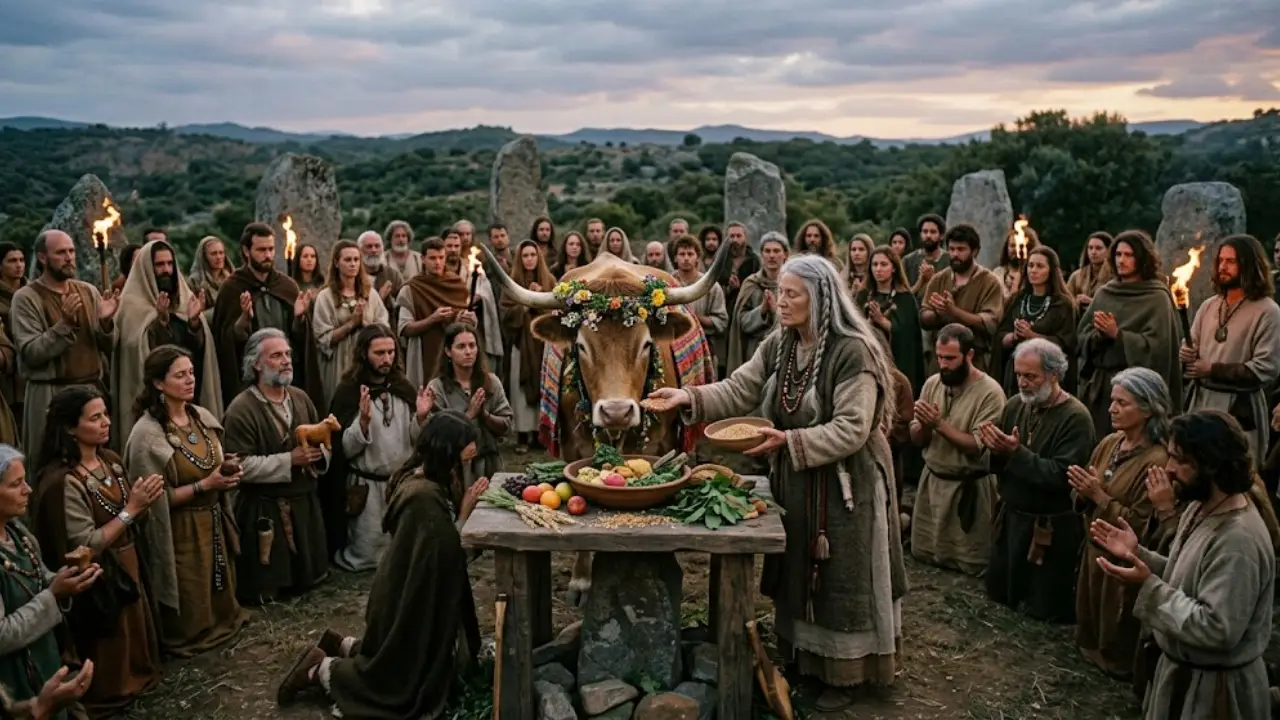
Animals That Became Sacred Through Ecology, Survival, and Human Religion
There is a strange pattern hidden inside many ancient religions.
The animals humans feared the most were not always driven away. Some animals were fed. Some were protected. Some were carried in religious processions. Even some became the companions of gods. And some were eventually treated as sacred.
A snake could kill a farmer, yet become a divine guardian. A crocodile could attack people, yet become associated with a sacred river. A cow could become so valuable to agriculture that protecting it became a moral principle. An elephant could destroy crops and still become a symbol of wisdom and prosperity. Bees could sting, insects could destroy harvests, and birds could steal grain yet astonishingly, entire cultures developed rituals around them.
This raises a more interesting question than simply asking, “Why did ancient people worship animals?”
Perhaps the better question is:
Did humans first worship these animals or did thousands of years of ecological dependence, fear, usefulness and coexistence gradually turn them sacred?
The evidence does not support one universal answer. Religion is too complicated to be reduced to ecology alone. But archaeology, anthropology, environmental history and modern ecology reveal something fascinating: many sacred animals occupied unusually important positions in human survival systems.
The Hidden Logic Behind Sacred Animals
Imagine a farming settlement thousands of years ago.
There is no supermarket, veterinary clinic, pesticide shop or modern hospital. A failed harvest can mean hunger. A contaminated water source can mean disease. A snakebite can become fatal. Livestock represent food, transport and agricultural labour. Insects can determine whether crops reproduce. Rivers can determine whether an entire settlement survives.
Under those circumstances, nature is not an abstract landscape.
It is the economy, hospital, water supply, food system and security system at the same time.
An animal repeatedly encountered at one of these critical points could acquire an importance far beyond its biological role.
That does not prove that people deliberately invented religion to conserve animals. But it suggests that ecological relationships could provide fertile ground on which religious meanings developed.
Modern conservation gives us an unexpected clue. The Indian government has documented roughly 14,000 sacred groves across India, although the actual number may be higher. These places often preserve rare plants and animals because religious rules restrict exploitation.
The sacred, in other words, sometimes became a form of environmental regulation.
Snakes: The Animal Between Fear and Protection
Few animals illustrate this paradox better than snakes.
For early agricultural societies, snakes lived directly around human settlements. Fields provided rodents; granaries attracted prey; houses provided shelter. Snakes therefore became part of the agricultural landscape.
Their ecological usefulness was real: many snakes consume rodents and other animals that can damage crops or stored grain.
But their danger was equally real.
Snakebite remains a serious public-health problem. WHO estimates that around 5.4 million snakebites occur globally each year, with roughly 1.8–2.7 million cases of envenoming. Estimates of deaths vary substantially because many cases occur in rural areas and are poorly recorded.
India carries an especially heavy burden. Published estimates based on the Million Death Study and other research have suggested approximately 1.2 million snakebite deaths in India during 2000–2019, averaging about 58,000 deaths annually. These are estimates, not a complete count, and methodological uncertainty remains important.
This creates a remarkable cultural situation.
The snake is simultaneously:
a predator of agricultural pests,
a potentially lethal animal,
a creature appearing unexpectedly in homes and fields,
an inhabitant of underground spaces,
and an animal associated with water, fertility and seasonal cycles in several traditions.
Research in India’s Western Ghats has found that sacred groves and serpent-deity traditions can influence people’s attitudes towards snakes. A study of sacred groves found that very few surveyed participants who encountered snakes inside such groves reported harming them.
A 2026 study of Kerala’s sacred ecology similarly describes serpent worship as intertwined with protection of sacred groves and the cultural management of snake habitat.
So the religious story may have served an ecological function even when that was never its original conscious purpose.
Fear created distance; reverence created restraint.
Crocodiles: When the River Became a God’s Territory
Crocodiles reveal another ecological pathway to sacredness: water.
The Nile, Ganga and other great rivers were not merely geographic features. They were survival machines.
They supplied drinking water, irrigation, fish, transport and fertile soil. But rivers also contained predators.
The crocodile therefore represented the dangerous side of the river.
In South Asian traditions, crocodiles became associated with sacred rivers and deities. Scholarly work on Indian freshwater conservation notes the association of crocodiles with Ganga and describes the wider religious use of animals as divine vehicles or companions.
The ecology is revealing.
The gharial, for example, is almost completely dependent on river systems. India’s Wildlife Institute of India describes it as a highly aquatic crocodilian requiring deep, clear, fast-flowing rivers and sandy banks for breeding. It is now Critically Endangered.
The mugger crocodile is classified as Vulnerable and occurs across parts of the Indian subcontinent, including numerous Indian states and sections of the Ganga drainage. Habitat destruction, agricultural expansion, fishing interactions and human conflict threaten populations.
This makes the ancient symbolism unexpectedly modern.
To protect a crocodile, one ultimately has to protect the river environment around it.
And protecting the river also protects fish, wetlands, birds, turtles and human water systems.
The sacred animal becomes a kind of ecological ambassador.
Cattle: Perhaps the Strongest Case for Ecology Shaping Religion
The cow presents an even more complicated story.
In India, cattle have historically supplied several different services:
milk, traction, manure, breeding, transport and agricultural support.
The ecological-anthropological argument made famously by Marvin Harris was that cattle should not be understood simply as economically irrational animals protected by religious taboo. He argued that cattle could function as part of a broader agricultural system, providing traction, milk and manure while remaining integrated into rural production.
Modern statistics demonstrate just how deeply livestock remain connected with agriculture.
India’s 20th Livestock Census recorded 193.46 million cattle in 2019, while total livestock reached 536.76 million.
Globally, the relationship is even larger. FAO reports that world milk production reached 985 million tonnes in 2024, of which about 797 million tonnes—81%—was cattle milk.
The historical lesson is not that religion was simply an agricultural policy.
It is subtler.
When an animal becomes embedded in food production, energy, transport, soil fertility and household economics, killing it has consequences far beyond eating its meat.
A cultural rule against slaughter can therefore become economically and ecologically meaningful under particular historical conditions.
But it is important not to turn this into a universal explanation for Hindu reverence. Religious traditions contain theological, philosophical, historical and emotional dimensions that cannot be reduced to resource management.
Elephants: The Giant That Reshapes Its Environment
Elephants appear to occupy a different category.
They were not domesticated in the same agricultural sense as cattle. They were powerful, dangerous and extraordinarily intelligent animals capable of transforming landscapes.
India’s latest nationwide DNA-based elephant estimation, covering the 2021–25 period, estimated 22,446 elephants, compared with 29,964 in the 2017 census. The newer methodology used DNA-based mark-recapture techniques rather than relying entirely on visual or dung counts.
The decline in the numerical estimate should not automatically be interpreted as an exact population crash: the methodologies differ substantially.
Ecologically, elephants are keystone species and ecosystem engineers. India’s Ministry of Environment, Forest and Climate Change notes that they disperse seeds, modify habitats and create ecological opportunities for other species.
That makes elephant symbolism particularly interesting.
A creature capable of moving through forests, breaking vegetation, creating pathways and transporting seeds could become culturally associated with strength, intelligence, fertility, prosperity and authority.
The religious symbolism may therefore reflect both human imagination and the animal’s extraordinary ecological presence.
Birds: The Animals Humans Could Not Control
Birds presented another kind of mystery.
They could cross boundaries humans could not.
They flew above forests, rivers and settlements. They migrated before humans understood migration. Some appeared seasonally and disappeared again. Others nested close to homes. Predatory birds hunted pests; seed-eating birds interacted with crops; nectar-feeding birds participated in pollination and seed dispersal.
Religions consequently gave birds multiple roles as messengers, vehicles, omens, companions of gods and symbols of freedom.
Indian traditions famously associate different birds with deities. Environmental scholarship notes examples including the peacock, owl, vulture and swan.
There was also practical value.
Birds can consume insects and other agricultural pests. Their ecological role becomes particularly important when farming systems depend on natural predators rather than synthetic pesticides.
The bird in the religious imagination may therefore have represented something humans could observe but never fully control: movement between worlds.
Insects: Tiny Animals, Enormous Consequences
The strangest part of this story may be the insects.
Modern humans often see insects as pests. Ancient agricultural societies could not afford such a simple classification.
A bee could sting but it also pollinated crops.
A beetle could damage plants but other beetles consumed pests.
A butterfly could appear decorative but its ecological relationship with flowering plants was part of a much larger system.
FAO estimates that around 75% of global food crop types depend at least partly on pollinators, while animal pollination affects approximately 35% of global crop production by volume.
The diversity is enormous: FAO notes around 200,000 animal species act as pollinators, including more than 25,000 bee species.
And insects are not only pollinators.
They are also part of natural pest-control systems. FAO has noted that natural enemies can control more than 90% of potential crop insect pests in some agroecosystems.
The ancient farmer did not need the phrase “ecosystem services.”
They simply needed the harvest to survive.
Dangerous Animals: Why Fear Could Produce Reverence
Here lies perhaps the most important clue.
Humans often ritualize what they cannot completely control.
A dangerous predator can be killed but killing every predator is usually impossible.
A snake can be hunted but snakes continually return.
A crocodile can be avoided but the river remains necessary.
A tiger can be feared but the forest cannot simply disappear.
A supernatural explanation can therefore create a social rule:
Do not destroy everything you fear. Learn to live beside it.
Research on human-wildlife coexistence in India notes that species causing crop damage, livestock predation or direct danger have sometimes acquired ritual or religious relationships with local communities.
This does not mean worship always protected wildlife.
Sacred status can coexist with hunting, sacrifice, conflict and exploitation.
That contradiction is crucial.
Religion did not magically create conservation.
Sometimes it created limits.
Agriculture May Have Been the Great Religious Classroom
Agriculture changed the human relationship with animals.
Once people began cultivating crops and storing food, they became deeply dependent on ecological relationships they could not fully control.
Consider the chain:
soil → plants → insects → birds → predators → livestock → humans
Remove one element and the consequences can travel through the system.
Modern agriculture still demonstrates the principle.
FAO describes biodiversity as essential for pest control, pollination, soil formation, nutrient cycling and ecosystem resilience.
So perhaps ancient religion was not simply a catalogue of supernatural beings.
It was sometimes a cultural memory of ecological relationships.
Disease Added Another Layer
There is an uncomfortable side to this story.
Animals and insects are not only providers; they can also carry disease.
WHO reports that vector-borne diseases account for more than 17% of infectious diseases and cause hundreds of thousands of deaths each year.
Malaria alone caused an estimated 597,000 deaths globally in 2023, according to WHO’s World Malaria Report 2024.
This means ancient communities lived within a biological world where mosquitoes, parasites, livestock and wildlife could determine survival.
Some animals became sacred because they were useful.
Others became feared because they were dangerous.
Some became sacred precisely because they were both.
Water May Be the Missing Piece
If there is one ecological force connecting snakes, crocodiles, cattle, elephants, birds and insects, it is water.
Water determines where people settle.
It determines where crops grow.
It attracts animals.
It creates wetlands.
It supports fish.
It carries disease.
It creates fertile floodplains.
It produces danger.
The Ganga is a striking example. India’s Wildlife Institute of India describes the Ganga basin as supporting extraordinary aquatic biodiversity, including crocodilians, turtles, fish, otters and the Gangetic dolphin.
The religious landscape surrounding rivers may therefore be read partly as a cultural response to a powerful ecological reality:
where water is sacred, the creatures living around water can become sacred too.
A Simple Comparison
| Animal | Human ecological relationship | Possible route to sacred status |
| Snake | Rodent control, danger, fields and homes | Fear, fertility, protection |
| Crocodile | River predator, wetland indicator | Water, danger, river symbolism |
| Cattle | Milk, manure, traction, agriculture | Economic dependence and reverence |
| Elephant | Forest engineering, seed dispersal | Power, intelligence, fertility |
| Birds | Pest control, seed dispersal, migration | Omens, divine vehicles, seasonal cycles |
| Bees/insects | Pollination and food production | Fertility, abundance, agricultural dependence |
| Dangerous predators | Conflict and ecological balance | Fear, appeasement and protection |
| Livestock/wildlife | Disease as well as benefit | Ritual boundaries and avoidance |
So, Did Humans Invent Animal Gods or Discover Them?
The evidence points toward neither extreme.
It is unlikely that every sacred animal was originally worshipped simply because it performed an ecological service.
But it is equally difficult to ignore how frequently sacred animals are connected to food, farming, water, danger, fertility, disease and survival.
Religion may have worked as a cultural technology for remembering relationships that were too important to forget.
A community did not need to know the modern concept of biodiversity to understand that a river, snake, bird, insect, livestock animal or forest predator mattered.
The relationship could be encoded in myth.
Then myth could become ritual.
Ritual could become taboo.
Taboo could become conservation.
And eventually, nobody might remember the original ecological calculation.
That is the most mysterious possibility of all.
What Modern Science Is Rediscovering
Today, conservation science uses sophisticated language ecosystem services, keystone species, ecological resilience, trophic networks, pollination and habitat connectivity.
Ancient societies used different languages.
They spoke of gods, spirits, sacred animals, taboos and divine punishment.
The vocabulary changed.
The ecological reality often did not.
India’s sacred groves provide a powerful modern example: cultural protection can preserve biodiversity without requiring every community member to understand ecological science.
The lesson is not that ancient religion was secretly modern ecology.
It was not.
The lesson is that humans have always needed ways to negotiate with the living systems on which they depend.
The Sacred May Have Begun With Survival
The oldest question may not be “Why did humans worship animals?”
It may be:
“Which animals became impossible for humans to ignore?”
The answer repeatedly leads us to fields, rivers, forests, granaries, livestock pens and wetlands.
The snake lived where food was stored.
The crocodile lived where water was essential.
The cow worked where agriculture began.
The elephant reshaped the forest.
The bird moved between ecological worlds.
The insect quietly determined whether plants reproduced.
And dangerous animals reminded humans that nature was never completely under their control.
Some of these relationships eventually became religious.
Others became myths, taboos, festivals or sacred landscapes.
So the most defensible conclusion is not that ecology created religion.
It is that ecology helped determine which animals became culturally unforgettable.
Perhaps humans did not simply look at animals and decide they were gods.
Perhaps they lived beside them for thousands of years fearing them, depending on them, competing with them and benefiting from them until the boundary between animal, environment and sacred power became impossible to separate.
And that may explain why, across very different cultures, the road to the divine so often seems to pass through the animal world.
The Crux
- Sacred animals cannot be explained by ecology alone; religion also involves theology, symbolism, politics and identity.
- Ecological dependence appears repeatedly around sacred animals.
- Snakes combine agricultural usefulness with serious danger.
- Crocodiles connect sacred symbolism with rivers and wetlands.
- Cattle demonstrate the extraordinary economic importance of animals embedded in farming systems.
- Elephants are genuine ecosystem engineers, not merely cultural symbols.
- Birds and insects provide important pest-control, pollination and seed-dispersal services.
- Disease and danger may have encouraged ritual rules around particular species.
- Sacred groves demonstrate that religious protection can sometimes produce measurable conservation benefits.
- The strongest interpretation is therefore co-evolution between human ecology and cultural meaning, rather than a simple “animals were worshipped because they were useful” theory.
Authentic Sources and Government References
- FAO — Global Action on Pollination Services — Current data on pollinators, agriculture and ecosystem services.
- FAO — Agricultural Production Statistics 2010–2024 — Current global livestock, milk and agricultural statistics.
- Department of Animal Husbandry & Dairying, Government of India — Livestock Census — Official Indian livestock census information.
- Ministry of Environment, Forest and Climate Change — Annual Report 2024–25 — Official information on elephants and Project Elephant.
- Wildlife Institute of India — Gharial — Official ecological and conservation information.
- Wildlife Institute of India — Marsh/Mugger Crocodile — Official crocodile ecology and conservation information.
- Wildlife Institute of India — National Chambal Sanctuary — River, gharial and wetland conservation information.
- WHO — Vector-borne disease information — Global disease statistics and vector-control information.
- WHO — World Malaria Report 2024 — Current global malaria burden.








Leave a Reply