
Hidden geography of global power
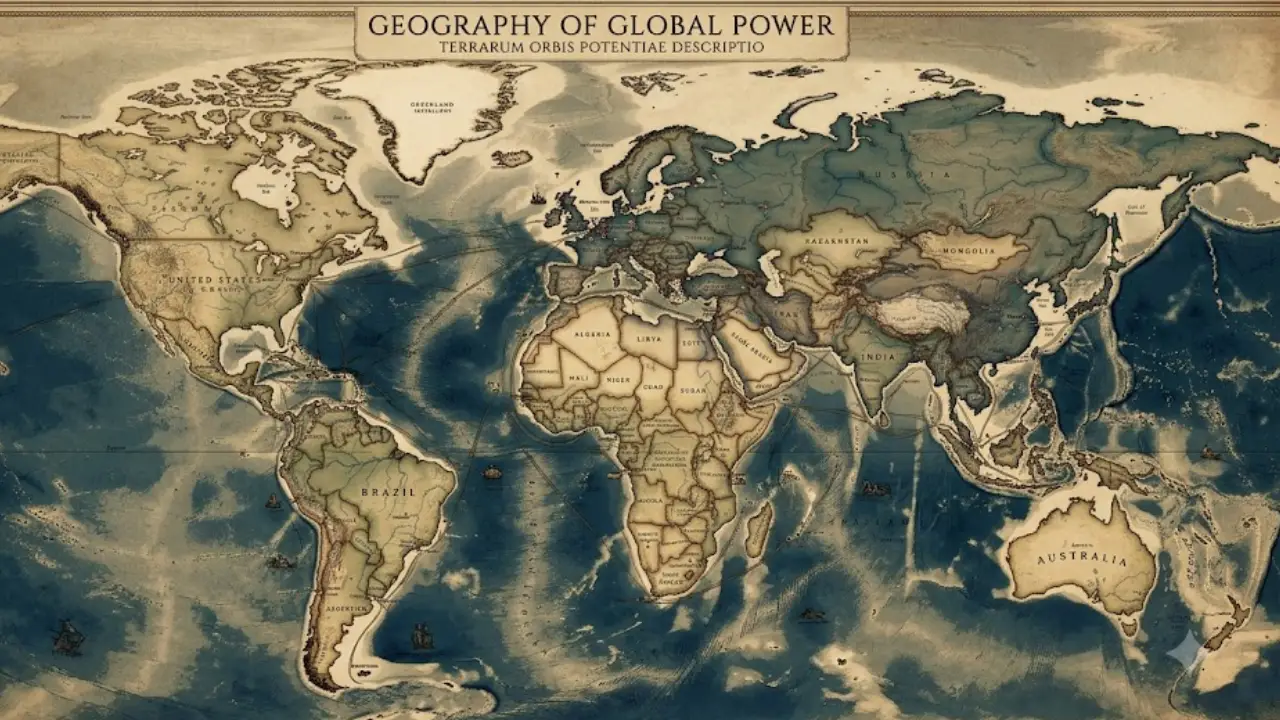
There is something unsettling about a world map.
We look at it and instinctively search for the giants.
Russia. China. The United States. India. Europe.
We imagine power as something that spreads across enormous territories. The bigger the country, the greater the influence. The larger the army, the more dangerous the state. The larger the economy, the greater the leverage.
But that map is hiding something.
Look closer.
There is a narrow strip of water between countries. A small island sitting beside a major shipping route. A refinery thousands of kilometres from the consumers who depend upon it. A factory whose machines are almost impossible to reproduce. A mineral deposit beneath an apparently ordinary landscape.
Now remove one of them.
Nothing dramatic happens at first.
A ship waits.
A factory searches for another supplier.
A commodity price moves.
An order is delayed.
Then another factory is affected.
Then another country.
And somewhere much farther away, someone discovers that a product has become expensive or has disappeared altogether.
That is the strange secret of the modern economy.
The world is enormous. Its vulnerabilities are often tiny.
The most important question in geopolitics may therefore no longer be “Who is the biggest?”
It may be:
“Who controls something everyone else finds difficult to replace?”
That question opens a very different map.
The World Was Built for Efficiency and Accidentally Built Chokepoints
For decades, globalisation pursued a deceptively simple goal: produce things where they could be produced most efficiently and move them as cheaply as possible.
The result was spectacular.
Factories became specialised. Ports became gigantic. Companies stopped making everything themselves. Countries concentrated on particular industries. Raw materials travelled across oceans before becoming finished products somewhere else.
It was extraordinarily efficient.
It was also a little like building a city with superb roads but only three bridges.
As long as the bridges work, everyone celebrates the efficiency.
The moment one fails, everyone discovers the geography.
Recent research into maritime chokepoints makes precisely this distinction important. Not every disruption causes a worldwide catastrophe: some commodities can be rerouted, suppliers can be changed and markets can adapt. A 2026 study of global coal trade, for example, found considerable resilience through rerouting and supplier switching.
But that does not make chokepoints irrelevant.
It makes the real question more interesting:
How difficult is it to replace this particular route, supplier, refinery, technology or location and how long would replacement take?
That is where small places become unexpectedly powerful.
Taiwan: The Island Hidden Inside the AI Revolution
Consider Taiwan.
On a conventional map, it is an island.
On the technological map of 2026, it is something much larger.
Taiwan sits at the centre of the world’s most advanced semiconductor manufacturing ecosystem. Chatham House has described Taiwan as producing roughly 90% of the world’s leading-edge semiconductors.
That number matters because modern computing has become dependent on increasingly sophisticated chips.
AI systems need them.
Data centres need them.
Advanced automobiles need them.
Telecommunications systems need them.
Modern military technology needs them.
And the remarkable part is that the dependency cannot simply be solved by saying, “Build another factory somewhere else.”
A leading semiconductor facility is not merely a building filled with machines.
It is an ecosystem of engineering knowledge, specialised equipment, suppliers, chemical inputs, clean-room infrastructure, electricity, water, technicians and accumulated manufacturing experience.
That makes the Taiwanese semiconductor advantage something more complicated than market share.
It is institutional memory turned into strategic power.
And there is another vulnerability hiding behind the chips.
Water.
Advanced semiconductor manufacturing requires enormous quantities of extremely pure water. That means Taiwan’s semiconductor significance is connected not only to geopolitics, but also to climate and infrastructure resilience.
The island therefore sits at the intersection of three vulnerabilities:
geography + technology + resources.
That is precisely the sort of combination that creates disproportionate strategic importance.
Singapore: The Country That Turned a Location Into a Weaponless Form of Power
Now move south.
Singapore does not possess the territorial scale of a great power.
It does something more interesting.
It makes its location indispensable.
In 2025, Singapore’s port handled a record 44.66 million TEUs of container throughput and 3.22 billion gross tonnes of vessel arrivals. Marine-fuel sales reached 56.77 million tonnes.
Those figures reveal an extraordinary transformation.
Singapore took geography and converted it into infrastructure.
Infrastructure became logistics.
Logistics became finance.
Finance became influence.
The country did not need to own the cargo.
It became extraordinarily good at helping the cargo move.
That distinction is crucial.
There are two ways to become strategically important.
You can control the thing.
Or you can control the system through which the thing moves.
Singapore demonstrates the second.
And this model may become increasingly valuable as supply chains become more complicated.
Malacca: The Narrow Waterway Carrying a Giant Economy
Then there is the Strait of Malacca.
It looks almost insignificant compared with the economies surrounding it.
But during the first half of 2025, an estimated 23.2 million barrels of oil per day passed through the strait around 29% of global maritime oil flows, according to the U.S. Energy Information Administration.
That is an astonishing amount of economic activity squeezed through a relatively narrow geographical passage.
But here we need to resist the temptation to turn every chokepoint into a doomsday story.
Markets adapt.
Ships reroute.
Suppliers change.
Prices move.
The coal research mentioned earlier demonstrates exactly this resilience.
The real danger is therefore not simply closure.
It is friction.
A longer route.
A more expensive journey.
A delayed delivery.
A shortage of specialised material.
A sudden increase in insurance.
Multiply that across millions of transactions and the apparently tiny geographical problem becomes a global economic calculation.
This is how geography quietly enters your shopping bill.
Panama: The Chokepoint That Depends on Rain
And then comes one of the strangest stories of all.
The Panama Canal.
The canal is a masterpiece of human engineering. But its operation depends on something humans cannot manufacture at will:
fresh water.
That creates a fascinating paradox.
The canal can be strategically important because it saves ships enormous distances.
But the canal can become vulnerable because the surrounding watershed does not always provide enough water.
Recent research identifies drought-related disruption at the Panama Canal among the major vulnerabilities capable of affecting global trade networks.
This is where climate change quietly rewrites geopolitical theory.
For much of history, strategic geography meant mountains, rivers, deserts and seas.
Now it increasingly includes:
rainfall patterns, reservoirs and water availability.
The next generation of strategic planners may have to think like hydrologists.
A canal does not need to be invaded to become vulnerable.
Sometimes the enemy is simply a dry season that lasts too long.
Then the Story Moves Underground
The map changes again when we stop looking at shipping lanes and start looking beneath the ground.
Lithium.
Nickel.
Cobalt.
Graphite.
Rare earth elements.
Gallium.
Germanium.
These are not merely obscure entries in a chemistry textbook anymore.
They are increasingly embedded in batteries, semiconductors, renewable-energy technologies, electronics, defence systems and data infrastructure.
And demand is accelerating.
The IEA reports that global battery demand increased by more than 35% in 2025, exceeding 1.5 terawatt-hours. Lithium demand has been rising particularly quickly, averaging about 25% annual growth over the previous two years.
UN Trade and Development projects lithium demand to rise 353% between 2024 and 2040.
But here comes the twist.
The world does not merely need minerals.
It needs processed minerals.
And processing is where the map becomes surprisingly concentrated.
The Mine Is Not the Real Bottleneck
Imagine finding a mountain containing an enormous quantity of a critical mineral.
It sounds like victory.
It isn’t necessarily.
The ore must be processed.
Chemicals must be separated.
Purity must be controlled.
Specialised machinery must be installed.
Workers must learn complicated processes.
Energy and water must be available.
Transport infrastructure must connect the facility to the world.
Only then does the mineral become useful to industry.
This is why the IEA’s 2026 assessment is so revealing.
Excluding rare earths, the average share of the top refining country across assessed critical minerals reached 72% in 2025, up from 70% in 2023. Indonesia and China accounted for more than three-quarters of growth in refined supply over the previous two years.
The vulnerability therefore isn’t necessarily:
“There is only one mine.”
It can be:
“There are many mines, but almost everyone sends the material to the same place to make it usable.”
That is a much subtler form of power.
And perhaps a more durable one.
Indonesia: The Refinery Became More Important Than the Mine
Indonesia illustrates this transformation beautifully.
The country has become a giant in nickel.
UN Trade and Development reports that Indonesia accounted for 67% of global nickel mine production in 2025 and 43% of global nickel refining capacity.
The important story is not simply that Indonesia possesses nickel.
It is that Indonesia has moved further down the value chain.
That means more economic activity occurs domestically before the material reaches global manufacturers.
This is the direction many resource-rich countries want to travel.
For decades, developing economies often exported raw materials while importing higher-value finished products.
Critical minerals are creating a new opportunity:
mine → refinery → chemicals → components → manufacturing.
The country that controls more links can capture more value and acquire more bargaining power.
Congo: When a Mineral Learns to Negotiate
Now consider cobalt.
The Democratic Republic of the Congo accounted for 74% of global cobalt mine production in 2025, according to UN Trade and Development.
Then came an extraordinary demonstration of what concentrated supply can mean.
The IEA says cobalt prices rose by around 130% in 2025, largely because of export restrictions imposed by the DRC.
The episode matters because it changes the traditional relationship between producer and consumer.
The producer is no longer simply waiting for someone to buy its resource.
It can use access itself as a bargaining instrument.
UN Trade and Development reports that nearly 100 export-related measures affecting critical energy-transition minerals have been introduced since 2020. These include licensing requirements, export taxes, bans and quotas.
The mineral is no longer just a commodity.
It has become a diplomatic sentence.
“You want access? Then we need to talk.”
Morocco: The Quiet Power Beneath the Food System
Then there is a resource almost nobody discusses with the excitement reserved for lithium.
Phosphate.
Yet phosphate matters because modern agriculture depends heavily on fertiliser.
Morocco possesses an extraordinary share of the world’s phosphate-rock reserves.
That makes the country strategically important in a way that is easy to miss.
It is not about powering an electric vehicle.
It is about helping produce food.
And that points toward a broader truth.
The resources of the future will not all be technological.
Some will remain stubbornly biological.
Water.
Fertiliser.
Food.
Land.
Energy.
A country can become strategically important because it controls something as old-fashioned as agricultural productivity.
The Netherlands: The Most Important Machine You Have Never Seen
Now comes perhaps the strangest example.
The Netherlands.
No giant oil field.
No enormous population.
No continent-spanning empire.
Yet the country is home to ASML, the world’s only manufacturer of EUV lithography systems.
These machines are used to produce the most advanced semiconductor chips.
The machine itself is not the chip.
It is the machine that enables the chip to be manufactured.
That is a deeper layer of power.
Think of it as controlling the factory that makes the tools for building the factory.
The IEA’s 2026 report highlights how difficult such upstream capabilities can be to duplicate. In several critical-mineral processing chains, specialised equipment suppliers are limited, lead times can be long and technical knowledge is difficult to reproduce quickly.
A recent 2026 study of AI supply chains makes the same broader point: concentration becomes especially severe as one moves upstream from consumer-facing AI systems toward advanced packaging, lithography and critical inputs.
The public sees the chatbot.
The strategic vulnerability may be hidden several industrial layers behind it.
This Is Why “Small Country” Is Almost the Wrong Phrase
There is an important correction to the popular narrative.
Taiwan, Singapore, the Netherlands and Panama are not powerful simply because they are small.
Size is not the magic ingredient.
Irreplaceability is.
A small country without a strategic asset can be geopolitically marginal.
A large country without control over a bottleneck can also become dependent.
And a country can create strategic importance without possessing the original resource at all.
Singapore did it through connectivity.
The Netherlands did it through technology.
Indonesia did it through processing.
Panama did it through geography.
Taiwan did it through industrial concentration.
That suggests a better formula for understanding modern power:
Strategic leverage = scarcity × dependency × concentration × difficulty of replacement.
If something is abundant, easily substituted and widely distributed, controlling it gives limited leverage.
But if it is scarce, highly concentrated, essential and slow to replace, the equation changes dramatically.
The 72% Problem Is Bigger Than It Looks
The IEA’s 72% refining concentration figure is therefore more than another statistic.
It is a warning about architecture.
The world has diversified some supply chains.
But diversification has often happened more slowly than demand growth.
The IEA notes that for some minerals such as gallium, graphite, manganese and rare earths the top refiner, China, accounts for more than 90% of global refined supply.
That creates an extraordinary asymmetry.
A country does not necessarily need to own 100% of something to influence the market.
It may only need enough control that the rest of the world cannot replace its supply quickly.
This is why chokepoint power can be surprisingly cheap.
A state does not have to physically shut the world down.
The possibility of disruption can itself alter behaviour.
Companies build inventories.
Governments subsidise alternatives.
Manufacturers redesign products.
All because the possibility of the door closing has become economically significant.
The Most Powerful Weapon May Be the Threat of a Closed Door
This is where economics and geopolitics finally collide.
A chokepoint is most powerful when everyone knows it exists.
Because uncertainty creates its own cost.
A company that depends upon a single supplier may pay more for insurance.
A government may spend billions creating alternative capacity.
A manufacturer may redesign its product to use a less efficient material.
A country may stockpile minerals.
None of those actions require an actual blockade.
The fear of interruption is already changing the economy.
This is visible in the growing race for critical-mineral security.
UN Trade and Development says 58 critical-mineral partnership agreements have been signed since 2022, while governments increasingly use trade policy to secure supply chains.
The race is therefore not simply for resources.
It is for optionality.
And Here Lies the Great Irony
The world spent decades making supply chains more efficient.
Now it is spending billions trying to make them less efficient but safer.
One supplier is dangerous.
So build two.
One refinery is dangerous.
Build another.
One shipping route is dangerous.
Create an alternative.
One country dominates a technology.
Develop a substitute.
This is economically expensive.
But geopolitical insurance always is.
The IEA estimates that diversifying some strategic mineral supply chains could require tens of billions of dollars of investment. Yet the cost of building alternatives can still be smaller than the economic damage caused by a prolonged disruption.
The world is therefore entering a strange new calculation:
Efficiency versus resilience.
And resilience is winning.
The Future Map Will Have Invisible Borders
The old world map showed countries.
The new strategic map needs additional layers.
There will be a map of shipping routes.
A map of semiconductor production.
A map of mineral refining.
A map of electricity.
A map of freshwater.
A map of submarine cables.
A map of data centres.
A map of specialised machinery.
Put them together and something remarkable appears.
The places that matter most are not necessarily the largest coloured areas.
They are the nodes.
The intersections.
The bottlenecks.
The places where several systems overlap.
Taiwan is not merely a semiconductor location.
It is technology + maritime geography + geopolitics.
Singapore is not merely a port.
It is shipping + finance + logistics + connectivity.
Panama is not merely a canal.
It is trade + freshwater + climate.
Indonesia is not merely a mining country.
It is minerals + refining + industrial policy.
The Netherlands is not merely a technology exporter.
It is a crucial node in the machinery behind advanced chips.
This is why the new geography of power is so difficult to see.
It is layered.
The Most Dangerous Place May Be Somewhere Nobody Is Watching
That is perhaps the final mystery.
We tend to watch capitals.
Washington.
Beijing.
Moscow.
New Delhi.
Brussels.
But supply chains often do not care where the capital is.
They care where the refinery is.
Where the port is.
Where the mine is.
Where the canal is.
Where the machine is.
Where the water comes from.
And that creates a fascinating inversion of traditional geopolitics.
The most consequential event of a crisis might happen hundreds of kilometres away from the country’s political centre.
A refinery employee may become strategically important without ever appearing on television.
A reservoir level may matter more than a speech.
A factory maintenance schedule may matter more than a diplomatic summit.
A specialised machine may matter more than a military parade.
That is the new geography.
The Final Question Is Not “Who Is Strongest?”
It is tempting to turn this into a list of powerful small countries.
That would miss the point.
The deeper story is that globalisation created a hidden architecture of dependence.
And now governments are discovering that architecture.
They are mapping it.
Buying alternatives.
Building stockpiles.
Signing mineral agreements.
Subsidising factories.
Restricting exports.
Moving supply chains.
Creating rival technological ecosystems.
The great geopolitical competition of the coming decades may therefore be fought not only over territory, but over replaceability.
Who can be replaced?
Who cannot?
Who can be bypassed?
Who cannot?
Who has alternatives?
Who has none?
Those questions may determine the real balance of power.
Because the most powerful place on tomorrow’s map may not be the country with the biggest army.
It may be the apparently insignificant place that makes everyone else wait.
And perhaps that is the most mysterious thing about modern power:
sometimes you discover how important a place is only after the world tries to live without it.
The Unfolding
| Hidden source of power | Example | Why it matters |
| Advanced technology | Taiwan | Leading-edge semiconductor manufacturing |
| Maritime connectivity | Singapore | 44.66 million TEUs handled in 2025 |
| Shipping geography | Malacca | About 23.2 million barrels/day of oil flows |
| Canal infrastructure | Panama | Major Atlantic–Pacific trade shortcut |
| Mineral extraction | DRC | 74% of global cobalt mine production in 2025 |
| Mineral refining | Indonesia | 43% of global nickel refining capacity |
| Food security | Morocco | Major global phosphate reserve base |
| Specialised machinery | Netherlands | Unique position in EUV lithography |
| Processing concentration | China and others | Top refining countries dominate many critical minerals |
The broader lesson is more important than any single number: global power is increasingly determined by what cannot be quickly replaced.
Authentic Sources & Further Reading
- International Energy Agency — Global Critical Minerals Outlook 2026 — supply concentration, mineral demand, refining and strategic risks.
- UN Trade and Development — Global Trade Update: Critical Minerals — mineral production, refining, export restrictions and trade policy.
- IEA — Global Critical Minerals Outlook 2026 Executive Summary — 72% refining concentration and supply-chain vulnerabilities.
- Maritime and Port Authority of Singapore — official Singapore port statistics.
- Singapore Maritime and Port Authority — 2026 Maritime Centre Ranking — Singapore’s global maritime position.
- U.S. Energy Information Administration — World Oil Transit Chokepoints — energy flows through major maritime chokepoints.
- U.S. Geological Survey — Mineral Commodity Summaries — authoritative mineral production and reserve data.
- ASML — Semiconductor Manufacturing Technology — official information on lithography technology.
- Nature Communications — research on systemic impacts of maritime chokepoint disruption — research perspective on network vulnerability.
- Chatham House — global geopolitical and supply-chain analysis — Taiwan and strategic chokepoint analysis.
Government & International Links
- International Energy Agency
- UN Trade and Development
- U.S. Geological Survey
- U.S. Energy Information Administration
- Panama Canal Authority
- Maritime and Port Authority of Singapore








Leave a Reply