
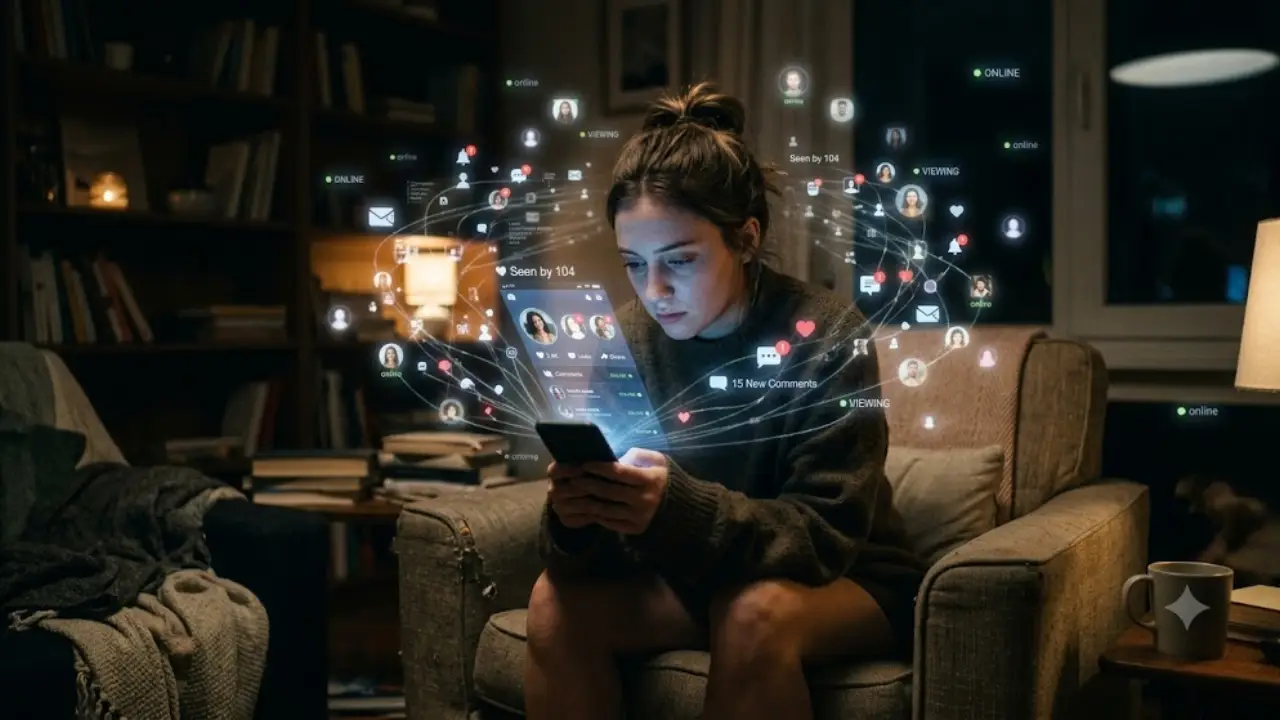
Being Seen Online
There is a peculiar little drama taking place on billions of smartphones every day.
It usually begins innocently.
You send a message.
Delivered.
You continue with your life.
Perhaps you make tea. Perhaps you answer another message. Perhaps you spend seven minutes watching a man repair a 1974 tractor in rural Lithuania for reasons you cannot explain.
Then you look at your phone.
Read.
Excellent.
Except there is no reply.
You wait.
Nothing.
You check again.
Still nothing.
Then comes the most dangerous piece of information modern technology ever gave the overthinking human brain:
They are online.
Ah.
So they are alive.
They have their phone.
They have internet.
They have apparently discovered the ability to communicate.
Just not with you.
At this point, the human brain an organ that once survived predators, famine and thunderstorms begins a forensic investigation over a three-word message.
Are they angry?
Did I say something wrong?
Are they deliberately ignoring me?
Did they see it and decide I am unbearable?
Are they typing a response?
And then, cruelly, the little typing indicator appears.
Three dots.
Hope.
The dots disappear.
Panic.
The dots return.
Suspense.
They disappear again.
Congratulations.
You are no longer having a conversation.
You are watching a tiny psychological thriller.
And the strangest part is that nothing has actually happened.
Nobody has insulted you.
Nobody has rejected you.
Nobody has even said no.
You simply received a piece of information:
the message was opened.
Everything else was written by your imagination.
That, in miniature, is one of the great psychological experiments of the digital age.
We did not merely make communication faster.
We made other people’s attention visible.
And once attention became visible, human beings did what human beings do exceptionally well:
We started measuring it.
Once Upon a Time, You Had to Wonder
For most of human history, there was no blue tick.
Imagine that.
You sent someone a letter and had absolutely no idea when they opened it.
You called someone and, if they didn’t answer, you had a beautifully simple explanation:
They weren’t there.
You invited someone somewhere and waited.
Perhaps they came.
Perhaps they didn’t.
You posted a photograph on your wall and had no counter beneath it announcing:
47 people approved of your face today.
Social life was certainly complicated.
But it was wonderfully imprecise.
Then technology arrived and decided ambiguity was inefficient.
Now we have:
Likes.
Views.
Followers.
Read receipts.
Online indicators.
Typing bubbles.
Reaction emojis.
Tiny pieces of digital information that appear harmless individually.
Together, they form something much stranger:
a live dashboard of our social visibility.
The question used to be:
“Do people remember me?”
Now it can become:
“Why did 83 people see my story but only 17 react?”
We have somehow turned friendship into amateur statistics.
Welcome to the Department of Social Surveillance
Consider the six little signals that have quietly infiltrated everyday life.
| Digital signal | What it actually tells you | What your brain may decide it means |
| ❤️ Like | Someone reacted | “They approve of me.” |
| ✓✓ Read receipt | Someone opened the message | “Why haven’t they replied?” |
| 🟢 Online | Someone is active | “They’re available.” |
| 👀 Story view | Someone watched | “Why didn’t that person watch?” |
| … Typing | Someone may be composing | “What are they going to say?” |
| Followers | Number of accounts following you | “How important am I?” |
There is a fascinating problem hiding inside this table.
None of these signals tells you what another person feels.
They tell you what another person did.
And those are very different things.
A person can read your message and love you.
They can read your message and hate you.
They can read your message while standing in a supermarket wondering whether to buy coriander.
The blue tick knows none of this.
It is a very efficient witness.
It is also a terrible psychologist.
The Blue Tick Knows What Happened. It Does Not Know Why.
This may be the most important distinction in digital communication.
A read receipt can establish:
The message was opened.
It cannot establish:
The reader’s emotional state.
Maybe they were busy.
Maybe they wanted to answer properly.
Maybe they were exhausted.
Maybe they opened the message while walking into a meeting.
Maybe they forgot.
Maybe they are travelling.
Maybe they are avoiding you.
All of these possibilities can produce exactly the same blue tick.
Technology gives us precision about the event while withholding the explanation.
And human beings absolutely hate explanatory vacancies.
So we fill them.
Usually with the worst available theory.
This produces a peculiar paradox:
The more precisely technology records behaviour, the more confidently we may invent meaning around it.
The timestamp looks scientific.
The interpretation is not.
“Online” Used to Mean Something Very Different
Before smartphones, if somebody didn’t answer the phone, you generally assumed they were unavailable.
Now?
You can watch them being online.
This creates a psychological trap.
Because somewhere along the way, online quietly became synonymous with available.
But being online doesn’t necessarily mean somebody is ready or willing to communicate. WhatsApp’s own documentation distinguishes being online from actually reading a message or being available for conversation.
Yet emotionally, the distinction can disappear.
You see:
Online
Your brain translates it into:
Available to everyone except me.
And suddenly an innocent technical status has become evidence in a relationship investigation.
The app did not accuse anyone.
We did.
Then Came the Story Viewer List
Stories introduced another delightful complication.
You post something.
It disappears later.
Perfectly harmless.
Except the application also tells you who watched it.
Now your audience becomes a census.
There is your best friend.
There is your colleague.
There is the cousin who watches everything.
There is the person you secretly hoped would see it.
And then—
nothing.
They didn’t watch.
You tell yourself you don’t care.
You absolutely care.
You check again.
Still nothing.
The remarkable thing is that silence now leaves footprints.
Before digital platforms, someone not knowing about your photograph was simply ignorance.
Now their absence from a viewer list can feel like a statement.
No words.
No confrontation.
Just a missing name.
And the brain, once again, reaches for its favourite hobby:
interpretation.
Likes Turned Approval Into Arithmetic
Humans have always wanted approval.
Likes didn’t invent that desire.
They invented something more powerful:
quantified approval.
Imagine showing ten friends a photograph.
Seven smile.
Two comment.
One says nothing.
Messy.
Ambiguous.
Human.
Now post it online.
127 likes.
Suddenly social approval has a number.
And numbers have a dangerous little personality trait:
they invite comparison.
Yesterday: 127
Today: 81
Your friend: 642
A celebrity:
42,000.
At some point the number stops feeling like a measurement of engagement and starts behaving like a scoreboard.
And once social life resembles a scoreboard, somebody is going to ask:
Who is winning?
The Comparison Machine Has No Closing Time
Human beings have always compared themselves with other people.
Your neighbour’s house.
Your colleague’s salary.
Your cousin’s achievements.
The problem is that the old comparison pool had geographical limits.
The internet removed the fence.
Now your comparison set can include practically anyone on Earth.
Worse, you rarely see the entire person.
You see the exhibition.
The holiday without the cancelled flight.
The wedding without the argument.
The promotion without the years of rejection.
The perfect family photograph without the disastrous breakfast.
The fitness transformation without the months when nothing worked.
Social media is therefore not quite a window into other people’s lives.
It is more like a museum of selected moments.
And then we commit one of psychology’s great accounting errors:
We compare our messy storage room with somebody else’s museum.
Naturally, we lose.
But Is Social Media Actually Making Everyone Miserable?
Here is where the dramatic version of the story falls apart.
And thank goodness.
Because “social media is destroying humanity” is an excellent headline and a rather poor scientific conclusion.
The evidence is considerably more interesting.
Pew Research Center’s 2025 survey of 1,391 U.S. teenagers found that 74% said social media made them feel more connected to their friends, while 63% said it gave them a place to show their creative side.
So yes, the internet can genuinely help people connect.
But the same research found that:
45% said they spend too much time on social media.
39% said social media overwhelms them with drama.
31% felt pressure to post popular content.
31% felt excluded by friends.
27% said social media made them feel worse about their own lives.
45% said it hurt their sleep.
40% said it hurt their productivity.
19% said it hurt their mental health.
22% said it hurt their grades.
There is no contradiction here.
That is the story.
Social media can make somebody feel:
connected and inadequate.
supported and pressured.
creative and competitive.
included and excluded.
The same phone can deliver a friend’s message and somebody else’s perfectly filtered holiday within five seconds.
The technology isn’t emotionally one-dimensional.
Neither are we.
The 45% Question
One number deserves particular attention.
In Pew’s 2025 research, 45% of teenagers said they spend too much time on social media, up from 36% in 2022 and 27% in 2023.
But even that number needs a little intellectual humility.
Two hours online does not necessarily mean two hours of psychological damage.
One teenager may spend those two hours talking to friends.
Another may spend them refreshing a post every six minutes to see whether someone reacted.
Same screen time.
Completely different experience.
So perhaps the more useful question isn’t:
“How many hours are you online?”
It is:
“What are you doing emotionally while you’re there?”
Connection or Surveillance?
Here is a surprisingly useful distinction.
Connection:
“I am talking to my friend.”
Surveillance:
“I am checking whether my friend has replied.”
Connection:
“I posted a photograph.”
Surveillance:
“I am checking how many people liked it.”
Connection:
“I watched my friend’s Story.”
Surveillance:
“I am checking who watched mine.”
The application hasn’t changed.
Your psychological activity has.
The first behaviour participates in social life.
The second monitors social life.
And monitoring has a nasty characteristic:
It never finishes.
A conversation ends.
A meal ends.
A visit ends.
A photograph can be taken.
But there is always another notification.
Another number.
Another viewer.
Another follower.
Another tiny piece of evidence requiring interpretation.
You are never quite finished checking.
The Adolescent Warning Light
This becomes particularly important during adolescence, when identity is still being built.
WHO Europe’s Health Behaviour in School-aged Children research surveyed almost 280,000 young people aged 11, 13 and 15 across 44 countries and regions in 2021/22. It found that 11% showed signs of problematic social-media use, up from 7% in 2018. Girls were affected more often than boys—13% versus 9%.
The same research found that 36% of adolescents reported constant online contact with friends, rising to 44% among 15-year-old girls.
The word worth noticing is:
constant.
Friendship used to contain pauses.
Now friendship can arrive as a 24-hour notification stream.
Your friend is eating.
Your friend is studying.
Your friend is online.
Your friend is posting.
Your friend is replying to someone.
Your friend has not replied to you.
The modern teenager doesn’t merely have friends.
They can have real-time access to the status of friendship.
That is a psychologically different environment.
FOMO Has a Younger, More Anxious Cousin
We already know FOMO:
Fear of Missing Out.
But there is another fear worth considering:
the fear of becoming socially invisible.
Not a clinical diagnosis.
Not a new psychiatric disorder.
Just a useful description of a very modern anxiety.
What happens when nobody reacts?
What happens when your post disappears into digital silence?
What happens when your follower count stops growing?
What happens when everyone seems to be somewhere without you?
The fear may no longer be:
“What am I missing?”
It can become:
“Am I becoming irrelevant?”
That is deeper.
Because now we aren’t talking about entertainment.
We’re talking about identity.
Your Follower Count Has a Very Limited Job Description
Let’s perform a small experiment.
What does your follower count actually measure?
It does not tell you:
How many people love you.
How many trust you.
How many would help you at 2 a.m.
How many would visit you when you were sick.
How many genuinely understand you.
How many would stand beside you when life becomes unpleasant.
It measures something considerably narrower:
how many accounts follow an account.
And yet the number sits there, beautifully formatted, behaving as though it has been appointed Chief Executive Officer of your social worth.
This is how metrics become psychologically dangerous.
The proxy slowly becomes the thing.
Followers become popularity.
Likes become approval.
Views become importance.
Online status becomes availability.
Read receipts become emotional acknowledgement.
The number becomes more persuasive than the reality it was supposed to represent.
The Research Refuses to Give Us a Simple Villain
Pew’s findings are particularly useful because they resist the temptation to make one dramatic conclusion.
A majority of teenagers say social media helps them feel connected and creative.
At the same time, significant minorities report drama, exclusion, pressure, sleep problems and other negative experiences.
Even teenagers themselves distinguish between their own experience and what they think happens to their peers.
About 48% said social media had a mostly negative effect on people their age.
Only 14% said it had a mostly negative effect on them personally.
That is fascinating.
Apparently the internet is terrible for teenagers.
Just not necessarily me.
The psychological lesson is bigger than the joke:
There is no single “social media effect.”
There are different platforms.
Different personalities.
Different communities.
Different reasons for logging in.
Different patterns of use.
The teenager searching for friendship is not psychologically identical to the teenager repeatedly checking whether friends have excluded them.
The adult promoting a business is not the same as someone refreshing an engagement counter at 1 a.m.
Behaviour matters more than the label.
Why Comparing Yourself Online Can Become Expensive
A 2025 meta-analysis examined 94 effect sizes from 54 independent samples involving 36,583 people and found associations between upward social comparison and poorer psychological adjustment, including negative social emotions, anxiety, depression, lower well-being and lower self-esteem.
That does not prove that looking at successful people causes depression.
Correlation is not causation.
But it points toward an important mechanism:
Repeatedly comparing yourself with people who appear to be doing better can become psychologically expensive.
And social media happens to be exceptionally good at producing exactly that comparison.
The problem isn’t that somebody else is beautiful.
Successful.
Rich.
Fit.
Popular.
The problem begins when their carefully selected highlight reel becomes the measuring instrument for your unedited life.
And Girls Often Experience the Pressure Differently
Pew’s 2025 research found that 25% of teenage girls, compared with 14% of boys, said social media hurt their mental health. Girls were also more likely to report negative effects on sleep and confidence.
Yet girls also reported some of the positive experiences more often.
For example, 57% of girls, compared with 45% of boys, said social media made them feel they had people who could support them through difficult times.
So again, the contradiction refuses to disappear.
The same digital environment can provide:
community and comparison.
support and pressure.
visibility and vulnerability.
That is why “Is social media good or bad for girls?” is a much less interesting question than:
Which digital experiences create support and which create evaluation?
We Have Become Tiny Social Auditors
Consider the modern ritual.
Post.
Wait.
Check.
Close the app.
Open the app.
Check again.
One person liked it.
Relief.
Your friend got 600 likes.
Comparison.
Someone sends a message.
Attention.
Someone doesn’t reply.
Uncertainty.
Someone is online.
Suspicion.
Someone watched your Story.
Curiosity.
Someone didn’t.
Investigation.
Nobody appointed you to the Department of Social Surveillance.
You volunteered.
And the interface didn’t necessarily force you to do it.
It simply made the information available.
We supplied the obsession.
That is why blaming technology alone is too easy.
The deeper issue is that modern platforms have made social feedback extraordinarily cheap to obtain and extraordinarily easy to monitor.
And humans are magnificent monitors.
The Strange Power of Absence
Here is another little psychological trick.
We don’t merely notice positive signals.
We notice missing ones.
If twenty people respond to your post, you may enjoy it.
But if the one person you expected to respond doesn’t?
Suddenly that absence becomes enormous.
Why?
Because the brain is sensitive to unexpected gaps.
The internet has simply upgraded absence.
It gives absence a timestamp.
Seen by 27 people.
Except not by her.
19 viewers.
Except not him.
Online 12 minutes ago.
Except no response to you.
Silence used to be empty.
Now silence comes with metadata.
That is a remarkable psychological transformation.
So What Are We Supposed to Do?
Not throw the smartphone into a river.
Not announce a heroic seven-year digital detox.
Not pretend we have suddenly evolved beyond wanting other people to like us.
We haven’t.
Human beings care about recognition.
The sensible goal is much smaller:
Stop confusing digital signals with complete social truth.
1. Separate observation from interpretation
“The message was read” is an observation.
“They don’t respect me” is an interpretation.
Do not allow the second sentence to disguise itself as the first.
2. Stop treating “online” as an invitation
Someone being online does not create a duty to reply.
Online means online.
Not:
“Available for your emotional appointment.”
3. Reduce unnecessary metrics
If follower counts and visible engagement numbers affect your mood, make them less important wherever platform settings permit.
4. Notice reassurance checking
If you repeatedly open an app after posting, ask:
“What information am I actually looking for?”
Often the answer is not information.
It is reassurance.
5. Curate your comparison diet
An account that consistently makes you feel inferior may not be “inspiring” you.
It may simply be exhausting you in high definition.
6. Protect sleep from social surveillance
The message can wait.
The blue tick can wait.
The Story can wait.
Your nervous system has no obligation to work the night shift at Instagram’s security desk.
7. Practise deliberate invisibility
Spend some time offline without announcing it.
No status.
No photograph.
No explanation.
No proof that you are having an interesting life.
Just disappear.
It is surprisingly liberating.
The Next Digital Skill May Be Not Checking
For years, we were taught how to become visible online.
Build a profile.
Post regularly.
Grow followers.
Increase engagement.
Collect reactions.
Become discoverable.
Perhaps the next digital skill is the opposite.
Learning not to monitor our visibility.
Posting something without immediately checking the number.
Sending a message without watching the read receipt.
Seeing someone online without constructing a theory.
Spending an evening without documenting it.
Going offline without fearing that civilisation will continue without you.
That is not technological failure.
It may be psychological independence.
The Privacy Question Is Bigger Than Privacy
There is another layer to this story.
Digital visibility depends upon data.
Your activity.
Your profile.
Your interactions.
Your audience.
Your communications.
Your status.
That makes the debate about privacy more interesting than simply asking whether companies should keep secrets secret.
A deeper question is emerging:
How much ordinary human behaviour should technology be allowed to measure, infer and expose?
India’s Digital Personal Data Protection Act, 2023 and the Digital Personal Data Protection Rules, 2025 are part of a broader regulatory movement around digital personal data.
But perhaps the future definition of privacy will become broader.
Privacy may not merely mean:
“Nobody knows my secret.”
It may also mean:
“I am allowed to exist without constantly being observable.”
The Internet May Be Moving Toward Selective Visibility
The early internet celebrated exposure.
Put yourself online.
Share everything.
Build an audience.
Be discoverable.
But perhaps the mature internet will eventually value something different:
Choose who sees you.
Choose who contacts you.
Choose who knows you are online.
Choose what activity remains visible.
Choose when to disappear.
That isn’t necessarily isolation.
Sometimes privacy is simply:
control over access to yourself.
The Real Problem Isn’t That We Want to Be Seen
Wanting to be seen is not a psychological defect.
It is profoundly human.
A child looks toward a parent.
A student looks toward a teacher.
A performer looks toward an audience.
A friend waits for a reply.
A partner wants reassurance.
Recognition has always mattered.
The technological novelty is that recognition can now be quantified continuously.
You don’t have to wonder occasionally whether people noticed you.
You can check.
Again.
And again.
And again.
That is where the trap begins.
Because:
the availability of reassurance can create the habit of seeking reassurance.
When the Number Becomes More Important Than the Thing
We use proxies everywhere.
Money represents purchasing power.
Grades represent academic performance.
Titles represent professional status.
Follower counts represent social reach.
Likes represent engagement.
The problem begins when the proxy becomes the goal.
Instead of:
“Did I make something meaningful?”
we ask:
“Did people react?”
Instead of:
“Did I have a good conversation?”
we ask:
“Why haven’t they replied?”
Instead of:
“Do I have people who love me?”
we ask:
“How many people follow me?”
The measurement is easier.
The truth is harder.
And human beings have a long history of drifting toward whatever is easiest to measure.
So, Has Being Visible Become a Modern Form of Social Reassurance?
Yes, but only partly.
The evidence does not support the dramatic claim that everyone who uses social media is being psychologically damaged.
Millions of people use these platforms for friendship, creativity, community, information and support. Pew’s research makes that abundantly clear.
But something genuinely has changed.
We have turned previously invisible pieces of social behaviour into measurable signals.
Someone saw.
Someone liked.
Someone followed.
Someone replied.
Someone is online.
Someone wasn’t.
These signals can reassure us.
They can also train us to monitor ourselves.
And when monitoring becomes habitual, social life starts to resemble a dashboard.
That is where the invisible pressure begins.
The Final Paradox
The smartphone promised connection.
It delivered something more complicated:
connection plus measurement.
We can reach more people than any generation before us.
We can also see more clearly who appears not to care.
We can speak instantly.
We can also discover instantly that someone hasn’t answered.
We can share our lives.
We can also watch thousands of carefully edited versions of everybody else’s.
We can become visible to thousands.
And still lie awake wondering whether anyone truly sees us.
That may be the great irony of the connected century.
We have never possessed so much evidence of being noticed.
And yet we have never had so many opportunities to wonder whether we matter.
The answer, however, is hiding somewhere the notification bar cannot reach.
Not in the like.
Not in the blue tick.
Not in the follower count.
Not in the viewer list.
Not in the green dot.
The people who matter most to us do not have to be watching us every minute for us to belong.
Perhaps the healthiest relationship with the internet begins with one surprisingly difficult idea:
Being unseen for a while is not the same thing as being forgotten.
And perhaps the ultimate digital status isn’t:
Online.
It is:
At peace.
Key Unfoldings
| What we see | What we should remember |
| ❤️ Likes | They measure reactions, not human worth |
| ✓✓ Read receipts | They reveal reading, not intention |
| 🟢 Online status | It indicates activity, not emotional availability |
| 👀 Story views | They show viewing, not friendship |
| Followers | They measure accounts, not relationships |
| Social comparison | Curated lives create imperfect comparisons |
| Screen time | The pattern and purpose of use matter, not just duration |
| Digital invisibility | Being offline does not mean being socially irrelevant |
The one sentence worth remembering
Digital visibility can reassure us that we are noticed, but it cannot prove that we are loved, valued or understood.
Frequently Asked Questions
Is wanting likes psychologically unhealthy?
No. Wanting recognition is normal. The concern begins when engagement metrics become a major source of self-worth or when checking them repeatedly becomes a form of emotional reassurance.
Does being left on read mean someone is ignoring you?
Not necessarily. A read receipt tells you that a message was opened. It does not tell you why the person hasn’t responded.
Is social media harmful to teenagers?
The evidence is mixed. Many teenagers report connection and creative benefits, while substantial minorities report drama, exclusion, pressure, sleep problems and negative effects on mental health. Pew’s research specifically cautions against treating the experience as identical for everyone.
Why can social comparison feel worse online?
Because social platforms provide an almost endless stream of carefully selected information about other people’s appearance, achievements, relationships, possessions and lifestyles. That creates abundant opportunities for upward comparison.
Is screen time the whole problem?
No. Duration matters, but what someone is doing online matters too. Talking with friends and repeatedly checking whether friends have responded may involve similar screen time but very different psychological experiences.
Should I turn off read receipts?
If read receipts make you unnecessarily anxious, reducing their importance or disabling them where the platform allows can be useful. The objective isn’t to hide from people. It is to stop treating every digital event as something requiring immediate interpretation.
Sources & Further Reading
Pew Research Center — Teens, Social Media and Mental Health (2025), based on a survey of 1,391 U.S. teens and parents.
Pew Research Center — 10 Facts About Teens and Social Media (2025), including statistics on time spent, positive and negative experiences, sleep, mental health and friendship.
WHO Regional Office for Europe — Teens, screens and mental health (2024), reporting findings from the Health Behaviour in School-aged Children study involving almost 280,000 adolescents across 44 countries and regions.
WHO Europe — HBSC research — international evidence concerning problematic social-media use and continuous online contact among adolescents.
Academic literature — systematic reviews and meta-analyses examining problematic social-media use, well-being and upward social comparison.
Platform documentation — WhatsApp guidance concerning online status, read receipts, Status views and privacy controls.
India — Government / regulatory framework — Digital Personal Data Protection Act, 2023 and Digital Personal Data Protection Rules, 2025.








Leave a Reply