
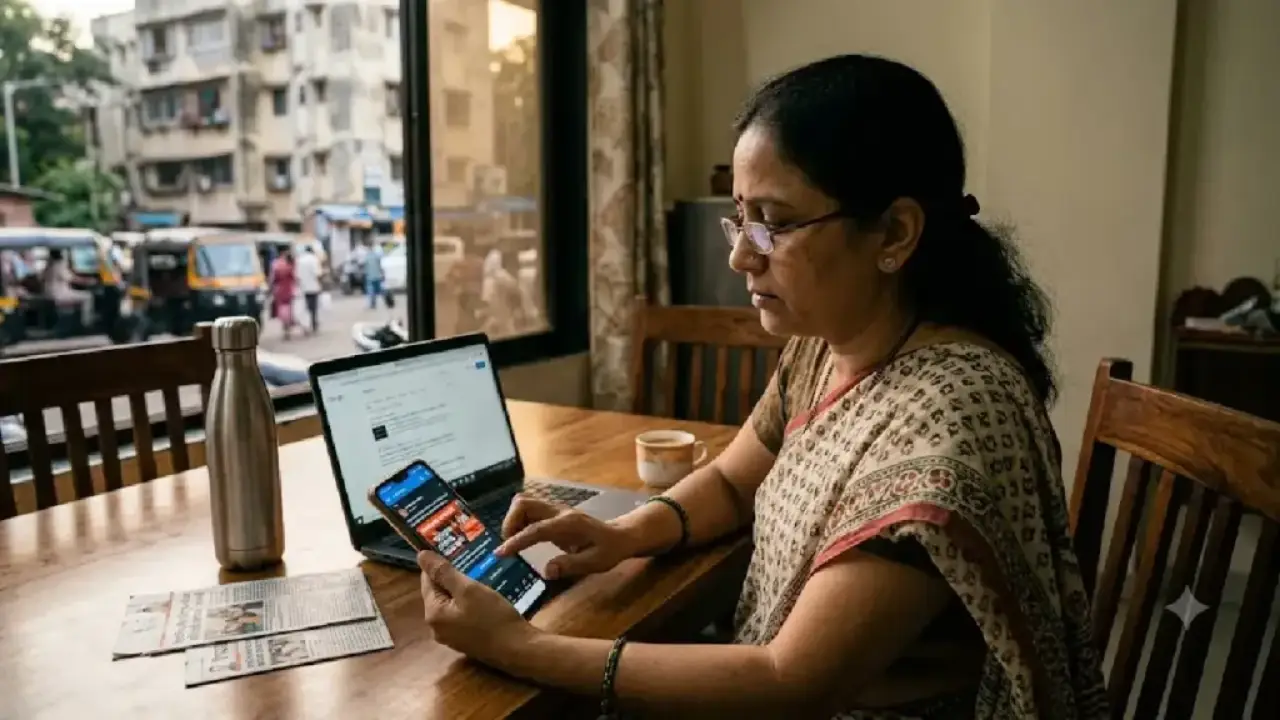
The Message Arrived Before Breakfast
At 7:42 in the morning, a message appeared on a phone.
It contained everything a dangerous piece of information needs.
A dramatic photograph.
A frightening headline.
A familiar person’s name.
A number large enough to sound convincing.
And, most importantly, a sentence at the bottom:
“Share this before it gets deleted.”
The message was forwarded to one person.
Then five.
Then fifty.
Within minutes, it had become “news”.
Nobody had checked where the photograph came from.
Nobody had opened the original report.
Nobody had asked whether the quoted person actually said those words.
Nobody had checked the date.
The message had achieved something extraordinary.
It had travelled faster than verification.
That is the real problem with misinformation.
A false claim does not need to survive a scientific examination.
It only needs to survive three seconds of human curiosity.
And AI is making that problem considerably more serious.
The Reuters Institute’s 2026 Digital News Report found that global trust in news has fallen to 37%, its lowest level in the report’s 11-year series. At the same time, 77% of people across the 48 markets surveyed consume online news video each week. AI chatbot use for news has also risen from 7% to 10%.
India presents an especially interesting picture.
The 2026 report found 39% of Indian respondents saying they trust most news most of the time, while 58% expressed concern about fake news and misinformation online. The survey also found 22% using AI chatbots for news, more than twice the global figure. The researchers caution that the India sample is primarily English-speaking internet users and is not nationally representative.
So here is the strange situation:
We have more information than ever—and more reasons than ever to ask whether that information deserves belief.
The good news is that you do not need to be a journalist, forensic scientist or computer programmer to investigate suspicious information.
You can start with twenty surprisingly simple methods.
1. Stop Before You Share
This sounds almost embarrassingly simple.
It is also one of the most powerful.
If a post makes you immediately angry, frightened, delighted or shocked, do not forward it yet.
Emotional reactions are precisely what viral misinformation exploits.
Instead, ask:
“What would I need to see before I believe this?”
That five-second pause changes your role.
You stop being a distributor of the claim.
You become its investigator.
2. Find the Original Source
Never treat a screenshot as the final source.
Look for the earliest identifiable version.
If a post says:
“Government announces new rule…”
search the exact wording.
Find the government announcement.
If it says:
“Scientist reveals…”
find the scientist.
If it quotes a newspaper, find the newspaper article.
Professional fact-checkers use this principle constantly. AFP says its fact-checkers work from primary-source material and require at least two independent sources to verify the central claim of a fact-check.
The internet may contain thousands of copies.
You need the beginning of the trail.
3. Read Beyond the Headline
A headline can be technically accurate and still create a completely false impression.
Consider:
“Scientists discover dangerous chemical in food.”
Sounds terrifying.
Now read the article.
Perhaps the chemical was detected at a concentration far below a harmful level.
The headline may not technically lie.
It may simply leave out the part that changes the meaning.
So never fact-check only the headline.
Read the paragraph where the claim is actually explained.
4. Check the Date
Old news is one of the internet’s favourite disguises.
A photograph from 2019 can suddenly reappear in 2026.
A five-year-old government order can be presented as today’s announcement.
A historical disaster can be described as something happening “right now”.
Before believing a claim, ask:
When was this originally published?
Then ask:
Is the situation still the same?
This matters particularly during elections, disasters, wars, disease outbreaks and major policy changes.
5. Reverse-Search the Photograph
A photograph is not necessarily evidence of the event described beside it.
It may be genuineb but completely unrelated.
Reverse-image search can help find earlier appearances of an image.
Alt News describes using Google reverse image search to investigate the origin of viral photographs and determine whether the same image has previously appeared in another context. For videos, its methodology describes extracting individual frames and using tools such as InVID.
The important question is not merely:
“Is this photograph real?”
It is:
“Where did this photograph originally come from?”
That second question is much more useful.
6. Search One Strange Sentence
Sometimes the easiest way to expose misinformation is to copy one unusual sentence from the message and search it.
Why?
Because misinformation is frequently recycled.
The same paragraph may have appeared on:
- Facebook;
- X;
- WhatsApp;
- blogs;
- old news sites;
- fact-checking websites.
AFP specifically notes that copying and searching a paragraph can reveal whether it has already circulated online.
A sentence can therefore act like a fingerprint.
7. Search the Claim With the Word “Fact Check”
This is one of the fastest public checks.
Suppose someone claims:
“This new medicine cures diabetes permanently.”
Search:
“new medicine cures diabetes fact check”
Then examine results from credible fact-checking organisations, medical institutions or authoritative sources.
But do not blindly trust the first fact-check result either.
Read its evidence.
A fact-check should show how the conclusion was reached.AFP says its goal is to transparently show the investigative steps and evidence used so readers can understand and reproduce the reasoning.
8. Check Google’s Context About the Result
Search engines increasingly provide additional context about websites and search results.
Use those signals to investigate:
- who operates the site;
- when it was established;
- whether it is an original publisher;
- whether other reputable sources report the same claim.
But remember:
A website appearing high in search results does not make its claim true.
Search ranking is not a truth certificate.
9. Look for the Primary Data
Statistics are particularly dangerous because numbers look authoritative.
Consider:
“Crime has increased by 300%!”
The number sounds impressive.
But increased from what?
100 to 400?
10 to 40?
Was the statistic national or local?
Was it annual or monthly?
Was it a percentage increase or percentage-point change?
Always locate the original dataset or report.
Alt News notes that for statistical claims it refers to government publications, research and other original data sources rather than simply accepting figures presented in viral claims.
A number without a denominator is often just decoration.
10. Check Whether the Quote Was Actually Said
A famous person can become the unwilling author of thousands of imaginary sentences.
Before believing:
“The Prime Minister said…”
or
“Einstein once said…”
or
“WHO says…”
look for the original speech, transcript, interview, press release or official account.
Alt News describes checking original videos or transcripts and, where necessary, contacting the person to whom a statement was attributed.
A quotation mark is not evidence.It is merely punctuation.
11. Watch the Video Before Watching the Claim
Short clips are extraordinarily powerful because they can remove context.
Someone says:
“We should not…”
The viral clip ends there.
But perhaps the next sentence was:
“…do this under any circumstances.”
The meaning has completely changed.
So look for the complete speech or longer recording.
Fact-checkers specifically examine original videos and transcripts when statements may have been clipped or presented out of context.
A ten-second video can tell the truth.
It can also tell only ten seconds of the truth.
12. Check the Location
A photograph may be genuine and still be falsely located.
Ask:
Does the architecture match?
Are the road signs correct?
Does the landscape fit?
Are there recognisable buildings?
Can the location be found on maps or satellite imagery?
Professional visual verification increasingly uses geographic clues.
Reuters reported in August 2026 that its visual-verification specialists examine user-generated imagery using methods including creator interviews, metadata, weather information and satellite data.
You can use a simpler version of the same idea.
13. Check the Weather
This sounds almost ridiculous.
It can be remarkably effective.
A post claims:
“This photograph was taken during yesterday’s storm.”
Look at the photograph.
Is the ground wet?
Are trees moving?
Is there snow?
Is the sky consistent?
Then compare with historical weather records for that location and date.
Weather cannot prove everything.
But when the claimed date and physical conditions dramatically disagree, you have discovered an important clue.
14. Examine the Image for Manipulation
Do not rely entirely on your eyes.
Look for suspicious signs:
- unnatural shadows;
- inconsistent reflections;
- distorted text;
- strange fingers;
- mismatched lighting;
- repeated objects;
- impossible geometry;
- unnatural edges;
- inconsistent facial details.
But here is an important warning:
AI-generated images are improving rapidly.
A clean-looking image is not proof of authenticity.
Visual inspection should therefore be treated as a clue, not a verdict.
15. Check Metadata But Don’t Worship It
Digital photographs can contain metadata such as:
- camera information;
- date;
- software;
- location information.
This can be useful.
But metadata can disappear during editing, compression or uploading.
It can also potentially be altered.
Therefore:
Metadata is evidence, not truth.
This is an important principle of modern digital verification.
A file saying “Camera X” does not prove that the event depicted actually happened.
16. Look for Content Credentials
A newer approach attempts to record provenance directly with digital content.
C2PA’s Content Credentials framework is designed to provide verifiable information about the origin and history of digital content.
In February 2026, C2PA said more than 6,000 members and affiliates had live applications of Content Credentials.
This is potentially powerful.
But remember the crucial distinction:
Provenance can tell you about the history of content. It does not automatically prove that the story attached to the content is true.
A genuine photograph can still be accompanied by a false caption.
17. Check Two Independent Sources
This may be the single most important professional habit.
Do not ask:
“Can I find another website saying this?”
Ask:
“Can I find an independent source that reached the same conclusion independently?”
Ten websites copying the same original mistake count as essentially one source.
AFP explicitly requires two independent sources for the central claim of its fact-checks.Independence matters more than quantity.
18. Go Straight to the Government
When the claim concerns:
- a new law;
- tax;
- government scheme;
- election;
- public warning;
- school examination;
- railway announcement;
- health advisory;
- disaster alert;
- official appointment;
look for the relevant government department.
For India, depending on the subject, useful starting points include official government websites, ministries, PIB, Election Commission, RBI, SEBI, health authorities and state-government portals.
For claims specifically concerning the Government of India, the PIB Fact Check portal accepts suspicious information through its official channels.
Government sources are particularly useful because they can answer the narrow question:
“Did the government actually announce this?”
19. Ask an Expert When the Claim Is Technical
You do not need to become a doctor to evaluate a medical claim.
You need to find someone qualified to evaluate it.
The same applies to:
- physics;
- climate science;
- economics;
- law;
- cybersecurity;
- nutrition;
- engineering.
But check the expert’s credentials.
A person calling themselves “Dr X” on social media is not automatically an authority.
Look for:
qualification + relevant field + institutional affiliation + evidence.Professional fact-checking organisations also consult subject-matter experts when necessary.
20. If Money or Safety Is Involved, Verify Twice
This is where fact-checking becomes more than an intellectual exercise.
A false celebrity quote is annoying.
A fake banking message can empty an account.
A fabricated government notice can cause panic.
A false medical claim can cause physical harm.
A fake investment opportunity can destroy savings.
If the information asks you to:
send money, reveal an OTP, click a suspicious link, install software, take medication, make a financial investment or act urgently stop.
Verify through the organisation’s official contact channel.
Never use the telephone number provided in the suspicious message itself.
In India, people facing cyber financial fraud can report it through the National Cyber Crime Reporting Portal and the 1930 helpline.
When money is involved, speed matters—but verification should come before compliance.
The 20 Checks at a Glance
| No. | What to check | What it can reveal |
| 1 | Pause before sharing | Emotional manipulation |
| 2 | Find original source | Origin of claim |
| 3 | Read beyond headline | Missing context |
| 4 | Check date | Recycled information |
| 5 | Reverse-search image | Earlier use/origin |
| 6 | Search unusual sentence | Recycled wording |
| 7 | Search “fact check” | Existing investigations |
| 8 | Examine search context | Publisher background |
| 9 | Find primary data | Misleading statistics |
| 10 | Verify quotation | False attribution |
| 11 | Find full video | Edited context |
| 12 | Verify location | Mislocated content |
| 13 | Check weather | Date/location clues |
| 14 | Inspect image | Possible manipulation |
| 15 | Examine metadata | File history clues |
| 16 | Check provenance | Content history |
| 17 | Find independent sources | Corroboration |
| 18 | Check government source | Official confirmation |
| 19 | Consult qualified expert | Technical verification |
| 20 | Verify before acting | Fraud/safety protection |
The 60-Second Fact-Check
You do not always have an hour.
So here is a practical sequence.
First 10 seconds
STOP.
Do not forward.
Next 10 seconds
Ask:
Who originally published this?
Next 10 seconds
Search the most unusual sentence.
Next 10 seconds
Reverse-search the photograph or a video frame if visual evidence is involved.
Next 10 seconds
Search for the original government document, scientific paper, speech, company announcement or other primary source.
Final 10 seconds
Find at least one genuinely independent source.If the claim involves money, health, safety or legal consequences, continue investigating rather than stopping at 60 seconds.
The New Rule: Don’t Ask Only “Is It Fake?”
There is a subtle mistake in the way we discuss misinformation.
We often imagine two boxes:
TRUE
or
FAKE
Reality is much messier.
A photograph may be real but incorrectly captioned.
A quotation may be genuine but taken out of context.
A statistic may be accurate but deliberately presented without its denominator.
A video may be authentic but five years old.
An AI-generated image may be entirely fictional but honestly labelled as fictional.
This is why professional fact-checkers use categories such as false, misleading, missing context, altered, satire and deepfake, rather than treating everything as a simple true-or-false contest. AFP’s published methodology explicitly uses such distinctions.
The better question is therefore:
“What exactly is true here and what has been added, removed or distorted?”
That question is much harder.
It is also much more useful.
The Most Dangerous Fake News May Look Completely Ordinary
The internet has trained us to expect fake news to be spectacular.
A giant conspiracy.
A bizarre photograph.
A visibly artificial face.
But tomorrow’s most dangerous misinformation may look boring.
A realistic invoice.
A convincing government notice.
A normal-looking email.
A voice message from someone you know.
A perfectly ordinary photograph with one false sentence beneath it.
This is where AI changes the game.
Reuters’ visual-verification team now deals with the increasing difficulty of distinguishing authentic from manipulated or misleading imagery, using a combination of source investigation, metadata, weather, satellite information, creator interviews and AI-based tools.
The lesson is important:
No single detector is enough.
Trust increasingly needs several independent pieces of evidence.
The Future May Belong to People Who Know How to Doubt
There was a time when literacy meant knowing how to read.
Then digital literacy meant knowing how to search.
Now another skill is becoming essential:
verification literacy.
It means knowing when to pause.
Knowing how to trace a photograph.
Knowing how to find the original document.
Knowing the difference between a source and a copy.
Knowing that a number needs context.
Knowing that a video can be genuine but misleading.
Knowing that an official-looking logo proves almost nothing.
And perhaps most importantly:
knowing when you do not yet know.
That final skill is surprisingly rare.
The internet rewards confidence.Truth often rewards caution.
The New Currency of the Internet May Be Evidence
We are entering an unusual era.
AI can generate enormous quantities of text.
Images can be manufactured.
Voices can be cloned.
Videos can be manipulated.
Documents can be imitated.
Social identities can be simulated.
The production of convincing information is becoming cheaper.
That makes something else more valuable:
proof.
Who created this?
Where did it originate?
Has it changed?
What evidence supports it?
Can somebody independent confirm it?
Can its history be established?
These questions sit at the heart of the emerging authentication economy.
And they also explain why ordinary people need fact-checking skills.
Because the future of trust will not belong only to governments, journalists or technology companies.
It will also belong to the person sitting at home, looking at a message on a phone and refusing to press Forward until one simple question has been answered:
“How do we know this is true?”
That may be the most powerful fact-checking tool of all.
The Must Unfoldings
- Never confuse viral with verified.
- Trace claims back to their original source.
- Reverse-search suspicious photographs.
- Search unusual sentences verbatim.
- Check dates and locations.
- Find primary government, scientific or institutional sources.
- Verify quotations against original speeches or transcripts.
- Examine full videos rather than short viral clips.
- Treat metadata and AI detectors as evidence, not absolute proof.
- Use provenance systems such as Content Credentials where available.
- Look for independent corroboration rather than multiple copies.
- Consult qualified experts for specialised claims.
- Treat financial, health and safety-related claims with extra caution.
- In India, suspicious government-related claims can be checked through PIB Fact Check, while cyber financial fraud can be reported via 1930 and the National Cyber Crime Reporting Portal.
- The ultimate skill is not knowing every fact. It is knowing how to verify a fact.
Frequently Asked Questions
Can AI detectors identify every deepfake?
No. Detection tools can provide useful signals, but increasingly sophisticated synthetic media means no single detector should be treated as definitive.
Is reverse-image search enough?
No. It can help discover earlier appearances and origins, but you still need to determine whether the original image actually supports the claim being made.
Does metadata prove a photograph is genuine?
No. Metadata can provide useful clues about a file’s history, but it can disappear or be altered and does not prove the event depicted actually happened.
How many sources are enough?
There is no universal number. What matters is independence and quality. Two genuinely independent primary or authoritative sources can be much stronger than twenty websites copying the same original claim.
How can I verify an Indian government announcement?
Start with the relevant ministry or department’s official website and official government channels. For claims concerning the Government of India, PIB Fact Check is also an appropriate verification route.
What should I do if a suspicious message asks for money?
Do not act through the message. Contact the organisation through an independently obtained official channel. If you have suffered cyber financial fraud in India, report it immediately through 1930 and the National Cyber Crime Reporting Portal.
What is the biggest mistake people make while fact-checking?
Searching only for information that agrees with what they already believe.
A good fact-check attempts to disprove its own assumption before accepting it.
Reliable sources and useful official links
- Reuters — Visual verification and how Reuters authenticates imagery — particularly useful for understanding how professional verification combines metadata, creators, weather, satellite data and AI tools.
- Reuters Institute — Digital News Report 2026 — global trust, video-news consumption and AI-chatbot usage.
- Reuters Institute — India 2026 report — India-specific data and important sample limitations.
- AFP Fact Check — How we work — professional methodology, source tracing, two-source verification and visual checks.
- C2PA — Content Credentials — provenance and authenticity standards.
- PIB Fact Check — Government of India — official channel for submitting suspicious claims concerning the Government of India.
- National Cyber Crime Reporting Portal — official Government of India cybercrime reporting portal; 1930 is the 24×7 helpline for cyber financial fraud.
- Bharatiya Sakshya Adhiniyam, 2023 — India Code — official legal reference for electronic and digital evidence.
You may like to know more here:
The Authentication Economy: Why Digital Trust Is Becoming Valuable








Leave a Reply