
The Man Behind the Glass
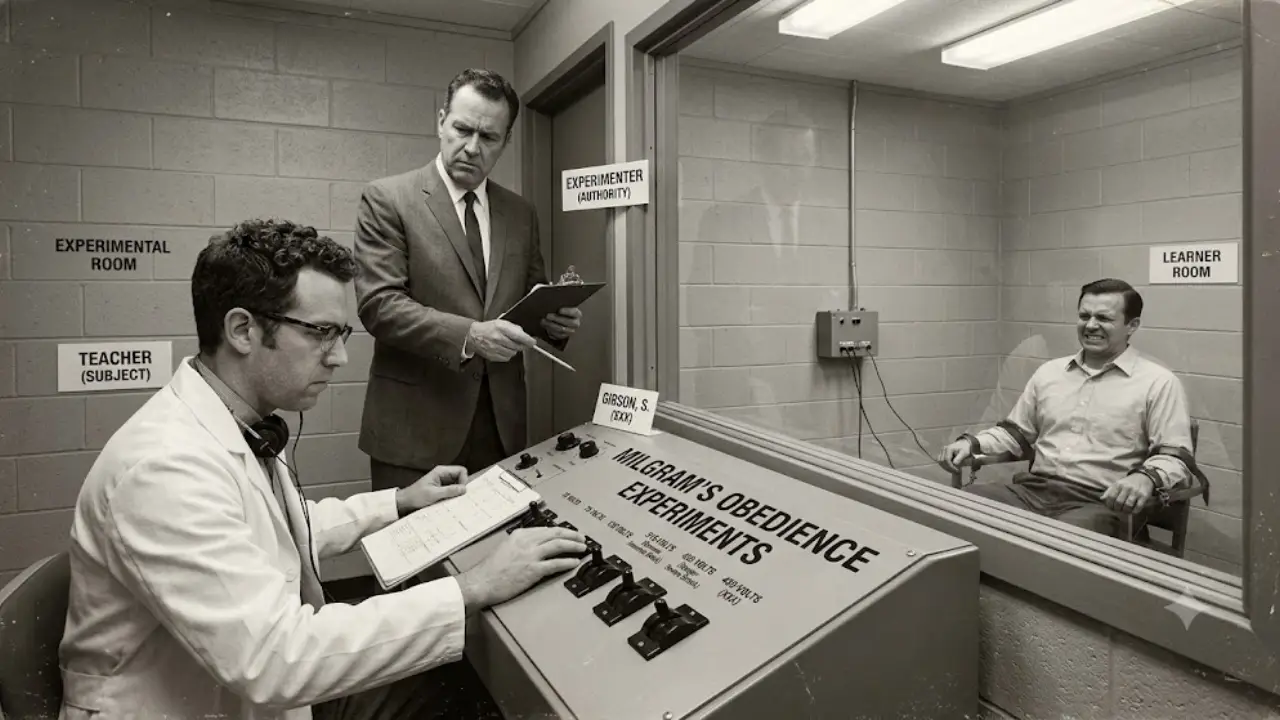
The man in the other room was screaming.
At least, that is what the person sitting in the Yale laboratory believed.
He had been told that this was a scientific experiment about learning. His job seemed simple: read a series of word pairs to another man and, whenever that man made a mistake, press a button.
The first button delivered 15 volts.
Then came 30.
45
46
The numbers climbed steadily.
Then the man behind the wall began to complain.
At 150 volts, he demanded to be released.
The person holding the switch hesitated.
Surely this was enough.
He turned towards the experimenter.
“Should I continue?”
The experimenter calmly told him to continue.
The next switch was waiting.
And then another.
And another.
By the time the machine reached its final setting of 450 volts, something extraordinary had happened.
The experiment was no longer really about memory.
It had become a test of something far more uncomfortable:
How far can an ordinary person go when somebody who appears to have legitimate authority tells them to continue?
In 1963, psychologist Stanley Milgram published the results of what would become one of the most famous — and controversial — experiments in psychology.
The number that entered history was 65%.
But that number is not the most interesting part.
The real mystery is what happened between the first button and the last one.
Because the people pressing those buttons were not emotionless monsters.
Many were visibly distressed.
And that is where the story becomes much darker.
They Did Not Know They Were in an Obedience Experiment
The participants did not arrive at Yale thinking:
“Today I am going to find out whether I obey authority.”
They believed they were participating in a study concerning learning and punishment.
Milgram’s original experiment recruited 40 men aged 20 to 50 from the New Haven area.
Their occupations and educational backgrounds varied.
They were paid $4.50 for participating.
The laboratory itself was important.
This was Yale University a place that carried enormous scientific prestige.
The experimenter looked and behaved like a scientist.
The equipment looked frighteningly real.
The participant was therefore not simply receiving an order from a stranger in the street.
He was inside an apparently legitimate scientific institution.
That distinction matters.
Because the experiment was quietly asking a more complicated question:
What happens when an instruction comes wrapped in legitimacy?
Milgram reported that 26 of the 40 participants, or 65%, continued all the way to the maximum 450-volt setting.
Fourteen stopped earlier.
But there is an important detail that is often lost in retellings.
The participants were not casually pressing buttons.
Milgram described considerable nervous tension, including sweating, trembling, stuttering and nervous laughter.
Some participants showed severe signs of emotional strain.
So the famous experiment did not produce a room full of enthusiastic torturers.
It produced something more disturbing:
people who could be deeply uncomfortable with what they were doing and yet continue doing it.
The Machine Was Fake. The Fear Was Not.
There was a secret at the centre of the laboratory.
The shock generator did not actually deliver the increasing electrical shocks.
The learner was a confederate.
The screaming was part of the experimental procedure.
But the participant did not know that.
Before the main procedure began, the participant received a small sample shock to make the equipment appear credible.
Then the staged experiment began.
Every mistake meant another increase.
There was something psychologically clever about the arrangement.
Nobody was initially asked to administer a devastating shock.
The participant was asked to perform a small task.
Then another.
Then another.
The journey from 15 volts to 450 volts was therefore not one giant decision.
It was a staircase.
And every step made the next one easier to take.
This is one of the hidden ideas inside Milgram’s work that deserves more attention:
People may not experience a dangerous decision as dangerous when it arrives as the next step in an already accepted procedure.
The first decision creates the context for the second.
The second helps normalise the third.
And eventually a person can find himself somewhere he never imagined he would go.
Then Came 150 Volts
There is a number that may actually be more revealing than 450.
It is 150.
At 150 volts, the learner’s protests became unmistakable. He demanded to be released.
This became an important psychological turning point.
Later analysis of Milgram’s experiments found that participants were particularly likely to disobey around this point.
A 2008 meta-analysis examining Milgram’s obedience studies found that disobedience was especially likely when participants first encountered the learner’s demand to be released at 150 volts.
That finding matters because it challenges the simplest version of the Milgram story.
If participants were merely programmed to obey authority, why did so many hesitate precisely when the victim’s resistance became undeniable?
Something else was happening.
The participant was negotiating between competing demands:
The experimenter says continue.
The learner says stop.
And the participant is caught between them.
The laboratory has suddenly become a miniature society containing two authorities the authority giving instructions and the person suffering from them.
The question is no longer merely:
“Will I obey?”
It becomes:
“Whose claim on me should matter more?”
The Famous 65% Hides a Much Bigger Experiment
Milgram’s famous 40-person experiment is only one piece of the story.
Across his series of obedience experiments, Milgram created 23 different experimental conditions.
A later synthesis examined 21 of those conditions involving 740 participants.
The overall maximum-obedience rate across those conditions was 43.6%.
That number is dramatically different from the famous 65%.
Why?
Because changing the situation changed the behaviour.
Researchers found that obedience was influenced by factors including:
how directly the experimenter gave instructions;
how legitimate the experimenter appeared;
whether the experimenter behaved consistently;
whether other people encouraged resistance;
how close the learner was;
how intimate the teacher-learner relationship was;
how directly the participant could observe the learner;
and the physical relationship between participant and experimenter.
This is perhaps the most important correction to the popular Milgram story.
There was no single “obedience switch” inside the human brain.
The environment mattered.
Change the social architecture and the result could change.
Distance Was a Psychological Weapon
Imagine two versions of the same event.
In the first, the person suffering is separated from you.
You hear him.
You know he is there.
But there is a wall.
In another version, the suffering person is physically much closer.
You can see him.
You can observe his reactions.
The psychological distance has collapsed.
Milgram’s experiments showed that proximity to the learner affected obedience.
Later analysis confirmed that the relationship between the teacher and learner including physical proximity and intimacy was among the factors associated with whether participants continued to the maximum.
This is a surprisingly modern finding.
Technology has spent decades making distance easier.
A person can now make decisions affecting somebody thousands of kilometres away without ever seeing the person affected.
A bureaucrat sees a file.
A banker sees a number.
An algorithm sees a data point.
A platform sees an account.
A manager sees a productivity chart.
The human being on the other side can disappear behind the interface.
Milgram’s laboratory was small.
The psychological problem it revealed is enormous.
But Were They Really “Just Obeying”?
This is where the experiment’s history becomes much more complicated.
Milgram’s interpretation emphasised the power of authority and the tendency of individuals to enter an agentic state behaving as instruments of another person’s authority.
But later psychologists questioned whether that explanation went far enough.
Researchers including Stephen Reicher and S. Alexander Haslam argued that participants may not simply have surrendered responsibility.
Some could have been actively identifying with the experimenter’s scientific mission.
That creates an uncomfortable alternative interpretation.
Perhaps the participant was not thinking:
“I have no choice.”
Perhaps he was thinking:
“This is an important scientific experiment, and I am helping the experimenter complete it.”
Those are psychologically very different states.
The first is passive submission.
The second involves identification.
And if identification matters, obedience becomes less about weakness and more about which group, goal or authority a person feels committed to.
That makes Milgram much more relevant to ordinary institutions.
The Experimenter Did Not Need to Threaten Them
This is another detail often lost in popular culture.
The experimenter did not need to point a weapon at the participant.
He did not physically force him.
He used standardised verbal prompts when participants hesitated.
The authority therefore came largely from the situation itself.
Yale.
The laboratory.
The equipment.
The scientific language.
The confident experimenter.
The carefully structured procedure.
Together they created a world in which continuing seemed, at least initially, to be the scientifically correct thing to do.
This is why Milgram’s experiment remains so unsettling.
The frightening instruction did not sound like:
“Be cruel.”
It sounded like:
“Please continue. The experiment requires that you continue.”
Cruelty rarely announces itself as cruelty.
Sometimes it arrives disguised as procedure.
Then History Opened the Laboratory’s Filing Cabinet
For decades, the famous experiment was largely remembered through Milgram’s published accounts.
But later scholars went back to the archives.
They examined recordings, transcripts and previously unpublished material.
And the neat textbook story became less neat.
Historian of psychology Stephen Gibson examined archival material from Milgram’s experiments and identified previously unreported procedural flexibility.
In three sessions of one experimental condition, when a participant attempted to resist, the experimenter left the room, apparently to consult the learner, then returned and told the participant that the learner was willing or able to continue.
The tactic was not simply part of the rigid procedure as later readers might assume. Gibson’s analysis found that its use did not always conform to the agreed conditions and that it disappeared from later experimental conditions and published accounts.
That does not erase Milgram’s findings.
But it changes the historical question.
The experiment was not necessarily a perfectly mechanical machine in which the same instructions produced the same behaviour every time.
The interaction between participant and experimenter mattered.
The experiment itself was partly a conversation.
The participant could resist.
The experimenter could persuade.
And the boundary between standardised procedure and human interaction was not always as clean as the textbook version suggests.
Could Scientists Repeat the Experiment Today?
Not in its original form.
The ethical landscape has changed dramatically.
The original study exposed participants to intense psychological distress while deceiving them about the true purpose and consequences of their actions.
Modern research ethics place far greater emphasis on informed consent, risk minimisation, debriefing and protection from unnecessary psychological harm.
The American Psychological Association’s ethics standards place restrictions on deception and require scientific justification when deception is used. Researchers must not deceive participants about significant physical risks or severe emotional distress.
The Belmont Report, issued by the U.S. National Commission for the Protection of Human Subjects, established three major principles for ethical human research:
respect for persons, beneficence and justice.
India’s Indian Council of Medical Research (ICMR) likewise provides ethical guidance for research involving human participants.
So Milgram’s experiment belongs to an earlier period of psychology — one in which researchers were still learning where the boundaries of experimentation should be drawn.
There is a remarkable irony here.
An experiment about obedience to authority helped provoke questions about when scientific authority itself should be challenged.
A Modern Replication Asked a Safer Question
In 2006, psychologist Jerry Burger conducted a partial replication.
He did something Milgram’s original researchers could not do by today’s ethical standards:
He stopped participants before the most extreme part of the procedure.
The study involved 70 adults.
Participants were taken only to the point at which the learner first protested at 150 volts.
The researchers then stopped the procedure.
The results were striking.
About 70% continued beyond 150 volts in the baseline condition.
Milgram had found 82.5% continuing beyond the comparable point in his relevant experiment.
The difference was not statistically significant according to Burger’s analysis.
But we must be precise.
Burger did not demonstrate that 70% of modern people would administer 450 volts.
The experiment stopped at 150 volts.
The researchers used Milgram’s earlier pattern to estimate what might have happened beyond that point.
That is an important distinction.
Good science becomes more interesting, not less, when we admit exactly what the evidence cannot tell us.
And Then Came Another Surprise
Burger also tested what would happen if participants watched another person refuse to obey the experimenter.
The obvious prediction was simple:
If people see someone else refuse, they should become more willing to refuse themselves.
But the result was not as dramatic as expected.
The participants who saw a confederate refuse did not show a statistically significant reduction in obedience compared with those who did not see such a model.
Again, Milgram refuses to become a simple morality tale.
There is no single psychological lever.
No universal formula.
No “obedience gene”.
People respond to combinations of authority, context, relationships, personality and interpretation.
So What Did Milgram Actually Prove?
Here we need to be careful.
Milgram did not prove that 65% of human beings are naturally cruel.
He did not prove that ordinary people will obey absolutely any authority.
He did not prove that people lose their morality when an authority figure enters the room.
And he certainly did not prove that human beings are secretly waiting for an opportunity to hurt one another.
What he demonstrated was narrower but arguably more important.
Under a particular set of social conditions, ordinary people could continue an action that appeared to conflict with their immediate moral discomfort.
And when Milgram changed the surrounding conditions, obedience changed too.
The later meta-analysis is particularly important here because it showed that obedience was associated with eight measurable situational factors, including authority directiveness and legitimacy, group pressure, learner proximity and intimacy, and the distance between participant and experimenter.
The human being was not isolated from his environment.
The environment was part of the experiment.
The Darkest Lesson May Not Be About Obedience
Perhaps Milgram’s most unsettling discovery can be expressed without mentioning electricity at all.
Imagine a person making a decision.
He believes someone above him is responsible.
The person above him believes someone else designed the policy.
The policy came from a committee.
The committee relied on a report.
The report came from a computer model.
The computer model followed an algorithm.
And somewhere along that chain, something harmful happens.
Who made the decision?
Everyone did.
And nobody did.
This is the modern version of the psychological problem Milgram exposed.
Responsibility can become fragmented.
The person pressing the button can tell himself:
“I didn’t create the rule.”
The person creating the rule can say:
“I didn’t carry it out.”
The system can continue moving because responsibility has been distributed across the machinery.
That is why Milgram remains relevant in a world of algorithms, automated decisions, bureaucracies and large institutions.
The laboratory was built around a fake electrical machine.
Modern society is filled with real systems in which one person can initiate an action whose consequences are experienced by someone they will never meet.
The Question We Should Ask Today
The usual question is:
“Would you have pressed the button?”
It sounds like a moral challenge.
But it is probably the wrong question.
A better question is:
“At what point would you have questioned the system?”
Would you question the first instruction?
The tenth?
The moment somebody complained?
The moment the authority sounded uncertain?
The moment another person refused?
Or only after something terrible had already happened?
That is where Milgram becomes personal.
Because obedience is rarely a dramatic moment.
It is often a sequence.
One small agreement.
Then another.
Then another.
Until stopping feels strangely harder than continuing.
The Experiment That Never Really Ended
The Yale laboratory closed decades ago.
The fake shock generator became history.
The participants went home.
But the psychological question never disappeared.
It followed us into offices, schools, armies, hospitals, governments, corporations and now into digital systems.
Whenever an instruction comes from someone who appears more knowledgeable, more powerful or more legitimate, we face a tiny version of Milgram’s dilemma.
We have to decide whether authority is actually evidence.
It isn’t.
A uniform is not evidence.
A title is not evidence.
A laboratory coat is not evidence.
A prestigious institution is not evidence.
An algorithm is not evidence simply because a computer produced the answer.
And a procedure is not morally correct simply because it is called procedure.
That may be the deepest lesson hidden beneath the famous 450-volt machine.
The machine was fake.
The screams were fake.
But the human conflict was real.
And the most frightening discovery was not that ordinary people could obey.
It was that ordinary people could become uncertain about where their own responsibility ended and somebody else’s authority began.
More than sixty years later, that boundary remains one of the most dangerous places in human psychology.
Key Unfoldings
- Milgram’s famous baseline study involved 40 male participants.
- 26 participants (65%) reached the maximum 450-volt setting.
- Participants believed the shocks were real.
- The learner was actually a confederate and was not receiving the shocks.
- Participants displayed substantial emotional distress.
- 150 volts became an important point of resistance.
- Milgram conducted numerous experimental variations, not just the famous baseline experiment.
- A later synthesis examined 21 conditions involving 740 participants, finding an overall maximum-obedience rate of 43.6% across those conditions.
- Obedience varied with authority, proximity, relationships, group pressure and experimental setting.
- Jerry Burger’s 2006 partial replication involved 70 adults and stopped at 150 volts for ethical reasons.
- 70% continued beyond 150 volts in Burger’s baseline condition.
- Later archival research has shown that some experimental procedures were more flexible and interactive than the classic textbook account suggests.
- Modern ethics make a direct repetition of the original high-distress procedure inappropriate.
- The strongest conclusion is not that humans blindly obey, but that social environments can powerfully influence how people interpret responsibility and moral choice.
Authentic Sources and Further Reading
Stanley Milgram — Original Research
Milgram, S. (1963). Behavioral Study of Obedience. Journal of Abnormal and Social Psychology, 67(4), 371–378. DOI: 10.1037/h0040525.
Jerry M. Burger — Modern Partial Replication
Burger, J. M. (2009). Replicating Milgram: Would People Still Obey Today? American Psychologist, 64(1), 1–11. DOI: 10.1037/a0010932.
Meta-analysis
Haslam, S. A., Reicher, S. D., Millard, K. & McDonald, R. (2014). Meta-Milgram: An Empirical Synthesis of the Obedience Experiments. PLOS ONE, 9(4), e93927. The analysis included 21 conditions and 740 participants.
Archival Research
Gibson, S. (2013). “The Last Possible Resort”: A Forgotten Prod and the In Situ Standardization of Stanley Milgram’s Voice-Feedback Condition. History of Psychology, 16(3), 177–194.
Rhetorical/Archival Analysis
Gibson, S. Milgram’s Obedience Experiments: A Rhetorical Analysis. British Journal of Social Psychology. The research examines recordings and transcripts and highlights negotiation, rhetoric and procedural flexibility within the experiments.
Relevant Government and Professional Resources
- U.S. Department of Health and Human Services — Belmont Report: principles governing ethical research involving human participants.
- American Psychological Association — Ethical Principles and Code of Conduct: standards concerning research, deception, informed consent and participant welfare.
- Indian Council of Medical Research — National Ethical Guidelines: India’s framework for ethical research involving human participants.
The Unfolded Shelf- Fact-Check
The often-repeated statement that “65% of people will obey an authority figure and administer 450 volts” is too broad.
The accurate statement is that 26 of 40 participants (65%) reached the maximum setting in Milgram’s particular baseline experiment. Across 21 analysed conditions containing 740 participants, the overall maximum-obedience rate was 43.6%, demonstrating how strongly the surrounding situation affected behaviour.
That distinction is not a minor technicality.
It is the mystery at the centre of the entire experiment.
Related Articles you may read:
The Memory Thousands of People Shared—But Was Wrong
How collective false memories can become stronger than individual doubt.
Why Your Brain Sometimes Hears Your Name in a Crowd
The strange psychology of selective attention and pattern detection.








Leave a Reply