
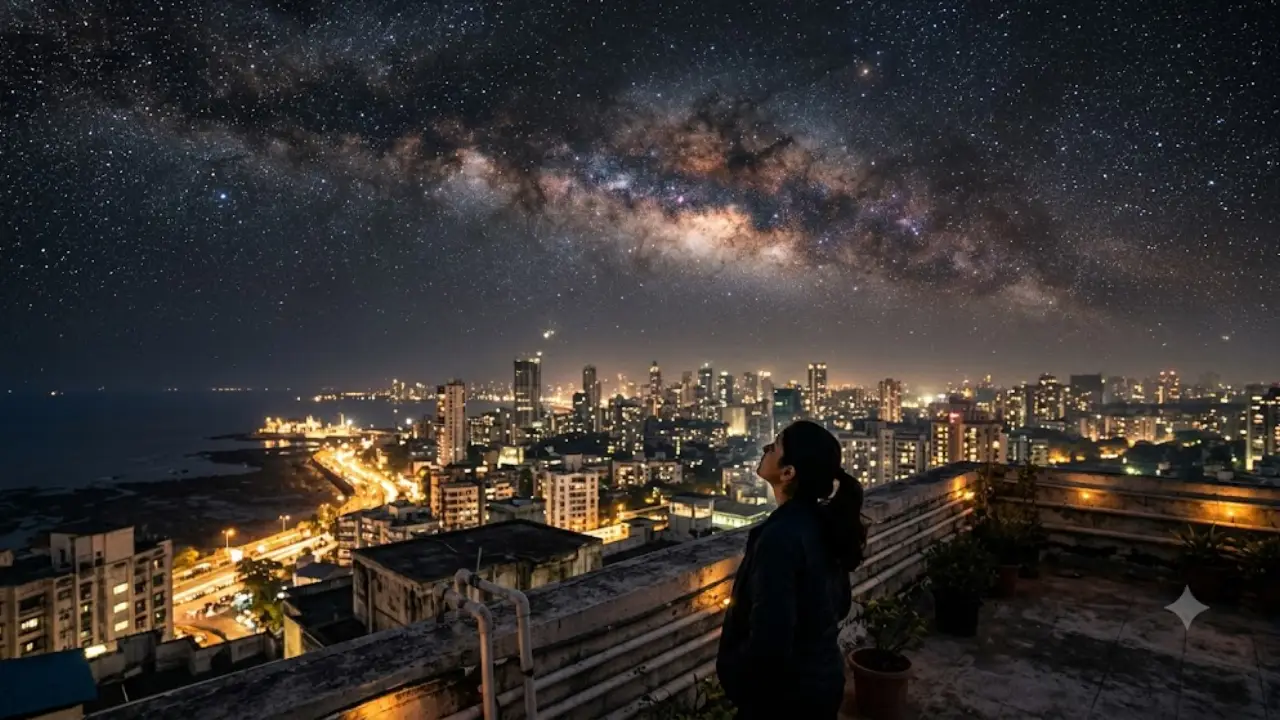
September 2026 Night Sky
At 9 p.m., the city tells you that the day is over.
The shops are still glowing. Apartment windows are lit. Cars move beneath white streetlamps. A billboard shines brighter than it has any reasonable business doing.
You look upward.
There are perhaps five stars.
It is tempting to conclude that there isn’t much happening.
That conclusion is spectacularly wrong.
Above that artificial ceiling, September 2026 is busy. Venus is preparing to become almost absurdly bright. Jupiter is climbing into the morning sky. The Moon will pass across Jupiter from some parts of Earth. A Harvest Moon will rise beside Saturn. Andromeda will be carrying light that has travelled for roughly 2.5 million years. Triangulum will be waiting for anyone patient enough to find it. Comets will be moving through the solar system. Earth itself will briefly become a lamp for the dark side of the Moon.
And there is something even more remarkable.
Much of this universe is visible without a professional observatory.
The difficulty is that modern humans have become extraordinarily good at looking everywhere except up.
September’s real astronomical story, therefore, is not simply what is happening in the sky.
It is how much of it we have stopped seeing.
September’s sky is not one spectacular event, it is a month-long conversation
The internet likes astronomical events that sound dramatic.
“Rare.”
“Once-in-a-lifetime.”
“Five planets align.”
“Supermoon.”
“Blood Moon.”
The problem is that astronomy rarely behaves like a fireworks display.
The most rewarding nights are often collections of smaller events: a bright planet here, a crescent Moon there, a galaxy hiding in the darkness, a faint triangular glow that turns out to be dust scattered through the solar system.
That is precisely why September 2026 is interesting.
NASA’s September guide highlights Venus, the September equinox and the Harvest Moon, while wider observing guides add Jupiter’s lunar encounter, Andromeda, Triangulum, comets, Earthshine and zodiacal light.
Think of September less as a celestial “event” and more as a month-long treasure hunt.
The quick map
| When | What is happening | Best for |
| Sept. 1–2 | Venus close to Spica | Everyone |
| Sept. 3 | Moon near the Pleiades | Naked eye/binoculars |
| Sept. 8 | Moon and Jupiter extremely close; occultation from some regions | Naked eye/telescope |
| Sept. 9–10 | September Epsilon-Perseids | Meteor watchers |
| Around Sept. 10–11 | New Moon and dark-sky window | Deep-sky observers |
| Sept. 14 | Moon and Venus close | Everyone |
| Sept. 18 | Venus reaches peak brilliance | Everyone |
| Sept. 22 | September equinox | Everyone |
| Sept. 26 | Harvest Moon near Saturn and Neptune | Naked eye/telescope |
| Throughout September | Andromeda, Triangulum, comets and deep-sky objects | Binoculars/telescope |
The precise appearance of every event depends on latitude, longitude, weather and local horizon conditions. That last point is important: there is no single “September sky.”
There are billions of slightly different versions of it.
September begins with a planetary illusion
On September 1 and 2, Venus approaches Spica, the brightest star in Virgo.
At first glance, the pair looks like two bright stars that happen to have wandered close together.
One of them, however, is a planet roughly 108 million kilometres from the Sun.
The other is a star system roughly hundreds of light-years away.
Their apparent closeness is therefore a trick of perspective.
The universe is full of these tricks.
Two objects can look like neighbours while being separated by incomprehensible distances. Constellations themselves are largely products of this effect: humans draw patterns between stars that may have no meaningful physical relationship with one another.
Venus makes the pairing particularly conspicuous because it is extraordinarily bright.
And it becomes even more interesting later in the month.
Venus is about to become brilliant and thinner
Around September 18, Venus reaches peak brilliance for its current evening appearance. NASA identifies September 18 as the key date, while current observing reports place its brightness around magnitude −4.8.
There is a beautiful contradiction here.
Venus becomes extremely bright while its visible illuminated fraction is shrinking.
Through a telescope, Venus is not going to look like a miniature full Moon.
It is becoming a crescent.
Why?
Because Venus is an inferior planet it orbits closer to the Sun than Earth does. As its position changes relative to Earth and the Sun, we see different portions of its sunlit hemisphere.
This is exactly the sort of observation that turns astronomy from memorising facts into understanding geometry.
Galileo’s observations of Venus’s phases were historically important because they were incompatible with the simplest version of the old geocentric model.
Four centuries later, the same planet is still quietly demonstrating the same geometry.
The difference is that now your backyard can be the laboratory.
Jupiter plays a completely different game
If Venus owns the evening, Jupiter increasingly owns the early morning.
By September, Jupiter is a conspicuous pre-dawn object. It rises progressively earlier and becomes one of the easiest planetary targets for observers willing to sacrifice a little sleep. Current September guides place it prominently in the eastern morning sky.
And then comes September 8.
The Moon moves extraordinarily close to Jupiter.
From some locations, something much more dramatic happens:
Jupiter disappears.
Not because the planet suddenly dims.
Not because clouds arrive.
Not because Jupiter has “moved behind” the Moon in space.
The Moon simply passes between us and Jupiter along our line of sight.
That is a lunar occultation.
But this is where generic astronomy articles can become misleading.
The occultation is not globally visible.
Whether Jupiter actually disappears depends on where you are standing on Earth. Current calculations place the occultation path across selected parts of the world, while many other observers see only a close apparent encounter.
That is one of astronomy’s great recurring lessons:
The sky is not the same for everyone.
A celestial event can be spectacular from one country and completely ordinary from another.
The Moon is not merely scenery
We tend to treat the Moon as the background character of astronomy.
That is a mistake.
The Moon is an extraordinarily useful celestial clock and pointer.
During September 14–20, NASA recommends using it as a guide to find Antares and the Teapot of Sagittarius, with dark skies potentially revealing the Milky Way’s central regions.
This is an old observing technique with a modern advantage.
Instead of trying to memorise a sky map, let the Moon do some of the navigation for you.
It is nature’s signpost.
The September equinox is Earth’s balancing act
Around September 22, the Sun crosses Earth’s equatorial plane in the familiar September equinox.
In the Northern Hemisphere, astronomical autumn begins.
In the Southern Hemisphere, spring begins.
People often say the equinox produces exactly equal day and night everywhere.
That is close enough for casual conversation but not strictly correct.
Atmospheric refraction and the finite apparent size of the Sun mean sunrise and sunset geometry does not produce a mathematically perfect 12-hour day everywhere on the equinox.
The larger point is more interesting.
The equinox is not Earth suddenly changing seasons because somebody flipped a cosmic switch.
It is a consequence of Earth’s 23.4-degree axial tilt and its continuing orbit around the Sun.
The seasons are geometry.
And geometry, when viewed on planetary scales, becomes spectacular.
Then comes the Harvest Moon
On September 26, the full Moon arrives as the traditional Harvest Moon in the Northern Hemisphere the full Moon closest to the September equinox.
NASA describes it rising near Saturn and Neptune. Saturn is bright enough for naked-eye observation; Neptune is much fainter and requires optical aid.
The Harvest Moon itself, however, is often surrounded by mythology that astronomy does not require.
It is not physically larger.
It is not a special species of Moon.
It does not suddenly become more powerful.
The name comes from the seasonal relationship between moonrise times and the equinox, historically useful during harvest periods.
And then there is the famous orange Moon.
Yes, it can look orange.
But the Moon has not changed colour.
When it sits low near the horizon, its light travels through a longer path in Earth’s atmosphere. Shorter wavelengths are scattered more strongly, leaving the warmer colours more prominent.
The orange Harvest Moon is therefore partly a story about Earth’s atmosphere getting between you and the Moon.
The real show may be two galaxies you cannot easily see
Now leave the bright Moon behind.
Find a genuinely dark place.
Turn your attention toward the region of Andromeda.
Somewhere there is a faint smudge.
It looks unimpressive.
That is because your brain has no intuitive scale for what you are looking at.
It is the Andromeda Galaxy.
Approximately 2.5 million light-years away.
The light entering your eyes tonight began its journey roughly 2.5 million years ago.
That means the human eye can, under suitable conditions, directly receive photons that started travelling toward Earth before our species had anything resembling modern civilisation.
And Andromeda is not alone.
The Triangulum Galaxy (M33) lies roughly 2.7 million light-years away and is a rewarding binocular target under dark skies.
Here the telescope industry teaches us a useful lesson by accident.
A bigger telescope does not automatically produce a better experience.
For faint, diffuse galaxies, darkness can matter more than magnification.
A modest pair of binoculars under a dark sky can outperform an expensive telescope pointed from the middle of a brightly illuminated city.
The universe has no respect for your equipment budget.
September’s comets are fascinating precisely because they are not guaranteed spectacles
Two comets repeatedly appear in September observing guides: 10P/Tempel 2 and 161P/Hartley–IRAS.
But serious astronomy requires a little restraint here.
Neither should be sold to casual readers as “the comet you will definitely see with your naked eyes.”
Comets are moving, evolving objects. Their brightness predictions can change because their activity depends on solar heating, dust production, gas release and viewing geometry.
This is why comet observing is different from checking the Moon phase.
The Moon follows remarkably predictable cycles.
A comet can surprise you.
That uncertainty is not an inconvenience.
It is one of the reasons astronomers keep watching.
There is a light on the Moon that comes from Earth
A thin crescent Moon sometimes contains a strange secret.
The bright crescent is obvious.
But if conditions are right, you may also see the faint outline of the rest of the lunar disk.
That is Earthshine.
Sunlight reflects from Earth, travels to the Moon, illuminates its night side and then returns toward Earth.
In other words:
the Moon is being lit by our planet.
The phenomenon is especially noticeable around crescent phases.
And because Earth’s reflective properties vary with clouds, land, ice and other surface conditions, Earthshine is not merely pretty.
It can carry information about Earth itself.
The Moon becomes a distant mirror in which our planet is faintly visible.
Then there is the zodiacal light the solar system glowing with dust
Go somewhere genuinely dark around the right time near the equinox.
Look toward the horizon.
You may notice a faint triangular glow rising into the sky.
It can be mistaken for atmospheric haze.
It is not.
It is zodiacal light, sunlight scattered by dust particles distributed through the inner solar system.
NASA notes that the phenomenon is especially favourable around the equinoxes under dark conditions.
Recent research has made the story even more interesting by pointing toward Mars as a significant contributor to the dust associated with zodiacal light.
So that faint glow is not merely “light pollution in reverse.”
It is sunlight interacting with the debris of our planetary neighbourhood.
The solar system is dusty.
We just rarely notice.
The stars have not disappeared. We have illuminated them out of existence.
This may be September’s most uncomfortable fact.
A landmark global study found that approximately 83% of the world’s population lived under skies affected by artificial light pollution. More than 99% of populations in the United States and Europe were exposed. The Milky Way was estimated to be hidden from more than one-third of humanity.
And newer research shows that the problem has continued to evolve.
A 2026 global assessment found that in 2020 approximately 81% of the world’s population was exposed to at least the study’s low-level outdoor artificial-light category, compared with 71% in 2000. The estimated exposed population increased by roughly 100 million people per year for that category over the period studied.
The exact percentages depend on methodology, satellite measurements and definitions of exposure.
But the direction is difficult to ignore.
The night is getting brighter.
And the irony is exquisite.
Humanity has spent centuries inventing technology to reveal distant worlds.
Then we invented enough lights to hide them.
Why light pollution is more than an astronomy problem
A dark sky is not simply a luxury for telescope owners.
Artificial night lighting changes ecosystems, affects nocturnal wildlife and alters the natural cycle of darkness.
For astronomers, the effect is brutally simple.
Skyglow raises the background brightness against which faint objects must be detected.
Imagine trying to read grey text on white paper.
Now imagine making the paper brighter.
The text has not become fainter.
The contrast has disappeared.
That is what happens to galaxies and faint nebulae under a bright urban sky.
And this is why places such as India’s Hanle region in Ladakh, with exceptionally dark and dry high-altitude conditions, have become important for astronomy and dark-sky conservation.
Darkness itself has become something worth protecting.
Your phone may now be better at seeing the sky than you are
There is another twist.
Human eyesight evolved for survival, not astrophotography.
Your eye is brilliant at detecting movement and contrast.
It is not a long-exposure camera.
Your smartphone is.
Modern computational photography can combine exposures, reduce noise and recover faint structures that are difficult to perceive directly.
NASA now provides dedicated guidance for smartphone astrophotography, including stabilising the phone, controlling focus and using longer exposures where possible.
The result is philosophically interesting.
For most of human history, seeing the Milky Way required being somewhere dark.
Now a person living beneath a moderately bright sky can sometimes photograph details their eyes cannot easily see.
The camera is effectively giving human vision a longer memory.
A simple September experiment
Pick one clear night.
Do not begin with a telescope.
Take your phone outside.
Find the darkest location you can reasonably reach.
Turn away from direct streetlights.
Stabilise the phone.
Use the phone’s night or astrophotography mode.
Focus manually or lock focus if possible.
Take several exposures.
Do not use aggressive digital zoom.
Photograph the same region with and without the Moon.
Compare the images.
Try to identify what you captured afterward.
You may discover something unsettling.
The phone can show you a universe that your own eyes did not realise was there.
What can the naked eye really see?
Quite a lot.
Under a dark sky, the unaided eye can see thousands of stars, the Milky Way, planets, meteors and some deep-sky objects.
Andromeda is the spectacular example.
The galaxy is millions of light-years away, yet its combined light can become visible without a telescope.
The implication is almost absurd.
You do not need a billionaire’s observatory to look across millions of light-years.
You need:
darkness, clear weather, reasonably good eyesight and enough patience to stop looking at your phone.
That last requirement may be the hardest.
September’s real astronomical experiment
Try this.
On one night this month, sit somewhere dark for at least 20 minutes.
Don’t photograph anything.
Don’t open a sky app.
Don’t search for a constellation.
Just wait.
Your eyes gradually adapt to darkness. Stars that initially seemed absent begin appearing. The sky becomes deeper. Patterns emerge.
And something psychologically strange happens.
You stop seeing “a few stars.”
You begin seeing depth.
That is the difference between looking at the sky and experiencing it.
A city sky is largely a flat picture.
A dark sky reveals layers.
Nearby planets.
Stars within our galactic neighbourhood.
The Milky Way stretching across the galaxy.
And, beyond it, other galaxies.
The night sky is not a ceiling.
It is a cross-section through space and time.
The universe is not becoming less interesting. We are becoming less available to it.
This is perhaps the most important conclusion.
September 2026 does not need another exaggerated claim about a “once-in-a-lifetime cosmic spectacle.”
There are already enough of those.
The more interesting truth is quieter.
Venus is moving.
Jupiter is rising.
The Moon is crossing our line of sight.
Saturn is accompanying the Harvest Moon.
Andromeda is sending us ancient photons.
Dust is scattering sunlight through the solar system.
Earth is illuminating the Moon.
Comets are travelling through darkness.
And billions of people live beneath skies bright enough to erase much of this from view.
The universe has not gone silent.
We have simply turned up the lights.
And perhaps that is why September is worth going outside for.
Not because the sky is putting on a show especially for us.
It isn’t.
The sky has been doing this for billions of years.
What has changed is the audience.
For a few minutes, put the phone down.
Find the darkest patch of sky you can.
Look toward Venus.
Find Jupiter.
Try Andromeda.
Wait for your eyes to adjust.
And remember that every tiny point of light is not merely a “star.”
Some are planets.
Some are suns.
Some belong to galaxies.
Some photons began travelling before humans existed.
And some of what you see or fail to see is a record of what civilisation has done to the darkness between them.
The most extraordinary thing above your head this September may therefore not be a rare celestial event.
It may be the simple realisation that the universe has been visible all along.
We just forgot to look.
September 2026: The practical skywatcher’s checklist
For beginners:
Start with Venus, Jupiter and the Harvest Moon. No telescope required.
For binocular owners:
Try Andromeda and Triangulum, then explore star clusters around Perseus and nearby regions.
For telescope users:
Use the Moon–Jupiter encounter as an opportunity to watch an occultation if you are within the visibility zone; otherwise observe the close approach.
For astrophotographers:
The darker period surrounding the September New Moon is particularly useful for deep-sky work, while the Harvest Moon offers a very different photographic subject. Current photography guides also highlight the equinox period for zodiacal-light opportunities.
For city observers:
Do not give up because you cannot see the Milky Way. Bright planets, the Moon and Venus remain accessible even when light pollution destroys faint stars.
For serious observers:
Travel.
A few kilometres away from urban light can sometimes make a larger difference than buying a more expensive telescope.
Final Unfoldings
September 2026 gives us an unusual opportunity to think about astronomy in two directions at once.
One direction points outward:
Venus. Jupiter. Saturn. Andromeda. Triangulum. Comets. Dust. Galaxies.
The other points inward:
What have we lost by no longer looking?
The answer may be larger than a list of stars.
The night sky was once humanity’s oldest calendar, navigation system, mythology, laboratory and source of philosophical terror.
Today it is increasingly something we encounter as a wallpaper on a smartphone.
That may be the strangest astronomical transformation of all.
The universe has not moved farther away.
Our attention has.
And September gives us a chance to bring it back.
Sources
NASA’s official September 2026 skywatching guide provides the primary calendar for Venus, the equinox, the Moon and the Harvest Moon.
Current astronomical observing guides were cross-checked for Jupiter, lunar occultation, Andromeda, Triangulum, deep-sky objects and comet targets.
The global light-pollution statistics are based on the peer-reviewed Science Advances World Atlas of Artificial Night Sky Brightness.
Updated 2026 research on global exposure to outdoor artificial light was also considered when discussing the continuing expansion of artificial night illumination.








Leave a Reply