
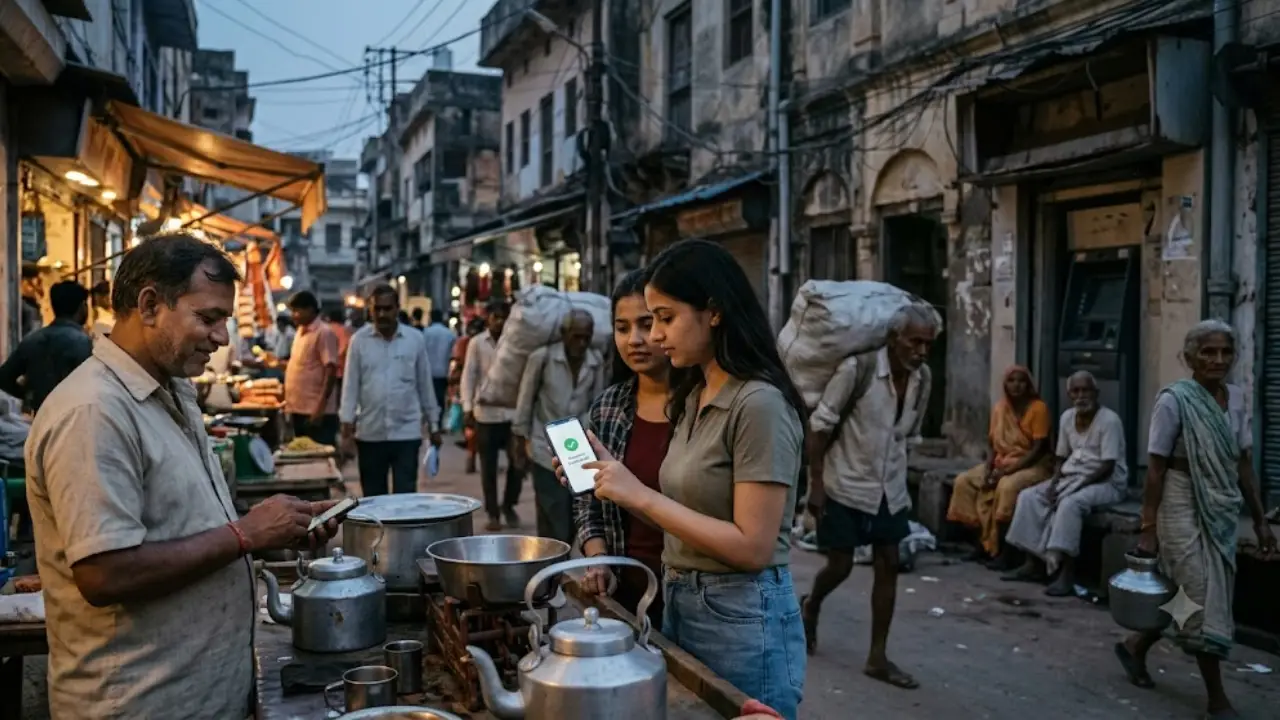
The familiar UPI QR code looks unchanged. The phone screen still says “₹5,000 paid.” There is no separate convenience fee staring back at the customer. Yet, from 15 October 2026, something important will change behind that familiar payment.
The National Payments Corporation of India (NPCI) has announced a 0.4% Merchant Discount Rate (MDR) on specified person-to-merchant (P2M) UPI transactions above ₹2,000, with a maximum charge of ₹300 for general merchants. Certain categories, including railways, telecom, insurance and fuel, will have a different capped structure. Person-to-person UPI transfers remain free.
That sounds like a small pricing adjustment.
It is more interesting than that.
UPI has spent a decade teaching Indians that paying digitally should feel almost invisible. In FY2025–26, it processed 24,161.69 crore transactions worth about ₹314.23 lakh crore, served more than 55.49 crore users and 6.5 crore merchants, and accounted for roughly 85% of India’s digital-payment transaction volume.
So the real question is not simply whether UPI is becoming expensive.
The more important question is:
If the customer is still not paying, who was paying for “free” UPI and who will pay now?
What Is Actually Changing?
The first thing to understand is what the new rule does not mean.
It does not mean that every UPI payment will suddenly carry a 0.4% charge.
The current framework is targeted at specified merchant payments above ₹2,000. P2P transactions remain free, while UPI transactions up to ₹2,000 have statutory protection from direct or indirect charges to the person making or receiving the payment.
From 15 October 2026, for applicable merchant transactions above ₹2,000:
| Transaction | Indicative treatment |
| P2P UPI payment | Free |
| P2M UPI up to ₹2,000 | No charge |
| Applicable P2M above ₹2,000 | 0.4% MDR |
| General merchant MDR ceiling | ₹300 |
| ₹75,000 transaction at 0.4% | ₹300 |
| Selected sectors such as railways, telecom, insurance and fuel | Special capped MDR structure |
The important word is merchant.
MDR is normally a charge associated with accepting a digital payment, rather than a consumer-facing UPI convenience fee. The announced framework therefore does not turn UPI into a conventional consumer transaction fee.
But economics rarely stops at the person who receives the bill.
The ₹2,000 Line Is More Important Than It Looks
Why ₹2,000?
Because it creates a deliberate dividing line between everyday digital payments and larger-value commerce.
The distinction is economically significant. Government data show that UPI’s P2M ecosystem is overwhelmingly dominated by small-ticket transactions. In FY2025–26, about 86% of P2M transactions were below ₹500.
That means the policy is attempting to preserve UPI’s most deeply embedded use case: buying vegetables, paying a tea shop, settling a restaurant bill or making a small retail purchase.
At the same time, a very small share of transactions can represent a disproportionately large share of value.
The Indian Express reported that in FY2025–26, only about 4% of P2M UPI payments were above ₹2,000, but those transactions represented roughly two-thirds of P2M payment value.
This is the central economic logic of the threshold.
The government can protect the high-frequency, low-value payment habit while creating a revenue mechanism around higher-value merchant commerce.
In other words, it is not really taxing the QR code.
It is trying to monetise the part of UPI where the economic value is concentrated.
Who Actually Pays the 0.4%?
Suppose a customer buys something worth ₹10,000.
At 0.4%, the MDR is:
₹10,000 × 0.004 = ₹40.
Formally, the merchant bears the ₹40.
But “who is charged?” and “who bears the economic cost?” are two different questions.
A merchant has several choices.
The first is absorption. The merchant simply accepts ₹40 as a payment expense and protects the customer’s price.
The second is margin compression. The merchant keeps the advertised price unchanged but earns slightly less.
The third is indirect recovery. Prices, discounts, cashback or promotional offers can change over time.
The fourth is behavioural substitution. A business could encourage another payment method if its economics are more attractive.
The current framework reportedly does not permit merchants to transfer the MDR directly to consumers as a payment surcharge.
That is important because otherwise the psychological effect could be immediate: consumers would see “UPI charge” every time they paid.
Instead, the more subtle risk is that the cost disappears into the merchant’s broader pricing decisions.
That makes the change less visible but not necessarily economically irrelevant.
Why the ₹300 Maximum Fee Matters
At 0.4%, a ₹75,000 transaction produces exactly ₹300 of MDR.
Above ₹75,000, the percentage calculation would produce more than ₹300, but the cap prevents that.
For example:
| Payment value | 0.4% calculation | MDR after ₹300 cap |
| ₹5,000 | ₹20 | ₹20 |
| ₹10,000 | ₹40 | ₹40 |
| ₹25,000 | ₹100 | ₹100 |
| ₹50,000 | ₹200 | ₹200 |
| ₹75,000 | ₹300 | ₹300 |
| ₹1,00,000 | ₹400 | ₹300 |
| ₹2,00,000 | ₹800 | ₹300 |
The cap dramatically changes the economics of very large payments.
For a ₹2 lakh payment, ₹300 is effectively only 0.15%.
For a ₹5 lakh payment, it falls to 0.06%.
This means the percentage-based burden is strongest around the lower end of the chargeable range and progressively becomes less important for very large transactions.
That structure makes sense if policymakers want to create payment-system revenue without making UPI prohibitively expensive for large-ticket commerce.
Small Merchant Versus Large Business
The same MDR does not mean the same thing to every merchant.
Consider a roadside retailer selling ₹200 items.
That merchant’s typical UPI transaction is below the threshold. The new MDR therefore has little direct effect.
Now consider a restaurant with an average bill of ₹4,000.
A 0.4% MDR means ₹16 on that payment.
For an e-commerce company processing a ₹20,000 purchase, the charge becomes ₹80.
The absolute number is small compared with the transaction value, but payment costs become meaningful when multiplied across millions of transactions.
The distinction becomes even more important for businesses operating with thin margins.
A retailer earning a 3% operating margin experiences a very different economic impact from a digital platform with a much larger margin.
The question is therefore not whether 0.4% is large.
It is whether 0.4% is large relative to the merchant’s margin and alternatives.
The Strange Economics of “Free” UPI
UPI was never economically free.
It was free at the point of use.
Those are not the same thing.
The payment infrastructure requires banks, switches, security systems, authentication, fraud monitoring, customer support, data infrastructure and continuous upgrades.
Someone has to fund those systems.
For years, India’s policy model deliberately suppressed MDR on UPI and RuPay debit-card transactions. The government instead used incentive mechanisms to support parts of the ecosystem.
For FY2026–27, the Union government’s outcome budget provides ₹2,000 crore for the incentive scheme promoting RuPay debit cards and low-value BHIM-UPI P2M transactions.
The government’s own earlier incentive structure illustrates the point clearly: small-merchant UPI transactions up to ₹2,000 could attract zero MDR while ecosystem participants received government-supported incentives.
So the “free” model was not a world without costs.
It was a different method of allocating them.
Why Did India Protect Free UPI?
Because price was part of the adoption strategy.
Imagine asking millions of small merchants in 2016 to install a digital payment system and then telling them every transaction would reduce their revenue.
Adoption would have been harder.
India instead created an extraordinary network effect.
Customers adopted UPI because it was convenient.
Merchants accepted it because customers wanted it.
More merchants increased its usefulness.
More users attracted more banks and applications.
And the larger ecosystem made the payment method even more convenient.
This is how infrastructure becomes habit.
By FY2025–26, UPI had reached more than 24,162 crore annual transactions, compared with just 1.78 crore in FY2016–17. Transaction value increased from ₹0.07 lakh crore to about ₹314 lakh crore.
That is not ordinary growth.
It is network-effect economics operating at national scale.
But Can “Free” Last Forever?
This is where the policy becomes intellectually interesting.
UPI has reached a scale at which even tiny costs become enormous.
At 24,161.69 crore transactions a year, a tiny fraction of a percentage point applied across the right transaction pool can generate substantial industry revenue.
At the same time, the infrastructure becomes increasingly important.
Cybersecurity costs rise.
Fraud prevention becomes more sophisticated.
Payment uptime becomes critical.
Consumers expect instant resolution when something fails.
Banks and payment companies must maintain systems capable of handling extraordinary volumes.
The RBI has previously described payment-system pricing as a balancing act: excessively high charges can discourage digital adoption, while excessively low charges can reduce incentives for investment.
That may be the deepest explanation for the new direction.
The argument is no longer simply:
“How do we make UPI popular?”
It is increasingly:
“How do we keep UPI economically sustainable after it has already become indispensable?”
Could Consumers Start Splitting Payments?
The ₹2,000 threshold creates an obvious loophole to think about.
Suppose a merchant bill is ₹4,000.
Could someone pay ₹2,000 twice?
Technically, the question is straightforward.
Economically, it is less straightforward.
If transaction splitting became widespread, the threshold would lose part of its intended purpose. Payment systems can also identify unusual transaction patterns, and merchant acquiring arrangements can be designed around transaction behaviour.
More importantly, a customer cannot assume that splitting payments will necessarily avoid applicable charges. The exact operational treatment depends on the merchant category, acquiring arrangement and NPCI framework.
The broader lesson is more interesting:
Whenever regulation creates a sharp numerical boundary, people have an incentive to reorganise behaviour around the boundary.
This is not unique to UPI. It is a basic feature of economic incentives.
Will This Bring Cash Back?
Possibly at the margin but probably not enough to reverse UPI’s structural advantage by itself.
Cash has a price too.
Someone must withdraw it.
Someone must count it.
Someone must store it.
Someone must reconcile the cash drawer.
There is theft risk.
There are counterfeit notes.
There are accounting costs.
There is no automatic digital audit trail.
UPI removes many of those frictions.
This is why the comparison should not be:
UPI = fee, cash = free.
It should be:
UPI cost versus the total economic cost of handling cash.
For a tiny street vendor, cash may remain perfectly practical.
For a large retailer, restaurant chain or e-commerce company, digital records and reconciliation can be worth far more than a fraction of a percent.
That is why MDR does not automatically make cash economically superior.
The Psychology of Losing Something That Was “Free”
There is another layer that spreadsheets cannot fully capture.
People hate newly introduced costs more than they value equivalent savings.
A customer who has always paid ₹10,000 through UPI without thinking about payment costs may react differently if an app suddenly says:
“UPI fee: ₹40.”
Even if ₹40 is objectively small, the mental experience has changed.
That is why keeping the charge away from the consumer-facing payment experience matters.
The customer continues to experience UPI as free.
The merchant experiences it as a business expense.
This may be a deliberate attempt to preserve the psychological architecture that made UPI successful.
The most powerful price is sometimes the price people never have to think about.
UPI and RuPay Are Part of the Same Larger Story
The simultaneous policy attention on UPI and RuPay is not accidental.
Both are domestic payment infrastructures.
The government has historically supported RuPay debit cards and low-value BHIM-UPI transactions through incentive programmes. The current framework continues to explicitly protect RuPay debit-card payments from charges.
This reflects a larger strategic ambition: build payment infrastructure that India controls rather than relying entirely on international card networks.
UPI has already become globally significant.
Government data put its share at approximately 49% of global real-time payment transaction volume, with UPI operational in 11 countries by 2026.
The objective therefore extends beyond cheap domestic payments.
It is also about building technological infrastructure with Indian ownership, interoperability and global reach.
The Merchant’s Real Choice
A merchant accepting UPI after October will not simply ask:
“Is 0.4% expensive?”
The better question will be:
“What does UPI save me?”
Suppose a business pays ₹40 MDR on a ₹10,000 transaction.
If accepting digital payment reduces cash handling, speeds reconciliation, reduces the need to maintain change, creates a transaction record and improves customer conversion, the ₹40 may be economically rational.
This is why MDR cannot be judged in isolation.
A payment method is a piece of business infrastructure.
The correct comparison is not payment fee versus zero.
It is:
digital-payment cost versus the full cost of alternative payment methods.
Could MDR Change Payment Habits?
It probably will at the margins.
Some businesses may encourage customers toward particular payment methods.
Some may adjust discounts.
Some may rethink how they price high-value transactions.
Some consumers may become more conscious of whether they are making a large UPI payment.
Cards could become more attractive in some situations, especially where rewards or credit benefits compensate the consumer.
Cash could remain attractive for certain small businesses.
But UPI possesses one enormous advantage: habit.
By July 2026, UPI was processing approximately 2,365.8 crore transactions in a single month, worth ₹29.87 lakh crore, through 741 live banks.
Once a payment network reaches that scale, a small pricing change does not automatically destroy it.
Network effects create inertia.
The Bigger Question: Who Should Fund UPI?
There are four obvious candidates.
Consumers could pay directly.
That would be simple but politically and behaviourally risky.
Merchants can pay MDR.
That protects the consumer experience but raises business costs.
Banks and payment companies can absorb the expense.
That preserves adoption but can weaken the economics of the intermediaries supporting the network.
Government can subsidise the system.
That protects affordability but moves the cost onto public finances.
There is no magical fifth option where infrastructure costs disappear.
The current model is moving toward a hybrid answer:
keep everyday and consumer-facing UPI extremely cheap while allowing selected higher-value commercial transactions to contribute to the economics of the network.
That is much more nuanced than saying “UPI is no longer free.”
What Could Go Wrong?
The risks are real.
Transaction splitting could become more common.
Some merchants could favour cash.
Some businesses could quietly recover costs through pricing.
High-volume merchants could negotiate better economics than smaller businesses.
Payment companies could design new products around fee differences.
Consumers could gradually become more sensitive to transaction size.
And if future pricing expands beyond the current carefully protected categories, the psychological promise of UPI could weaken.
The greatest danger is therefore not today’s 0.4%.
It is scope creep.
If users begin to believe that “UPI used to be free but now every payment can cost something,” trust in the original proposition could deteriorate even if most transactions remain free.
Is MDR a Threat to UPI?
Probably not at least not in its current targeted form.
The policy deliberately protects the smallest transactions and keeps P2P payments free. That preserves the behavioural foundation of UPI.
At the same time, charging selected higher-value merchant transactions creates a path toward greater commercial sustainability.
The real test will be what happens after October 2026.
Three indicators deserve watching:
First, transaction growth.
If UPI volume continues rising rapidly, the network may absorb MDR without major behavioural damage.
Second, merchant behaviour.
If businesses begin actively pushing customers toward cash or other payment methods, the cost is becoming economically meaningful.
Third, future pricing.
If MDR remains narrow and predictable, the system may stabilise. If charges expand repeatedly, the original “free UPI” proposition could gradually disappear.
The Larger Policy Contradiction
India wants two things simultaneously.
It wants cheap digital payments because affordability drives adoption.
It also wants financially sustainable payment infrastructure because infrastructure requires continuous investment.
These goals are not necessarily contradictory.
The mistake would be to think that the only choices are:
completely free UPI
or
expensive UPI.
There is a large middle ground.
A payment system can be free for a ₹300 grocery purchase while charging a carefully capped amount on a ₹1 lakh commercial transaction.
It can protect consumers while monetising commercial value.
It can preserve the network effect while gradually reducing dependence on subsidies.
That is what makes the new MDR framework more significant than its 0.4% headline suggests.
UPI Was Free. But Was It Ever Really Free?
The answer is no.
It was free to the user at the moment of payment.
The cost was distributed across government incentives, banks, payment companies, merchant economics and the wider digital-payment ecosystem.
That model was extraordinarily effective because it prioritised adoption.
And it worked.
UPI went from a fledgling payment system with 1.78 crore annual transactions in FY2016–17 to more than 24,162 crore in FY2025–26.
The next phase is different.
India no longer needs to convince the population that digital payments exist.
It needs to make the infrastructure behind them resilient, secure and economically sustainable without destroying the affordability that made UPI successful.
That is why the most important number is not 0.4%.
It is ₹2,000.
That number represents the boundary between protecting UPI’s mass-market habit and beginning to extract revenue from its commercial scale.
And the ₹300 cap tells us something else: policymakers are trying to put a ceiling on how painful the transition becomes for high-value payments.
So the future of UPI may not be a simple journey from free → paid.
It may instead be:
free where adoption matters most, paid where commercial value is greatest, and subsidised where public policy still demands it.
The real experiment begins on 15 October.
If merchants quietly absorb the cost, consumers may barely notice.
If businesses change pricing, payment preferences or cash incentives, the effects will become visible.
And if the model successfully finances more secure and reliable infrastructure without weakening adoption, India may have solved a problem that many digital-payment systems eventually face:
How do you make something cheap enough for everyone, but valuable enough to sustain itself?
That is the real story behind UPI’s first serious step toward commercialisation.
The QR code may look exactly the same.
The economics behind it will not.
UPI MDR: The Numbers That Matter
| Indicator | Current position |
| UPI annual transactions, FY2025–26 | 24,161.69 crore |
| UPI annual transaction value, FY2025–26 | ₹314.23 lakh crore |
| UPI users, June 2026 | 55.49 crore |
| Merchants served | 6.5 crore |
| Live UPI banks, July 2026 | 741 |
| UPI share of India’s digital-payment volume | ~85% |
| Global real-time payment volume share | ~49% |
| P2M transactions below ₹500 | ~86% |
| MDR for applicable P2M transactions above ₹2,000 | 0.4% |
| Maximum MDR for general merchants | ₹300 |
| Effective date of announced MDR | 15 October 2026 |
| P2P UPI | Remains free |
| Government FY2026–27 UPI/RuPay incentive outlay | ₹2,000 crore |
Sources: Ministry of Finance, PIB, NPCI-related government data and current reporting.
Practical Unfoldings
For consumers: ordinary low-value UPI payments and P2P transfers remain protected. There is no basis to assume that every UPI payment will suddenly carry a 0.4% customer fee.
For small merchants: the policy continues to protect the low-value end of the ecosystem, which is where UPI’s everyday adoption is concentrated.
For larger merchants: payment acceptance becomes a measurable operating expense for applicable transactions above ₹2,000.
For businesses: the relevant calculation is not merely MDR, but MDR versus the total cost of cash, cards, reconciliation, security and customer conversion.
For policymakers: the difficult part is maintaining the network effect while building a sustainable funding model.
The Real Cost of a “Free” Payment
UPI’s next chapter is not simply about charging merchants 0.4%.
It is about changing the economic architecture of a payment system that has grown too important to remain dependent on a single funding model forever.
The smartest version of this policy would keep the small-payment experience frictionless, protect consumers, prevent hidden surcharges, keep merchant costs predictable and use the revenue to strengthen security, reliability and innovation.
The worst version would gradually turn a carefully targeted MDR into a wider collection of charges that consumers and small businesses eventually experience as a tax on digital convenience.
For now, the evidence points to the former.
But India’s payment revolution has reached a new stage.
UPI was free at the checkout. The infrastructure behind it never was. The question now is whether India can put a fair price on that infrastructure without putting a price on the habit that made UPI revolutionary.
Authentic Sources and Government References
- Ministry of Finance / Department of Financial Services — official government information on payment policy and financial services.
- UPI and digital-payment statistics — Press Information Bureau — official statistics on UPI volume, value, users, merchants and banks.
- Union Budget 2026–27 Outcome Budget — ₹2,000-crore allocation for the RuPay/low-value BHIM-UPI incentive scheme.
- Reserve Bank of India — background on payment-system economics and the earlier zero-MDR framework.
- NPCI — India’s payment-system operator and source of UPI ecosystem rules and statistics.
- Reuters — current reporting on the 0.4% MDR framework, ₹2,000 threshold, ₹300 cap and 15 October 2026 implementation.
- Indian Express — analysis of the concentration of P2M value above the ₹2,000 threshold.








Leave a Reply