
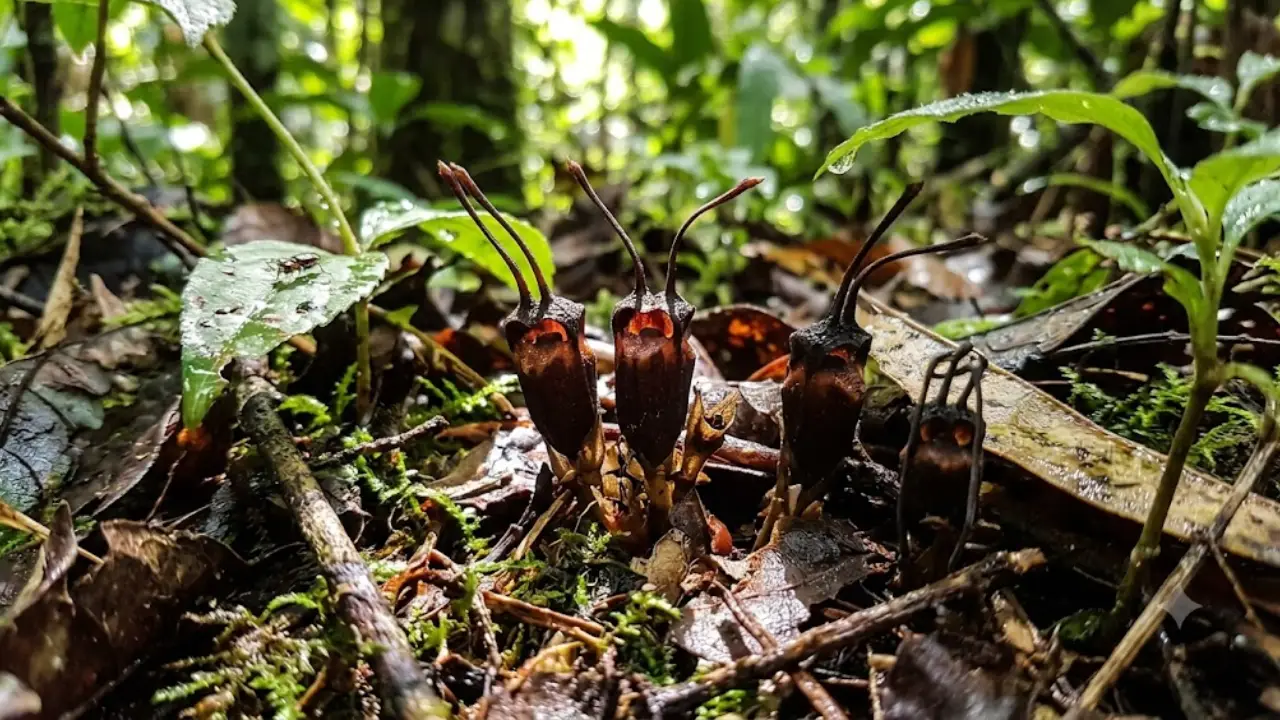
It has no leaves. It has no chlorophyll. It cannot make its own food. For most of its life, you probably would not know it was there.
Then, briefly, something strange happens beneath the forest canopy.
A tiny dark flower pushes through the leaf litter.
Its outer structures are reddish-orange and fleshy. Its inner parts form a small mitre-like crown. Three thin appendages project from the top like horns. The flower is so peculiar that the botanists who described it gave it a name borrowed from the devil himself:
Thismia daemona.
The plant was formally described on 17 August 2026 in PhytoKeys, after specimens were collected in Thong Pha Phum National Park in Kanchanaburi Province, western Thailand. The scientists used both detailed morphology and DNA evidence to establish it as a distinct species.
The obvious story is therefore:
Scientists discover a bizarre new “devil flower” in Thailand.
The more interesting story is:
Why was such a plant so easy to miss in the first place and what does that tell us about how little of Earth’s biodiversity we actually see?
That question takes us far beyond one strange flower.
The Flower That Looks Like a Warning Sign
Start with the photograph.
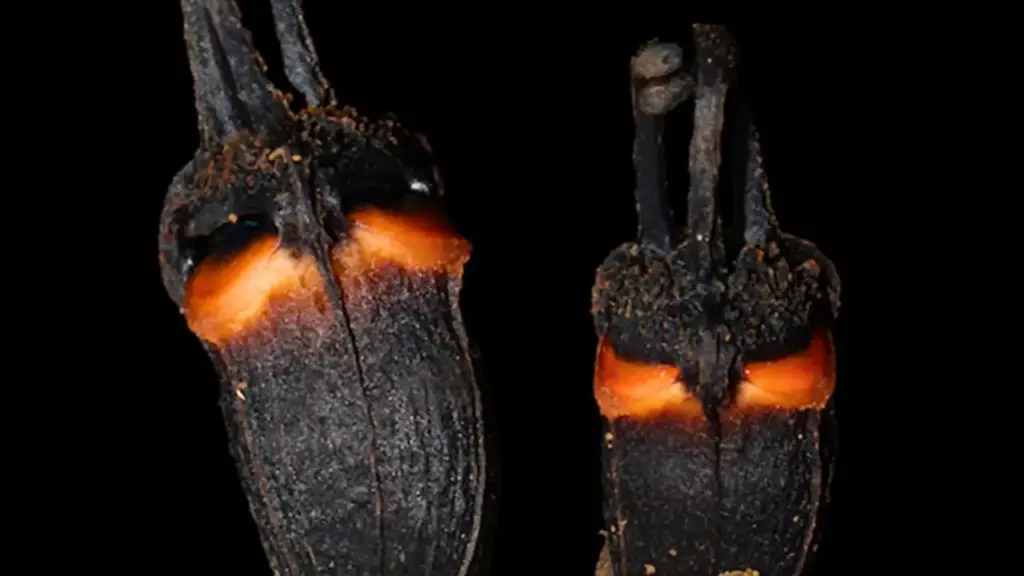
It is almost impossible not to anthropomorphise Thismia daemona.
The flower is dark, compact and architectural. Its blackish floral structures contrast with reddish-orange outer tepals. Three slender, club-shaped appendages rise from its mitre-like centre.
The resemblance to horns is precisely why the authors chose daemona, referring to the flower’s devil-like appearance.
But calling it a “devil flower” creates a useful trap.
It makes the organism sound like a botanical curiosity a little monster that happened to evolve in a Thai forest.
It is actually much stranger than that.
The plant is essentially a photosynthetic dropout.
Most flowering plants have a straightforward bargain with the Sun.
They collect light.
They use chlorophyll.
They turn carbon dioxide and water into organic compounds.
Leaves are their solar panels.
Thismia has largely abandoned the entire arrangement.
It contains no chlorophyll and cannot photosynthesise.
Instead, it gets its carbon through fungi.
That single fact transforms the story.
The flower is not merely unusual-looking.
Its entire economy runs differently from that of an ordinary plant.
A Plant That Outsourced Its Lunch
The scientific term is mycoheterotrophy.
It sounds forbidding, but the basic idea is surprisingly simple.
A mycoheterotrophic plant forms an intimate relationship with fungi and obtains organic carbon through that fungal network rather than producing enough carbon itself through photosynthesis.
So imagine the normal plant as a solar-powered factory.
Now remove the solar panels.
Instead, the plant taps into an underground supply chain.
For Thismia, the supply chain involves mycorrhizal fungi.
This is one reason scientists sometimes describe these plants in almost parasitic language: the plant ultimately obtains resources through fungi that themselves are associated with photosynthetic plants.
The crucial point, however, is that the relationship is more complicated than the cartoon version of “plant eats fungus”.
Research on Thismia and related fairy lanterns shows that these plants are deeply tied to fungal partners, and some species show considerable fungal specificity.
That means T. daemona is not really an isolated flower.
It is the visible end of an invisible ecological system.
And that system is underground.
The Part of the Plant You Cannot See Is the Real Story
This is where the headline “new flower discovered” becomes misleading.
The flower is only the temporary advertisement.
The plant itself spends much of its existence hidden beneath the forest floor.
The newly described species has coralliform roots, meaning its roots branch in a coral-like form.
Its stem is only about 35–65 millimetres long, and the entire plant reaches roughly 125 millimetres, including the flowers. It was found among leaf litter beneath shaded lower montane forest containing small bamboo.
The researchers collected the first type specimen on 13 May 2025, at approximately 970 metres elevation. A second specimen was collected three days later at approximately 930 metres.
This creates an extraordinary problem for anyone trying to study it.
Imagine being asked to find an organism that:
is only a few centimetres tall;
has no obvious green leaves;
lives largely below the visible forest layer;
can resemble fungal material more than a conventional plant;
may appear above the ground only during a limited reproductive period;
depends on a specialised underground fungal relationship.
You could walk through the same forest ten times and miss it ten times.
This is not an exaggeration.
Specialist studies of Thismia repeatedly describe these plants as notoriously difficult to detect because they remain concealed under soil or leaf litter and become visible mainly during flowering or fruiting.
So “undiscovered” does not necessarily mean somewhere no scientist has ever walked.
Sometimes it means:
scientists walked past it because nature had hidden the evidence.
A Forest Can Be Well Known and Still Be Biologically Mysterious
This is one of the most important ideas buried inside the discovery.
We often imagine biodiversity exploration as a geographical problem.
There must be some remote rainforest, we assume, that nobody has explored.
But modern biodiversity has another problem:
the species themselves can be cryptic.
A forest can be mapped.
Its roads can be mapped.
Its trees can be catalogued.
Tourists can visit it.
Scientists can collect specimens there.
And yet a tiny plant can remain scientifically invisible.
That is precisely why the recent discovery of other Thismia species is so revealing.
A new Thismia selangorensis was described in Malaysia after being found near a popular picnic and recreation area. Fewer than 20 individuals were subsequently recorded, despite the area having been visited for decades.
That is a wonderful corrective to the idea that biodiversity discoveries require untouched wilderness.
Sometimes the missing species is hiding in a place people already know.
The “Demon” Is Only the Surface; DNA Had the Final Word
Scientists did not decide that Thismia daemona was a new species simply because it looked unusual.
That would be dangerous taxonomy.
Nature is full of organisms that look different because of age, environment, development or ordinary variation.
The researchers therefore combined morphology with molecular evidence.
For the phylogenetic analysis, they used three nuclear markers—SSU, ITS and LSU and two mitochondrial markers, atpA and matR.
The combined dataset contained 5,498 characters, and the analysis included 27 accessions representing 24 Thismia species.
The molecular results placed T. daemona within Thismia section Geomitra, where it formed a sister relationship with Thismia betung-kerihunensis.
This is an important distinction.
Looking bizarre is not evidence of being a new species.
A consistent combination of physical characteristics plus an evolutionary signal in DNA is much stronger evidence.
Modern taxonomy is increasingly a conversation between the herbarium cabinet and the sequencing machine.
One tells us what the organism looks like.
The other helps tell us where it belongs in the tree of life.
And Then Comes the Uncomfortable Number: Fewer Than 50
Here the story stops being cute.
The researchers currently know of fewer than 50 individuals of Thismia daemona.
They know only one population.
The species is currently known only from its type locality in Thong Pha Phum National Park.
Its formal Area of Occupancy under the IUCN framework is estimated at 4 km², but the actual known population is confined to an area of no more than 0.05 km².
For perspective, 0.05 km² is about 50,000 square metres.
That is roughly seven football fields if one uses a standard 105 × 68 metre football pitch as a rough comparison.
And the researchers’ preliminary assessment is:
Critically Endangered.
There is an important qualification.
This is a preliminary assessment, not the same thing as saying the species’ entire global population has been exhaustively surveyed and proven to contain fewer than 50 individuals.
The authors explicitly note that additional populations might occur elsewhere in western Thailand or in Myanmar where suitable vegetation occurs.
That uncertainty is scientifically important.
But it does not make the situation comfortable.
It makes the situation harder to measure.
The National Park Paradox
The plant is inside a protected area.
That should be good news.
It is, but not automatically enough.
The authors identify regular tourist visits as a potential threat to its habitat.
This creates an interesting conservation paradox.
A national park is created partly so people can experience nature.
But for a plant that lives among leaf litter and occupies a microscopic habitat, human visitation can become a disturbance.
A large tree can survive someone walking past it.
A tiny plant emerging from fragile soil cannot necessarily make the same bargain.
This does not mean tourism is inherently destructive.
It means conservation sometimes has to operate at a much finer scale than the boundary of a protected area.
The important unit may not be:
“the national park.”
It may be:
“this patch of soil, this layer of leaf litter, this fungal network, this flowering season.”
That is a much harder conservation problem.
The World Has a Biodiversity Data Problem
And now the little Thai flower connects to something much larger.
Kew’s State of the World’s Plants and Fungi 2026 estimates that more than 100,000 plant species remain unknown to science.
During 2024 and 2025, more than 4,600 plant species and 7,800 fungal species were named as new to science.
Those numbers sound reassuring until another number appears.
Kew reports that 29,748 plant species are currently listed as threatened with extinction, while only about 18% of known plant species have been assessed for extinction risk. For fungi, fewer than 1% have been assessed.
Now the problem becomes obvious.
We are trying to calculate the health of a library when:
we have not finished cataloguing the books.
And some of the uncatalogued books may already be burning.
That is the deeper significance of T. daemona.
It is not merely another rare plant.
It is a demonstration of the knowledge gap itself.
The 100,000 Unknown Plants Are Not All Hiding in Jungles
This is where biodiversity reporting often becomes too simplistic.
“Scientists estimate that 100,000 plant species remain undiscovered” sounds as though somewhere there is an enormous secret forest waiting to be opened.
Reality is messier.
Some species are difficult because they are:
tiny;
seasonal;
subterranean;
geographically restricted;
visually similar to other species;
reproductively unusual;
dependent on specific ecological partners;
represented by very few specimens.
Others may already exist in scientific collections.
They have been collected.
Pressed.
Labelled.
Stored.
Forgotten.
Kew estimates that approximately 406 million herbarium specimens exist worldwide, yet fewer than 16% have been imaged and made available online.
That statistic should change the way we imagine discovery.
Sometimes the next new species is not waiting in a jungle.
It is waiting in a drawer.
The Museum Cabinet Is Becoming a Second Forest
For centuries, herbarium collections were essentially libraries made of plants.
A specimen could be collected in 1890, labelled, pressed and stored—and then remain physically inaccessible to most researchers.
Digitisation changes that.
A specimen can now be photographed, its label transcribed, its location mapped and its characteristics compared with millions of other records.
Kew’s 2026 report describes how artificial intelligence and machine learning are increasingly being used to process this enormous biological archive.
But there is an important correction to the fashionable AI narrative.
AI is not about to replace botanists.
Kew explicitly stresses that machine-generated identifications require expert checking.
The more realistic future is less dramatic and much more useful:
humans decide what matters; machines help humans search faster.
That could become crucial when millions of specimens need to be compared.
We May Lose Species Before Naming Them
This is the real race.
Traditional scientific thinking follows a comforting sequence:
discover → name → study → protect
But extinction does not respect scientific publishing schedules.
A species can experience:
habitat loss → population collapse → disappearance
before anyone has formally described it.
Kew’s 2026 report explicitly warns that some species disappear before scientists have had the opportunity to describe them. It also highlights a broader problem in recognising extinctions because proving that a species is truly gone is itself difficult.
This produces a disturbing blind spot.
An organism can disappear twice.
First biologically.
Then scientifically.
The first disappearance removes the species from the forest.
The second removes the possibility of ever knowing what we lost.
Even the Flowering Calendar Is Changing
There is another reason these tiny plants matter.
Biodiversity is not static.
Kew’s 2026 report describes research using 8 million plant specimens that found global flowering times have shifted by an average of approximately 2.5 days per decade over the last century, with particularly strong changes in tropical regions.
That sounds trivial.
It isn’t.
A few days can matter when flowering, pollination and animal activity have to line up.
And Thismia makes the problem even more interesting because its biology is tied to highly specific ecological conditions.
Recent research on other Thismia species shows how seasonal conditions can influence emergence, while specialist studies suggest that some fairy lanterns interact with tiny insects such as fungus gnats for pollination.
We therefore have a plant that is already difficult to find.
Now imagine changing the temperature, rainfall pattern, soil moisture and timing of its ecological partners.
The plant does not need to be cut down to be threatened.
Its biological calendar can be disturbed.
Why Does Evolution Produce Something This Strange?
There is a tempting but misleading question:
Why would evolution make a flower that looks like a demon?
Evolution did not set out to create a demon.
It created structures that improved survival and reproduction in a particular ecological environment.
The “horns” are our interpretation.
To the plant, they are anatomy.
To a pollinator, they may be a signal.
To a taxonomist, they are diagnostic characters.
To evolution, they are simply structures that persisted because they worked or at least did not prevent reproduction.
That distinction matters.
Nature does not design for beauty.
It does not design for human convenience.
And it certainly does not design for Instagram.
It produces workable solutions.
Sometimes those solutions happen to look like tiny monsters.
The Fairy Lanterns Are Evolution’s Alternative Business Model
The genus Thismia now contains about 120 accepted species, according to the 2026 species description. Southeast Asia contains the highest diversity of the group.
That is remarkable because these plants have adopted such an unusual strategy.
They have effectively traded:
leaves + sunlight
for:
fungi + underground networks + extreme ecological specialisation.
The trade has advantages.
A plant without large photosynthetic leaves can survive in deep shade where conventional plants face intense competition for light.
But the trade also creates dependence.
Instead of depending primarily on sunlight, the plant depends on an underground partner.
That is why a Thismia species can be simultaneously:
small, hidden, specialised and extraordinarily vulnerable.
The Most Important Discovery May Not Be the Flower
Scientists have already discovered hundreds of thousands of species.
So why should another tiny plant matter?
Because discoveries like this force us to update our mental model of biodiversity.
We tend to divide nature into:
known and unknown.
But Thismia suggests something more complicated:
known, but rarely seen;
seen, but not understood;
collected, but not digitised;
named, but not assessed;
protected, but not sufficiently monitored.
The gap between these categories is where much of modern biodiversity science now lives.
What Should Scientists Do Next?
The logical next steps for Thismia daemona are not simply to find more flowers.
Researchers need to establish:
Whether additional populations exist in western Thailand or neighbouring Myanmar.
How large the true population is, rather than relying on currently visible individuals.
Which fungi support the plant and how specific that relationship is.
When and how the plant flowers and fruits.
Which organisms pollinate it.
How sensitive its microhabitat is to trampling and soil disturbance.
Whether climate and rainfall changes affect emergence.
How its population changes from year to year.
Only then can conservation move from a preliminary warning to a much more precise management strategy.
We Are Bad at Seeing What Is Small
Humans naturally notice large things.
A tiger.
A tree.
A whale.
A mountain.
A tiny plant without leaves that appears for a short time beneath dead leaves is almost the perfect organism to escape human attention.
That creates a philosophical problem disguised as a botanical one.
Our knowledge of nature is partly determined by what our senses are good at noticing.
Science exists partly to correct that bias.
Microscopes reveal microorganisms.
DNA reveals hidden evolutionary relationships.
Satellites reveal forest loss.
Herbaria preserve species long after collectors leave.
AI can now search millions of biological records.
Each technology extends the human eye.
Thismia daemona is therefore not merely a strange flower.
It is an argument for looking harder.
And Perhaps That Is Why the “Demon Flower” Story Works
The image gets the reader’s attention.
The biology earns it.
The conservation problem makes it matter.
And the global biodiversity crisis gives it scale.
That is the structure a good science story should have.
Not:
“Look at this weird flower.”
But:
“Look at this weird flower and realise that its existence exposes how incomplete our map of life still is.”
The tiny plant becomes a doorway.
Behind it are fungal networks, evolutionary experiments, hidden populations, herbarium cabinets, DNA databases, national parks, climate change and an uncomfortable race against extinction.
That is a much bigger story than a demon-shaped flower.
The Final Irony
There is something almost poetic about Thismia daemona.
Humanity has spent centuries trying to catalogue life.
We have named species after kings, scientists, places, colours, shapes and mythical creatures.
We have built museums containing hundreds of millions of specimens.
We have sequenced genomes.
We have trained machines to recognise plants.
And still, in a forest in Thailand, a tiny leafless plant can spend most of its life hidden under the leaves.
When it finally appears, it looks like a miniature creature from another world.
Scientists give it a name.
They photograph it.
They sequence it.
They publish it.
And then comes the uncomfortable question:
How many others are still hiding?
Kew estimates that more than 100,000 plant species remain unknown to science. More than 4,600 plant species were newly named during 2024–2025, yet only about 18% of known plants have been assessed for extinction risk.
So Thismia daemona is not simply a new flower.
It is a reminder that the catalogue of life is unfinished.
And the deadline for finishing it may be much closer than we think.
The forest is not an empty book waiting for us to read it.
It is a library in which some books are hidden, some are written in languages we have not learned, and some may already be disappearing from the shelves.
The tiny demon flower is simply one of the books that, for a brief moment, opened itself.
The Numbers Behind the Story
| Finding | What it tells us |
| T. daemona formally described | 17 August 2026 |
| Known location | Thong Pha Phum National Park, Thailand |
| Known population | 1 |
| Known individuals | <50 |
| Known occupied area | ≤0.05 km² |
| Formal AOO estimate | 4 km² |
| Elevation | ~930–970 m |
| Preliminary conservation status | Critically Endangered |
| Accepted Thismia species | ~120 |
| Plant species currently listed as threatened | 29,748 |
| Known plants assessed for extinction risk | ~18% |
| Estimated plant species still unknown to science | >100,000 |
| Plant species newly named in 2024–2025 | >4,600 |
| Worldwide herbarium specimens | ~406 million |
| Herbarium specimens imaged and online | <16% |
| Plant flowering-time shift | ~2.5 days/decade over the last century |
The figures above come primarily from the peer-reviewed species description and Kew’s 2026 global assessment. They should not be interpreted as interchangeable measurements: for example, the 4 km² AOO is an IUCN-style formal estimate, while the ≤0.05 km² figure describes the actual area occupied by the known population.
Additional scientific context
Research on Thismia demonstrates the remarkable diversity and ecological complexity of these mycoheterotrophic plants, including their hidden underground lifestyles and specialised fungal relationships.
Research on fairy-lantern pollination has also suggested that some species may exploit fungus-associated cues and interact with small insects such as fungus gnats. This is useful ecological context for the genus, but should not be treated as proof of the specific pollination mechanism of T. daemona, which remains to be studied directly.
Frequently Asked Questions
Is Thismia daemona really a flower?
Yes. It is a flowering plant in the genus Thismia, although its biology differs dramatically from familiar green flowering plants.
Why is it black and orange?
Those are characteristics of its floral morphology. The dark coloration and horn-like appendages also inspired the species name daemona.
Does the plant eat fungi?
It is better described as mycoheterotrophic. It obtains carbon through fungal associations rather than photosynthesis. Calling it simply a “fungus-eating plant” hides the complexity of the relationship.
Does Thismia daemona have leaves?
It is an achlorophyllous plant and does not have normal green photosynthetic leaves. Its reduced structure is part of its adaptation to a subterranean lifestyle.
Why is it so difficult to find?
Most of the plant remains concealed in soil or leaf litter, and the visible flowering stage is limited. Related Thismia species can remain invisible even in areas where they are known to occur.
Is it already extinct?
No. A living population has been documented. However, researchers currently know of fewer than 50 individuals and have given the species a preliminary Critically Endangered assessment.
Could there be more populations?
Possibly. The researchers specifically note that suitable habitat in western Thailand and Myanmar could contain additional populations, but these have not yet been confirmed.
Why does the discovery matter beyond Thailand?
Because it illustrates a global problem: scientists are still discovering species while simultaneously trying to understand an extinction crisis affecting species that have not yet been adequately documented. Kew estimates that more than 100,000 plant species remain unknown to science.
Sources and Further Reading
Primary research
Seelanan, T., Chantapram, I., Taosiri, N., Chuchuea, C. & Chantanaorrapint, S. (2026). Thismia daemona (Thismiaceae), a new species from Thailand supported by morphological and molecular evidence. PhytoKeys 278: 177–189. DOI: 10.3897/phytokeys.278.202868.
International Plant Names Index — Thismia daemona
Global biodiversity
Royal Botanic Gardens, Kew — State of the World’s Plants and Fungi 2026
Kew — 2026 global biodiversity and extinction assessment
You may also Like Reading
The Himalayan Forest May Know a Wildfire Is Coming Before We Do — an exploration of how forests can contain biological signals that humans notice only after the obvious event.
The Hidden Science of Nature’s Unseen Networks — how plants, fungi and underground ecological systems complicate our conventional picture of forests.
When Technology Starts Reading Nature’s Oldest Archives — how digitised specimens, DNA and artificial intelligence are changing biodiversity research.








Leave a Reply