
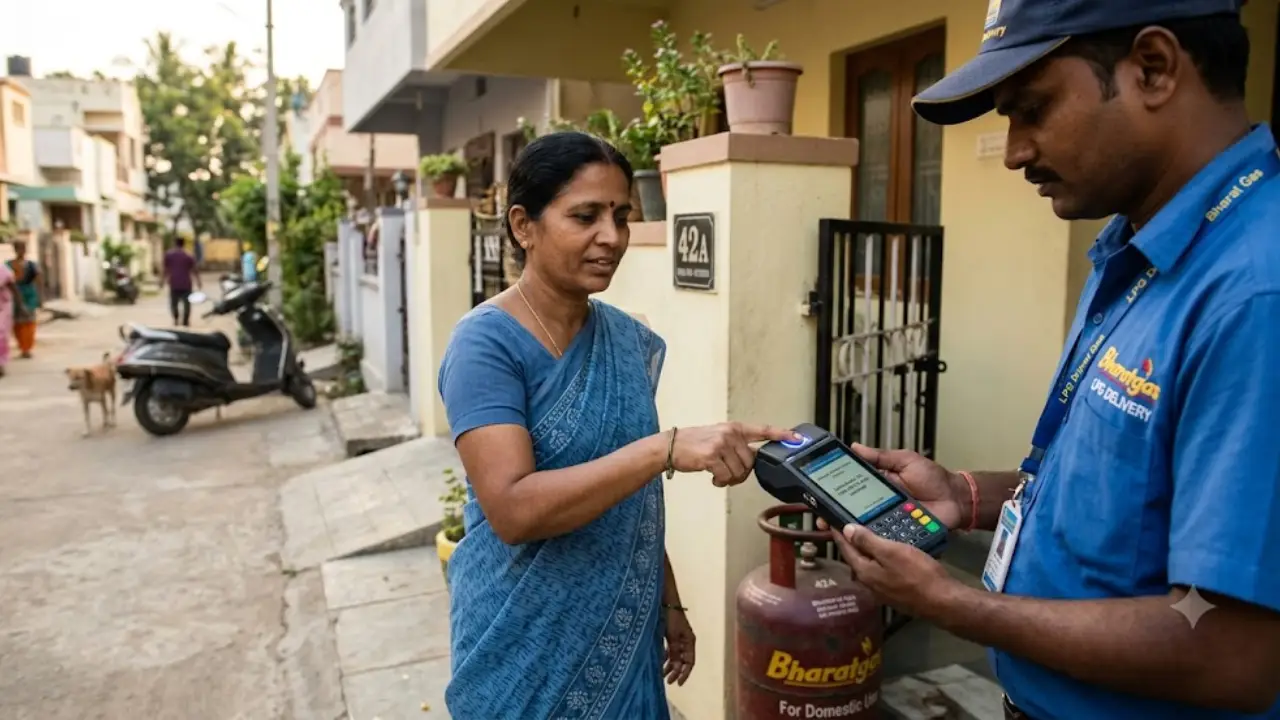
At some point in the next few days, millions of Indian households may perform an oddly intimate little transaction.
Not at a bank counter.
Not at an airport.
Not while opening a phone.
At the kitchen door.
A delivery worker arrives with an LPG cylinder. A small device appears. A finger is placed on it. A few seconds pass.
Authentication successful.
The cylinder is delivered.
The whole thing may take less than a minute.
But hidden inside that minute is a much bigger transformation in the relationship between citizens and the state.
From 1 October 2026, domestic LPG consumers who want to book refills at the regulated retail selling price with applicable subsidy will need to have completed Biometric Aadhaar Authentication (BAA).
The government says the purpose is straightforward: make sure subsidised LPG reaches genuine and eligible consumers, identify duplicate or ineligible connections and reduce diversion of subsidised domestic cylinders into commercial or industrial use.
Yet there is an important detail that many short headlines obscure:
No biometric authentication does not mean no LPG.
Consumers who do not complete BAA can still receive LPG, but without the applicable subsidy and through the alternative process specified by their oil marketing company.
That distinction turns a frightening headline into a much more interesting story.
Because this is not really about whether your fingerprint can unlock a cylinder.
It is about something bigger:
India is moving from identity as a document to identity as infrastructure.
The October 1 rule, without the noise
Here is the practical version.
As of 19 September 2026, the Ministry of Petroleum and Natural Gas said 27.43 crore active domestic LPG consumers 89.9% of the total had completed biometric Aadhaar authentication. Consumers who have already completed it do not need to repeat the process.
For the remaining consumers, BAA can be completed through several routes:
| Option | What the consumer does |
| During delivery | Ask the LPG delivery personnel to complete authentication through the OMC system |
| Distributor showroom | Visit the LPG distributor and complete authentication |
| OMC mobile app | Use the relevant official application |
| After authentication | Subsidised refill booking becomes available under the stated rules |
The three public-sector OMC applications identified by the government are IndianOil ONE for Indane, HelloBPCL for Bharatgas and HP PAY for HP Gas.
And what if someone does not want to authenticate or genuinely cannot?
The government has said that such consumers can still obtain LPG at the applicable market price without subsidy. The stated arrangement includes 5-kg or 10-kg cylinders, subject to availability, with the consumer registering the choice through OMC digital channels such as websites, mobile apps, WhatsApp chatbots or IVRS.
So the real rule is:
No BAA → no subsidised refill at the regulated price.
It is not:
No BAA → no cooking gas whatsoever.
That difference matters.
For a household living on a tight budget, however, the distinction between subsidised and market-priced LPG can still be very real.
Why does the government want your fingerprint in the first place?
The official answer is targeting.
The government’s LPG subsidy architecture has been moving in this direction for years.
The PAHAL/DBTL system was implemented nationwide in January 2015 to transfer applicable LPG subsidies directly to consumers’ bank accounts. Alongside it came Aadhaar-based verification, database de-duplication and measures to identify inactive or duplicate connections.
By July 2025, the government reported that 4.08 crore duplicate, fake, non-existent or inactive LPG connections had been blocked, suspended or deactivated.
That number needs an important footnote.
It is a government figure describing connections identified through the system; it should not automatically be interpreted as “4.08 crore people were caught committing fraud.”
The categories included duplicate, fake, non-existent and inactive connections.
Still, the scale explains why the government regards identity verification as more than bureaucratic paperwork.
The Common LPG Database Platform also uses multiple data points for de-duplication, including Aadhaar number, bank-account details, ration-card information, name and address.
The basic economic logic is simple:
If the state pays a subsidy, it wants to know who is receiving it.
The technological question is:
How certain can that identification be?
Biometrics are being introduced as one answer.
This is the next chapter of a story that started with PAHAL
It is tempting to treat October 1 as a sudden new government rule.
It isn’t.
It is another step in a much longer experiment.
The evolution looks roughly like this:
Paper identity
↓
Digitised LPG records
↓
Aadhaar-linked identification
↓
Direct Benefit Transfer
↓
Database de-duplication
↓
Biometric authentication
↓
Real-time identity verification
The significance of that progression is easy to miss because each individual step sounds boring.
Together they represent something profound.
The LPG system is gradually moving from asking:
“Do you possess the right documents?”
to asking:
“Can the system authenticate you as the person associated with this benefit?”
That is a very different administrative philosophy.
The money behind the fingerprint
There is another reason this story matters: LPG subsidy is not a trivial government expense.
In a 2025 Rajya Sabha reply, the Petroleum Ministry reported that the government had paid ₹22,000 crore to public-sector oil marketing companies as compensation for domestic LPG under-recoveries in FY2022-23. The government said ₹30,000 crore each was being provided in FY2025-26 and FY2026-27. It also reported accumulated domestic-LPG under-recoveries at public-sector OMCs exceeding ₹62,000 crore as of 31 August 2026.
The latest government communication also placed the implicit subsidy for a 14.2-kg cylinder at around ₹210 in September 2026, compared with around ₹721 in June 2026.
In other words, the subsidy mechanism is not an administrative side note.
It is a major fiscal system.
And the larger the subsidy bill, the greater the incentive to reduce leakage.
The astonishing scale of Aadhaar authentication
Now zoom out.
LPG is only one small window into a much larger machine.
UIDAI’s authentication dashboard reports 17,759.21 crore Aadhaar authentication transactions during FY2025-26, involving 492 Authentication User Agencies and 35 Authentication Service Agencies.
Those are not 17,759 crore individual people.
They are transactions.
That distinction is crucial.
One person can authenticate many times.
But the number still tells us something extraordinary.
Identity verification has moved from an occasional administrative ritual to a high-volume digital infrastructure service.
Your identity can now be checked repeatedly by systems that need to establish that you are the person you claim to be.
LPG is simply one more doorway into that infrastructure.
The real problem begins when the fingerprint says “No”
Here is where the neat technological story becomes messy.
Imagine an elderly LPG consumer.
The connection is legitimate.
The Aadhaar is legitimate.
The household is legitimate.
The subsidy is legitimate.
But the fingerprint does not authenticate.
Perhaps the fingerprints have become difficult to read.
Perhaps the finger is worn from years of manual work.
Perhaps the device has a problem.
Perhaps the network is unavailable.
Perhaps the application fails.
Perhaps the consumer’s records do not match correctly.
The system sees:
Authentication failed.
The citizen sees:
I am standing here. I am the same person. Why isn’t the machine accepting me?
Those are not the same problem.
And this is one of the deepest questions in digital public infrastructure.
Fraud prevention asks:
“Can the system stop the wrong person?”
Inclusion asks:
“Can the system recognise the right person when technology misbehaves?”
A serious identity architecture has to solve both.
A failed fingerprint is not proof of fraud
This distinction deserves to be shouted from the rooftops.
Authentication failure ≠ ineligibility.
It simply means the chosen authentication attempt did not succeed.
UIDAI’s broader authentication framework recognises the possibility of biometric failure and provides for alternative mechanisms in appropriate circumstances.
That principle becomes particularly important when authentication is connected to essential services.
A system that treats every failed biometric attempt as suspicious risks confusing technical uncertainty with human wrongdoing.
And the opposite extreme is not acceptable either.
A system that makes authentication meaningless defeats the purpose of authentication.
The difficult design problem sits in the middle:
high enough security to prevent abuse, but enough flexibility to prevent legitimate people from falling through the cracks.
That is much harder than putting a fingerprint scanner beside a cylinder.
The hidden price of convenience is dependency
Digital government often performs a neat trick.
It makes the citizen’s side of the process incredibly simple.
Press a button.
Scan a fingerprint.
Receive an OTP.
Done.
But the simplicity visible to the user is built on increasingly complicated infrastructure underneath.
For an LPG biometric transaction to work smoothly, a chain of systems may have to cooperate:
Aadhaar authentication infrastructure
biometric device
OMC database
delivery application
mobile network
authentication service
consumer records
registered identity information
subsidy and payment systems
When everything works, none of this is visible.
That is the beauty of infrastructure.
You notice electricity when the electricity disappears.
You notice the internet when the internet disappears.
And you notice digital identity when the authentication system says:
Try again.
This is why resilience matters as much as convenience.
What happens to the data generated by all these identity checks?
This is perhaps the least discussed part of the story.
People often imagine biometric authentication as a very simple event:
finger → database → match/no match
But an authentication transaction can involve information about the transaction itself.
UIDAI provides an Aadhaar Authentication History service through which holders can view authentication records, including details such as the date and time, authentication modality, requesting agency and transaction information.
That matters because the digital identity system is not merely concerned with who you are.
It also creates an auditable history around authentication events.
This does not mean that every service provider receives unlimited access to a person’s life.
Nor should the existence of an authentication record automatically be interpreted as surveillance.
But it does mean citizens should understand an increasingly important rule of the digital age:
When identity becomes a digital transaction, the transaction itself leaves an administrative footprint.
That makes privacy, security, data governance and grievance mechanisms part of everyday citizenship not abstract technology-policy topics.
The scam opportunity hiding inside the deadline
There is another side effect of a nationwide authentication campaign.
Scammers love deadlines.
A message saying:
“Complete Aadhaar verification immediately or your LPG connection will be cancelled.”
is almost perfectly designed for panic.
It combines:
government + deadline + subsidy + Aadhaar + fear of losing money.
That is precisely why consumers should be suspicious of unsolicited links.
The safest rule is boring but effective:
Don’t authenticate from a message.
Open the official OMC application or website yourself.
For consumer complaints and LPG-related assistance, the Petroleum Ministry lists 1800 2333 555. UIDAI lists 1947 as its toll-free number. The Ministry also provides grievance routes through OMC websites/apps, CPGRAMS, chatbots and other official channels.
And remember another useful detail: LPG delivery systems already use mechanisms such as SMS notifications and Delivery Authentication Codes. The government says consumers receive SMS notifications at important stages of refill transactions, while the Delivery Authentication Code is used to authenticate delivery.
The more digital the system becomes, the more important it becomes to distinguish authentication from social engineering.
A real government process does not become genuine merely because someone says the word “Aadhaar.”
The strange irony: the system gets more secure and more fragile at the same time
This is the paradox worth remembering.
Biometric authentication can make it harder to maintain duplicate or ineligible connections.
That is a legitimate policy objective.
But every new verification layer can also introduce another point at which an ordinary transaction can fail.
The system may therefore become:
more secure against one type of abuse
while becoming
more dependent on successful digital infrastructure.
Those are not contradictory observations.
They can both be true.
That is why the most useful question is not:
“Is biometric authentication good or bad?”
That is too simplistic.
The useful questions are:
Does it reduce leakage?
How often does legitimate authentication fail?
What alternatives exist?
How quickly are failures resolved?
Can consumers access the service while a dispute is being investigated?
Is the grievance mechanism easy enough for elderly or low-digital-literacy users?
What records are generated?
Who can access them?
How long are they retained?
What happens when the network is unavailable?
Those questions are much more revealing than arguments for or against Aadhaar in the abstract.
The numbers tell a surprisingly complicated story
| Indicator | What the latest official/public data shows |
| Active domestic LPG consumers with BAA completed | 27.43 crore |
| Share authenticated by 19 Sept. 2026 | 89.9% |
| Approximate share remaining | 10.1% |
| LPG authentication drive | Underway nationally since October 2023 |
| Duplicate/fake/non-existent/inactive LPG connections blocked/deactivated by July 2025 | 4.08 crore |
| LPG refills delivered in FY2024-25 | ~194 crore |
| Complaints as share of FY2024-25 refills | ~0.08% |
| Aadhaar authentication transactions, FY2025-26 | 17,759.21 crore |
| Aadhaar Authentication User Agencies | 492 |
| Aadhaar Authentication Service Agencies | 35 |
| LPG OMC compensation for FY2025-26 | ₹30,000 crore |
| LPG OMC compensation for FY2026-27 | ₹30,000 crore |
| Reported domestic LPG under-recoveries at OMCs, 31 Aug 2026 | >₹62,000 crore |
The 89.9% number is especially revealing.
The government has already crossed the difficult middle of the adoption curve.
The remaining 10.1% is now the difficult population not necessarily because those consumers are resisting, but because the final group is likely to contain more complicated cases: people who missed communications, have difficulty using apps, have biometric problems, have record mismatches, or simply have not needed to interact with the system yet.
The last ten percent is rarely just the first ninety percent repeated at smaller scale.
What should an LPG consumer actually do?
There is no need for panic.
There is a need for verification.
If you already completed BAA
You generally do not need to repeat it under the latest government clarification.
If you have not completed it
Use one of the recognised routes:
1. OMC mobile application
Use the official application associated with your LPG provider.
2. Distributor showroom
Visit the distributor and request biometric authentication.
3. During delivery
Ask the delivery personnel whether authentication can be completed through the OMC system.
If biometric authentication fails
Do not immediately assume that your subsidy eligibility has disappeared.
Ask the distributor or OMC about the authorised alternative or grievance route.
If you receive a suspicious message
Do not click first and investigate later.
Investigate first.
If your subsidy transaction fails
Keep the SMS/error information and contact the OMC through its official channel or the LPG helpline.
The government says consumers can also use CPGRAMS and other grievance mechanisms if necessary.
There is an important lesson hidden in PAHAL
The LPG story also tells us something about how technology changes government.
The original problem was not really technological.
It was economic.
The state wanted to subsidise cooking fuel without subsidising every duplicate, inactive or fictitious connection that happened to exist in its records.
Technology became the mechanism for solving the economic problem.
First came digital records.
Then database matching.
Then Aadhaar.
Then direct transfers.
Then biometric authentication.
The pattern is familiar:
Once a digital system works, governments naturally discover more things it can be used to verify.
That does not make the expansion inherently good or bad.
But it means citizens should pay attention to the architecture not merely each individual notification.
Because the important change is not that a fingerprint is being used for LPG.
The important change is that identity itself is becoming a reusable layer of public infrastructure.
From identity card to identity infrastructure
For much of modern history, identity was something you carried.
A card.
A certificate.
A passbook.
A ration document.
A signature.
You showed it when somebody asked.
India’s digital transformation is creating a different model.
Identity is increasingly something that can be queried, authenticated and recorded electronically.
That is tremendously powerful.
It can make welfare delivery faster.
It can reduce duplication.
It can make transactions auditable.
It can eliminate repetitive paperwork.
But power has a second face.
The more services depend on identity infrastructure, the more important infrastructure reliability becomes.
A broken photocopier is irritating.
A broken authentication system can prevent a benefit from being accessed.
That is why India’s next phase of digital governance will not be judged merely by how clever the technology is.
It will be judged by how gracefully the system behaves when reality refuses to cooperate.
The real test is not whether the fingerprint works
A technologically sophisticated system is not one in which everything works perfectly.
Perfect systems do not exist.
A sophisticated system is one that knows what to do when something fails.
The fingerprint fails.
The network fails.
The phone is lost.
The database has an error.
The beneficiary is elderly.
The person does not understand the app.
The delivery worker cannot complete authentication.
The subsidy does not arrive.
A good public system needs an answer for every one of these situations.
That is the real meaning of digital inclusion.
Not giving everyone an app.
Giving everyone a way through.
The bigger story is only beginning
The LPG biometric rule may disappear from the headlines after October 1.
People will authenticate.
Cylinders will arrive.
The news cycle will move on.
But the underlying transformation will continue.
Aadhaar authentication is already occurring at an enormous scale across sectors. UIDAI’s FY2025-26 dashboard records 17,759.21 crore authentication transactions.
LPG is therefore less an isolated event than a particularly visible example of a national transition.
The state increasingly does not merely ask:
“Who are you?”
It asks:
“Can the infrastructure verify you right now?”
That sounds like a small linguistic difference.
It isn’t.
It is the difference between identity as an object and identity as a service.
And once identity becomes a service, the quality of that service becomes part of everyday life.
Final Unfolding: your fingerprint is not the story
The fingerprint is merely the most visible part.
The real story is the enormous invisible system behind it.
Aadhaar.
LPG databases.
Subsidy accounts.
Oil marketing companies.
Authentication agencies.
Mobile networks.
Biometric devices.
Grievance systems.
Government databases.
And billions of digital transactions.
The promise is compelling: fewer duplicates, better targeting, less leakage and more efficient subsidy delivery.
The risk is equally practical: dependence on technology can create new forms of exclusion when authentication fails.
Neither side of that equation should be ignored.
Because the ultimate measure of India’s digital public infrastructure will not be how successfully it identifies the fraudulent connection.
It will be how intelligently it treats the genuine citizen whose fingerprint simply doesn’t work that morning.
That is where the philosophy of digital government meets the reality of human beings.
And that is why the most important question on October 1 will not be:
“Did the fingerprint match?”
It will be:
“What happens when it doesn’t?”
Quick facts
Rule begins: 1 October 2026
Applies to: Domestic LPG consumers seeking subsidised refills at the regulated retail selling price
Already authenticated: 27.43 crore active consumers
Coverage: 89.9% as of 19 September 2026
Authentication options: OMC app, distributor showroom, delivery interaction
Without BAA: LPG remains available under the stated market-price arrangement, without subsidy
LPG consumer helpline: 1800 2333 555
UIDAI helpline: 1947
Sources and official references
Ministry of Petroleum & Natural Gas / Press Information Bureau — latest September 19, 2026 announcement on mandatory Biometric Aadhaar Authentication for subsidised LPG refills.
Ministry of Petroleum & Natural Gas / PIB, December 1, 2025 — PAHAL, DBTL, Common LPG Database Platform, biometric authentication, de-duplication and grievance mechanisms.
Ministry of Petroleum & Natural Gas / PIB, August 5, 2025 — LPG subsidy reform, 4.08 crore duplicate/fake/non-existent/inactive connections blocked or deactivated, Aadhaar compliance and 194 crore FY2024-25 refills.
UIDAI Authentication Dashboard — FY2025-26 authentication volumes and authentication-agency data.
UIDAI — Aadhaar authentication and citizen services, including authentication history and official support.
Official LPG consumer grievance mechanism — Ministry of Petroleum & Natural Gas lists 1800 2333 555, OMC websites/apps, CPGRAMS, chatbots and distributor-level complaints.








Leave a Reply