
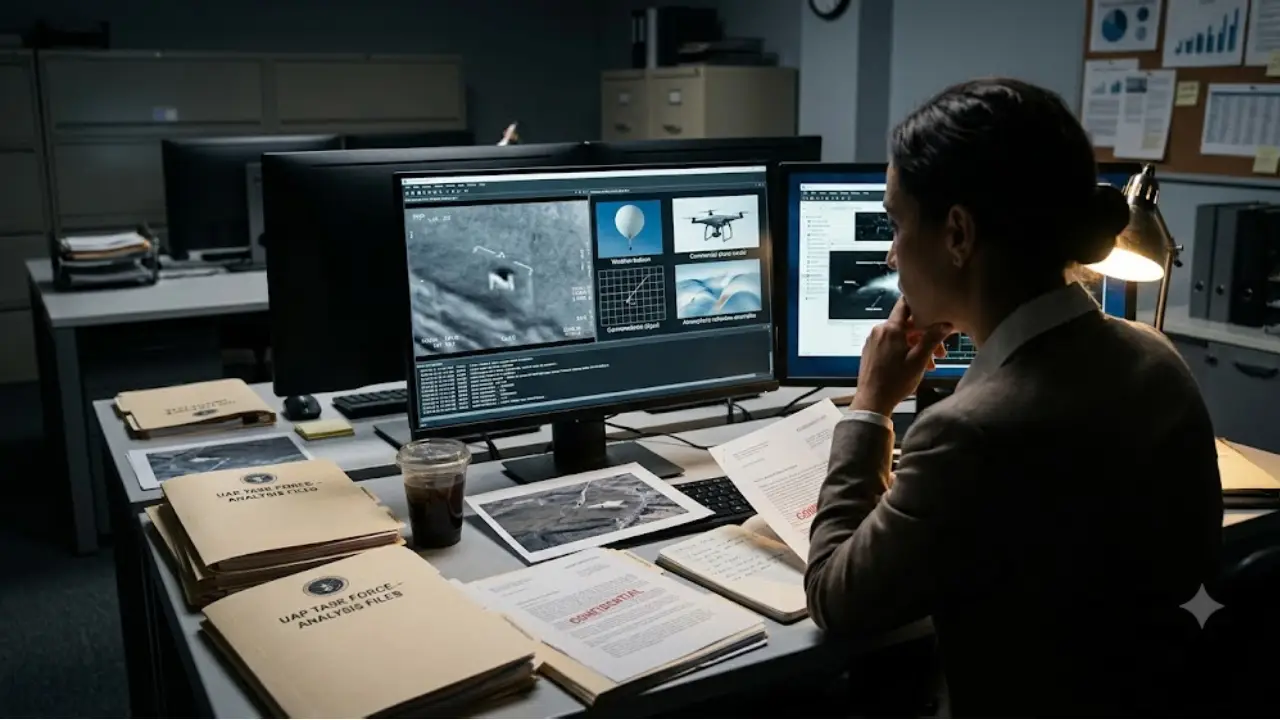
The 71 Files That Make the UFO Mystery More Interesting
At first glance, the number sounds almost disappointingly small.
Seventy-one files.
Not 71 alien spacecraft.
Not 71 secret crashes.
Not 71 pieces of proof that somebody has been quietly parking interstellar vehicles behind the Pentagon.
Just 71 files.
Yet those files contain something much more interesting: a glimpse into how governments deal with observations that do not fit neatly into an existing box.
The latest U.S. release, published on September 18, 2026, contains 55 PDF documents, 15 videos and one audio file. Sixty-seven records came from the Department of Defense and four videos came from Colorado law-enforcement agencies. The material stretches from 1952 to 2025, and 64 of the 71 files contain redactions.
And then there is the irresistible part.
Among the documents are studies concerning warp drives, wormholes, antigravity, negative-mass propulsion and invisibility cloaking.
That is the sort of sentence capable of making the internet forget every rule it has ever learned about evidence.
But there is a catch.
The documents do not demonstrate that the United States possesses a warp drive.
They do not demonstrate that somebody recovered a wormhole.
They do not demonstrate that UAP are extraterrestrial.
And they certainly do not turn every unidentified light in the sky into an alien spacecraft.
In fact, the deeper one goes into the files, the less the story resembles a science-fiction revelation—and the more it resembles a fascinating lesson in uncertainty, intelligence, sensor technology, human perception and the dangerous gap between “we don’t know” and “therefore we know.”
That gap is where most UFO mythology lives.
UAP Is Not a Polite Government Word for Aliens
Let’s begin with the word itself.
UAP means Unidentified Anomalous Phenomena.
NASA describes UAP as observations of events in the sky that cannot be identified as aircraft or known natural phenomena.
That definition is deliberately boring.
And that is precisely why it matters.
The term does not contain the words:
extraterrestrial, spacecraft, alien, non-human or interstellar.
An unidentified object is an observation whose identity has not been established.
That’s all.
Think about walking through a dark room and seeing a shape in the corner.
You know something affected your vision.
You do not yet know whether it is:
a chair,
a coat,
a person,
a shadow,
or your child’s schoolbag sitting there like an accidental horror-movie prop.
The uncertainty is real.
But uncertainty does not identify the object.
UAP investigations begin in exactly this uncomfortable territory.
The Four Words That Must Never Be Treated as Synonyms
Much of the public argument collapses four completely different ideas into one.
They should be kept separate.
| Stage | Meaning | What it actually tells us |
| Unexplained | No satisfactory explanation has yet been established | Our current explanation is incomplete |
| Unidentified | The object/event cannot confidently be assigned an identity | Its identity remains uncertain |
| Secret technology | A classified human system could potentially explain it | Requires evidence connecting the event to that technology |
| Extraterrestrial | The phenomenon originates beyond Earth | Requires extraordinary, independently verifiable evidence |
This distinction sounds semantic.
It isn’t.
It is the entire argument.
Consider the logical progression:
“We cannot identify it.”
becomes
“We cannot explain it.”
which becomes
“It must be technologically advanced.”
which becomes
“It must be non-human.”
And suddenly a missing data point has become a spaceship.
That is not investigation.
That is narrative acceleration.
What the New Files Actually Contain
The September release is particularly interesting because it contains several very different kinds of evidence.
There are historical records.
There are military videos.
There are law-enforcement reports.
There are theoretical aerospace studies.
There are documents discussing unusual injuries.
And there are records in which the most important information remains hidden behind redactions.
That means the 71 files should not be treated as 71 equivalent pieces of evidence.
A theoretical paper and an infrared military video are not the same kind of evidence.
A witness statement and calibrated radar data are not the same kind of evidence.
A 1952 report and a 2025 sensor record are not equally testable.
This sounds obvious.
Yet internet discussions routinely place all of them into one enormous bucket labelled:
“UFO evidence.”
That is where analytical discipline begins to disappear.
The Warp-Drive Trap
Now we reach the most shareable part of the release.
The documents include 37 Defense Intelligence Reference Documents, or DIRDs, produced under the Advanced Aerospace Weapon System Applications Program (AAWSAP).
The program was established by the Defense Intelligence Agency in 2008 to investigate possible future aerospace threats and technologies extending toward 2050. It ended in 2012. The documents examine concepts including warp drives, wormholes, antigravity, negative-mass propulsion and invisibility.
Read that quickly and it sounds astonishing.
Read it carefully and the picture changes.
The Pentagon’s accompanying explanation says the DIRDs should be understood as reference and synthesis products rather than original research, and that they should not be interpreted as current validation of the concepts discussed. The underlying documents had also been publicly available previously through other releases, although the new versions contain additional information that had previously been withheld.
That distinction deserves to be printed in very large letters:
Studying a technology is not the same thing as possessing it.
Governments study technologies precisely because they may not yet exist.
Military planners routinely ask what an adversary might develop decades from now.
Intelligence analysts examine technologies that could theoretically alter warfare.
Scientists investigate physical possibilities that may remain far beyond current engineering.
A paper about warp propulsion therefore establishes something interesting about what researchers were asked to investigate.
It does not establish that somebody successfully built a warp engine.
The difference between those two claims is approximately the size of the universe.
The Strange Injury Document
One document is arguably more disturbing than the warp-drive material.
It examines reports of injuries allegedly associated with anomalous aerospace events.
The 2010 paper describes three people who reportedly experienced symptoms including skin heating, redness and hair loss after unusual incidents. One case included reported signs described as consistent with radiation illness and later serious health complications. The paper compares these cases with known radio-frequency injuries and proposes a hypothesis involving advanced aerospace systems.
But again, the document does not establish the cause.
It does not publicly provide the complete chain of evidence necessary to demonstrate that an unknown craft caused those injuries.
There is a critical difference between:
“This person became ill after an unusual event.”
and
“This unusual event caused the illness.”
And another difference between that and:
“The illness was caused by an advanced non-human spacecraft.”
Each additional step requires additional evidence.
This is how serious investigation works.
Correlation opens the door.
Causation has to walk through it carrying evidence.
The Military Videos: Fascinating, Frustrating and Incomplete
The videos are perhaps the most seductive part of the release.
A moving object appears on a screen.
It changes direction.
It moves rapidly.
It seems to hover.
It disappears.
The human brain immediately starts writing the missing chapters.
But a video is only a two-dimensional representation of a three-dimensional event.
To calculate what an object is doing, investigators ideally need information such as:
exact range,
altitude,
camera position,
aircraft motion,
sensor mode,
focal length,
atmospheric conditions,
object size,
angular velocity,
acceleration,
radar correlation,
infrared characteristics,
and precise timestamps.
Without that information, apparent speed can become deceptive.
A tiny nearby object can look fast.
A huge distant object can look slow.
A camera moving quickly can make a stationary object appear to move.
A zooming sensor can transform ordinary motion into something that looks extraordinary.
This is not theoretical nitpicking.
AARO’s own historical reporting has repeatedly identified insufficient sensor data and sensor artifacts as major reasons cases remain unresolved. Its earlier annual reporting specifically pointed to gaps in radar and electro-optical/infrared data, along with phenomena such as infrared flare.
In other words, sometimes the mystery is not:
“What machine was doing this?”
It is:
“What exactly did the sensor measure?”
Those are very different questions.
The Most Important Number Is Not 71
Here is where the broader UAP database becomes more revealing than the headline.
AARO’s FY2025 annual report covers the period from June 2, 2024 through May 30, 2025.
During that reporting cycle, AARO received 319 UAP reports.
Of those:
284 concerned events during the reporting period.
35 concerned older events.
AARO resolved 114 of the 319 reports.
It also resolved 256 cases from earlier periods.
That produced 370 total case resolutions during the reporting cycle.
191 of the 319 reports were placed in an active archive because available information was insufficient for resolution.
9 reports were considered worthy of additional analysis by intelligence and scientific/technical partners.
There is a subtle statistical trap here.
Some reporting describes the 319 cases as producing 205 unresolved cases, because 319 minus 114 equals 205.
That arithmetic is correct.
But AARO’s own classification further separates those 205 into:
191 cases placed in the active archive because of insufficient information, and
9 cases requiring further analysis,
with the remaining cases subject to additional handling or review categories.
So “unresolved” is not a single scientific category.
It is an administrative description covering cases at different stages of investigation.
That distinction matters.
And Then the Ordinary Objects Arrive
Among the 114 cases AARO resolved during the reporting period, the explanations were strikingly mundane.
They included:
60 balloons
44 satellites
4 aircraft
2 birds
2 unmanned aerial systems
1 commercial rocket launch
1 manned jet pack
That means balloons and satellites alone accounted for 104 of the 114 newly resolved cases—about 91%.
There is something almost comical about this.
Humanity spends decades imagining secret alien fleets.
Then an investigation opens the file.
And sometimes the answer is:
“Balloon.”
Or:
“Satellite.”
Or, in one wonderfully 21st-century twist:
“Jet pack.”
But this should not be used to dismiss every UAP report.
It demonstrates something more useful:
Unidentified observations have a very large mundane-explanation layer.
The Satellite Problem Is Bigger Than It Sounds
AARO also reported that a new capability allowed analysts to resolve 238 reports as satellite flaring.
The phenomenon occurs when sunlight reflects from satellites in ways that can create bright, apparently unusual objects in the sky.
This is an important reminder that the sky is not an empty black screen.
It is a crowded technological environment.
There are:
satellites,
aircraft,
drones,
balloons,
rockets,
spacecraft,
atmospheric phenomena,
astronomical objects,
sensor artifacts,
and increasingly sophisticated civilian technology.
The more objects humans put into the sky, the more opportunities there are for humans to misidentify something in it.
The irony is delicious:
Our technological civilization may be creating some of the visual confusion that makes us wonder whether another civilization is visiting us.
Why the Military Sees More “Mysteries”
There is another piece of the puzzle that is rarely explained properly.
Military personnel have access to sensors that ordinary people do not.
They also operate in unusual environments.
Restricted airspace.
Training ranges.
War zones.
Naval operating areas.
Nuclear facilities.
Sensitive installations.
That means the military is more likely to encounter things the average person never sees.
But there is a second effect.
Much of the information surrounding a military observation may itself be classified.
The public may see the video but not:
the radar track,
the aircraft’s exact location,
the sensor specifications,
classified flight operations,
nearby military platforms,
intelligence information,
or the full-resolution original data.
This creates a peculiar paradox.
The military may have more information than the public, while the public has less information about why the military cannot explain something.
Secrecy therefore does not necessarily create the phenomenon.
But it can create the appearance of a larger mystery.
The “Secret Technology” Explanation Needs Evidence Too
There is a seductive middle position between “ordinary object” and “alien spacecraft”:
Maybe it is secret American technology.
That is certainly possible in individual cases.
Governments do develop classified aircraft, sensors, drones and surveillance systems.
But “classified technology” should not become a universal escape hatch.
If an object is attributed to secret technology, investigators still need evidence connecting the observation to a real program.
Otherwise:
“Maybe it is classified”
is simply another version of:
“We don’t know.”
The only difference is that one sounds more sophisticated.
Why “Unresolved” Is Not a Scientific Verdict
This is perhaps the most important lesson in the entire debate.
Imagine a photograph showing a bright object against a dark sky.
Suppose investigators cannot determine whether it is:
a balloon,
a drone,
a satellite,
an aircraft,
an atmospheric phenomenon,
or something else.
The correct scientific conclusion is:
Unresolved.
Not:
Alien.
But also not necessarily:
Definitely ordinary.
An unresolved case occupies a middle territory.
It tells us that the available evidence has failed to distinguish among competing explanations.
That is useful information.
It narrows our certainty.
It does not magically create a new certainty.
The Difference Between “Impossible” and “Not Yet Identified”
This distinction is so important that it deserves its own equation:
Unknown ≠ Impossible
A phenomenon can be:
poorly observed,
badly measured,
incompletely documented,
misunderstood,
technologically unfamiliar,
or genuinely unusual.
None of those automatically means that known physics has been violated.
This is where some UAP arguments become logically backwards.
They begin with:
“Scientists cannot explain it.”
But science not being able to explain an observation immediately does not mean the observation contradicts science.
There are two possibilities:
The phenomenon is genuinely new.
Or:
The data are insufficient to recognise an existing phenomenon.
Until better evidence distinguishes between those possibilities, both remain open.
NASA’s Position Is More Interesting Than “NASA Says No Aliens”
NASA’s UAP work is sometimes reduced to a headline:
“NASA says UFOs aren’t aliens.”
That misses the more useful point.
NASA’s scientific framework focuses on the quality of evidence.
Its FAQ states that NASA has not found credible evidence of extraterrestrial life and that there is no evidence that UAP are extraterrestrial.
But NASA is not saying:
“Nothing unusual ever happens.”
It is saying that unusual observations need usable data.
This is an important distinction.
Science does not require the universe to be boring.
It requires the evidence to be good enough to support the claim.
What Would Actually Count as Extraordinary Evidence?
This is where the discussion becomes genuinely interesting.
Suppose tomorrow someone announces:
“We have proof of an extraterrestrial spacecraft.”
What would we want?
Not one blurry photograph.
Not one witness.
Not a document saying “possible non-human technology.”
We would want several independent lines of evidence.
For example:
Multiple sensors recording the same object.
Precise measurements of distance, velocity and acceleration.
Material evidence that can be independently examined.
A reproducible physical signature.
Independent laboratories reaching the same conclusion.
A chain of custody for physical samples.
Data that survive hostile attempts at falsification.
That is how a spectacular claim becomes science rather than folklore.
The UAP Evidence Ladder
| Claim | Minimum evidence needed |
| Someone saw something unusual | Credible testimony |
| Something was recorded | Original, verifiable recording |
| The object behaved unusually | Reliable measurements |
| It exceeded known technology | Multiple independent calibrated sensors |
| It was secret human technology | Evidence linking it to a classified system |
| It was extraterrestrial | Independent, extraordinary physical evidence |
Notice what happens as we move downward.
The claim gets larger.
So does the evidence required.
This is not because scientists are allergic to excitement.
It is because reality does not award extra credibility to an interesting story.
Why the Internet Is Almost Perfectly Designed to Misunderstand UAP
The internet has a peculiar weakness.
It is excellent at distributing images.
It is much worse at distributing uncertainty.
A 12-second video travels beautifully.
A 17-page explanation of sensor geometry does not.
“Pentagon releases warp-drive documents” is a headline.
“Pentagon releases previously accessible theoretical research documents whose accompanying notes explicitly caution against interpreting them as validation of the concepts discussed” is not.
One gets millions of clicks.
The other gets read by people who own spreadsheets.
And yet the second sentence is where the truth lives.
The Psychology of the Empty Explanation
There is also something deeply human happening here.
When information is incomplete, the brain does not enjoy sitting quietly beside the empty space.
It fills it.
A moving light becomes a craft.
A craft becomes advanced technology.
Advanced technology becomes non-human technology.
Non-human technology becomes extraterrestrial visitors.
The chain feels logical because each step follows the previous story.
But the original evidence has not changed.
Only the interpretation has expanded.
This is one of the oldest human habits imaginable.
Ancient people saw lightning and invented gods.
Modern people see unidentified lights and sometimes invent civilizations.
The technology changed.
The psychological machinery did not.
The Real Scientific Problem Is Data Quality
AARO has repeatedly identified inadequate information as a central obstacle to UAP resolution.
Its earlier annual reporting explicitly connected the continued unidentified nature of many reports to gaps in domain awareness, insufficient radar and electro-optical/infrared data, and sensor artifacts.
That changes the question completely.
Instead of asking:
“Why can’t they explain UFOs?”
we should ask:
“Why are observations of potentially important objects sometimes recorded with inadequate data?”
That is a solvable engineering problem.
Better sensors.
Better calibration.
Better metadata.
Multiple observation platforms.
Automated cross-checking.
Standardised reporting.
And rapid preservation of original data.
That is much less cinematic than a crashed flying saucer.
It is also much more useful.
A Better Way to Investigate a UAP Claim
When the next extraordinary video appears online, follow this sequence.
Step 1: Establish what was actually observed
Was it a light, object, reflection, radar return or camera artifact?
Step 2: Find the original data
Avoid relying only on compressed social-media copies.
Step 3: Establish geometry
How far away was the object?
How high?
How large?
Step 4: Establish motion
Was the observer moving?
Was the camera moving?
Was the object actually accelerating?
Step 5: Check conventional explanations
Aircraft.
Satellites.
Balloons.
Drones.
Birds.
Rocket launches.
Astronomical objects.
Atmospheric phenomena.
Step 6: Compare independent sensors
Did radar, infrared and optical systems record the same event?
Step 7: Ask what remains
Only after ordinary explanations have been tested should investigators ask whether genuinely anomalous characteristics remain.
This approach does not kill the mystery.
It protects the mystery from being destroyed by bad reasoning.
So, What Do the 71 Files Actually Prove?
Very little about aliens.
Quite a lot about uncertainty.
They show that UAP investigations span decades.
They show that government agencies have investigated reports seriously enough to preserve documents, footage and technical studies.
They show that some observations remain unresolved.
They show that theoretical concepts once examined by intelligence-linked researchers can sound dramatically more advanced than the evidence actually supports.
They show the continuing problem of incomplete information.
And they show something else that is easy to overlook:
When the government releases a file, the file itself becomes evidence but only of what the file documents.
A document discussing warp propulsion proves that someone studied warp propulsion.
A witness report proves that someone reported an observation.
A video proves that a camera recorded something.
An unresolved case proves that the investigators could not confidently identify it.
None automatically proves the next proposition.
This sounds almost painfully obvious.
It is also where the entire debate tends to go wrong.
The Bigger Mystery Is Not “Are We Alone?”
That is a much bigger question.
And it deserves serious science.
The universe contains hundreds of billions of galaxies, and our own galaxy contains enormous numbers of stars and planets. The scientific search for life beyond Earth is therefore entirely legitimate.
But the existence of extraterrestrial life somewhere in the universe and the claim that a particular unexplained object above Earth is an extraterrestrial spacecraft are two completely different propositions.
The first is a question about the universe.
The second is a forensic claim about a particular observation.
One does not prove the other.
What Comes Next?
The most valuable future development in UAP research may not be another dramatic document release.
It may be better data collection.
Imagine a global network of calibrated cameras, radar systems, infrared sensors and astronomical instruments continuously monitoring the atmosphere.
When something unusual appears, researchers could immediately compare:
optical data,
infrared data,
radar,
weather,
satellite position,
aircraft traffic,
astronomical observations,
and atmospheric conditions.
The mystery would not disappear.
But the percentage of mysteries caused by missing information might.
And that would be a scientific victory.
Because the goal of investigation is not to maximise the number of mysteries.
It is to turn mysteries into measurements.
The Mystery Is the Word “Unidentified”
The 71 new files are worth reading.
Not because they finally reveal the aliens.
They do not.
They are worth reading because they expose something much more interesting: how fragile certainty becomes when the evidence is incomplete.
A military pilot can genuinely see something strange.
A sensor can genuinely record something unusual.
An investigator can genuinely fail to identify it.
A government can genuinely study warp drives.
A document can genuinely describe a bizarre encounter.
And none of those facts requires an extraterrestrial explanation.
At the same time, none of them should be dismissed simply because the explanation is not obvious.
That is the intellectually honest middle ground.
Unexplained is not extraterrestrial.
Unidentified is not impossible.
A theoretical study is not a working machine.
A government investigation is not confirmation of the phenomenon being investigated.
And a redacted document is not automatically evidence of a cover-up.
The 71 files therefore leave us with a more interesting question than the one that usually dominates the headlines.
Not:
“Are aliens here?”
But:
“How much evidence would we need before we could honestly say that something truly extraordinary had happened?”
That is a question worth asking.
Because if the answer is ever yes, we should want that conclusion to be so well supported that it survives not only excitement, but scepticism.
Until then, the most scientifically powerful phrase in the entire UAP vocabulary remains the least dramatic one:
We don’t know yet.
And unlike “aliens,” that sentence does not need to be invented.
The Unfoldings
The September 18, 2026 release contains 71 files: 55 PDFs, 15 videos and one audio recording.
64 of the 71 files contain redactions, limiting independent examination of some underlying information.
The collection includes 37 AAWSAP-related technical reference documents, including studies of warp drives, wormholes, antigravity and other advanced concepts. The Pentagon says these should not be interpreted as validation of those concepts.
AARO received 319 reports during its FY2025 reporting period and resolved 114 of those incoming cases.
AARO additionally resolved 256 older cases, producing 370 total resolutions during the reporting cycle.
191 cases were placed into an active archive because the available evidence was insufficient for resolution.
Of the 114 newly resolved cases, 60 involved balloons and 44 involved satellites, meaning those two categories represented about 91% of that group.
AARO’s new analytical capability also identified 238 reports as satellite flaring across its broader casework.
NASA states that it has not found credible evidence of extraterrestrial life and that there is no evidence that UAP are extraterrestrial.
The central lesson is simple: an unidentified observation is a statement about the limits of available evidence, not a declaration of extraterrestrial origin.
Authentic Sources and Government Records
U.S. All-domain Anomaly Resolution Office (AARO)
AARO official website
NASA UAP Research
NASA UAP Research
NASA UAP Frequently Asked Questions
NASA UAP FAQs
AARO FY2025 UAP reporting
The FY2025 reporting period covers June 2, 2024–May 30, 2025; it should therefore not be interpreted as a complete real-time database of events occurring in September 2026.








Leave a Reply