
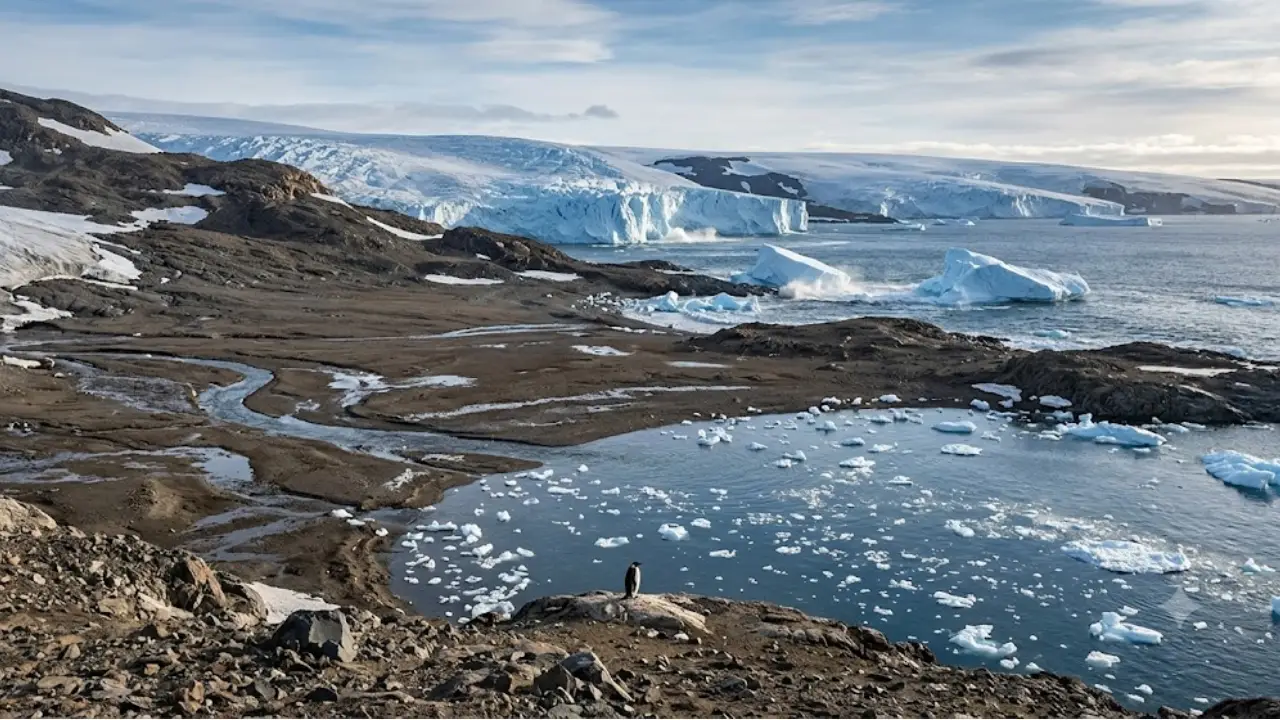
The Antarctic sea-ice story has become stranger, not simpler. Four unusually low winters, a warming ocean beneath the ice, restless winds, and a continent that refuses to behave like the Arctic are forcing scientists to ask a much bigger question: is Antarctica merely having a run of bad years, or is something deeper changing?
Imagine standing at the edge of Antarctica in September.
There is almost nothing familiar about the place.
The Sun has only recently begun clawing its way back after the long polar night. The continent is buried beneath enormous sheets of ice. The ocean around it should be doing what it has done for thousands, perhaps millions, of years: freezing outward through the dark winter, building a gigantic white moat around the world’s coldest continent.
Then the satellites look down.
And the moat is smaller than it should be.
On September 11, 2026, Japan’s National Institute of Polar Research measured Antarctic sea-ice extent at 17.71 million square kilometres the third-lowest winter maximum in the satellite record stretching back to 1979. The U.S. National Snow and Ice Data Center reached a slightly different result, estimating that the maximum most likely occurred around September 14 at 17.59 million square kilometres, which would also place 2026 third-lowest if that date holds.
The British Met Office, using another satellite product, initially put the September 11 extent at 18.12 million square kilometres and warned that Antarctic maxima can occur surprisingly late even into October.
Three numbers.
Three methods.
One enormous frozen ocean.
At first glance, this looks like an argument over decimals.
It isn’t.
The differences are a reminder of something that is almost always lost when climate data become headlines: Earth does not know that humans have chosen a particular date to measure it.
The ice moves.
It grows.
It breaks.
It drifts.
It freezes again.
And near the Antarctic winter maximum, a small change in wind or ocean conditions can alter the measured extent dramatically.
The more interesting question, therefore, is not whether one satellite says 17.59 and another says 17.71.
The interesting question is this:
Why has Antarctica spent so much of the last four winters near the bottom of its satellite-era record?
Because 2026 is not an isolated oddity.
It is the latest chapter in a sequence that has become increasingly difficult to ignore.
Antarctica has just done something very strange
There is a peculiar trap hidden inside the phrase Antarctic sea-ice maximum.
The word “maximum” sounds reassuring.
It isn’t.
Every year, Antarctic sea ice expands during the Southern Hemisphere’s autumn and winter. Around September, it reaches its greatest extent. Then spring arrives, sunlight returns, temperatures rise, and the ice retreats toward its summer minimum around February.
So when scientists announce a September maximum, they are not saying Antarctica has suddenly frozen over.
They are saying:
This is approximately as far as the winter ice managed to spread this year.
And that distance has recently become unusually short.
The updated NSIDC record puts the 2023 Antarctic winter maximum at about 17.07 million square kilometres, the lowest in the satellite record. The 2024 maximum reached about 17.26 million square kilometres, the second-lowest. In 2025, the ice recovered somewhat, but the maximum of about 17.81 million square kilometres was still the third-lowest on record.
Now comes 2026.
Depending on the dataset and final processing, it is again around third-lowest.
That means something remarkable has happened.
Four consecutive years—2023, 2024, 2025 and 2026—have occupied the extreme low end of the Antarctic winter-maximum record.
That does not prove Antarctica has entered a permanent new climate regime.
But it is certainly enough to make scientists ask whether the old description of Antarctic sea ice highly variable, difficult to predict, and occasionally bizarre – is becoming incomplete.
And this is where the story becomes much more interesting.
Because Antarctica has never been a simple climate machine.
The Antarctic ice mystery begins underneath the ice
Imagine a frozen lake.
Now imagine someone heating the water from underneath it.
The ice on top might look perfectly calm for a while.
That does not mean nothing is happening.
The Southern Ocean works on a vastly larger scale.
Antarctic sea ice is not simply responding to the temperature of the air above it. It sits on an ocean containing different layers of water with different temperatures, salinities and densities.
Some of that water is cold.
Some is relatively warm.
And some of the warmest water is lurking below the surface.
That matters because Antarctic sea ice can behave rather like a roof over an enormous reservoir of heat.
The roof looks white.
The reservoir underneath may not be.
A major 2026 study in Nature Climate Change offers an especially intriguing piece of this puzzle. Researchers examined around 110,000 hydrographic profiles together with atmospheric data and reconstructed how the upper ocean changed before the dramatic sea-ice decline that began around 2015–2016.
Their finding is almost cinematic.
Between about 2005 and 2015, the layer of cold Antarctic Winter Water gradually became thinner.
At the same time, warmer and saltier Circumpolar Deep Water moved closer to the surface.
Then came 2015.
Strong winds stirred the ocean.
The thinner cold layer could no longer insulate the surface as effectively.
Warm subsurface water was mixed upward.
Sea ice suffered.
And the resulting changes in ocean stratification helped sustain the decline.
In other words, the wind may have been the immediate trigger.
But the ocean had spent years quietly preparing the stage.
That is a much more unsettling story than “Antarctica got warmer.”
It suggests that the climate system can sometimes behave like a trap being slowly loaded.
Nothing spectacular happens.
Then one physical threshold changes.
And suddenly the system behaves differently.
The ghost layer called Winter Water
The phrase Winter Water sounds almost harmless.
It isn’t.
It is one of the important pieces of Antarctica’s ocean machinery.
During winter, the ocean surface cools and mixes. A layer of relatively cold water forms beneath the surface.
That cold layer can help separate the surface from warmer water deeper down.
Think of it as insulation.
As long as the insulation remains thick enough, warm subsurface water is kept at a certain distance from the surface ice.
But the 2026 Nature Climate Change study found evidence that this Winter Water layer had gradually thinned between 2005 and 2015, while warmer Circumpolar Deep Water moved upward. Then unusually strong winds in 2015 enhanced vertical mixing.
The implication is fascinating.
A single storm does not necessarily create a long-term sea-ice decline.
But a storm arriving in an ocean that has already been reorganised can have a very different effect.
The ocean, in other words, remembers.
Not consciously, obviously.
It remembers through temperature.
Through salinity.
Through density.
Through the shape of its layers.
That is one reason Antarctica is so difficult to read from a single year’s weather.
The conditions producing today’s ice may have been assembled years earlier.
And then there is the wind
If the ocean is the hidden machinery, the wind is one of its most important hands.
Antarctic sea ice is not a giant stationary sheet.
It is a drifting, breaking, compressing, spreading, colliding mass.
Wind can push ice away from the coast.
It can spread ice outward.
It can pile floes together.
It can transport ice northward.
It can increase mixing between ocean layers.
It can expose open water.
And it can change how much heat escapes from the ocean into the atmosphere.
This is why Antarctic sea ice can sometimes behave in ways that seem almost contradictory.
A particular wind pattern can actually increase the measured geographical extent of sea ice by pushing ice outward, even if the underlying physical system is changing in other ways.
That helps explain one of Antarctica’s great historical puzzles.
From roughly 1979 to 2015, Antarctic sea ice showed a modest overall increase, even while the planet as a whole was warming.
Then the system changed dramatically.
The 2026 Nature Climate Change research revisits that transition and argues that the apparent reversal from unusually high sea ice around 2012–2015 to persistently lower and more variable conditions after 2016 cannot be explained simply by one large-scale climate pattern.
The implication is uncomfortable for anyone looking for a tidy answer.
There may not be one.
Antarctica did not suddenly forget how to freeze
This is an important distinction.
The recent decline does not mean Antarctica’s ocean has stopped freezing.
It hasn’t.
The continent still develops an enormous seasonal sea-ice cover.
The problem is the extent, the timing, the distribution and the behaviour of that ice.
And that distinction becomes even more important when comparing Antarctica with the Arctic.
The two poles are often presented as opposite ends of one climate story.
But geographically they are almost mirror-image machines.
The Arctic is largely an ocean surrounded by continents.
Antarctica is a continent surrounded by ocean.
That difference changes everything.
Ocean circulation is different.
Wind patterns are different.
Ice transport is different.
Freshwater influences are different.
The surrounding geography is different.
So when Arctic sea ice declines, Antarctica does not have to follow obediently like a second graph on the same spreadsheet.
In fact, Antarctica has spent decades doing the opposite.
That is precisely why the recent Antarctic change is so scientifically interesting.
One number can hide an entirely different Antarctica
Suppose someone tells you that two years both had exactly 17.7 million square kilometres of sea ice.
You might assume they were essentially the same.
They could be nothing of the sort.
The ice might be missing from completely different places.
This is one of the most important details buried beneath the 2026 headline.
NIPR’s analysis shows substantial regional contrasts around Antarctica. Some areas, including parts of the Weddell and Bellingshausen Seas, were above their 2010s average, while the Amundsen and Ross Seas and parts of the Indian and Pacific sectors were below average.
That matters because animals do not live inside a global average.
Neither do ocean currents.
Neither do storms.
Neither do ice shelves.
Neither does a penguin colony.
A sea-ice deficit in one region can mean something entirely different from an equally sized deficit somewhere else.
The global number is useful.
The map tells the story.
The 17.59-million-square-kilometre problem
Here is another detail that sounds trivial until you understand what it means.
NSIDC says 2026 most likely reached its Antarctic maximum on September 14 at 17.59 million square kilometres.
NIPR says the maximum occurred on September 11 at 17.71 million square kilometres.
The Met Office’s September assessment, using another dataset, reported 18.12 million square kilometres on September 11 and warned that the maximum could occur later.
So which number is correct?
The scientifically honest answer is:
They are measurements produced by different systems, not competing declarations of truth.
Sea-ice extent is derived from satellite observations using algorithms that determine whether particular grid cells meet a specified ice-concentration threshold.
Different satellite instruments, processing methods, averaging periods and data products can therefore produce slightly different results.
NSIDC itself explains that its daily sea-ice products and longer time-series calculations use specific processing and averaging methods, and that later quality-controlled datasets can revise earlier estimates.
That is why the 2023 and 2024 values were revised.
The 2023 maximum moved from an earlier near-real-time estimate of about 16.96 million square kilometres to 17.07 million in the higher-quality dataset.
The 2024 estimate moved from about 17.16 million to 17.26 million.
Even the date changed.
That is not evidence that satellites are useless.
It is evidence that scientists understand the difference between preliminary measurement and final analysis.
The lesson is surprisingly simple:
precision is not the same thing as certainty.
The strange case of 2023
To understand why scientists are so interested in today’s numbers, go back three years.
In 2023, Antarctica produced what looked almost like a statistical insult to expectations.
The winter sea-ice maximum fell to the lowest level in the satellite record.
And then scientists started asking an uncomfortable question:
Was this simply a freak year?
Or was something deeper happening?
A 2024 Communications Earth & Environment study found that unusually warm Southern Ocean conditions that had developed before the 2023 collapse were particularly important. In model experiments, the researchers estimated that roughly 70% of the 2023 winter sea-ice anomaly was attributable to warm Southern Ocean sea-surface temperatures that developed before the event, with atmospheric circulation accounting for much of the remainder.
The study also found little effect from the transition from La Niña to El Niño on that particular anomaly.
That last detail matters.
Because it is tempting to blame a familiar climate celebrity.
El Nino.
El Nino arrives, but it cannot be the convenient villain
As 2026 unfolds, El Nino is firmly established.
The World Meteorological Organization reported in September that El Nino was expected to strengthen and persist through early 2027, with an exceptionally high nearly 100% likelihood of persistence through the relevant forecast periods.
That is important.
But it does not mean:
El Nino caused the 2026 Antarctic sea-ice minimum or maximum.
Climate systems rarely offer such clean confessions.
El Nino alters atmospheric circulation around the globe.
Those circulation changes can influence the Southern Ocean.
But the strength, location and timing of those responses vary.
And research into the extraordinary 2023 Antarctic sea-ice collapse found that the La Nina-to-El Nino transition had little effect on that specific event.
So El Nino is part of the background cast.
It is not automatically the murderer standing over the body with a smoking gun.
That is precisely the kind of distinction good climate journalism should make.
The ice is not just frozen water. It is a mirror.
There is another reason sea ice matters.
White ice reflects sunlight.
Dark ocean absorbs much more of it.
This is the famous ice-albedo effect.
When sea ice retreats, darker water can be exposed.
More sunlight can be absorbed.
That extra energy can influence the ocean and subsequent ice conditions.
But again, Antarctica refuses to cooperate with slogans.
The feedback does not operate independently.
Clouds matter.
Winds matter.
Ocean heat matters.
Season matters.
Ice thickness matters.
Location matters.
And the timing of retreat matters.
The 2023 collapse demonstrated how these processes can reinforce one another.
Ice loss can expose ocean.
The altered surface can absorb more energy.
Ocean-atmosphere heat exchange can change.
Wind can redistribute ice.
The resulting circulation can influence where the next generation of ice forms.
A feedback is not a single arrow.
It is a loop.
And loops are notoriously difficult to photograph in a headline.
Then something even stranger happened: the ocean started breathing harder
Sea ice acts as a partial barrier between ocean and atmosphere.
Remove that barrier and the ocean can exchange heat and gases with the atmosphere much more efficiently.
A major Nature study examining the exceptional 2023 decline found that areas experiencing severe ice loss underwent an unprecedented doubling of winter ocean heat loss.
In some affected regions, sea-ice concentration fell by as much as 80%.
The study also reported increased storm activity and changes in dense-water formation.
In the four principal regions examined, average stormy days during June and July increased from roughly 9.1 to 11.6 days in 2023.
That is a remarkable transformation.
The story therefore isn’t simply:
less ice.
It becomes:
less ice → more exposed ocean → different heat exchange → altered atmosphere-ocean interaction → potentially different storms and circulation.
The missing ice can change the behaviour of the ocean.
And the changing ocean can then influence the ice.
That is the sort of circular relationship that makes Antarctica fascinating and infuriating.
There is an even bigger machine underneath: the Southern Ocean
Antarctica is not just a frozen continent.
It sits inside one of Earth’s great climate engines.
The Southern Ocean absorbs and redistributes heat.
It exchanges carbon with the atmosphere.
It helps form dense water that sinks and participates in global ocean circulation.
Sea ice is woven into that machinery.
Changes in freezing and melting affect freshwater.
Freshwater changes density.
Density influences stratification.
Stratification influences mixing.
Mixing determines how easily deeper heat reaches the surface.
And the surface conditions influence the next generation of sea ice.
This is why scientists are watching Antarctic sea ice for reasons that extend far beyond penguins.
Research has linked changes in Antarctic sea ice and winds to changes in Antarctic Bottom Water the cold, dense water that sinks and helps drive deep-ocean circulation.
A separate Nature Climate Change study has reported a substantial slowdown in Antarctic Bottom Water formation and export in recent decades.
The exact connections are complicated.
But the basic principle is simple:
Antarctica is connected to the rest of the ocean.
What happens there does not necessarily stay there.
And then there are the animals
This is where the story becomes easier to picture.
Imagine an emperor penguin colony.
The adults arrive.
Eggs are laid.
Chicks hatch.
The colony depends on sea ice remaining stable long enough for the breeding cycle to work.
Now imagine two years with identical total Antarctic sea-ice extent.
In Year One, stable ice remains exactly where the colony needs it.
In Year Two, ice breaks up early in that region.
The satellite could report almost the same total number.
The penguins would not experience the same year.
This is why ecological impacts cannot simply be inferred from global sea-ice area.
For some species, more open water can temporarily improve access to food.
For others, the loss of stable ice can remove habitat.
Krill depend on seasonal ice conditions.
Seals use ice for resting and breeding.
Penguins respond to the timing and location of ice.
The ecosystem therefore experiences timing and geography, not an annual spreadsheet average.
That distinction is crucial.
The most tempting conclusion may also be the wrong one
After four unusual years, it is tempting to announce a new Antarctic regime.
There is scientific reason to consider that possibility.
The 2026 Nature Climate Change study itself describes the post-2016 period as a persistent low-sea-ice state and discusses evidence consistent with a possible shift toward a different regime.
But “possible” is not “proven.”
That distinction is not semantic.
It is the difference between science and storytelling pretending to be science.
The satellite record is only about five decades long.
Antarctica’s climate history is vastly longer.
Natural variability remains substantial.
Climate forcing is changing at the same time.
Ocean circulation is changing.
Atmospheric circulation is changing.
And models have historically struggled to reproduce the precise timing and magnitude of some Antarctic sea-ice changes.
So the scientifically interesting question is not:
Has Antarctica entered a permanent new state?
It is:
How much of the recent low-ice cluster reflects persistent physical change, and how much reflects the extraordinary natural variability of the Southern Ocean?
That question is harder.
It is also much more valuable.
Four years do not make a straight line
Look at the sequence again.
2023: exceptionally low.
2024: exceptionally low.
2025: substantial recovery, but still third-lowest.
2026: exceptionally low again.
That is not a neat downward staircase.
It looks more like a system jumping around a new and possibly shifting baseline.
This distinction matters because climate systems rarely behave like graphs drawn with a ruler.
A long-term forced change can coexist with enormous year-to-year variability.
A warmer background state does not mean every individual year must be warmer than the previous year.
A changing ocean does not mean every winter must contain less ice than the winter before.
The real signal may be hidden inside the noise.
And Antarctica has an enormous amount of noise.
The summer will tell us something the winter maximum cannot
The September maximum is only half the conversation.
The next question is what happens during the Antarctic summer.
How quickly will the ice retreat?
Where will it retreat?
Will regions that were already anomalously low remain low?
Will the system rebound?
Will ocean conditions amplify the loss?
Will atmospheric circulation rearrange the ice again?
The summer minimum will not answer every question.
But it will provide another piece of the puzzle.
And then comes the next winter.
And another.
And another.
This is why the most important Antarctic number may not yet exist.
It could be a number measured in 2027.
Or 2028.
Or 2030.
The scientific significance of 2026 will become clearer only when scientists can place it inside a longer sequence.
What if the ice comes back?
This possibility is worth taking seriously.
Antarctic sea ice has demonstrated extraordinary variability before.
A recovery would not necessarily disprove climate change.
Nor would another low year automatically prove a permanent regime shift.
This is exactly why scientists need repeated measurements.
Suppose sea ice rebounds sharply in 2027.
That would tell us something.
Suppose it stays unusually low.
That would tell us something else.
Suppose it oscillates violently between the two.
That might be even more interesting.
The system could be telling us that variability itself is changing.
And that is an underappreciated possibility.
Climate change does not only concern the average state.
Changes in variability, extremes and the conditions that create them can matter enormously.
The phrase “missing ice” is useful but only if we understand what is missing
There is a danger in the title of almost every Antarctic sea-ice story.
“Antarctica is losing ice.”
The sentence sounds straightforward.
It isn’t.
Sea-ice extent is not ice mass.
It does not directly tell us thickness.
It does not directly tell us volume.
It does not tell us how much land ice has been lost.
And it does not translate directly into sea-level rise.
Sea ice is already floating.
When floating sea ice melts, it does not produce the same direct sea-level effect as melting land-based Antarctic ice.
The Antarctic ice sheet is a different system entirely.
That distinction matters enormously.
If the Antarctic ice sheet loses land ice to the ocean, global sea level rises.
If floating sea ice retreats, the immediate sea-level effect is fundamentally different.
But that does not make sea ice irrelevant.
It is part of the ocean-atmosphere system.
And the system is what scientists are watching.
Antarctica’s real mystery may be hiding in the delay
This is perhaps the most fascinating idea to emerge from the latest research.
The atmosphere may change quickly.
Winds can strengthen within days.
Storms can arrive within hours.
Sea ice can move rapidly.
But the ocean has memory.
Heat can accumulate below the surface.
Freshwater can alter stratification.
Layers can thin over years.
Circulation can rearrange itself slowly.
Then an atmospheric event arrives and suddenly releases the consequences.
That means today’s ice conditions may partly reflect yesterday’s weather, last year’s ocean, and a decade of changes beneath the surface.
It makes Antarctica less like a thermometer and more like a complicated machine with hidden gears.
You cannot understand the machine by looking only at the dial.
So, what is actually happening in 2026?
Here is the uncomfortable but scientifically useful answer.
We know the Antarctic winter sea-ice maximum is exceptionally low.
We know 2023 and 2024 produced the two lowest maxima in the updated NSIDC record, while 2025 remained among the lowest.
We know NIPR’s 2026 estimate of 17.71 million square kilometres places the year third-lowest in its satellite record.
We know NSIDC’s preliminary estimate is about 17.59 million square kilometres and similarly places 2026 around third-lowest if its maximum date holds.
We know the exact number is still subject to revision.
We know Antarctic sea ice is strongly affected by regional winds, ocean temperatures, stratification, storms and ice transport.
We know recent research has strengthened the case for an important role of subsurface ocean heat.
We know the ocean can be preconditioned over years before a dramatic ice loss occurs.
We know El Niño is powerful in 2026, but it should not be treated as a universal explanation for Antarctic sea-ice behaviour.
And we know that the four-year cluster is unusual enough to deserve serious scientific attention.
What we do not know is whether these years represent the beginning of a fundamentally different Antarctic sea-ice state.
That is the part of the story that remains unwritten.
The next mystery is already waiting
Look at Antarctica from space again.
The continent is still there.
The ice sheet is still enormous.
The Southern Ocean is still turning.
The sea ice is still expanding and contracting with the seasons.
Nothing has suddenly vanished.
And yet something is clearly worth watching.
For four winters, the Antarctic sea-ice system has repeatedly wandered into territory that was once considered exceptional.
The 2026 maximum may eventually be revised.
Another year may produce a dramatic recovery.
A new study may discover that one mechanism mattered more than expected.
Or scientists may eventually conclude that several interacting processes have pushed the system into a persistently different state.
Right now, the evidence does not allow us to honestly choose among those possibilities with certainty.
And perhaps that is the most interesting part.
Because the real Antarctic mystery is not:
Where did all the ice go?
It didn’t all go anywhere.
The mystery is much subtler.
Why has a system capable of enormous natural swings suddenly produced such a remarkable cluster of low-ice years—and what is happening to the ocean underneath while we watch the surface?
The answer may not be written in the snow.
It may be written in the water beneath it.
In a layer of Winter Water that has been thinning.
In warm deep water creeping closer to the surface.
In winds that arrive at exactly the wrong or perhaps exactly the right—moment.
In storms that rearrange the ice.
In currents that carry the consequences far beyond Antarctica.
And in the next winter, when the Sun returns and the frozen fringe begins its annual expansion once again.
The satellites will watch.
The numbers will change.
And Antarctica, as usual, will refuse to explain itself in a single number.
That may be the real warning.
Not that Antarctica is suddenly disappearing.
But that one of Earth’s most complicated climate systems may be changing in ways that become visible only after the pieces have already been moving for years.
And if the ice is the clue, the ocean underneath may be the witness we have only just learned how to question.
The Antarctic questions worth watching now
The next few years will matter more than any single dramatic headline.
Will the 2026 summer minimum remain unusually low?
Will the 2027 winter maximum rebound or remain near the bottom of the record?
Will Southern Ocean subsurface heat continue moving closer to the surface?
Will Winter Water continue thinning?
Will strong winds increasingly interact with a preconditioned ocean?
Will regional losses become concentrated in particular sectors?
Will Antarctic Bottom Water formation continue changing?
And perhaps the biggest question of all:
Are we watching a temporary run of extraordinary years—or the early fingerprints of a different Antarctic sea-ice system?
Science has not answered that yet.
But Antarctica has given us another year of evidence.
And this time, the evidence is becoming difficult to ignore.
Sources behind the investigation
- National Snow and Ice Data Center (NSIDC) — 2026 Antarctic sea-ice assessment and the updated satellite-era record.
- National Institute of Polar Research (NIPR), Japan — independent September 2026 Antarctic maximum assessment and regional distribution.
- UK Met Office — independent September 2026 assessment and explanation of uncertainty around the Antarctic maximum.
- World Meteorological Organization (WMO) — September 2026 El Niño assessment.
- Nature Climate Change (2026) — Wind-triggered Antarctic sea-ice decline preconditioned by thinning Winter Water, examining the oceanic conditions behind the 2015–2017 transition.
- Nature Reviews Earth & Environment (2026) — current synthesis of Arctic and Antarctic sea-ice processes and their wider climate significance.
- NSIDC Sea Ice Index documentation — explanation of satellite processing, averaging and later revisions to historical estimates.








Leave a Reply