
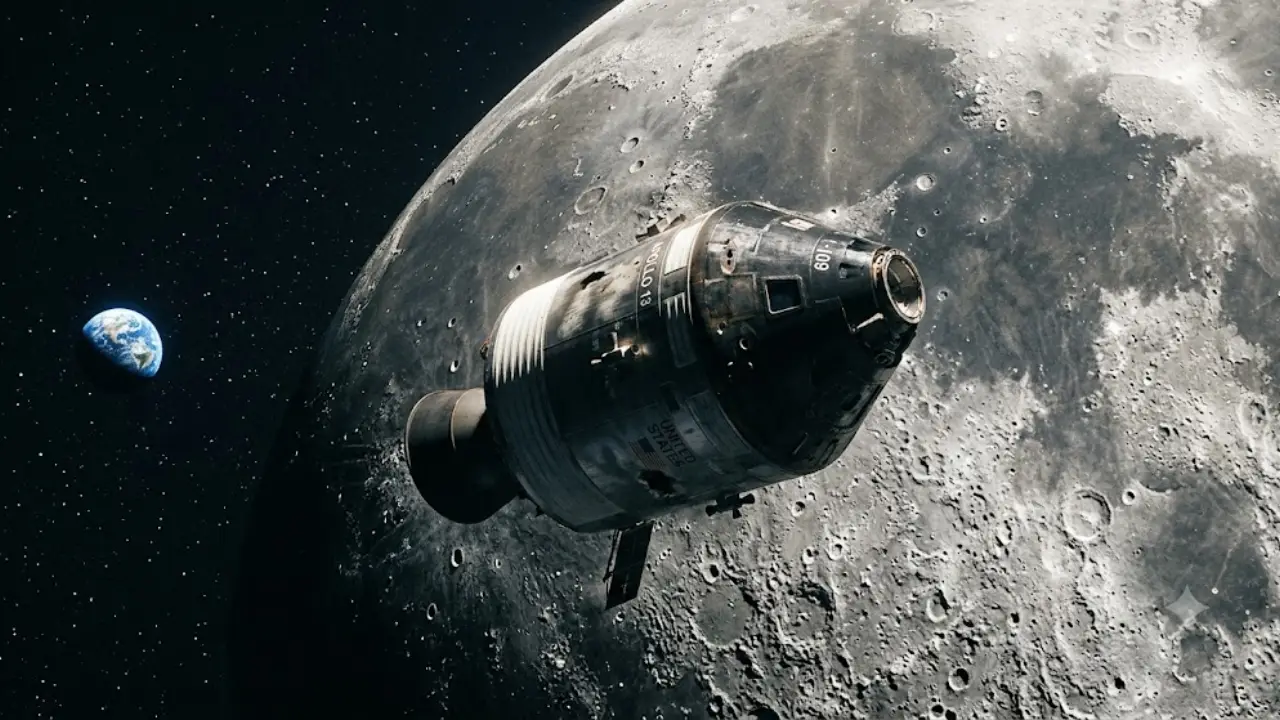
There was nothing dramatic about the problem at first.
No fire.
No explosion.
No astronaut in danger.
No alarm screaming that something terrible was waiting in the machinery.
There was simply an oxygen tank that refused to empty.
It happened on Earth, weeks before Apollo 13 was supposed to fly to the Moon. Engineers were conducting what should have been a routine countdown demonstration test at Kennedy Space Center. The spacecraft was being prepared exactly as thousands of engineers had prepared Apollo hardware before it.
But Oxygen Tank No. 2 was behaving strangely.
Tank No. 1 emptied normally.
Tank No. 2 did not.
Engineers tried again.
Still nothing.
They increased the pressure.
The tank remained stubborn.
Eventually, the team decided to use the tank’s own heaters to boil away the remaining liquid oxygen.
It worked.
That should have been the end of the story.
It wasn’t.
It was the beginning.
Because inside that tank, something was quietly being damaged and almost nobody knew it.
Twenty days later, Apollo 13 lifted away from Earth.
Two days after that, about 200,000 miles from home, the damaged tank exploded.
And suddenly the strange little problem from the launch pad became a matter of life and death.
The Tank That Already Had a History
The most frightening part of the Apollo 13 story is that Oxygen Tank No. 2 was not an innocent piece of hardware waiting peacefully for its first adventure.
It already had a history.
The tank had previously been installed aboard Apollo 10. It was later removed for modification, and during that process it was dropped roughly two inches. The incident slightly disturbed an internal fill-and-drain line.
At the time, the damage did not appear serious enough to stop the work.
The tank was repaired.
It was tested.
It was installed in the Apollo 13 service module.
And then it passed through the enormous machinery of NASA’s testing system.
This is where the story becomes uncomfortable.
The Apollo program was built around testing because engineers knew that spaceflight does not forgive assumptions. Hardware was tested, inspected, retested and checked again.
Yet the tank carried a small unresolved mystery into the final stages of preparation.
During the Countdown Demonstration Test, when engineers tried to remove the liquid oxygen, Tank No. 1 behaved normally.
Tank No. 2 barely cooperated.
NASA’s later investigation found that the tank initially emptied by only about 8 percent. Repeated attempts failed. The problem was believed to involve the fill line.
The tank was, in effect, telling its engineers:
Something is different here.
But it was not yet telling them why.
Then Someone Made the Tank Empty
The engineers needed to get the oxygen out.
So they chose another method.
They used the electrical heaters inside the tank.
The idea was simple enough: heat the liquid oxygen until it boiled away.
But there was a detail that would later become horrifying.
The spacecraft’s heater system was designed around approximately 28 volts DC.
The ground equipment used during this operation supplied about 65 volts DC.
The difference may sound small when written on paper.
It was not.
The thermostatic switches protecting the heaters had been designed for the lower spacecraft voltage. They had not been properly modified for the higher ground voltage.
And now those heaters were being operated for a very long time.
Not minutes.
Not a brief test.
About eight hours, across five heater cycles.
The engineers watched the temperature gauge.
It did not look alarming.
And that was part of the problem.
The gauge could only show temperatures up to roughly 80–85°F.
It could not tell them what was actually happening deeper inside.
The thermostatic switches were supposed to open the circuit when the heater reached roughly 80°F.
But under the higher voltage, they could fail to open properly.
The result was almost absurd.
The heater tube may have reached approximately 1,000°F.
The people watching the instruments did not see 1,000°F.
They saw an instrument that had essentially reached the top of its measuring ability.
The spacecraft was not screaming.
It was whispering.
And the whisper was being misread as normal.
The Invisible Injury
At around 1,000°F, the problem was no longer simply an overheating heater.
The heat could severely damage the Teflon insulation surrounding nearby electrical wiring.
The insulation could degrade.
The wires could become vulnerable.
But there was no spectacular sign that a disaster had been created.
There was no giant crack in the tank.
There was no visible hole.
The tank still worked.
The oxygen could still be loaded.
The spacecraft could still be launched.
And that is precisely why the danger survived.
NASA’s later investigation concluded that the damaged tank should have been recognized as hazardous. Yet at the time, the possibility that the prolonged heater operation had severely damaged the internal wiring was not understood.
Replacing the tank would also have created a major launch problem.
So the tank stayed.
Then came the most chilling step.
It was filled with liquid oxygen.
The same tank whose internal wiring insulation had probably been damaged was now filled with an extremely reactive oxidizer.
The danger had gone from theoretical to physical.
But nobody knew exactly how close they were to it.
Then Apollo 13 Left Earth
On April 11, 1970, Apollo 13 launched.
Three astronauts James Lovell, Jack Swigert and Fred Haise were heading toward the Moon.
The rocket worked.
The spacecraft worked.
The astronauts settled into the rhythm of the mission.
For a while, Apollo 13 looked like exactly what NASA wanted it to be.
Then, nearly two days into the flight, the spacecraft needed to perform a routine operation.
The oxygen tanks were stirred.
Fans inside the cryogenic oxygen tanks were activated to keep the contents mixed.
It was not an extraordinary command.
It was normal spacecraft operation.
But inside Tank No. 2, the old damage was waiting.
A damaged wire.
A vulnerable insulation layer.
Liquid oxygen.
Electrical energy.
The ingredients had been carried all the way from Earth.
They had simply been waiting for the right moment to meet.
At first, Mission Control did not understand what was happening.
There were electrical disturbances.
The oxygen tank readings changed.
Then the quantity indication behaved strangely.
And then came the bang.
The crew felt the spacecraft shudder.
Warnings appeared.
Oxygen began escaping into space.
Two of the three fuel cells were lost.
Tank No. 1 was also damaged.
Suddenly, the mission was no longer about landing on the Moon.
It was about getting three human beings home alive.
The Most Frightening Clue Came Before the Explosion
There is another detail that makes the story even stranger.
The spacecraft had already been showing unusual behavior before the final explosion.
During the critical sequence, the oxygen Tank No. 2 readings became abnormal. Its quantity indication went off-scale, sensors behaved erratically, and electrical disturbances appeared.
Mission Control initially did not know what they were seeing.
Was it an instrumentation problem?
A transient?
Something else?
The crew itself did not immediately know.
The spacecraft was effectively sending pieces of a message, but nobody yet understood the language.
Then the explosion supplied the missing punctuation.
And this is perhaps the most important lesson of Apollo 13:
The explosion was not the beginning of the accident. It was the moment the hidden accident finally became visible.
The Moon Was Suddenly Irrelevant
The original Apollo 13 mission was supposed to land on the lunar surface.
That plan disappeared almost instantly.
The spacecraft had lost critical oxygen and electrical capacity. Water was also becoming a major concern because the fuel cells produced water as a by-product, and losing them meant losing an important source of the crew’s supply.
The command module, Odyssey, was no longer a comfortable ride home.
The lunar module, Aquarius, was suddenly something far more important.
It became a lifeboat.
The irony was extraordinary.
The spacecraft designed to take two astronauts down toward the lunar surface would now help three astronauts survive a return journey they had never planned to make.
A Spaceship Designed for Two Had to Save Three
Aquarius had not been designed as an emergency shelter for three men travelling for several days.
Yet that was exactly what happened.
The crew moved into the lunar module.
Power had to be conserved.
Water had to be rationed.
Heat became a problem.
Carbon dioxide became another.
And then NASA discovered another small but potentially lethal mismatch.
The lunar module and command module used different carbon-dioxide removal arrangements.
The command module had square lithium-hydroxide cartridges.
The lunar module’s system used a different configuration.
The crew had the right chemical.
They did not have enough of the right container.
So engineers on Earth faced an almost ridiculous engineering question:
How do you fit a square filter into a round hole?
The answer involved plastic bags, duct tape, hoses and instructions transmitted from hundreds of thousands of miles away.
It was not elegant.
It was not beautiful.
It was engineering under pressure.
And it worked.
The improvised system eventually reduced carbon dioxide dramatically, preventing another crisis from becoming fatal.
This is why Apollo 13 is sometimes described as a “successful failure.”
The mission failed spectacularly.
The landing failed.
The spacecraft was badly damaged.
But the survival system worked because thousands of people adapted faster than the disaster could evolve.
The Computers Could Not Save Them
It is tempting to remember Apollo 13 as a triumph of advanced technology.
It was.
But it was also a reminder of technology’s limits.
NASA could not simply press a button labelled EMERGENCY RETURN.
The situation had not been fully predicted.
The procedures did not already exist in the exact form required.
Mission Control had to calculate, test and improvise.
Engineers built procedures while the astronauts were already flying through space.
The famous ingenuity of Apollo 13 therefore did not come from having a perfect answer.
It came from creating an answer while the clock was running.
That distinction matters.
A perfect system is designed for known failures.
A resilient system is designed to cope with failures that nobody completely imagined.
Apollo 13 needed the second kind.
The Final Problem Was Waiting at Home
Even after the crew had escaped the immediate crisis, getting back to Earth was not simply a matter of pointing the spacecraft home.
The command module had been largely powered down to conserve electricity.
Now it had to be brought back to life.
But there was another danger.
The cold spacecraft had accumulated condensation.
Water and electrical equipment are not ideal companions.
A careless power-up could create another failure at the very moment the astronauts were preparing for re-entry.
So engineers on Earth worked out a procedure that would normally have taken far longer to develop.
They compressed months of preparation into days.
The crew followed the sequence.
The command module came alive.
Apollo 13 separated from the damaged service module.
The astronauts left Aquarius.
And on April 17, 1970, four days after the explosion, the command module splashed down safely in the Pacific.
Three men who had left Earth expecting to walk on the Moon instead came home having survived one of the most complicated spacecraft emergencies ever encountered.
So What Actually Caused Apollo 13?
It is tempting to give one answer:
A faulty oxygen tank.
But that answer is too simple.
The real story was a chain.
A tank had a complicated history.
A possible fill-line problem complicated detanking.
A ground procedure used higher voltage.
Thermostats were not properly suited to that voltage.
The heaters operated for hours.
The temperature measurement could not reveal the extreme heat.
Insulation was damaged.
The tank remained in the spacecraft.
Liquid oxygen was loaded.
The crew later activated the tank’s fans.
Damaged wiring became vulnerable.
An electrical failure ignited the surrounding material.
The tank ruptured.
The explosion damaged another oxygen tank.
The fuel cells failed.
The spacecraft lost critical resources.
And a lunar mission became a survival mission.
NASA’s later investigation described the accident not as one isolated mistake but as the result of interacting conditions and overlooked warning signs.
That is much more frightening than the idea of a single faulty component.
Because a single faulty component can be replaced.
A chain of individually reasonable decisions is much harder to see.
Apollo 13 in One Glance
| Moment | What happened |
| 1968 | Oxygen Tank No. 2 was removed from Apollo 10 for modification |
| 1968 | Tank was dropped about two inches during handling |
| March 1970 | Tank showed unusual difficulty during detanking |
| March 27 | Engineers used heaters to boil away remaining oxygen |
| Ground test | About 65 V was used instead of the spacecraft’s 28 V |
| About 8 hours | Heaters operated through repeated cycles |
| Up to ~1,000°F | Heater temperature may have reached extreme levels |
| April 11 | Apollo 13 launched |
| April 13 | Oxygen Tank No. 2 exploded |
| April 13–17 | Lunar module became an emergency lifeboat |
| April 17 | Crew splashed down safely in the Pacific |
The Warning Was Not Hidden
This is perhaps the strangest part of the entire story.
The warning was not completely invisible.
The tank had already behaved differently.
The detanking problem had been documented.
The heater had operated for an unusually long time.
The system contained thermostats that were not properly suited to the higher ground voltage.
The temperature instrument could not show what was really happening.
And the tank itself had an unusual history.
None of these facts alone necessarily announced disaster.
Together, however, they formed a pattern.
And patterns are often hardest to recognize when every individual event looks manageable.
That is the lesson Apollo 13 left behind for engineers far beyond the Apollo program.
The dangerous failure is not always the component that suddenly breaks.
Sometimes it is the component that has been quietly behaving strangely for weeks and everyone has a reasonable explanation for why it is probably fine.
Why Apollo 13 Still Matters
Modern spacecraft are vastly more capable than the machines of 1970.
Computers are enormously faster.
Sensors are better.
Simulation is more sophisticated.
Materials and manufacturing controls have improved dramatically.
But one problem has not disappeared.
Complex systems still fail through interactions.
A component may be safe by itself.
A voltage may be safe in one situation.
A procedure may be safe under normal conditions.
A temperature may appear normal on an instrument.
But combine the wrong components, the wrong procedure and the wrong assumptions, and the system can move into territory nobody intended.
That is why modern engineering places enormous importance on system safety, configuration control, traceability, independent review and learning from near-misses.
Apollo 13 demonstrated the value of those principles in the most unforgiving laboratory imaginable.
Space.
NASA’s later case studies still use Apollo 13 as an example of how manufacturing history, testing, human decisions and system interactions can combine to create a failure that no single engineer intended.
The Final Mystery
When people remember Apollo 13, they usually remember the explosion.
But the explosion is almost the least mysterious part.
We know what happened.
We know the tank failed.
We know the wiring had been damaged.
We know the heaters had been exposed to conditions they were not designed to handle.
We know the explosion crippled the spacecraft.
And we know three astronauts survived.
The real mystery is much quieter.
It is the question that existed before the launch:
How many small warnings can a sophisticated system give before somebody realizes they are all describing the same problem?
Apollo 13 never answered that question completely.
Instead, it gave us something more valuable.
A demonstration.
A spacecraft can survive an explosion.
A crew can survive the loss of its mission.
Engineers can invent solutions while the clock is running.
But the safest disaster is still the one that is recognized before it happens.
Apollo 13 became famous for the explosion on the way to the Moon.
Its deeper story began much earlier inside a tank that refused to empty, inside a test that seemed to succeed, and inside a temperature gauge that quietly stopped telling the truth.
The spacecraft did not suddenly become dangerous in space.
It had been carrying a secret from Earth.
And by the time everyone could see it, Apollo 13 was already 200,000 miles from home.
The greatest lesson of Apollo 13 was not how to survive the explosion. It was how easily a warning can look harmless until the moment it becomes history.
Key Unfoldings
- Apollo 13’s disaster began with problems encountered during ground testing, not suddenly in deep space.
- Oxygen Tank No. 2 had an unusual history before launch.
- A difficult detanking operation led engineers to use 65-volt ground power on hardware designed around 28-volt spacecraft power.
- The heaters operated for about eight hours, potentially reaching around 1,000°F.
- The resulting heat likely damaged nearby Teflon insulation.
- The damaged tank was subsequently filled with liquid oxygen and launched.
- The later explosion destroyed critical oxygen and electrical capacity.
- The lunar module became a lifeboat for all three astronauts.
- Improvised engineering—including the carbon-dioxide filter adaptation helped keep the crew alive.
- Apollo 13 remains a classic lesson in system safety because the disaster was produced by a chain of individually understandable events rather than one spectacular mistake.
Further Reading
For the primary historical record, see NASA’s Apollo 13 Mission Details, the Apollo 13 Accident Review Board report, and the NASA Technical Reports Server Apollo 13 case study.








Leave a Reply