
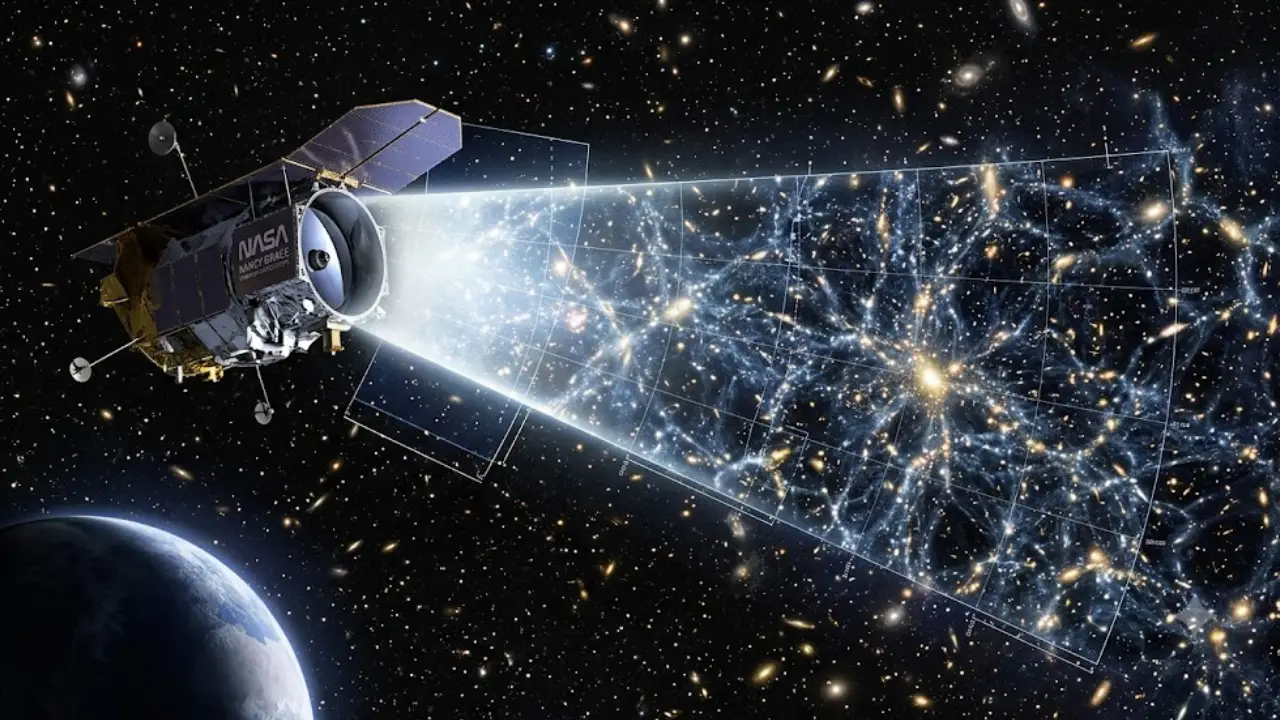
The telescope that may discover what astronomers were not looking for
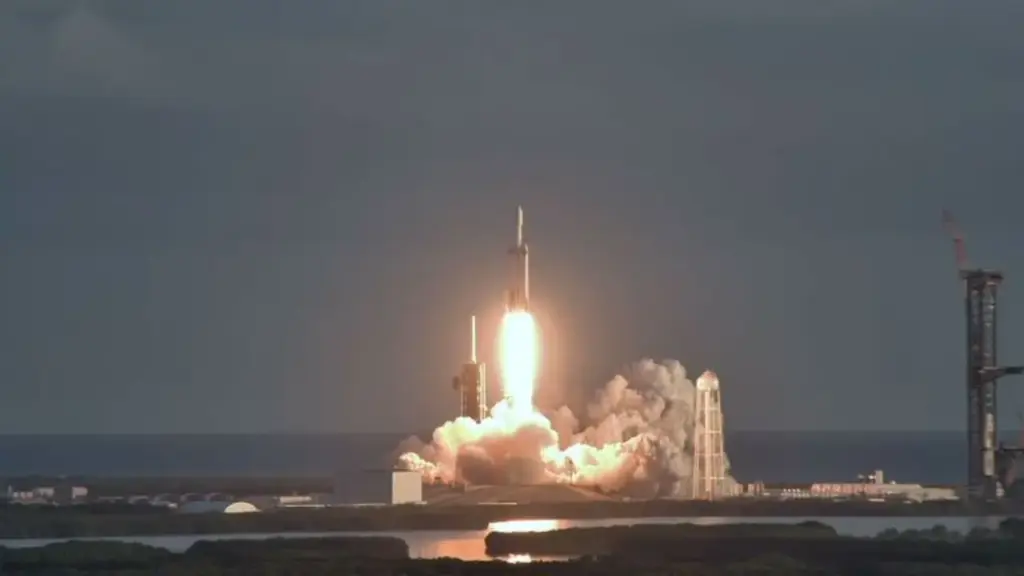
At 7:26 on the morning of August 30, 2026, a Falcon Heavy rose from Florida carrying something unusual.
It was not merely another telescope.
It was a machine designed to change the scale at which humanity sees the universe.
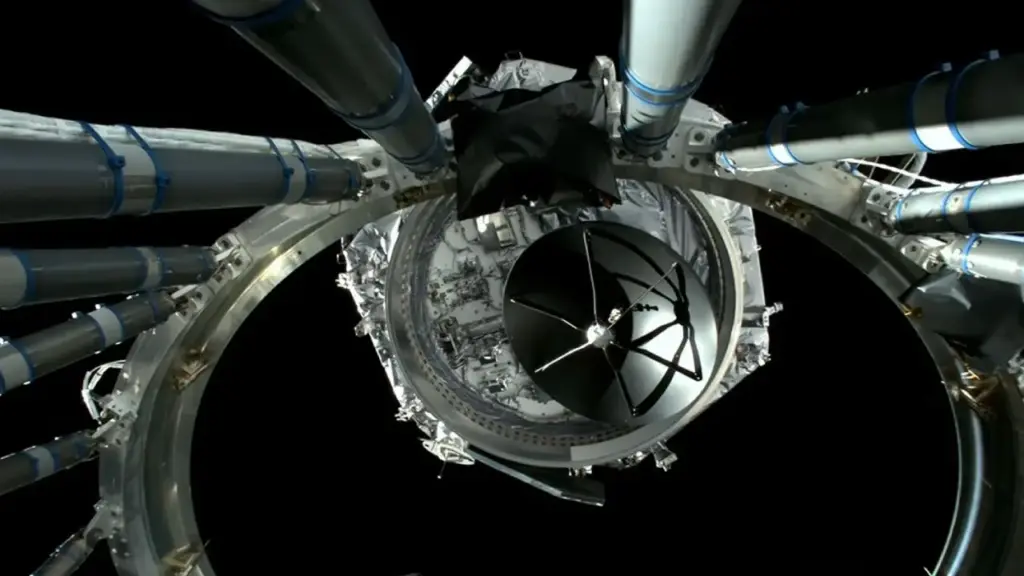
NASA’s Nancy Grace Roman Space Telescope separated from its launch vehicle less than half an hour after liftoff and has now begun its roughly three-month journey toward the Sun-Earth L2 region, about one million miles from Earth. NASA’s first post-launch manoeuvres are already underway.
The obvious question is: What will Roman see?
The more interesting question is:
What will Roman see that our existing telescopes could not see simply because they were looking at too little of the sky?
That distinction matters.
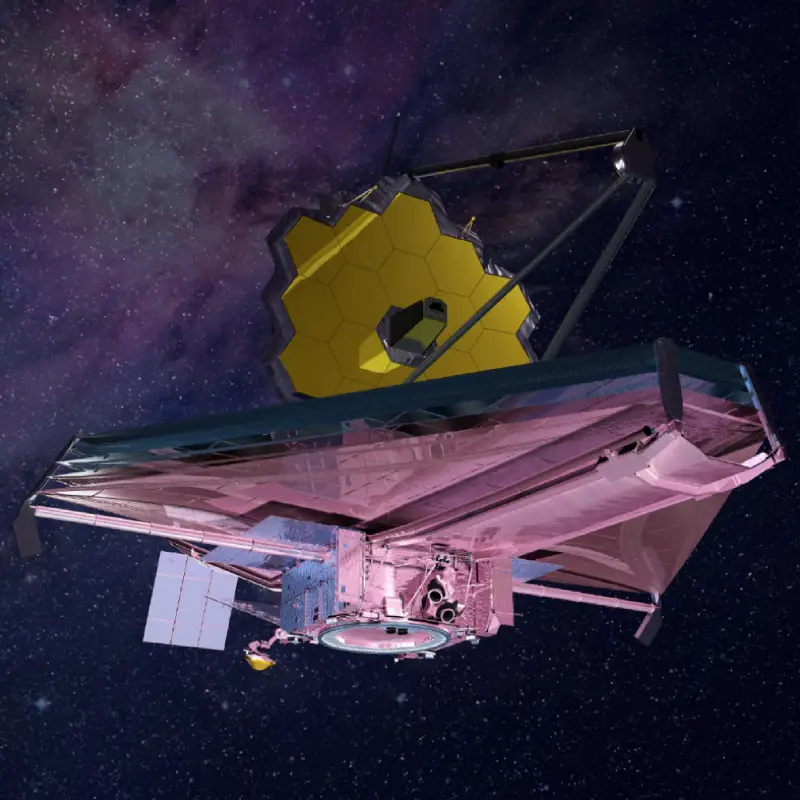
The James Webb Space Telescope has already shown that the universe becomes stranger the deeper we look. Webb can spend enormous amounts of observing time examining individual galaxies, stars and planetary systems with extraordinary sensitivity.
Roman approaches the problem differently.
Its primary mirror is 2.4 metres across the same diameter as Hubble’s but its Wide Field Instrument can see roughly 100 times more sky in one exposure than Hubble’s infrared camera. Its 288-megapixel near-infrared detector is being built not merely to make beautiful images, but to conduct enormous surveys.
And that changes the question astronomy can ask.
Webb can tell us:
“What is this?”
Roman can increasingly ask:
“How many of these are there where are they, how do they change, and what does their distribution tell us about the universe?”
That is a much more dangerous question for our theories.
We Have Been Studying the Universe Like Art Collectors
For much of astronomical history, discovery worked like this.
Find an unusual object.
Point a telescope at it.
Study it.
Publish the result.
Move on.
The method produced extraordinary discoveries, but it has an inherent weakness.
A single object can be fascinating without being representative.
If you discover one peculiar galaxy, you do not know whether it is a cosmic freak or an example of something common.
If you discover one unusual planetary system, you do not know whether planets normally form that way.
If you find one strange exploding star, you do not know whether it represents a new population or merely an extraordinarily rare event.
This is where survey astronomy becomes powerful.
Instead of asking only what exists, it asks about distributions.
How many?
Where?
Under what conditions?
How often?
How does frequency change with cosmic time?
Roman is being designed around exactly this philosophy.
NASA says the observatory will survey enormous areas of sky, investigate dark energy and dark matter, conduct a statistical census of planetary systems and enable a much broader range of astrophysics.
The telescope is therefore less like a photographer and more like a cosmic census bureau.
And census data can be far more disruptive than a single spectacular photograph.
Roman’s Great Trick Is Not Its Mirror
Here is the slightly counterintuitive part.
Roman does not have a mirror dramatically larger than Webb.
Webb’s primary mirror is about 6.5 metres across.
Roman’s is 2.4 metres.
So if “bigger telescope” were the whole story, Roman would lose immediately.
But astronomy has another dimension of power:
how much sky you can examine at once.
Roman’s Wide Field Instrument has a field of view of about 0.28 square degrees.
That is vastly larger than Webb’s principal imaging field.
Nature’s recent comparison puts the difference in stark terms: Roman’s field of view is roughly 100 times wider than Hubble’s and its image sharpness remains remarkably high for such a wide survey instrument.
This is the key.
Roman is sacrificing some of the “stare forever at one tiny patch” philosophy in favour of a far broader survey.
It is designed to move astronomy from isolated discoveries toward statistical populations.
Imagine Searching a Forest With a Microscope
Suppose you want to understand a forest.
One approach is to take a microscope into one square metre and examine it with extraordinary detail.
You might discover fascinating insects.
You might find fungi nobody knew existed.
You might learn how one tiny ecosystem works.
But you could still misunderstand the forest.
Maybe your square metre was unusual.
Maybe it was unusually wet.
Maybe it was beside a tree.
Maybe it happened to contain a rare species.
Now imagine somebody gives you a second instrument.
It cannot examine the insect’s individual hairs as well.
But it can survey the entire forest repeatedly.
Suddenly you can determine where the insects live.
How common they are.
Which environments contain them.
How their numbers change.
Whether the rare-looking insect is actually common.
Webb is closer to the microscope. Roman is closer to the aerial survey.
Neither makes the other unnecessary.
Together, they are vastly more informative.
Why Webb and Roman Need Each Other
The Webb-Roman relationship is therefore not a competition.
It is a pipeline.
Roman can survey enormous areas and identify objects or events worth investigating.
Webb can then examine selected targets in extraordinary detail.
NASA explicitly describes the observatories as complementary. Roman’s large field makes it particularly effective for finding populations and transient events, while Webb can provide detailed follow-up observations of selected discoveries.
This could become particularly powerful for supernovae.
Roman may find thousands across a huge region.
Instead of astronomers guessing where to look, they receive a catalogue of promising targets.
Then other observatories can follow them.
The telescope becomes a discovery engine for the wider astronomical ecosystem.
And that is an important change.
The most valuable telescope may not be the one that answers the question.
It may be the one that tells everyone else which questions are worth asking.
NASA
The Invisible Universe Is Where Roman Gets Serious
Beautiful galaxies are not Roman’s deepest reason for existing.
The mission’s central cosmological targets are much more elusive.
Dark matter.
Dark energy.
Together they dominate the modern cosmic mystery.
Dark matter does not shine in the ordinary sense.
Yet its gravity shapes the distribution of visible matter.
Dark energy appears to be associated with the accelerated expansion of the universe.
And neither mystery can be solved simply by taking a prettier photograph.
Roman therefore has to do something subtler.
It must measure patterns.
Roman Will Try to Map Something It Cannot Photograph
Imagine looking at a distant galaxy.
Its shape appears slightly distorted.
You might blame the galaxy.
But perhaps the distortion was produced by gravity somewhere between that galaxy and us.
Mass bends spacetime.
Light follows that curved geometry.
The resulting distortion is called gravitational lensing.
Weak lensing is particularly interesting because the effect is so small that no single galaxy tells you much.
But Roman will observe enormous numbers of galaxies.
Statistically, tiny distortions begin to add up.
And from those distortions, astronomers can reconstruct how matter is distributed.
This includes the gravitational influence of dark matter.
It is an extraordinary form of indirect vision.
Roman will not photograph dark matter.
It will photograph what dark matter does to other things.
That is often how science sees the invisible.
Then Comes the Bigger Mystery: Dark Energy
There is a strange fact hiding inside modern cosmology.
The universe is expanding.
That was already known.
But observations in the late 1990s revealed something more unsettling:
the expansion is accelerating.
Whatever causes that acceleration is usually called dark energy.
NASA estimates dark energy accounts for roughly 68% of the universe’s total cosmic content.
So the component associated with the universe’s accelerating expansion is not some tiny correction.
It dominates the cosmic budget.
And yet we still do not know its physical nature.
Roman will attack this problem using several independent approaches.
That matters because one measurement can deceive.
Three measurements that agree are much harder to dismiss.
Three measurements that disagree may be even more interesting.
Roman Will Turn Exploding Stars Into Cosmic Measuring Sticks
One of Roman’s tools will be Type Ia supernovae.
These explosions are useful because their intrinsic properties allow astronomers to estimate their distances.
Combine distance with redshift a measure related to how much the universe’s expansion has stretched the light and astronomers can reconstruct how expansion has changed through cosmic history.
Roman’s wide survey should find thousands of these events.
But Roman will not rely on supernovae alone.
It will also use baryon acoustic oscillations, the large-scale imprint left by sound waves in the early universe, and weak gravitational lensing, which probes how cosmic structures grew.
The logic is almost forensic.
If all three methods tell the same story, confidence rises.
If they disagree, scientists have a problem.
And sometimes a problem is exactly what science wants.
What If the Universe Refuses to Agree With Itself?
This is one of the most exciting possibilities.
Imagine Roman determines the expansion history of the universe.
Another method produces a slightly different answer.
Then another telescope measures something else.
The discrepancy survives increasingly careful analysis.
At first, scientists will suspect calibration.
Then systematic errors.
Then data processing.
Then perhaps the theory.
That sequence matters.
Scientific revolutions rarely begin with someone announcing:
“We have disproved physics.”
They begin with something much less glamorous:
“That number doesn’t quite fit.”
Roman’s multiple probes could make those disagreements much harder to ignore.
Perhaps dark energy evolves.
Perhaps gravity behaves differently across cosmological distances.
Perhaps the standard cosmological model needs modification.
Or perhaps an apparently profound discrepancy turns out to be an instrumental effect.
Roman cannot promise a revolution.
But it can make the universe much less tolerant of sloppy explanations.
The Telescope Is Also Going Planet Hunting
And here Roman becomes almost schizophrenic.
One part of the mission studies the largest structures in the universe.
Another searches for planets.
Roman’s microlensing survey will monitor enormous numbers of stars toward the crowded centre of the Milky Way.
The principle is beautifully simple.
A foreground star passes almost directly in front of a more distant star.
Its gravity bends and magnifies the background light.
If the foreground star has a planet, the planet can produce an additional disturbance in the magnification pattern.
For a brief period, the hidden planet announces itself through gravity.
The telescope does not need the planet to cross its star.
It needs the planet to bend light.
That gives Roman access to a different population of worlds.
The Exoplanet Census Could Be More Important Than the Planet List
This distinction is often missed.
People naturally ask:
“How many planets will Roman discover?”
The more important question is:
“What kind of planetary population will Roman reveal?”
Current NASA mission estimates and recent Nature reporting describe different components of the exoplanet programme, including a very large transit survey and a smaller but especially valuable microlensing sample. Nature reports that Roman could detect around 100,000 exoplanets through transits, while its microlensing programme could find roughly 1,000 additional worlds, many of them in planetary regimes difficult to sample with conventional transit searches.
That distinction matters.
The transit method favours planets with particular orbital configurations.
Microlensing favours another population.
Together they can reveal how incomplete our current planetary census actually is.
Nature has described Roman’s potential yield as perhaps 40 times the number of distant worlds currently catalogued, depending on the definition of the sample and the detection method.
That is not simply “more planets.”
It is a chance to discover whether our existing picture of planetary systems has been badly biased by the methods we have been using.
Our Own Solar System Is a Warning
There is a wonderfully uncomfortable thought here.
If astronomers tried to discover our Solar System using some existing exoplanet techniques from a distant location, they could easily miss most of it.
Earth is small.
Its orbit is relatively wide compared with many hot exoplanets.
Neptune takes 165 years to orbit the Sun.
A survey lasting months or even a few years would have a difficult time recognising such a system through methods designed around repeated transits or stellar motion.
This is why detection methods matter.
Every telescope creates a bias in what it can discover.
Roman’s importance is partly that it introduces different biases.
Only by combining them can astronomers approach a more honest census of planetary systems.
NASA
And Then There Is the Possibility Nobody Can Put in a Proposal
Every major survey has a secret scientific objective.
It is the discovery nobody predicted.
Astronomers can specify dark energy.
They can specify exoplanets.
They can specify galaxy evolution.
But they cannot specify what nature will do outside those categories.
Roman will repeatedly observe enormous regions of sky.
That means it will encounter rare things.
A bizarre transient.
An unusual stellar explosion.
A strange gravitational lens.
An unexpected galaxy population.
A black hole behaving in a way nobody anticipated.
A planetary configuration that does not fit existing formation models.
The most valuable discovery may not have been listed in the mission proposal because there was no reason to imagine it.
This is one of the strengths of large surveys.
They enlarge the space of possible accidents.
Roman Will Turn the Sky Into a Movie
There is another subtle revolution here.
Astronomy has traditionally been photographic.
Take an image.
Study it.
Take another image.
Compare them.
Roman’s repeated wide-field observations move closer to time-domain astronomy.
The sky becomes a changing system rather than a static picture.
A star brightens.
A supernova appears.
A planet creates a brief microlensing signature.
A black hole changes its feeding behaviour.
Something moves.
Something disappears.
The telescope notices.
This is the astronomical equivalent of replacing a photograph album with surveillance footage.
Except the “camera” is watching millions or billions of cosmic objects.
The Price of Seeing Everything Is Data
And here is Roman’s less glamorous problem.
A telescope that sees enormous amounts of sky also produces enormous amounts of information.
NASA estimates Roman could generate approximately 20 petabytes of data during its five-year primary mission, with roughly 11 terabits of data per day expected to be transmitted during operations.
That changes astronomy.
Humans cannot manually inspect everything.
Algorithms become essential.
Machine learning will help classify objects and detect transient events.
Automated pipelines will process images.
Databases will connect Roman discoveries to observations from other telescopes.
The bottleneck is therefore shifting.
For centuries, the problem was:
We do not have enough observations.
Now it increasingly becomes:
We have too many observations to understand without machines.
The next generation of astronomers may therefore spend as much time designing algorithms as pointing telescopes.
Roman Is Joining a Much Larger Cosmic Network
Roman’s arrival is particularly important because it is not entering an empty observational landscape.
The Vera C. Rubin Observatory is already beginning its era of enormous optical surveys from Chile.
The European Space Agency’s Euclid mission is mapping large-scale cosmic structure.
Webb is examining selected targets with extraordinary infrared sensitivity.
Roman brings something different:
wide, sharp, repeated infrared observations from space.
Nature recently described Roman, Rubin and Euclid as complementary large-scale observatories that together could transform cosmic mapping.
This is important.
The future of astronomy may not belong to a single “best telescope.”
It may belong to coordinated telescopes with different strengths.
One finds the object.
Another measures its spectrum.
Another sees its infrared properties.
Another maps its gravitational environment.
The discovery becomes a network event.
The Most Powerful Telescope May Be the One That Knows Where to Look Next
Consider a hypothetical Roman observation.
A transient appears.
Roman’s software detects it.
Its position is sent to other observatories.
Ground-based telescopes obtain spectra.
Webb examines its infrared emission.
Other surveys search archival data.
Within hours or days, an event that would once have been invisible becomes a multi-observatory investigation.
This is the emerging logic of modern astronomy:
Survey → detect → classify → trigger → follow up → compare.
Roman is unusually well suited to the first step.
And that makes it disproportionately useful to everyone performing the later ones.
There Is a Deeper Reason Scale Changes Science
Imagine finding one coin buried in a field.
Interesting.
Find ten coins.
Now you suspect something.
Find ten thousand.
Now you have archaeology.
The difference is not simply quantity.
It is that large samples expose patterns.
Roman’s billion-galaxy scale therefore matters because it transforms individual observations into population statistics.
A galaxy’s shape means something.
But the distribution of millions of galaxy shapes means much more.
One planet tells you about one planet.
A planetary population tells you about planet formation.
One supernova measures one point.
Thousands trace cosmic expansion.
One gravitational lens is an oddity.
Millions of weak distortions can map invisible matter.
This is why Roman’s true superpower is not magnification.
It is statistics.
What Could Roman Do to Our Understanding of the Universe?
There are several possibilities.
It could confirm the standard cosmological model.
This would sound boring.
It would not be.
A theory that survives a much larger and more precise dataset becomes substantially stronger.
It could reveal evolving dark energy.
That would be revolutionary because the simplest models generally treat dark energy as a constant property of space.
It could expose problems with gravity.
If structure growth and expansion refuse to fit together under standard gravity, physicists may have to reconsider the rules.
It could reveal unexpected dark-matter structure.
The distribution of invisible matter could differ from current predictions.
It could transform planetary demographics.
A much larger and less biased planetary census could change theories of how planetary systems form.
Or it could discover something nobody has named.
History suggests that large surveys are particularly good at producing this final category.
Roman’s Most Important Discovery May Not Be an Object
It could be a pattern.
That is perhaps the hardest idea to sell in an age of spectacular space photography.
Humans love objects.
A new planet is exciting.
A black hole is exciting.
A strange galaxy is exciting.
But physics often hides in relationships.
The universe may reveal its secrets through correlations:
galaxy shapes with dark matter;
galaxy clustering with cosmic expansion;
planet frequency with stellar environment;
supernova distance with cosmic time;
structure growth with gravity.
Roman is being built to measure those relationships.
That is why its enormous survey is scientifically more important than any individual image it produces.
A Telescope Named After a Woman Who Changed Astronomy
There is another story beneath the engineering.
Nancy Grace Roman was NASA’s first chief astronomer and played a major role in developing the agency’s space-astronomy programme.
She strongly advocated space telescopes because Earth’s atmosphere limits astronomical observations.
She also championed broad scientific access to astronomical data.
The telescope bearing her name therefore has an appropriate mission.
Roman is not simply looking through a larger window.
It is helping build an astronomical infrastructure in which enormous datasets can be shared, analysed and reused by scientists around the world.
Her legacy is therefore unusually visible in the telescope’s philosophy.
The observatory is designed not merely to produce discoveries.
It is designed to produce a scientific resource.
Roman’s Journey Has Only Just Begun
The launch is the dramatic part of the story.
But in a sense, it is the least interesting part.
The Falcon Heavy has already done its job.
Roman is now travelling toward L2.
The spacecraft has completed its first major trajectory correction.
The engineering teams will spend the coming months preparing the observatory for operations.
Then comes the part that cannot be simulated completely on Earth.
The telescope opens its eye.
And begins counting.
Not one galaxy.
Not one planet.
Not one supernova.
Millions.
Perhaps billions.
Patterns will emerge.
Some will confirm what astronomers already believe.
Others will refuse to cooperate.
And somewhere in that enormous statistical forest may be a tree nobody has ever seen.
The Hidden Universe May Not Be Hidden Because It Is Dark
This may be Roman’s most profound lesson.
Some things are hidden because they emit almost no light.
Dark matter is the obvious example.
Other things are hidden because they are too rare.
Some are hidden because they appear only briefly.
Some are hidden because previous telescopes looked in the wrong way.
And some are hidden because the universe is simply too large for a small survey to reveal their pattern.
Roman attacks that last problem directly.
It gives astronomers something they have never possessed at this scale:
a wide, sharp, infrared view of enormous regions of the universe, repeatedly observed.
That changes the nature of discovery.
We are moving from:
“Look at this strange thing.”
toward:
“Look at the pattern formed by everything.”
And patterns are where theories live.
The Final Mystery Is What We Are Not Expecting
The Roman Space Telescope has been sold, understandably, through the great mysteries of modern cosmology.
Dark matter.
Dark energy.
Exoplanets.
Galaxy evolution.
They are enormous questions.
But the most exciting possibility may sit outside all of them.
Perhaps Roman will discover something that forces astronomers to create an entirely new category.
Perhaps the universe will produce an event that makes today’s models look quaint.
Perhaps it will reveal a statistical anomaly too persistent to explain away.
Or perhaps it will do something more subtle.
It may show us that several apparently unrelated cosmic mysteries are actually connected.
That would be the truly transformative result.
Because the greatest discoveries rarely add another fact to the encyclopedia.
They change the way the encyclopedia is organised.
Roman has now left Earth carrying a 2.4-metre mirror and a 288-megapixel infrared eye.
But its real cargo is something less visible:
the possibility of a universe measured at a scale large enough to expose the assumptions hidden inside our theories.
Webb taught us to look deeper.
Roman is about to teach us to look wider.
And when depth meets scale, the universe may finally run out of places to hide.
Roman Space Telescope: The Numbers That Matter
| Feature | What it means |
| Launch | August 30, 2026 |
| Launch vehicle | SpaceX Falcon Heavy |
| Launch time | 7:26 a.m. EDT |
| Destination | Sun–Earth L2 |
| Distance from Earth | About 1 million miles |
| Primary mirror | 2.4 metres |
| Main instrument | Wide Field Instrument |
| Detector | 288-megapixel near-infrared camera |
| Field of view | About 0.28 square degrees |
| Relative field | Roughly 100× Hubble’s |
| Primary mission | 5 years |
| Potential extended mission | Up to 10 years |
| Data expected | About 20 petabytes over primary mission |
| Daily data | About 11 terabits |
| Major science | Dark matter, dark energy, exoplanets, galaxy evolution |
| Galaxy reach | Up to roughly 1 billion galaxies |
| Microlensing survey | About 100 million stars |
| Planned broad cosmology survey | More than 5,000 square degrees |
Figures are based primarily on current NASA mission documentation, supplemented by recent Nature reporting.
Roman Versus Webb: Two Different Ways of Seeing
| Roman | James Webb | |
| Primary philosophy | Survey widely | Examine deeply |
| Mirror | 2.4 m | 6.5 m |
| Main advantage | Huge field of view | Exceptional sensitivity and detail |
| Infrared astronomy | Yes | Yes |
| Large population studies | Exceptional | More limited |
| Individual-target detail | Very strong | Exceptional |
| Transient discovery | Major strength | Excellent for follow-up |
| Dark-energy surveys | Core mission | Not its primary role |
| Exoplanet census | Major mission | Targeted studies |
| Likely relationship | Finds many targets | Investigates selected targets |
The two observatories should therefore be viewed as complementary instruments, not rivals.
Five Questions Roman Could Change
1. Is dark energy really constant?
Roman’s combination of supernovae, galaxy clustering and weak lensing can test whether cosmic acceleration changes with time.
2. Does dark matter form structures exactly as predicted?
Weak gravitational lensing can map its influence indirectly.
3. How many planetary systems resemble ours?
Roman’s combination of transit and microlensing observations will sample planetary populations that current surveys cannot fully capture.
4. How did galaxies assemble so efficiently in the early universe?
Roman’s wide infrared surveys will provide enormous samples of distant galaxies.
5. What did astronomers fail to imagine?
This is the question no mission proposal can answer in advance.
The Unfolding
Roman successfully launched August 30, 2026, and is travelling toward Sun–Earth L2.
Its greatest advantage is not mirror size but survey scale.
Roman’s field of view is roughly 100 times larger than Hubble’s, allowing it to survey enormous regions rapidly.
It will investigate the universe’s two largest mysteries: dark matter and dark energy.
It will use several independent cosmological probes rather than betting everything on one measurement.
Roman could transform exoplanet science by creating a much larger and more diverse planetary census.
Its approximately 20-petabyte primary-mission data output means data science and automated discovery will be central to its success.
Webb and Roman are complementary, with Roman particularly valuable for finding populations and events and Webb for detailed follow-up.
The mission’s greatest discovery may be something that was never predicted.
Frequently Asked Questions
Is Roman more powerful than Webb?
Not in any simple sense. Webb has a much larger mirror and excels at extremely detailed, sensitive observations. Roman’s advantage is its enormous field of view and survey speed. They are designed for different jobs.
Will Roman replace Hubble?
No. Roman and Hubble overlap in some capabilities but have different observing strategies. Roman is designed primarily for large-scale infrared surveys, while Hubble remains an extraordinarily versatile observatory across multiple wavelengths.
Can Roman see dark matter?
Not directly. It will infer dark matter’s distribution from the gravitational effects it has on the light of distant galaxies.
Can Roman see dark energy?
No telescope photographs dark energy. Roman will investigate its effects by measuring cosmic expansion and the growth of large-scale structure.
How many planets will Roman discover?
The answer depends on detection technique. Current projections include roughly 100,000 planets from transit observations and around 1,000 from microlensing, with the exact yield depending on mission performance and definitions of detectable planets.
Could Roman find an Earth-like planet?
It could find planets of interest, but Roman is primarily designed for a statistical planetary census rather than directly imaging Earth twins around Sun-like stars.
Why is Roman going to L2?
L2 provides a favourable environment for a space observatory, with the Sun, Earth and Moon generally in the same direction from the spacecraft, helping thermal management and observations.
Why does Roman need such a huge amount of data?
Because it will repeatedly survey enormous areas of sky containing vast numbers of galaxies and stars. The scientific value comes partly from comparing those objects statistically over time.
Could Roman discover something completely unexpected?
Absolutely possible, although no particular discovery can responsibly be predicted. Large surveys are especially powerful at finding rare events and previously unrecognised populations.
Authoritative Sources
NASA — Nancy Grace Roman Space Telescope launch
NASA’s official August 30, 2026 launch release confirms liftoff at 7:26 a.m. EDT aboard Falcon Heavy and Roman’s journey toward L2.
NASA — Roman mission
Official mission objectives, instruments, survey plans and scientific goals.
NASA — Roman technical information
Official specifications and mission architecture.
NASA — Roman and Webb
Official explanation of how the two observatories complement one another.
Nature — Roman launch and dark-energy mission
Independent scientific reporting on Roman’s capabilities, cosmological goals and relationship with Euclid and Rubin.
Nature — Roman and exoplanet science
Detailed analysis of Roman’s transit and microlensing planet-hunting capabilities and expected discoveries.








Leave a Reply