
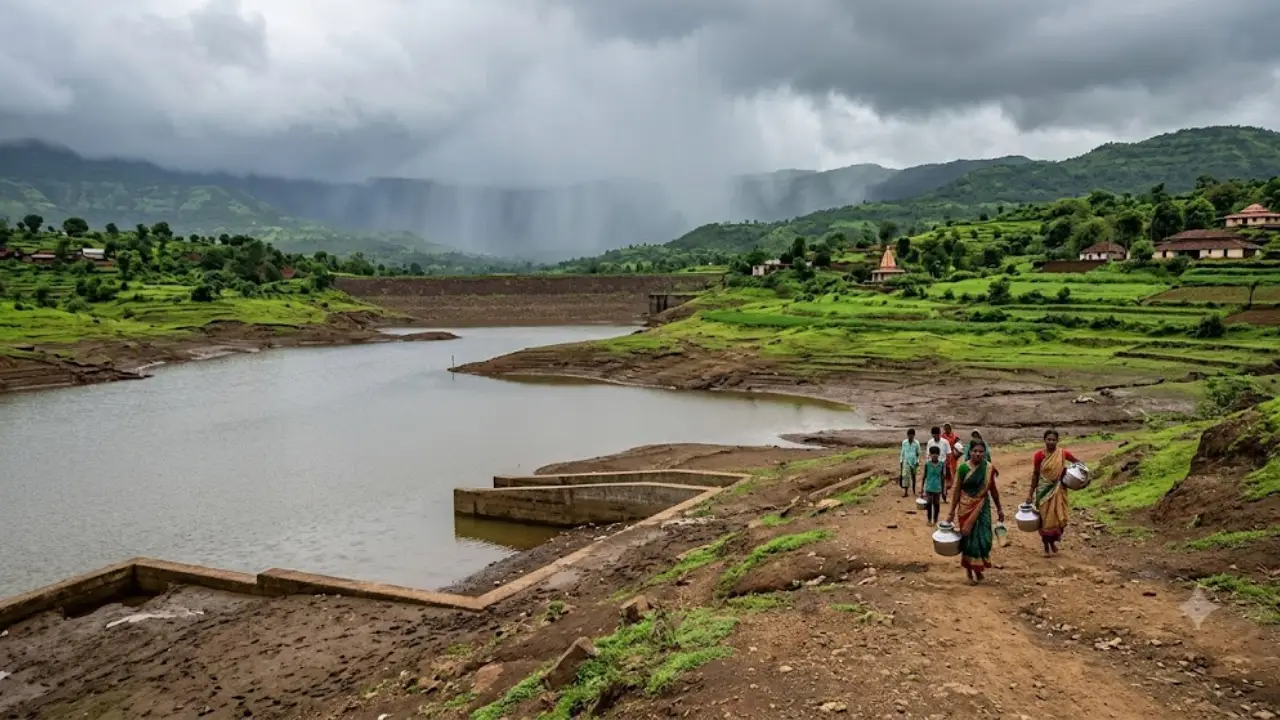
The strange thing about India’s water story is that it begins with rain
The rain came.
That should have been the reassuring part.
Across India, the southwest monsoon spent four months doing what it has done for centuries: crossing the subcontinent, filling rivers, feeding crops and replenishing the reservoirs that quietly keep the country functioning after the clouds leave.
Then came the curious number.
As of 24 September 2026, water stored in 178 major reservoirs monitored by the Central Water Commission (CWC) stood at roughly 70% of their combined live-storage capacity.
The 10-year average for the same period was 76.62%.
The corresponding figure in 2025 was about 79%.
And in southern India, the picture was considerably harsher: reservoir storage was only about 50%, compared with 87.25% a year earlier. The region had also received about 23% below-normal rainfall by late September.
Suddenly, the obvious question becomes the wrong one.
It is not:
“Did India get enough rain?”
It is:
“How much of the rain became water that India can actually carry into the dry season?”
That distinction is where the real story begins.
A reservoir is not a rain gauge
There is a peculiar habit in discussions about India’s monsoon.
We count rainfall as though the country were a gigantic bucket.
Rain falls.
The bucket fills.
Problem solved.
Unfortunately, India is not a bucket.
It is a continent-sized collection of mountains, river basins, aquifers, farms, cities, reservoirs and coastlines—and water does not politely distribute itself according to national averages.
A raindrop falling in Karnataka is not available to a reservoir in Madhya Pradesh.
A cloudburst over a city is not automatically groundwater recharge.
Rain falling intensely for two hours is not necessarily equivalent to the same rainfall spread over several days.
And water rushing through a river after an extreme storm is not the same thing as water remaining behind a dam in November.
Between rainfall and usable storage lies an entire chain:
Rain → soil moisture → runoff → river flow → reservoir inflow → storage → release → actual use
At every step, water can take another route.
That is why the reservoir number is so revealing.
It is not telling us how much rain India received.
It is telling us something closer to how much of the country’s enormous seasonal water pulse has survived long enough to become a reserve.
The 70% number is serious, but not for the reason the headline suggests
“10-year low” sounds like the country has reached some historic bottom.
It has not.
The CWC comparison is against the average storage for the corresponding period over the previous decade. CWC’s own reporting system compares current storage with both the previous year and the 10-year average; when storage falls substantially below normal, the Commission can advise states to use available water judiciously.
So the useful comparison is:
| Measure | Late September 2026 |
| Reservoirs monitored | 178 |
| Current storage | ~70% |
| 10-year average | 76.62% |
| Same period, 2025 | ~79% |
| Southern India | ~50% |
| Southern India, 2025 | 87.25% |
The difference between 70% and 76.62% is not a catastrophe by itself.
The more interesting number is the gap between regions.
Because a country can have a reasonably respectable national reservoir percentage while particular river basins are already under severe pressure.
That is exactly what is happening here.
India is not experiencing one water story
Look at the map in your head.
Western India: comparatively strong.
Central India: comparatively strong.
Eastern India: around its normal position in some recent CWC comparisons.
Northern India: considerably weaker.
Southern India: dramatically weaker.
Recent CWC-based reporting put the western region at around 84.61%, central India at 85.55%, and the eastern region at roughly 73% in the late-September assessment, while northern reservoirs were around 62% and southern reservoirs around 50%.
That is not a national water level.
It is a collection of very different water realities.
And this is where the phrase “India’s reservoirs are 70% full” becomes slightly dangerous not because it is false, but because it is too smooth.
The average irons out the drama.
Water does not.
The South is where the arithmetic becomes uncomfortable
Southern India’s approximately 50% storage deserves particular attention because the comparison with last year is extraordinary.
The region’s monitored reservoirs held roughly 27.926 billion cubic metres of water, around half their live capacity, against approximately 87.25% at the comparable point in 2025.
The affected region includes:
Andhra Pradesh
Telangana
Karnataka
Kerala
Tamil Nadu
These are not five states waiting politely for the next rain.
They contain major agricultural systems, large cities, industrial centres and river basins where water is already an intensely managed resource.
And the consequences can arrive long before a reservoir becomes “empty”.
Telangana, for example, was already dealing with immediate irrigation pressure in September, with water released from the Jurala project to help standing crops after an assurance of additional Krishna water from Karnataka.
This is what water stress looks like in real life.
Not necessarily a dry reservoir bed.
Sometimes it is simply a farmer asking:
“Will there be enough water for the crop that is already in the ground?”
The Marathwada clue: why local rainfall matters more than the national number
Another useful warning comes from Maharashtra.
By September 20, reservoir storage in Marathwada was reported at 46.19%, while rainfall in the region was only around 71% of its seasonal average.
Tanker deployment for drinking water had risen from 101 to 196 in roughly two weeks.
Yet some larger dams in the broader region remained substantially fuller because they benefited from rainfall elsewhere.
That is the paradox in miniature.
A large dam can look comfortable while smaller local reservoirs are struggling.
Why?
Because the geography of storage is not identical to the geography of rainfall.
The lesson is bigger than Maharashtra:
A national water statistic can be perfectly accurate and still be a poor description of what a particular village is experiencing.
Also comes the calendar
September is not simply the end of the monsoon.
It is the beginning of the countdown.
The southwest monsoon normally withdraws progressively from the country after its retreat begins in northwest India. IMD’s criteria include sustained cessation of rainfall, establishment of an anticyclonic circulation and reduction in atmospheric moisture; withdrawal from the southern peninsula and the country follows later.
The important thing is what happens after the clouds leave.
The water already stored in reservoirs must now bridge a period during which many regions receive considerably less dependable rainfall.
That water has jobs waiting for it.
It must potentially serve:
farms + cities + industry + ecosystems + electricity generation
And those demands do not pause simply because the monsoon has gone home.
This is why October storage matters.
It is not merely a measurement of what happened during the monsoon.
It is a down payment on what happens next.
Agriculture does not need an empty reservoir to feel the squeeze
It would be too simplistic to say:
Low reservoirs = food crisis.
Reality is more interesting.
The chain is longer:
Lower storage → tighter irrigation decisions → altered crop choices or irrigation schedules → possible yield and income effects → possible market consequences
CWC itself uses reservoir-storage information as an input into crop-planning decisions.
Recent reporting also noted that India’s kharif sowing area was about 108.63 million hectares as of 4 September, around 1.6% below the corresponding area a year earlier.
But the reservoir problem matters particularly as India moves into the rabi season.
That is when stored water becomes increasingly valuable.
A farmer does not need to know that India’s reservoirs are at 70%.
The farmer needs to know whether water will arrive at the canal when the crop needs it.
That is a much more local and much more consequential number.
The invisible reservoir beneath the visible one
Now the story gets deeper.
India has another water-storage system.
You cannot photograph it from a helicopter.
It has no giant concrete wall.
It is underground.
Groundwater.
According to the latest national groundwater assessment, India had around 406.19 billion cubic metres (BCM) of annual extractable groundwater resources and approximately 245.64 BCM of annual groundwater extraction, giving an overall extraction stage of 60.47%.
Agriculture accounted for about 213.29 BCM of extraction—roughly 87% of the total.
Domestic use accounted for about 28.07 BCM, while industrial use was around 4.28 BCM.
And the national average again conceals the sharp edges.
The 2024 assessment classified 751 of 6,746 assessment units as over-exploited, with another 206 classified as critical.
So when a reservoir runs low, groundwater can act as a shock absorber.
But a shock absorber has a limit.
If India responds to every weak monsoon by pumping harder, the country may simply be moving the problem from a visible reservoir to an invisible aquifer.
Water is also an electricity story
There is another character quietly standing backstage:
the power grid.
Hydropower turns stored or flowing water into electricity.
That makes reservoir storage part of India’s energy system.
Recent reporting noted that India’s hydropower generation had fallen 11% year-on-year during April–August 2026, while weaker water availability was already being watched alongside broader power-system pressures.
But again, there is no justification for jumping from:
lower reservoir storage
to
India is heading for a power crisis.
Hydropower is only one part of the electricity system.
The more defensible conclusion is narrower:
Less dependable water can reduce hydropower flexibility and increase pressure on other sources of electricity.
That matters because India’s electricity demand does not care whether the monsoon performed well.
Factories still run.
Air-conditioners still run.
Hospitals still run.
Data centres still run.
The lights have no meteorological sympathy.
The water-energy trap
And here is the really interesting part.
Water needs energy.
Energy can depend on water.
Groundwater has to be pumped.
Water has to be treated.
Cities have to move it through pipelines.
Wastewater has to be processed.
Meanwhile, reservoirs can generate electricity.
So the relationship is circular:
Water → electricity
and
electricity → water
A stressed water system can therefore create additional energy demand just as reduced water availability can constrain part of the energy system.
This is the kind of connection that disappears when water is treated merely as a “natural resource”.
It is not just a resource.
It is infrastructure.
What does “70% full” actually mean?
Here is another trap.
Reservoirs have different storage zones and operating characteristics.
The figure normally discussed in CWC reservoir bulletins concerns live storage the water available for regulated use within the reservoir’s operational range.
That is not synonymous with every drop physically occupying the entire reservoir.
There is gross storage.
There is live storage.
There is dead storage.
There are inflows.
There are releases.
There are evaporation losses.
There are operational rules.
And there are downstream requirements.
So:
70% storage ≠ 70% of all water India possesses.
It is a measurement of a particular monitored reservoir system.
That distinction sounds technical.
It is actually the difference between understanding the number and merely repeating it.
The full-dam illusion
Suppose two reservoirs are both 80% full.
One serves a relatively small population.
The other serves millions of people, irrigates extensive farmland and supports hydropower generation.
Which is safer?
The percentage cannot tell you.
Now imagine the first reservoir receives strong inflows next month.
The second receives almost none.
The same percentage has suddenly become two completely different futures.
This gives us a better equation:
Water security is not storage alone. It is storage + expected inflow − expected demand − losses.
The most important word there may be expected.
Because water management is essentially a wager against the future.
And then there is evaporation
Stored water does not sit inside a refrigerator.
It sits under the sun.
Evaporation therefore matters, especially during hot, dry periods.
A warming climate can alter atmospheric demand for moisture, while shifts in rainfall timing can change how long reservoirs and soils remain exposed to dry conditions.
But this is where restraint matters.
It would be intellectually lazy to take the September 2026 reservoir figure and announce:
“Climate change caused it.”
We do not have evidence for such a one-line explanation.
A better question is whether changing climate conditions can amplify the vulnerability of a water system already exposed to rainfall variability, high demand and uneven storage.
That is a much more defensible and much more interesting question.
The monsoon’s great trick: too much water and too little water can coexist
This is perhaps the strangest part of India’s water story.
One place can flood.
Another can remain dry.
A river can rise violently after a cloudburst.
A reservoir in another basin can remain below normal.
A city can be underwater while farmers elsewhere wait for irrigation water.
There is no contradiction.
The mistake is imagining that “India’s water” exists in one giant national tank.
It doesn’t.
India has thousands of hydrological stories happening simultaneously.
The monsoon does not distribute water fairly.
It distributes water according to geography, atmospheric circulation, topography and timing.
Human infrastructure then attempts to negotiate with that distribution.
Sometimes it succeeds.
Sometimes the map wins.
What about El Niño?
The temptation in any weak-monsoon year is to find one villain.
This year, El Niño is an obvious candidate.
But the intellectually honest version is more complicated.
El Niño is a Pacific Ocean–atmosphere phenomenon known to influence global circulation and India’s monsoon behaviour.
Recent reporting has linked strengthening El Niño conditions with the erratic 2026 monsoon and dry spells.
But that does not mean:
El Niño → exactly 70% reservoir storage.
Weather is not a single-variable machine.
Rainfall depends on interacting oceanic and atmospheric processes, regional circulation, intraseasonal variability and local geography.
So El Niño belongs in the explanation.
It does not deserve the entire explanation.
The more important question is not “Why did the rain fail?”
It is:
“Where, when and how did the rain fail to become stored water?”
That question changes the investigation.
Instead of looking only at national rainfall totals, we examine:
basin-level rainfall;
rainfall intensity;
dry spells;
runoff;
reservoir inflows;
groundwater recharge;
evaporation;
irrigation demand;
reservoir operations.
The result is a much more complicated picture.
And complexity, in this case, is not the enemy of a good story.
It is the story.
What we know and what we don’t
What we know
CWC data show that the 178 monitored major reservoirs entered the end of the southwest monsoon at around 70% of live capacity, below the 76.62% decadal average and the comparable 2025 level of about 79%.
Southern India is the sharpest regional concern, with storage around 50%, versus about 87.25% a year earlier.
Groundwater extraction remains enormous, particularly for agriculture.
What we can reasonably infer
Lower starting storage means a smaller buffer entering the dry season.
Southern India is more exposed than the national average suggests.
Agriculture and hydropower are among the systems worth watching closely.
Groundwater may provide a buffer in some locations but is already heavily stressed in others.
What we do not know yet
We do not know exactly how individual basins will behave through the coming dry months.
We do not know whether subsequent rainfall will materially improve specific reservoirs.
We do not know how farmers will adjust irrigation and crop decisions.
We do not know which local water systems will experience the greatest pressure.
And we certainly cannot infer a nationwide drinking-water emergency simply from the 70% number.
That uncertainty should remain visible.
The dashboard that matters after October
Forget the dramatic headline for a moment.
If you really want to understand India’s water position, watch these:
| Watch | Why it matters |
| Reservoir storage | The starting buffer |
| Reservoir inflows | Whether the buffer is being replenished |
| Basin rainfall | Where the rain is actually falling |
| Groundwater levels | Pressure on the underground reserve |
| Rabi sowing | Emerging agricultural demand |
| Irrigation releases | Rate of water consumption |
| Hydropower output | Water-energy connection |
| Urban restrictions | Local drinking-water stress |
| River-basin conditions | The geography hidden by national averages |
| Northeast monsoon | Especially important for southern India |
This is a far better way to follow the story than waiting for the next headline containing the words “water crisis.”
So, is India running out of water?
No.- That sentence is too crude for the evidence.
But neither is everything comfortable.
The more accurate description is this:
India is entering the post-monsoon period with below-normal reservoir storage, substantial regional differences and a particularly weak position in southern India.
That creates vulnerability.
Whether vulnerability becomes serious water stress depends on what happens next.
And there is something larger hiding underneath the numbers.
India’s water challenge may not ultimately be solved by asking for more rain.
The harder question is whether the country can capture, store, distribute, recharge and use the rain it already receives more intelligently.
Because a country can have plenty of rainfall and still have a water problem.
It can have full dams and thirsty villages.
It can have flooded streets and depleted aquifers.
It can have a river in spate and a farmer waiting for irrigation water.
And it can have 70% of its monitored reservoir capacity filled while some regions are already worrying about what happens next.
That is not a contradiction.
It is the map.
The Unfolded question
The monsoon is often described as India’s annual water refill.
Perhaps that metaphor is too comforting.
A refill suggests that someone simply plugs the country in, waits four months and starts again.
India’s water system is more like a household trying to survive an uncertain year with one enormous, unevenly distributed bank account.
Some accounts are overflowing.
Some are nearly empty.
Some families are quietly borrowing from groundwater.
Some reservoirs are earning electricity.
Some are feeding crops.
And everywhere, the withdrawals continue.
So the question that matters as the clouds leave is not:
“Did India get enough rain?”
It is a much harder one:
“How much water did India actually carry out of the monsoon—and how much of that reserve can it afford to spend?”
That is the number worth watching.
And unlike a sensational “water crisis” headline, it does not pretend the future has already been written.
Key Unfoldings
ndia’s 178 monitored major reservoirs were around 70% of live-storage capacity at the end of September 2026.
The figure was below the 76.62% 10-year average and about 79% at the comparable point in 2025.
Southern India was the major regional outlier, at roughly 50%, against about 87.25% a year earlier.
Reservoir storage is not the same thing as rainfall, groundwater or total national freshwater.
Groundwater is an enormous second reserve—but one already under serious pressure in many assessment units.
Agriculture is the dominant groundwater user.
Reservoir conditions also affect hydropower and therefore India’s wider water-energy system.
The 70% national figure conceals major basin-level differences.
Climate variability may amplify water stress, but a single cause such as El Niño cannot explain the entire reservoir picture.
The real test begins after the monsoon: how long can today’s stored water meet tomorrow’s demand?
Authentic sources and government links
Central Water Commission (CWC) — India’s principal technical authority for water-resources monitoring, including reservoir storage.
India Meteorological Department (IMD) — monsoon, rainfall and withdrawal data.
Central Ground Water Board (CGWB) — national groundwater-resource assessment and groundwater monitoring.
Central Electricity Authority (CEA) — hydropower and electricity-system data.
National Water Mission, Government of India — water conservation, efficiency and integrated water-resource management.
National Water Data Portal / National Water Informatics Centre — reservoir-level datasets; the CWC daily reservoir dataset was updated as recently as 29 September 2026.
NITI Aayog — water budgeting and integrated water-resource planning.
Primary reporting used for the September 2026 assessment: Central Water Commission data reported by The Indian Express, Mint and other outlets.
Related reading on THE UNFOLDED SHELF
- The Himalayan Forest May Know a Wildfire Is Coming Before We Do — an investigation into moisture, atmospheric dryness and how landscapes can become vulnerable before the danger becomes visible.
- Hidden Geography of Power: How Small Places Stop the World — a broader exploration of how geography creates hidden vulnerabilities in interconnected systems.
- THE UNFOLDED SHELF Editorial Policy — the evidence-first approach behind the site’s research articles.








Leave a Reply