
There is something slightly absurd about the annual iPhone ritual.
A company worth trillions gathers the world’s attention, lowers the lights, plays carefully engineered music and reveals a rectangle.
The rectangle is usually a little faster.
The camera is a little better.
The screen is a little brighter.
The battery lasts a little longer.
And somewhere in the audience, someone whispers: “But is it really worth upgrading?”
For years, that question could be answered by counting improvements.
The iPhone 3GS was faster than the 3G. The iPhone 4 changed the display. Later generations transformed photography, biometrics, processors and connectivity.
But smartphones have reached an awkward stage of technological maturity.
Today’s premium phone is already astonishing.
Its screen is difficult to improve dramatically without a laboratory instrument. Its camera can produce photographs that would have required expensive equipment not long ago. Its processor is powerful enough to perform tasks most owners never ask it to perform.
So Apple faces a rather uncomfortable problem with the iPhone 18 generation.
How do you persuade someone to replace an excellent phone with another excellent phone?
The answer may not be another camera lens or another percentage point in processor performance.
It may be intelligence.
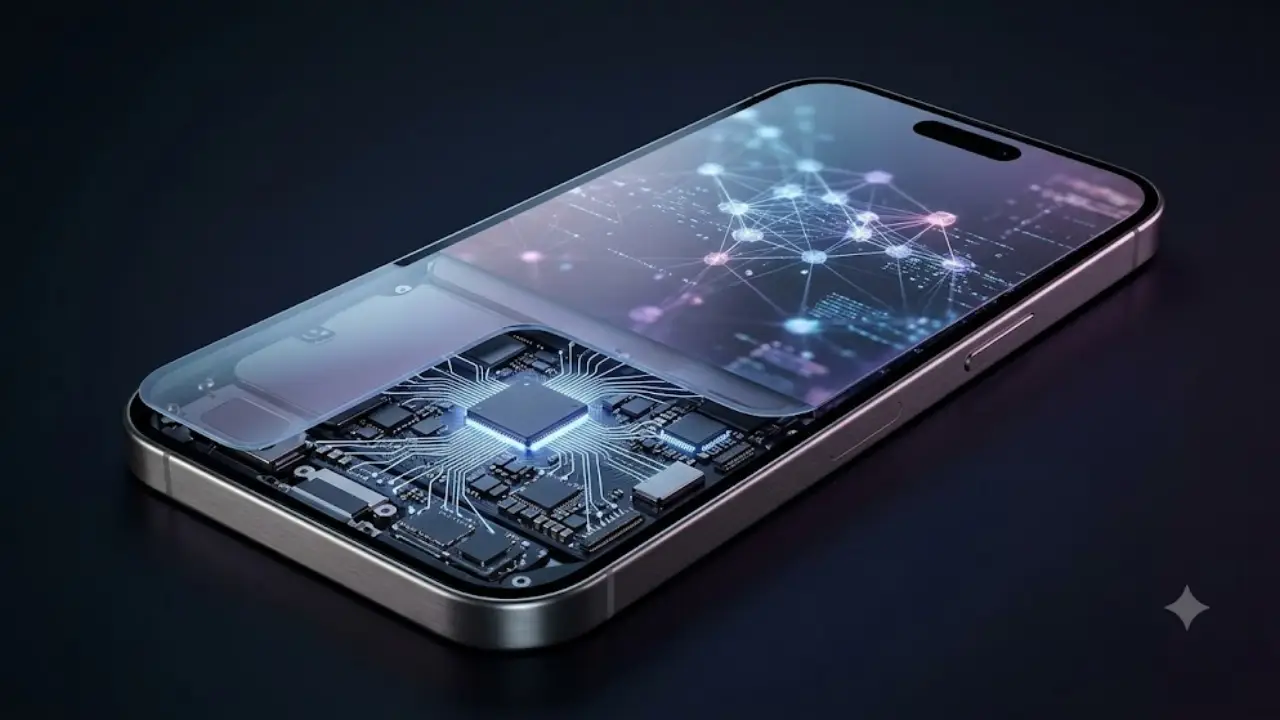
And that is why the most interesting iPhone 18 story is happening somewhere the launch photographs will not show you: inside the silicon, the operating system and the AI architecture.
As Apple prepares its September 9, 2026 launch under new CEO John Ternus, reports point toward a premium-first iPhone strategy, with the iPhone 18 Pro and Pro Max expected alongside Apple’s first foldable iPhone, while the conventional iPhone 18 may arrive later. Reuters and other outlets describe the foldable as potentially Apple’s biggest hardware change since the original iPhone.
But the foldable is only half the story.
The deeper story is what happens when the world’s most tightly integrated smartphone platform starts becoming an AI computer that happens to have a screen.
The iPhone 18 problem is not speed. It is usefulness.
The smartphone industry has spent years confusing technical progress with human progress.
A processor gets a higher benchmark score and the advertisement declares victory.
But try explaining that improvement to someone who spends most of the day messaging family, watching videos, taking photographs, making payments and checking maps.
They don’t care about the benchmark.
They care whether the phone survives until bedtime.
They care whether a photograph taken at night looks good.
They care whether the phone understands what they are saying.
They care whether the device can find a document they saved six months ago.
And increasingly, they care whether AI can actually do something useful rather than merely rewrite a sentence in a different tone.
That distinction is becoming visible in consumer research. A recent report citing Counterpoint and an Amazon India survey found that performance, battery and camera remain major purchase drivers, even as AI increasingly influences buying decisions.
This creates a hierarchy of upgrades.
A faster chip is nice.
A smarter chip that makes the phone last longer and understand you better is different.
That is the territory Apple is moving toward.
The strange thing about Apple’s next chip is what you may not notice
The expected A20 Pro has become one of the most discussed pieces of iPhone 18 hardware, with reports pointing toward a 2-nanometre manufacturing process and a redesigned architecture. Those details remain reports rather than Apple-confirmed specifications at the time of writing.
But focusing only on whether A20 Pro is 10%, 20% or 30% faster misses the larger technological story.
The important word is efficiency.
A smartphone is a peculiar computer. A desktop can afford a large cooling system and a wall socket. A phone cannot.
Every calculation has an energy price.
Every AI request consumes electricity.
Every camera frame processed in real time costs something.
Every background task quietly drains the battery.
So the ideal mobile processor is not simply the one that calculates fastest.
It is the one that calculates intelligently while wasting the least energy.
Apple’s recent silicon direction offers a clue. In August 2026, Apple introduced its M6 generation on a 2nm process, describing improvements in performance and power efficiency and highlighting its Neural Engine for AI workloads.
If that philosophy reaches the A-series, the biggest benefit may be invisible.
Your phone may not feel dramatically faster.
It may simply stop running out of battery as quickly while doing much more work.
That is the sort of upgrade that doesn’t look impressive on a stage.
It becomes impressive at 9:30 p.m., when the phone still has 38% battery.
The real battlefield is the part of the iPhone you cannot photograph
Apple has spent years assembling something unusual.
It designs the processor.
It controls the operating system.
It builds its own machine-learning frameworks.
It designs specialised components.
It increasingly designs wireless silicon.
And it decides how all those pieces communicate.
The iPhone 17 generation already introduced Apple’s N1 wireless networking chip for Wi-Fi 7, Bluetooth 6 and Thread. That illustrates where the company is heading: fewer generic components, more specialised Apple-designed silicon.
Why does this matter?
Because custom silicon allows Apple to optimise the entire chain.
Imagine a camera recognising a face.
The sensor produces data.
The image processor interprets it.
The neural engine analyses it.
The operating system decides what should happen.
The AI model understands context.
The result appears on the display.
In a conventional hardware ecosystem, those pieces may come from different companies.
Apple increasingly owns the conversation between them.
That is not merely an engineering preference.
It is a strategic moat.
The AI story is much bigger than Siri
For years, smartphone assistants have had a slightly embarrassing reputation.
Ask your assistant for the weather and it works.
Ask it something complicated and suddenly you are negotiating with a very polite robot.
Apple knows this.
And its 2026 AI architecture suggests it is attempting something much more ambitious.
Apple announced its third-generation Foundation Models in June 2026. The company says the family contains multiple models, including on-device models and server models operating through Private Cloud Compute. Apple developed the new models in collaboration with Google and technologies associated with the Gemini family.
That detail deserves more attention than most launch rumours receive.
Because Apple’s AI strategy is not simply:
“Put a giant chatbot inside the iPhone.”
It is closer to:
“Build intelligence into the operating system.”
That changes the relationship between human and device.
Today, we often think:
I want something → I open an app.
The emerging model is:
I want something → I tell the system.
That difference sounds tiny.
It isn’t.
Suppose you say:
“Find the photographs from our last family trip, choose the best ones, make a short video and send it to the family group.”
The old smartphone requires you to remember where everything is.
The intelligent smartphone needs to understand your intention.
That is the real transition.
The phone stops being a toolbox.
It starts becoming an operator.
Apple’s most interesting AI idea may be the one nobody sees
There is an important misconception about Apple’s AI strategy.
People sometimes describe Apple Intelligence as if everything happens on the phone.
That is not quite right.
Apple’s architecture uses a mixture of on-device processing and Private Cloud Compute.
Simple or privacy-sensitive tasks can run locally.
More complex requests can be processed on specialised servers.
But Apple says Private Cloud Compute is designed so user data is not stored or made accessible to Apple while requests are processed. Apple has also opened aspects of the system to outside security researchers.
In 2026, Apple expanded Private Cloud Compute beyond its own data centres, working with Google and NVIDIA to support workloads in third-party infrastructure while retaining its stated privacy architecture.
That is strategically fascinating.
Because the AI industry has largely followed one direction:
more data → more cloud computation → more powerful models.
Apple is trying to construct another path:
personal data → local intelligence where possible → private cloud when necessary.
The distinction matters because an AI assistant becomes more useful as it knows more about you.
But the more it knows, the more dangerous a conventional cloud model can become.
Your messages.
Your photographs.
Your location.
Your calendar.
Your relationships.
Your documents.
Your habits.
Your financial information.
The more useful the assistant becomes, the more intimate the data becomes.
Apple’s bet is that privacy itself can become an AI feature.
That may eventually be more important than benchmark scores.
The camera is quietly becoming a computer
For years, smartphone camera marketing was obsessed with megapixels.
Then it became obsessed with multiple lenses.
Then zoom.
Now the battle is becoming computational.
The camera sensor captures raw information.
The processor interprets it.
AI decides what belongs in the image.
That is why a future camera upgrade should not be judged simply by its megapixel count.
Reports suggest a variable-aperture camera could appear in the iPhone 18 Pro Max. The feature could provide more physical control over light and depth of field, although this remains unconfirmed before Apple’s announcement.
That matters because smartphones have traditionally relied heavily on computational tricks to compensate for tiny sensors.
A variable aperture would give the system another physical tool.
Now imagine combining that with AI.
The camera could determine:
which face needs exposure priority;
which part of a scene should remain sharp;
whether motion is intentional;
whether a light source is causing flare;
which background elements should be softened;
how skin tones should be preserved;
how several frames should be combined.
The future camera may therefore behave less like a camera and more like a visual decision-making engine.
And video could become even more interesting.
Photography gives the phone one final image.
Video gives it hundreds or thousands of frames.
That creates enormous opportunities for real-time computational processing.
The phone could eventually understand not just what the camera sees, but what is happening.
That is a much more powerful capability.
The display race may be running out of road
There is a point at which a specification stops being an upgrade and becomes a number.
Refresh rate is approaching that territory.
Moving from 60Hz to 120Hz was a genuine transformation.
Everything feels smoother.
Scrolling feels different.
Animations feel more natural.
But beyond that, the practical benefit becomes increasingly difficult for ordinary users to perceive.
The smarter direction is therefore not necessarily 144Hz or 180Hz.
It is adaptive efficiency.
If the display can intelligently reduce its refresh rate when nothing is moving and increase it instantly when needed, the user receives smoothness without continuously paying the battery cost.
That is a more mature engineering philosophy.
The best display technology may eventually be the technology users stop talking about.
Because it simply works.
Then there is the little black island Apple may finally shrink
The Dynamic Island has become part of the iPhone’s visual identity.
But it is also an admission.
The phone still needs physical space for sensors.
Reports suggest the iPhone 18 Pro models could feature a smaller Dynamic Island, while under-display Face ID remains one of the more persistent long-term possibilities.
The engineering challenge is harder than the marketing version suggests.
Face ID is not simply a selfie camera.
It depends on specialised sensing technology.
Move those components beneath a display and the display becomes part of the optical system.
Light must pass through another layer.
The sensor must still operate reliably.
Security cannot become weaker.
So Apple has a choice:
make the hardware invisible, or keep the hardware visible because it works better.
Apple’s history suggests it will choose the former only when the engineering is good enough.
That is why rumours of an invisible Face ID system should be treated carefully.
A smaller cutout is plausible.
A truly invisible biometric system is a much bigger engineering achievement.
Battery life may be the iPhone 18’s most underrated revolution
Here is a useful thought experiment.
Would you rather have:
20% more processing power
or
20% more battery life?
The technology industry usually celebrates the first.
Most humans would probably choose the second.
That is why chip efficiency matters so much.
If a smaller manufacturing process, better CPU architecture, more efficient neural processing, smarter display control and better software optimisation all work together, Apple can increase what the phone accomplishes without increasing what the battery has to endure.
This is especially important for AI.
An AI assistant that needs a charger every afternoon is not an assistant.
It is a needy roommate.
For AI to become truly embedded in the smartphone, computation has to become cheap enough in energy terms to happen constantly.
That is the hidden importance of efficient silicon.
The strange new iPhone 18 problem: Apple may be selling fewer iPhones more intelligently
There is another development that could prove just as significant as the technology itself.
Apple appears to be changing the traditional annual iPhone rhythm.
Reports indicate that the premium iPhone 18 Pro and Pro Max could arrive in September 2026, while the standard iPhone 18 and other lower-priced models may be delayed until spring 2027.
Why?
One factor is the extraordinary rise in memory costs.
The current memory shortage is being driven partly by AI infrastructure competing for advanced memory capacity. Reports indicate smartphone DRAM prices have risen dramatically, creating pressure across the industry.
But there is another business logic.
Premiumisation.
If consumers are already taking longer to replace phones, manufacturers have an incentive to make each high-end customer more valuable.
The smartphone industry is discovering something uncomfortable:
selling more phones every year is not necessarily the only way to grow.
Selling fewer phones at higher prices can become attractive.
That could make the iPhone 18 generation unusually important to Apple’s economics.
India’s premium smartphone story makes this especially interesting
India presents Apple with a contradiction.
It is one of the world’s largest smartphone markets, yet historically it has been dominated by lower and mid-range devices.
That is changing.
Counterpoint data shows India’s premium smartphone segment has been expanding strongly, while Apple’s share of the country’s smartphone value has reached record levels.
But there is a warning hidden inside those numbers.
Counterpoint’s current tracking shows iPhone 17 sell-through in India during its first five months was 19.8% lower than the iPhone 16’s comparable period.
That does not mean Apple has suddenly become weak in India.
It means something more interesting.
Premium buyers are becoming more selective.
A ₹1 lakh-plus smartphone is no longer automatically justified because it is new.
The customer wants a reason.
A better camera is a reason.
Longer battery life is a reason.
A genuinely useful AI assistant could be a reason.
A small benchmark improvement is probably not.
That makes India an important test market for the iPhone 18 proposition.
Upgrade fatigue is becoming a technological phenomenon
There was a time when buying last year’s phone felt like buying yesterday’s technology.
That psychology is weakening.
Today’s three-year-old flagship is often still excellent.
It receives software updates.
Its camera is good.
Its processor is fast.
Its display is beautiful.
Its battery may be the only serious complaint.
Counterpoint’s research found Pro iPhone users replace their phones after an average of about 2.75 years, compared with roughly 3.15 years for non-Pro users in the markets it studied.
That tells us something profound about technological maturity.
When innovation becomes incremental, ownership periods lengthen.
And when ownership periods lengthen, manufacturers need transformational features to restart the upgrade cycle.
This is why AI matters economically.
Apple does not merely need AI to be impressive.
It needs AI to be useful enough to make a two- or three-year-old phone feel meaningfully less capable.
That is a much harder challenge.
The foldable changes the meaning of “iPhone 18”
Then comes the elephant in the room.
Or perhaps the elephant folds.
Apple is expected to introduce its first foldable iPhone, potentially with a large internal display and a premium price exceeding $2,000. Reuters reports analysts expect the device to potentially accelerate a foldable market that has remained relatively niche.
This is important because Apple’s greatest competitive advantage may not be that it invented foldables.
It didn’t.
Samsung and Chinese manufacturers have been experimenting with them for years.
Apple’s advantage is that it can enter later.
It can watch others discover the problems.
Hinges.
Creases.
Durability.
Weight.
Camera compromises.
Battery capacity.
Software scaling.
Then Apple can attempt to solve the version of the problem that it considers acceptable.
That is the classic Apple strategy:
let somebody else pay for the first draft of the future.
Whether that strategy works again is another matter.
Foldables are still expensive, physically complicated and comparatively fragile.
But if Apple makes one that feels normal rather than experimental, it could change consumer expectations very quickly.
Android has something Apple cannot copy: impatience
This is where the competitive story becomes fascinating.
Android manufacturers are often willing to experiment aggressively.
Fast charging.
Periscope cameras.
Foldable screens.
Huge batteries.
High-resolution displays.
Satellite communication.
AI features.
New form factors.
Some experiments fail.
Others become mainstream.
Apple generally follows a different rhythm.
It watches.
It waits.
It integrates.
Then it arrives with a product designed to feel finished.
That creates two very different innovation philosophies.
Android asks: “What can we try?”
Apple asks: “What can we integrate?”
Neither philosophy is automatically superior.
Android is often faster.
Apple is often more cohesive.
But AI may alter the competition because AI is not just hardware.
It touches the operating system.
The assistant.
The camera.
Search.
Messaging.
Photos.
Mail.
Files.
Maps.
Notifications.
Privacy.
And eventually almost everything.
That is an environment in which Apple’s integration strategy could become unusually powerful.
The environmental paradox nobody wants to put on the launch stage
There is one final contradiction.
Suppose the iPhone 18 is dramatically more efficient.
Suppose its AI requires less energy.
Suppose it contains more recycled materials.
Suppose its battery lasts longer.
Excellent.
But if millions of people throw away perfectly functional iPhones to buy the new one, the environmental equation becomes less comfortable.
Apple has increased recycled content and renewable energy use in its products and manufacturing, but the most environmentally friendly smartphone is still usually the one that stays in someone’s hand for longer.
That creates an uncomfortable question for the entire industry:
Can technological progress and longer ownership coexist?
The answer should be yes.
A better phone does not necessarily need to be a phone that people replace every year.
It could instead be a phone that remains useful for five or six years because software keeps making it better.
That would be a more radical form of progress than another annual camera bump.
So what will actually matter to the person holding an iPhone 18?
Forget the keynote for a moment.
Forget benchmark charts.
Forget the colour names.
Forget the dramatic animation around the processor.
Imagine an ordinary Tuesday.
You wake up.
The phone knows your schedule.
It summarises the messages that actually matter.
You leave home.
It understands that you are heading somewhere you have never been before.
You photograph something.
The camera understands the scene rather than merely recording it.
You receive a message in another language.
The phone translates it.
You ask for an old photograph.
It finds it.
You need to prepare something.
It retrieves the relevant document.
You ask it to perform several actions.
It does them.
And most importantly, much of this happens without your personal information being treated as a commodity.
That is the future Apple is trying to construct.
Not a better smartphone.
A less visible computer.
The five tests Apple must pass
The iPhone 18 generation should ultimately be judged against five questions.
1. Does AI actually save time?
If AI merely creates emojis, rewrites emails and generates amusing pictures, it is entertainment.
If it eliminates ten minutes of repetitive work every day, it becomes infrastructure.
2. Does the AI understand context?
The difference between a chatbot and an assistant is context.
A chatbot answers.
An assistant understands why you are asking.
3. Does local AI remain genuinely private?
Apple’s privacy architecture is promising, but the company’s long-term credibility will depend on transparency, independent verification and clear user controls. Apple’s Private Cloud Compute architecture is explicitly designed around this principle.
4. Does the hardware support AI without destroying battery life?
This is where silicon matters.
A brilliant AI model that turns a phone into a hand warmer is not a finished product.
5. Does the new iPhone do enough to justify replacing the old one?
This is the hardest test.
Because Apple’s biggest competitor may no longer be Samsung.
It may be your existing iPhone.
The final irony: the best iPhone 18 feature may make the iPhone less important
This is where the story becomes bigger than Apple.
For almost two decades, smartphone companies have trained us to admire the device.
The glass.
The camera.
The processor.
The screen.
The industrial design.
AI reverses the emphasis.
If AI becomes genuinely useful, the hardware fades into the background.
You stop thinking about which processor performed an operation.
You simply ask.
You stop opening six applications.
You give an instruction.
You stop searching through hundreds of photographs.
You describe the photograph.
You stop worrying about where information is stored.
You ask the system to retrieve it.
In that world, the smartphone becomes something closer to a personal interface to computing itself.
And that creates the ultimate iPhone 18 question.
Not:
How fast is it?
Not:
How many megapixels does it have?
Not even:
How thin is it?
The question is much harder.
Does the iPhone understand me well enough to become genuinely useful without knowing so much about me that I stop trusting it?
If Apple answers yes, the iPhone 18 generation could eventually be remembered as a turning point.
If it answers no, we may look back at 2026 and realise that the most advanced phone in the world was still, fundamentally, just a very good phone.
And perhaps that is the strangest thing about the smartphone industry in 2026.
The next revolution may not be making the phone do more.
It may be making the human do less.
The Unfolded line
The iPhone 18 story is therefore not one upgrade.
It is four stories happening simultaneously:
Silicon is becoming more specialised for AI and efficiency.
Cameras are becoming computational imaging systems.
Software is becoming increasingly intelligent and contextual.
The smartphone itself is slowly becoming an interface to AI rather than merely a collection of apps.
Some reported hardware features such as a 2nm A20 Pro, variable aperture, smaller Dynamic Island and under-display Face ID remain subject to Apple’s official confirmation.
But the direction is already visible.
Apple is building an ecosystem in which hardware, software, AI and privacy are designed to reinforce one another.
That is why the most important specification of the iPhone 18 may never appear on its specification sheet.
It will be measured in something much harder to quantify:
How many things did the phone quietly make easier today?
Frequently Asked Questions
Is the iPhone 18 officially confirmed?
Apple’s September 9, 2026 event is expected to reveal the new generation, but individual specifications circulating before the event should be treated according to their evidence level. The standard iPhone 18’s timing is particularly unusual, with multiple reports expecting some non-Pro models to move to 2027.
Will the iPhone 18 have a 2nm chip?
Reports strongly point toward a 2nm A20 Pro for premium models, but the exact manufacturing configuration should be considered unconfirmed until Apple announces it.
Will Face ID move under the display?
That remains a possibility rather than an established specification. Reports continue to mention a smaller Dynamic Island and under-display Face ID as potential developments.
Will every iPhone 18 have a variable-aperture camera?
Current reports suggest the feature could be restricted to the highest-end model, potentially the Pro Max. This should not be treated as confirmed before Apple’s announcement.
Will AI be processed entirely on the iPhone?
No. Apple’s architecture deliberately combines on-device models with Private Cloud Compute for more demanding workloads.
Why is Apple’s private AI approach important?
Because AI becomes increasingly valuable when it can understand personal context. Apple is attempting to provide that capability while keeping processing local when possible and using privacy-focused cloud computation when greater computing power is required.
Should an iPhone 16 or 17 owner upgrade?
Not automatically. For most owners, the strongest reason to upgrade will be a meaningful improvement in battery endurance, camera performance, AI functionality or a genuinely new form factor—not a modest benchmark increase.
What does the iPhone 18 mean for India?
India’s growing premium smartphone market makes it strategically important for Apple. But the reported decline in comparable early iPhone 17 sell-through also suggests that premium consumers are becoming more selective about what justifies an expensive upgrade.
Sources and further reading
- Apple — Apple Foundation Models and next-generation Apple Intelligence.
- Apple — Apple Intelligence 2026 announcement.
- Apple Security Research — Private Cloud Compute expansion.
- Apple Developer — Foundation Models and Private Cloud Compute.
- Reuters — Apple’s AI and foldable strategy under new CEO John Ternus.
- Reuters — History and outlook for foldable smartphones.
- Associated Press — Apple’s September 2026 product strategy.
- Financial Times — Apple’s AI ambitions and foldable strategy.
- The Verge — iPhone 18 launch expectations and memory-cost pressures.
- Counterpoint Research — iPhone 17 sales tracking in India.
Related government resources
For the environmental and consumer side of the smartphone story, readers can also consult:
- Central Pollution Control Board (CPCB) — India’s e-waste framework and E-Waste Management Rules.
- Ministry of Environment, Forest and Climate Change — India’s environmental policy framework.
- Department of Consumer Affairs — consumer protection and product-related rights.
- Department of Telecommunications — India’s official telecommunications framework.








Leave a Reply