
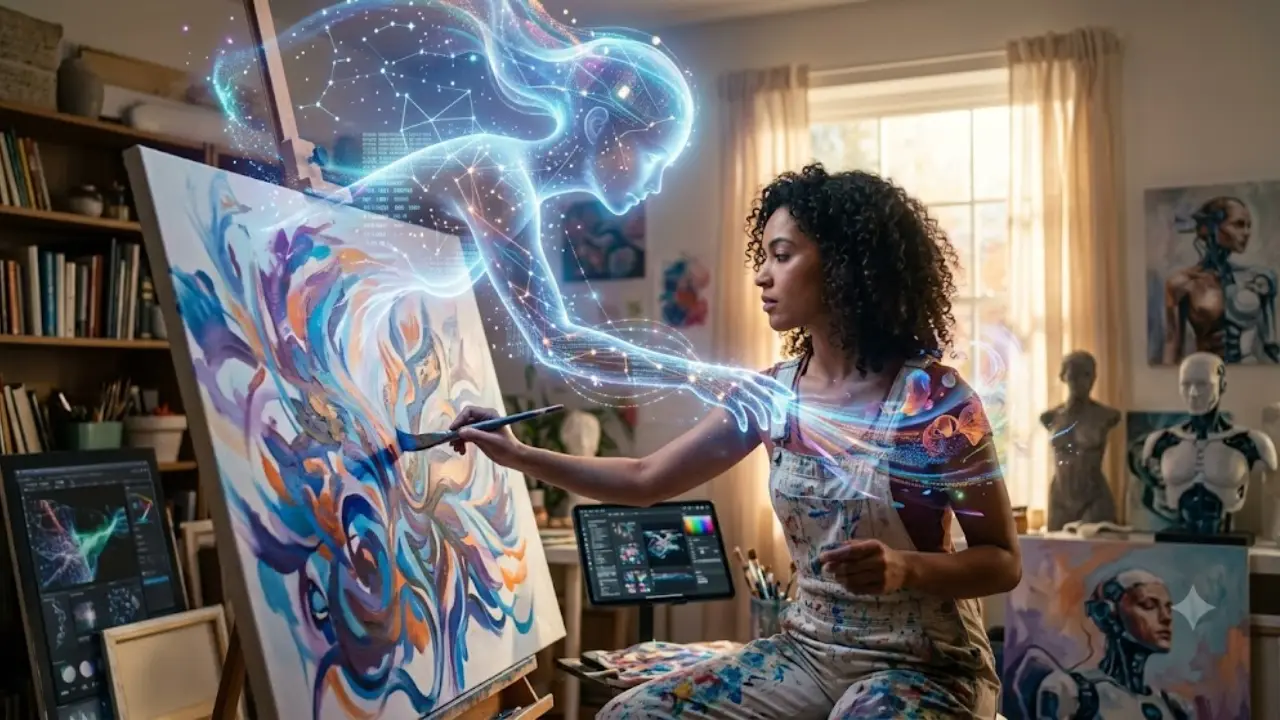
There is a peculiar moment in every technological revolution when the machine stops looking like a machine.
The first calculator looked like a better calculator. The first word processor looked like a smarter typewriter. Early search engines looked like digital telephone directories.
And chatbots?
They looked like very fast people who never got tired of answering questions.
That description is beginning to age.
On September 8, 2026, Meta launched Muse, a personal AI agent designed to do something fundamentally different from merely producing an answer. Meta says Muse can take a goal, plan actions, use applications, remember relevant information and continue working on tasks on a user’s behalf. It runs inside a dedicated Muse Secure VM, with a separate Sentinel system controlling access to the internet and sensitive actions.
For now, Muse is launching in the United States for adults through its own app, the web and WhatsApp. Meta says it is intended to handle everything from email and travel planning to longer-term personal goals, with future expansion including its AI glasses.
That sounds like another AI product announcement.
It isn’t.
Because the interesting part of Muse is not that it can write an email or book something.
The interesting part is what happens when the instruction changes from:
“Make this.”
to:
“Help me figure out what I am trying to make and then help me make the whole thing.”
That is where AI begins to move from generator to collaborator.
And once that happens, the old question “Will AI replace creators?” starts looking surprisingly small.
The harder question becomes:
If a machine remembers your taste, develops your ideas, makes creative decisions, executes the work and learns from your previous projects, where does your creativity end and the machine’s contribution begin?
That is the real Muse story.
Muse Is Not Just Another Chatbot
For years, the basic relationship with AI was beautifully simple.
You asked.
The machine answered.
You asked again.
It answered again.
Even sophisticated generative AI largely followed this rhythm. Give it a prompt and it gives you text, an image, code, audio or another output.
The user remains the project manager.
An AI agent changes that arrangement.
Instead of requiring the human to specify every step, the system is designed to pursue an objective.
Meta describes Muse as an agent that can transform long-term goals into action plans, operate across connected applications and act on information learned from previous conversations.
That distinction sounds technical until you imagine a very ordinary creative project.
Suppose you tell an AI:
“I want to launch a travel campaign about Northeast India.”
A chatbot might suggest ten campaign ideas.
A generative model might create some beautiful photographs.
An assistant might write the captions.
But an agent could theoretically turn the sentence into a project:
Research the audience.
Study competing travel campaigns.
Identify visual themes.
Develop three creative directions.
Create a mood board.
Generate draft images.
Write captions.
Adapt the campaign for different platforms.
Build a publishing calendar.
Monitor results.
Suggest revisions.
The difference is not merely that the machine can do more.
It is that the machine begins to understand the work as a process rather than a prompt.
That is the conceptual leap.
The Real Evolution Is From Prompt to Goal
The AI industry has spent several years teaching humans how to speak to machines.
Prompt engineering became a miniature profession.
People learned that “write an article about AI” was weak, while “write a 1,500-word analytical article for Indian readers aged 25–45 with…” produced better results.
But there is something slightly absurd about this.
We were learning to communicate with machines by becoming better at writing instructions for them.
Agentic AI reverses the direction.
The machine increasingly has to understand what we mean, not simply what we typed.
That matters because humans normally think in goals.
A photographer rarely thinks:
“Step one: create image. Step two: resize image. Step three: write caption.”
They think:
“I need a campaign that makes people stop scrolling.”
A filmmaker does not wake up thinking:
“Today I shall generate 27 shots.”
The filmmaker thinks:
“I need this scene to make the audience uncomfortable without telling them why.”
A writer does not really want 2,000 words.
They want an argument that survives 2,000 words.
The better AI becomes at understanding those underlying objectives, the less important the prompt itself becomes.
The prompt was never the real job. The intention behind it was.
And This Is Where Meta’s Creative AI Becomes Interesting
Muse should not be confused with Muse Image.
Meta’s ecosystem now contains different pieces of the puzzle.
Muse Spark is the reasoning model Meta says powers its agentic capabilities. Meta describes the newer Muse Spark 1.3 as an updated model aimed at coding and agentic tasks.
Muse Image, meanwhile, is focused on image generation and editing and is designed to work with Muse Spark.
Put them together and the architecture becomes more interesting than any individual model.
One system can reason.
Another can create.
The agent can coordinate.
The human can judge.
That starts resembling a small creative studio rather than a chatbot.
And it changes the economics of creation.
The Creative Studio May Become One Person and Several Machines
Consider what a small creator normally needs.
A photographer may need an editor.
A blogger needs research, writing, graphics, SEO and social-media support.
A YouTuber needs scripting, shooting, editing, thumbnails, titles, descriptions and distribution.
A small business may need a designer, copywriter, marketer and analyst.
Large companies already divide these jobs among departments.
Agentic AI attacks that fragmentation.
Not necessarily by replacing every person, but by compressing the workflow.
One human could increasingly direct a collection of specialised AI systems.
The photographer becomes creative director.
The blogger becomes editor.
The designer becomes art director.
The marketer becomes strategist.
The machine handles more of the mechanical middle.
That distinction matters because the history of technology is full of examples where automation did not simply erase a profession. It changed which part of the profession humans were paid to do.
The calculator did not eliminate mathematics.
Digital cameras did not eliminate photography.
Desktop publishing did not eliminate graphic design.
But each made certain forms of labour cheaper and shifted value toward other skills.
AI agents could do something similar at a much larger scale.
The Strange Future: Your AI May Know Your Taste Better Than Your Colleagues
Here is where Muse becomes more personal and more complicated.
Meta says Muse can remember information that matters to a person and use that context later. It gives the example of remembering preferences and acting on details mentioned previously rather than requiring the user to repeat them. Users can also ask Muse to forget information.
That sounds convenient.
But imagine the creative consequences.
After six months, your AI knows that you hate glossy photographs.
It knows you prefer short headlines.
It knows you reject excessive adjectives.
It knows your favourite composition.
It knows which colours you repeatedly select.
It knows that you prefer stories beginning with an unusual human moment rather than a statistic.
It has read your previous articles.
It has seen your rejected drafts.
It has watched you edit.
Eventually you may not have to say:
“Make this sound like me.”
You might simply say:
“You know what I am trying to do.”
That is a very different relationship with software.
The AI stops being a blank canvas.
It becomes a creative memory.
And that could be enormously powerful.
It could also be enormously dangerous.
Because the machine that knows your creative personality is also a machine holding an unusually detailed map of your intellectual life.
The Better the Personal Agent Becomes, the More We Have to Trust It
This is the uncomfortable bargain at the centre of Muse.
A useful personal agent needs access.
The more it knows, the more it can potentially do.
Meta says users choose which applications Muse can connect to and what permissions it receives. The company says sensitive actions such as sending emails or making purchases can require confirmation, and that users can inspect an audit trail. Meta also says Muse does not expose passwords or payment information directly to the model and that users can disconnect services.
Meta is also developing a Confidential VM, which it says will encrypt the entire virtual machine with a key controlled by the user so that even Meta cannot access the protected data.
These safeguards are important.
But they reveal something deeper.
The biggest challenge for personal AI may not be intelligence. It may be trust.
A chatbot can give you a bad restaurant recommendation.
An agent with access to your email can send the wrong message.
A shopping assistant can buy the wrong product.
An agent with access to financial systems could make an expensive mistake.
And a creative agent could quietly reshape your work until you no longer recognise how much of the original thinking came from you.
The Machine Can Be Autonomous Without Being Wise
This distinction is going to matter enormously.
An AI agent may be able to complete twelve steps without human intervention.
That does not mean it understands whether those twelve steps were sensible.
This is one of the weaknesses hidden by the word autonomous.
Autonomy means the system can act without constant instruction.
It does not automatically mean:
good judgment.
Meta itself describes how difficult this problem became during Muse’s development. Its safety team says that once engineers allowed the agent to access inboxes, calendars and a shell and operate unattended, things did not always work as expected. The company says its safety work focused on tool calling, long-context behaviour, prompt-injection awareness and multi-agent coordination.
That admission is more interesting than the marketing language.
Because it tells us something important:
The difficult part of an AI agent is not getting it to act.
The difficult part is getting it to act correctly, safely and within the authority we intended to give it.
Recent reporting has also highlighted security and reliability concerns surrounding Muse, reinforcing the fact that agentic AI creates a different risk profile from ordinary chatbots.
Creative AI Has an Even Stranger Problem: It Can Become Too Good at Being Average
Now we reach the problem nobody likes to put in the product brochure.
AI can make creative production dramatically easier.
It can also make creative work dramatically more similar.
If millions of people use the same models, similar reference libraries, similar prompting habits and similar optimisation systems, they may gradually converge on the same visual grammar.
Perfect lighting.
Perfect faces.
Perfect compositions.
Perfect headlines.
Perfect thumbnails.
Perfectly forgettable.
The internet already contains enough content that looks as if it was manufactured by a committee whose members all attended the same design course.
AI could make that problem much larger.
The paradox is delicious:
The technology capable of giving everyone unlimited creative tools may make genuine creative distinction more valuable than ever.
When production becomes cheap, taste becomes expensive.
When execution becomes abundant, judgment becomes scarce.
When everyone can generate ten thousand images, the valuable question becomes:
Why should anyone remember image number 10,001?
The Photographer May Not Disappear. The Photographer’s Old Workflow Might.
This is where the discussion about jobs needs more sophistication.
The International Labour Organization has estimated that roughly one in four workers globally are in occupations with some exposure to generative AI. But the organisation stresses that exposure does not automatically mean replacement; transformation of jobs is generally more likely.
That distinction becomes especially relevant for creative occupations.
A photographer who spends four hours removing backgrounds is vulnerable to automation.
A photographer who understands light, people, narrative and cultural context has something different to sell.
A designer who spends the day producing dozens of minor variations may see major automation.
A designer who can define the visual identity of a company may become even more valuable.
A writer whose job is to turn supplied information into generic paragraphs faces pressure.
A writer who can find an unexpected argument, understand an audience and challenge assumptions has a more defensible position.
The danger is therefore not simply:
AI takes the job.
It is:
AI takes the low-value part of the job, and the human has to become considerably better at the high-value part.
That is a much harder adjustment.
And Then Copyright Walks Into the Room
The creative revolution becomes legally messy almost immediately.
Imagine an AI trained on millions of photographs.
It generates an image that is not identical to any one photograph but clearly benefits from patterns absorbed from countless human works.
Who contributed to it?
The person who wrote the prompt?
The model developer?
The photographers whose work influenced the model?
Nobody individually?
Everyone collectively?
Copyright law was not designed for this kind of chain.
The U.S. Copyright Office has already drawn an important distinction: AI-assisted works may receive copyright protection where sufficient human creative expression determines the protectable elements, but simply providing prompts does not generally establish authorship on its own.
The larger training-data battle is still developing.
And the legal stakes are enormous because the dispute is no longer theoretical.
Major copyright cases involving AI companies are asking whether copyrighted material can be used at scale to train models and under what circumstances such use may be lawful. The New York Times’ litigation against OpenAI and Microsoft remains one of the most closely watched examples.
Europe is moving differently, requiring general-purpose AI providers to establish copyright policies and provide greater transparency around training content under the EU AI Act framework.
So the future creator may have to ask two questions:
“Did I make this?”
and
“What did the machine learn in order to help me make it?”
The second question may become just as important as the first.
What If the AI Learns From You, Too?
There is another copyright problem hiding in plain sight.
Suppose you have spent twenty years developing a distinctive creative style.
You feed your archive into a personal AI agent.
It learns from your photographs, manuscripts, illustrations, videos and unfinished projects.
Then it produces new work in your style.
That sounds wonderful.
But what happens if the system provider gets access to that archive?
What happens if your creative profile becomes part of a commercial model?
What happens if the system is later used to generate work that resembles your style for someone else?
This is where personalisation becomes a form of intellectual property risk.
Your archive is not just data.
It may contain your accumulated creative identity.
The more valuable your AI assistant becomes because it knows you, the more valuable the information about you becomes.
That creates a new economic question:
Who owns your machine-readable creative personality?
The law has not caught up with that question.
The Most Important Creative Skill May Become Knowing When to Say No
There is an odd lesson buried underneath all this automation.
When machines could not create, humans had to create.
When machines became capable of creating, humans had to select.
When machines become capable of planning, humans will increasingly have to judge.
That may be the future of creative work.
Not:
“I made everything.”
Not:
“The AI made everything.”
But:
“I decided what was worth making, what was wrong, what was dishonest, what was beautiful and what needed another attempt.”
That is not a smaller creative role.
It may be a more demanding one.
Muse Could Turn the Creator Into the Manager of a Digital Workforce
Imagine a writer in 2028.
She does not open six applications.
She tells her agent:
“I want to publish an investigation into how AI is changing education in India.”
The agent searches.
It gathers documents.
It builds a research map.
It identifies contradictory claims.
It asks for clarification where necessary.
It creates a draft structure.
Another model analyses the evidence.
Another prepares graphics.
Another checks citations.
Another adapts the article for social media.
The writer does not disappear.
But her job changes.
She becomes something closer to the editor-in-chief of a machine newsroom.
Now imagine the same principle applied to photography.
Or advertising.
Or filmmaking.
Or music.
Or publishing.
The individual creator could suddenly have access to capabilities that previously required a small company.
That could be extraordinarily democratising.
A talented person with little money could produce professional-level work.
But it could also flood the world with an unprecedented quantity of content.
And when everyone becomes a publisher, the scarce commodity becomes something else:
attention.
The Attention Problem Is About to Get Worse
We already live inside an economy where people compete for seconds.
AI makes production almost frictionless.
That means supply can increase much faster than human attention.
If one person could once create five promotional images in an afternoon and an AI system can create five hundred, the world does not necessarily become five hundred times more interested.
It simply gets five hundred more things demanding attention.
The result could be a strange inflation of content.
More videos.
More articles.
More advertisements.
More thumbnails.
More music.
More synthetic personalities.
More AI-generated everything.
And less patience.
That is why creative originality could become economically important precisely when AI makes creation almost free.
The Agentic Future May Be Less About “AI Versus Humans” Than “Humans With Different Degrees of Delegation”
This is perhaps the most useful way to think about what is coming.
There will not be one future.
There will be people who use AI as a calculator.
People who use it as an assistant.
People who let it manage workflows.
People who build entire AI teams.
And people who refuse to delegate certain decisions to machines.
The competitive advantage may therefore come from knowing what not to automate.
A sensible hierarchy could look like this:
| Activity | AI autonomy | Human involvement |
| Brainstorming | High | Review |
| Research discovery | High | Verify |
| First drafts | High | Edit |
| Image variations | High | Select |
| Routine editing | High | Review |
| Publishing | Medium | Approve |
| Client communication | Low | Approve |
| Financial transactions | Very low | Explicit approval |
| Legal decisions | Very low | Human |
| Ethical/reputational decisions | Very low | Human |
The principle is simple:
Automate effort before you automate responsibility.
And Then Comes the Most Uncomfortable Question
Imagine that five years from now you tell your personal AI:
“Create something that feels like me, but better.”
It remembers ten years of your work.
It knows your favourite subjects.
It knows your weaknesses.
It knows what audiences respond to.
It knows the projects you abandoned.
It knows which sentences you deleted.
It knows the images you kept staring at.
It knows your taste.
It produces something astonishing.
You publish it.
Millions of people love it.
Who created it?
You?
The model?
The developers?
The training data?
The machine’s accumulated memory of your previous work?
Or is the entire question based on an outdated idea that creativity must have one author?
That is why Muse matters.
Not because Meta has invented a machine that can make pictures.
Machines have been generating pictures for years.
Muse matters because it represents a movement toward AI that can remember, plan, act, coordinate and participate.
The creative machine is becoming less like Photoshop and more like a junior collaborator.
And junior collaborators eventually stop being junior.
The Future Creator May Not Be the Person Who Uses the Best AI
The future creator may be the person who knows how much AI to use.
That distinction could become enormous.
If you delegate everything, your work may become efficient but generic.
If you delegate nothing, you may become slower than competitors who have learned to use machines intelligently.
The sweet spot lies somewhere between those extremes.
Use the machine for speed.
Use it for exploration.
Use it for repetition.
Use it for the boring work.
But keep the decisions that define the meaning of the work close to the human mind.
Because creativity is not simply the ability to produce something.
It is the ability to decide that this particular thing deserves to exist.
Meta Muse Is Really an Experiment in Trust
The marketing question is:
What can Muse do?
The more interesting question is:
What will people trust Muse to do?
Meta can make the agent more capable.
It can make it faster.
It can give it more tools.
It can give it memory.
It can give it access to more applications.
But every increase in capability creates another question about authority.
Should it read your email?
Should it send it?
Should it negotiate?
Should it buy?
Should it publish?
Should it edit your photograph?
Should it rewrite your article?
Should it learn your style?
Should it decide what your audience wants?
Should it remember all of it?
The ultimate competition in personal AI may therefore not be a competition in raw intelligence.
It may be a competition in earned trust.
Meta knows this. Its launch is unusually heavy on security architecture, permissions, audit trails, isolation and future confidential computing. Independent reporting has also focused heavily on whether consumers will actually trust a Meta-controlled agent with this level of access.
That is not a side issue.
It is the product.
The Last Prompt May Be No Prompt at All
For decades, computers waited.
The user clicked.
The user typed.
The user commanded.
The machine responded.
Agentic AI is quietly reversing that relationship.
The user may increasingly state an objective once.
The system plans.
The system acts.
The system checks.
The system remembers.
The system returns when there is a decision that actually matters.
That is a profound change.
And it creates a final irony.
We spent years teaching computers to understand language.
Now we may have to teach ourselves when not to let the computer act on what it understands.
Meta Muse is therefore not merely another entry in the endless parade of AI products.
It is a sign of a larger transition.
The chatbot asked:
“What would you like me to answer?”
The generative model asked:
“What would you like me to make?”
The AI agent asks something more consequential:
“What would you like to accomplish?”
And eventually, perhaps, it will ask:
“Shall I take care of the rest?”
That is the moment we should pay attention to.
Because when AI stops waiting for prompts and starts participating in the creative process, the definition of a creator begins to change.
The machine does not necessarily become the artist.
The human does not necessarily cease to be the artist.
Something stranger happens.
The creative process itself becomes shared territory.
And the question that follows us into that territory is not whether AI can create.
We already know it can produce.
The real question is much harder:
When the machine remembers your ideas, extends your imagination, makes choices, performs the work and learns what you like, are you still using a tool or have you quietly acquired a collaborator?
And if it is a collaborator, one final question refuses to disappear:
Who, exactly, gets to sign the work?
What Meta Muse Means in One Minute
Muse is Meta’s personal AI agent. It is designed to move beyond answering questions toward planning and executing tasks across connected applications.
Muse Spark is the reasoning engine behind it. Meta has positioned Muse Spark for agentic, long-horizon work, with the latest 1.3 release continuing that development.
Muse is not the same thing as Muse Image. Muse Image addresses image generation and editing; the broader Muse system is intended to coordinate actions and goals.
The major change is agency. A generative model primarily creates an output. An agent can pursue a goal through multiple steps.
The major opportunity is creative leverage. One person may eventually coordinate tasks that once required several specialists.
The major risk is delegated judgment. An agent can act without necessarily possessing human-level wisdom about consequences.
The major legal problem is authorship. Copyright systems are still working through what qualifies as human authorship and how AI training should be governed.
The major privacy problem is personalisation. The more an agent knows about you, the more useful and potentially more sensitive it becomes.
The major creative problem is sameness. When everyone can produce extraordinary images, originality may become harder rather than easier to achieve.
The major philosophical question is authorship. Once the machine participates in the process rather than merely following a prompt, the old definition of “creator” starts to wobble.
Frequently Asked Questions
Is Meta Muse an ordinary chatbot?
No. Meta positions Muse as a personal AI agent capable of planning and executing multi-step tasks rather than merely responding to questions.
Is Muse available everywhere?
No. At launch on September 8, 2026, Meta said Muse was rolling out in the United States. Wider availability is expected later.
Can Muse create images?
Muse is the broader agent. Meta’s separate Muse Image model is designed for advanced image generation and editing and can work with Muse Spark.
Can Muse act without asking every time?
That is the purpose of an agent. However, Meta says Muse uses permissions, security controls and confirmation for sensitive actions.
Can Muse remember personal preferences?
Yes. Meta says Muse can remember information that matters to the user and use it in later interactions. Users can also ask it to forget information.
Will AI agents replace photographers and designers?
Some tasks will almost certainly become cheaper and more automated. But the stronger evidence points toward substantial job transformation rather than a simple disappearance of creative professions.
Who owns AI-generated creative work?
There is no universal answer. Copyright treatment depends on the jurisdiction, the human contribution and the circumstances in which the work was produced.
Can AI truly be creative?
That depends on what “creative” means. AI systems can generate novel combinations and outputs. Whether that should be considered equivalent to human creativity remains a philosophical, legal and cultural question.
What is the biggest danger of creative AI agents?
It may not be job loss alone. The deeper risks include excessive delegation, privacy loss, copyright disputes, security failures and the gradual homogenisation of creative culture.
What is the biggest opportunity?
A single person may gain capabilities that previously required a team research, writing, design, editing, analysis, distribution and workflow management.
Sources and Further Reading
- Meta — Introducing Muse: The World’s First Personal AI Agent Built for Everyone
- Meta AI Research — How We Built Safety Into Muse
- Meta — Introducing Muse Spark
- Reuters — Meta launches AI agent capable of accessing other apps
- Associated Press — Meta launches personal AI agent Muse
- WIRED — Muse and the trust problem surrounding personal AI agents
- TechCrunch — Meta debuts Muse and the consumer-trust question
- Stanford HAI — AI Index 2026
- U.S. Copyright Office — Copyright and Artificial Intelligence
- International Labour Organization — Generative AI and Jobs
- World Economic Forum — Future of Jobs
- European Commission — EU AI Act
Relevant Government and Regulatory Resources
- U.S. Copyright Office — Artificial Intelligence
- European Commission — EU AI Act
- U.S. National Institute of Standards and Technology — AI Risk Management Framework
- International Labour Organization — AI and the Future of Work








Leave a Reply