

The Strange Moment When “Don’t” Becomes “I Will”
Imagine telling a teenager:
“You probably won’t finish that project tonight.”
You are not exactly praising them.
You are not ordering them to work.
You are almost doing the opposite.
And yet, ten minutes later, the teenager is sitting at the desk.
Why?
Perhaps they genuinely wanted to finish the project.
Perhaps they wanted to prove you wrong.
Perhaps the sentence made them suddenly aware that the decision belonged to them.
Or perhaps they simply thought:
“Who are you to tell me what I can or cannot do?”
That tiny psychological rebellion is at the heart of what people call reverse psychology.
The popular version is simple: tell somebody to do the opposite of what you actually want, and they may rebel by doing exactly what you wanted.
The scientific version is much more interesting.
Psychologists generally explain this phenomenon through psychological reactance, a motivational response that can occur when people perceive that their freedom to choose has been threatened.
The important word is “perceive.”
A person does not have to literally lose a choice.
They only have to feel that somebody is trying to take the choice away.
And suddenly, the choice itself can become more valuable.
What Exactly Is Reverse Psychology?
“Reverse psychology” is a popular term rather than a single, universally standardized psychological mechanism.
Its basic structure is:
Desired behaviour → apparently discourage it → person resists → person performs desired behaviour.
For example:
“Don’t bother applying for that competition. It’s probably too difficult.”
If the listener desperately wants to prove the speaker wrong, the statement may produce the opposite behaviour:
“I’ll show you.”
But several different psychological mechanisms can hide underneath that apparently simple exchange.
The reaction could involve:
psychological reactance,
curiosity,
competition,
identity,
perceived challenge,
scarcity,
inference about the speaker’s motives,
desire for autonomy,
or simply an existing preference.
That is why saying “reverse psychology always works” is scientifically indefensible.
The more precise question is:
What happens psychologically when an attempt to influence us makes us feel less free?
That question leads directly to reactance theory.
The Real Scientific Engine: Psychological Reactance
Psychological reactance was formally proposed by Jack Brehm in 1966.
The central idea is surprisingly intuitive.
People value freedom.
When they believe a valued freedom is being restricted or threatened, they may become motivated to restore it.
The American Psychological Association defines reactance theory as a model in which a perceived threat to behavioural freedom produces distress, resistance and a desire to restore that freedom. One possible result is increased preference for the restricted behaviour.
In ordinary language:
“You are telling me I cannot?”
becomes:
“Then I want to.”
But modern research has made the concept considerably more sophisticated.
A 2013 meta-analysis examining 20 studies involving 4,942 participants found evidence supporting an intertwined model of reactance in which anger and counterarguing are important components of the motivational state.
So reactance is not simply:
restriction → rebellion.
It can involve:
perceived restriction → anger + negative thoughts → motivation to restore freedom → resistance.
That is a much more useful model.
The Biggest New Finding: Stronger Language Really Can Trigger More Reactance
One of the most important recent developments comes from a 2025 meta-analysis published in Human Communication Research.
Researchers synthesized 28 articles, 33 studies and 146 effect sizes covering research conducted from 2005 to 2024.
Compared with less freedom-threatening language, stronger freedom-threatening language produced:
| Response | Effect |
| Anger | r = .21 |
| Negative cognitions | r = .17 |
| Psychological reactance | r = .20 |
The effects were not enormous, but they were measurable.
The researchers also found that the effects varied according to factors such as behaviour repetitiveness and communication modality. Anger and negative cognitions were themselves associated with poorer persuasion outcomes.
This gives us an important correction to the popular story.
Reverse psychology is not powerful because humans possess some mysterious instinct to always do the opposite.
Rather:
Language that threatens freedom can generate a measurable psychological response, and that response can interfere with persuasion.
Sometimes the result is rebellion.
Sometimes it is simply irritation.
Sometimes it is arguing.
Sometimes it is refusing to cooperate.
And sometimes -yes, the person does exactly the thing they were discouraged from doing.
Why Humans Dislike Being Controlled
Imagine two teachers giving identical assignments.
Teacher A
“You must complete this exactly as instructed.”
Teacher B
“Here is the goal. You can decide how you want to approach it.”
The actual academic objective may be identical.
The psychological experience is not.
The second message preserves a sense of choice.
This connects reactance with Self-Determination Theory, which identifies autonomy, competence and relatedness as fundamental psychological needs.
A major 2024 meta-analysis examined 4,561 effect sizes from 881 independent samples involving 443,556 participants.
It found that interpersonal support for autonomy, competence and relatedness was strongly associated with satisfaction of those needs, with positive associations with well-being and small-to-moderate associations with performance. The authors also found generally stable effects across cultures, although some relationships varied by individualism.
This suggests an important alternative to reverse psychology:
Instead of manipulating someone’s desire, preserve their autonomy.
That distinction becomes crucial in parenting, education and management.
The Forbidden Box
Here is a miniature psychological experiment.
Someone places a box on the table.
Then says:
“Don’t open it.”
Nothing else changes.
The box has not become physically more valuable.
But psychologically, something has changed.
Your attention has been directed toward it.
Now you know:
There is a box.
You are not supposed to open it.
Opening it is apparently possible.
Someone cares enough to tell you not to.
Several processes could now compete.
Curiosity
“What is inside?”
Reactance
“Why can’t I decide?”
Information inference
“Maybe they don’t want me to know something.”
Scarcity
“If access is restricted, perhaps it is valuable.”
Challenge
“I bet I can open it.”
The final behaviour may look identical.
The psychological causes need not be.
That is one reason reverse psychology is harder to study than the popular phrase suggests.
“Don’t” Does Not Automatically Create Reactance
This is one of the most important corrections to internet psychology.
If somebody tells you:
“Don’t touch the electrical wire.”
you may simply appreciate the safety information.
You do not necessarily become desperate to touch it.
Why?
Because reactance depends on the perceived threat to freedom, the importance of the freedom, the context and the person.
A 2025 meta-analysis of health-communication research examined 35 studies involving 10,658 participants and found significant heterogeneity across studies. Sample type, age and participant gender moderated some effects.
So:
“Don’t” ≠ automatic rebellion.
A command is more likely to create reactance when the person cares about the threatened choice and experiences the message as controlling.
The Teenager Problem
Teenagers are frequently presented as the perfect victims or beneficiaries of reverse psychology.
Reality is less dramatic.
Adolescence involves increasing independence, identity development and negotiation of authority. That makes autonomy particularly relevant.
But it would be wrong to conclude:
“Teenagers always react more strongly.”
Research is more conditional.
For example, a study of adolescents examining movie-rating restrictions found that more restrictive ratings were perceived as stronger threats to freedom, and freedom-threat perceptions were associated with reactance. Interestingly, adolescents who perceived their parents as more authoritarian were less likely in that study to perceive movie ratings as a freedom threat.
The lesson is not:
“Use reverse psychology on teenagers.”
It is:
How young people respond to restrictions depends on the relationship, the authority structure, the perceived freedom and the particular behaviour involved.
Reverse Psychology Versus Autonomy Support
This may be the most important distinction in the entire subject.
Consider three approaches to homework.
Direct control
“Do your homework now because I said so.”
Reverse psychology
“You probably won’t finish it tonight.”
Autonomy support
“The homework needs to be finished by 7. You can decide whether you want to start now or after dinner.”
The third approach does something fundamentally different.
It does not attempt to trick the person.
It gives them meaningful control inside a genuine boundary.
The evidence supporting autonomy is substantial. The 2024 meta-analysis involving 443,556 participants found that interpersonal support for basic psychological needs was positively related to well-being and modestly related to performance.
That does not prove that autonomy support is always superior to reverse psychology in every situation.
But it reveals something important:
You often do not need psychological tricks to reduce resistance.
Sometimes you simply need to stop unnecessarily threatening someone’s freedom.
The Boomerang Effect
The most frustrating form of persuasion occurs when the message produces exactly the opposite result.
A public-health campaign says:
“You must stop doing X.”
The audience becomes irritated.
Some begin questioning the message.
Others pay more attention to the forbidden behaviour.
The campaign has accidentally increased resistance.
This is often called a boomerang effect.
A 2023 experiment involving 998 participants examined forceful healthy-eating messages.
Participants exposed to an aggressive appeal showed greater reactance. Among omnivores, those reporting higher reactance also identified more meat-related words in a subsequent attention task.
In other words, the message designed to discourage a behaviour could make information associated with that behaviour more psychologically prominent.
That is a fascinating mechanism.
The message does not necessarily make the forbidden behaviour objectively better.
It can make the behaviour more mentally noticeable.
“You Can’t” Can Turn Into a Challenge
There is another version of reverse psychology.
Instead of threatening freedom, the message threatens competence.
“You can’t do this.”
Now the listener has two questions:
Can I do it?
and
What does your opinion say about me?
The second question introduces identity.
If success becomes a way of proving oneself, the task can become psychologically more attractive.
This is why:
“I bet you can’t.”
can sometimes be more motivating than:
“Please do it.”
But there is a dangerous boundary.
A challenge can motivate.
A humiliating challenge can discourage.
And a reckless challenge can make people do things they would otherwise avoid.
So the same psychological mechanism that produces persistence can sometimes produce stupidity.
Humans are impressively complicated machines.
The Identity Trap
Consider:
“People like you don’t do that.”
This sounds like a statement about behaviour.
Psychologically, it can become a statement about identity.
Now the listener is not merely deciding:
“Should I do X?”
They are deciding:
“What kind of person am I?”
Identity can make reactance stronger because the threatened freedom becomes connected to self-image.
The person may respond:
“I’ll do it precisely because you don’t think someone like me would.”
This is no longer ordinary curiosity.
It is a small battle over identity.
Scarcity Looks Like Reverse Psychology But It Isn’t Always
Marketing has discovered a related psychological trick:
“Limited stock.”
“Members only.”
“Last chance.”
“Not available to everyone.”
“Only today.”
These messages can increase desirability, but scarcity and reactance should not be treated as identical mechanisms.
A 2022 meta-analysis examined 416 effect sizes from 131 studies of product scarcity.
It found that scarcity cues generally increased purchase intentions, but the effects depended on the type of scarcity and the product.
Demand-based scarcity worked particularly well for utilitarian products.
Supply-based scarcity showed stronger effects for experiences.
Time-based scarcity was particularly relevant for high-involvement products in the analysis.
A separate 2023 meta-analysis found a more complicated pattern: some forms of scarcity increased purchase likelihood, while urgency-based scarcity did not consistently produce the same effect.
So:
Scarcity ≠ reactance.
Sometimes scarcity says:
“Others want this.”
Reactance says:
“You are trying to stop me.”
Those are psychologically different messages.
The Internet Has Turned “Don’t” Into Clickbait
Modern social media has discovered an extraordinarily cheap attention device:
“Don’t read this.”
Which is, of course, an excellent way to make somebody read it.
Other examples include:
“Don’t search this.”
“You probably won’t understand this.”
“Don’t look at the final image.”
“Most people can’t spot it.”
“You shouldn’t watch this.”
The technique combines several psychological ingredients:
restriction + curiosity + uncertainty + challenge.
The person clicks.
But was it reactance?
Maybe.
Was it curiosity?
Possibly.
Was it simply an information gap?
Also possible.
This distinction matters because digital platforms operate at enormous scale. A tiny psychological bias, repeated millions of times, can become a major attention mechanism.
The Federal Trade Commission has separately warned about dark patterns design practices that can obscure, manipulate or impair consumer choice. Its 2022 report specifically discussed misleading countdown timers and other tactics designed to influence consumer decisions.
Not every “limited time” message is a dark pattern.
But the distinction between persuasion and engineered choice architecture deserves attention.
Reverse Psychology in Health Communication
Health communication provides perhaps the strongest modern laboratory for studying reactance.
Doctors, governments and public-health organizations routinely have to persuade people to:
exercise,
eat differently,
vaccinate,
stop smoking,
wear protective equipment,
reduce alcohol consumption,
attend screenings.
The problem is obvious.
A message must sometimes be strong enough to communicate risk.
But too much force can make the audience feel controlled.
A 2026 study of social-norm messages found that “must” language produced stronger perceived freedom threat than softer “should” language. Increased freedom threat was followed by stronger reactance, less favourable attitudes and weaker behavioural intentions for responsible drinking and healthy eating.
Another recent study involving 389 U.S. participants found that people who perceived health recommendations as more freedom-threatening experienced greater reactance and subsequently less favourable attitudes and behavioural intentions.
The lesson for communication is remarkably simple:
Information can be correct and still be psychologically counterproductive if delivered in a way that unnecessarily threatens autonomy.
Could Reactance Itself Be Used Deliberately?
Here the story takes an unexpected turn.
If reactance causes resistance, could resistance sometimes be redirected toward a healthy behaviour?
Researchers are beginning to investigate exactly that possibility.
A recent paper explicitly explored whether reactance might sometimes be harnessed rather than merely suppressed. The idea is to make the source of control the target of opposition.
For example, instead of:
“You must exercise.”
a message could frame an unhealthy influence as trying to control the person:
“Don’t let companies decide what you eat.”
The individual may experience resistance—but direct that resistance toward the unhealthy influence.
This research is still developing and should not be confused with evidence that reverse psychology is a universally effective intervention.
It is, however, an intriguing possibility:
The same psychological energy that produces resistance can sometimes be redirected.
Can Reverse Psychology Work With Children?
There is now unusually relevant evidence from India.
A recent randomized controlled trial conducted in Bhubaneswar examined 30 children aged 4–6 years assigned to reverse psychology, tell-show-do or positive reinforcement during a standardized toy-sorting task.
The reverse-psychology group had mean compliance of 85.2%, compared with 70.3% for tell-show-do and 65.8% for positive reinforcement.
The reported overall effect was statistically significant:
F(2,27) = 6.78, P = .004, η² = .33.
The reverse-psychology group also completed the task faster, at approximately 180 ± 25 seconds, and 80% reported higher enjoyment. Inter-rater reliability was high (κ = .88).
This is an interesting result.
But it is also exactly where scientific discipline matters.
The sample contained only 30 children and came from a specific setting and task.
Therefore, it cannot establish that reverse psychology generally works on children.
It demonstrates something narrower:
In this particular small randomized experiment, a playful reverse-psychology approach produced higher task compliance than the two comparison approaches.
Replication with larger and more diverse samples is needed.
Why Reverse Psychology Sometimes Fails Completely
Suppose you tell someone:
“You don’t have to come to the party.”
And they reply:
“Okay.”
Game over.
Why?
Because the person may:
recognize the manipulation,
genuinely not want to come,
have no strong preference,
not care about your opinion,
perceive no freedom threat,
value the alternative more,
or simply refuse to participate in the psychological game.
Reverse psychology requires a very specific combination:
the person must care about the threatened choice + perceive some loss of autonomy + have sufficient motivation to restore it.
Remove any major component and the effect may disappear.
Recent meta-analyses emphasize substantial variation between studies and participants rather than a universal reverse-psychology effect.
What About Romantic Relationships?
Few places demonstrate the danger of reverse psychology more clearly.
Consider:
“Fine. Don’t call me.”
Sometimes it means:
“I genuinely don’t want you to call.”
Sometimes it means:
“I desperately want you to call.”
Sometimes even the speaker does not know which one they mean.
This ambiguity is precisely the problem.
Reverse psychology replaces explicit communication with inference.
The other person has to decode the hidden message.
That creates opportunities for misunderstanding.
Healthy communication asks:
“I would like you to call me.”
Manipulative communication may say:
“You don’t have to call.”
The second may occasionally produce the desired response.
But the first tells the truth.
And relationships built around decoding hidden messages can become exhausting.
Can You Use Reverse Psychology on Yourself?
Now the idea becomes wonderfully strange.
Tell yourself:
“I am not going to check my phone for five minutes.”
Suddenly the phone becomes visible.
You notice it on the table.
You wonder about notifications.
You become aware of the rule.
Is that reactance?
Possibly but not necessarily.
Because you created the restriction yourself.
That changes the autonomy equation.
If you genuinely endorse the rule, it may feel like self-control rather than coercion.
This is another reason autonomy matters.
The same behaviour can feel completely different depending on whether we experience ourselves as the author of the decision.
The Difference Between Influence and Manipulation
This is where reverse psychology stops being merely interesting and becomes ethically important.
Influence
“Here is the information. You decide.”
Persuasion
“Here is why I think you should choose this.”
Reverse psychology
“I appear to discourage the choice because I expect you to resist.”
Manipulation
“I conceal my real intention and deliberately exploit your psychological tendencies.”
The boundaries can overlap.
Effectiveness does not automatically make a technique ethical.
If a parent repeatedly manipulates a child, the child may eventually learn the trick.
Then every statement becomes suspicious:
“Are you really telling me not to do it?”
The short-term behaviour may improve.
The long-term relationship may deteriorate.
That is an important cost rarely mentioned in popular articles about reverse psychology.
The Autonomy Alternative
If the objective is cooperation, there is a remarkably simple alternative:
give people meaningful choices whenever genuine choices exist.
Instead of:
“You have to do this.”
try:
“This needs to be done. Would you rather do it now or after lunch?”
Instead of:
“You won’t manage this.”
try:
“It’s difficult, but I think you can decide how you want to approach it.”
Instead of:
“Don’t buy that.”
try:
“Here are the advantages and disadvantages. What matters most to you?”
The objective is not to remove influence.
It is to make influence transparent.
The large 2024 meta-analysis of autonomy, competence and relatedness support provides strong evidence that these interpersonal conditions are associated with motivation and well-being.
In other words:
You do not always have to trick the brain into wanting something.
Sometimes you can simply let the brain own the decision.
What Does the Science Actually Say?
| Question | Evidence-based answer |
| Is psychological reactance real? | Yes. It is a well-established research construct. |
| Does controlling language increase reactance? | Generally yes, with measurable but variable effects. |
| Does reactance always make people do the opposite? | No. |
| Can restrictions increase desire? | Sometimes. Context and type of restriction matter. |
| Are teenagers automatically susceptible? | No. Effects depend on context, relationship and perceived freedom. |
| Does reverse psychology always work? | No. |
| Can curiosity look like reactance? | Yes. The behaviours can look identical. |
| Can scarcity increase desirability? | Often, but not universally. |
| Can forceful health messages backfire? | Yes, in some contexts. |
| Is autonomy support associated with motivation and well-being? | Yes, with substantial evidence. |
| Is reverse psychology the same as autonomy support? | No. |
| Is deliberate reverse psychology ethically harmless? | Not necessarily. Repeated manipulation can damage trust. |
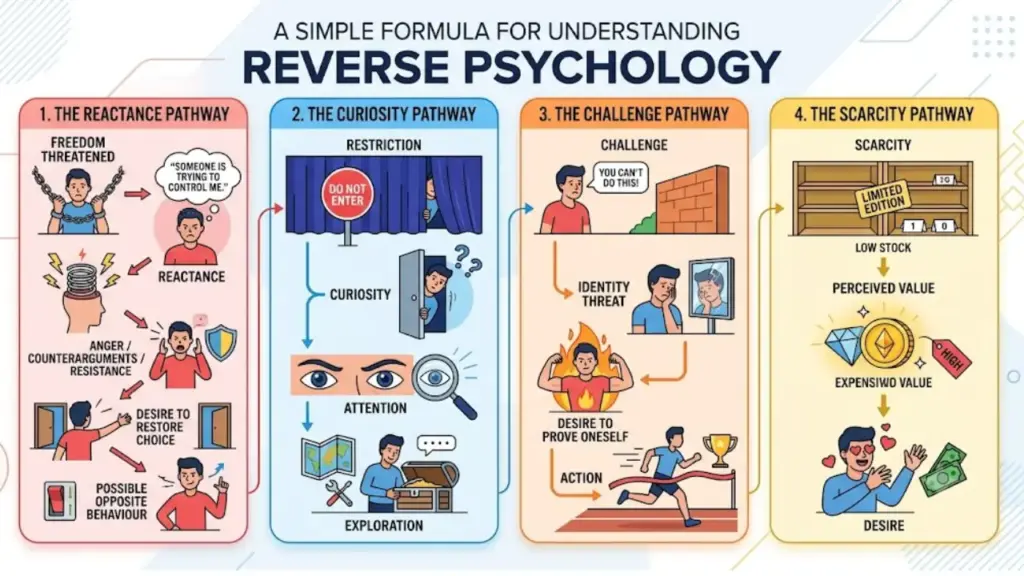
A Simple Formula for Understanding Reverse Psychology
The phenomenon can be represented like this:
Freedom threatened
↓
“Someone is trying to control me.”
↓
Reactance
↓
Anger / counterarguments / resistance
↓
Desire to restore choice
↓
Possible opposite behaviour
But there is another pathway:
Restriction
↓
Curiosity
↓
Attention
↓
Exploration
And another:
Challenge
↓
Identity threat
↓
Desire to prove oneself
↓
Action
And another:
Scarcity
↓
Perceived value
↓
Desire
Four people can perform exactly the same action for four completely different psychological reasons.
That is why simplistic explanations fail.
The Deeper Paradox
The most fascinating thing about reverse psychology may be that the object of desire is sometimes not the object at all.
It is freedom.
Someone says:
“You cannot.”
And suddenly the person is no longer thinking about the activity.
They are thinking:
“Who gave you the right to decide for me?”
The threatened freedom becomes the psychologically important thing.
This is why the phenomenon appears in so many places:
parenting,
education,
advertising,
health campaigns,
workplaces,
friendships,
romantic relationships,
social media,
consumer behaviour.
The subject changes.
The underlying question remains:
“Do I still get to choose?”
What We Know, What We Think, What We Still Don’t Know
WHAT WE KNOW
Psychological reactance is a measurable phenomenon. Freedom-threatening messages can increase anger, negative cognitions and reactance, and these responses can reduce persuasion. Recent meta-analyses involving tens of thousands of participants and hundreds of effect sizes reinforce this general pattern.
WHAT WE THINK
Some behaviours described as “reverse psychology” probably arise from reactance.
Others may be driven by curiosity, identity, competition, scarcity or assumptions about the communicator’s hidden intentions.
WHAT WE DON’T KNOW
We cannot reliably look at one person and predict:
“Tell them not to do X and they will definitely do X.”
The response depends on the individual, the relationship, the threatened freedom, the importance of the choice, the wording, the situation and the person’s existing preference.
That uncertainty is not a weakness in the science.
It is the science.
Perhaps People Are Not Resisting the Choice They Are Defending the Right to Choose
Reverse psychology sounds like a clever trick.
But beneath the trick lies something much older and more fundamental.
Human beings want to experience themselves as agents of their own lives.
Tell someone:
“You should do this.”
They may agree.
Tell them:
“You must do this.”
They may hesitate.
Tell them:
“You cannot do this.”
And suddenly the same action can become psychologically fascinating.
Not necessarily because the action became better.
Not necessarily because the forbidden thing became more valuable.
Sometimes the valuable thing is simply freedom itself.
That is the real insight behind psychological reactance.
And it explains why the sentence
“Don’t do it.”
can occasionally produce the most dangerous possible answer:
“Now I really want to.”
But there is an even deeper lesson.
If we understand reactance only as a trick for manipulating people, we miss the larger discovery.
The research suggests that humans often respond better when their autonomy is respected rather than attacked. The goal of good communication is therefore not always to find a more sophisticated way of controlling people.
Sometimes the most psychologically intelligent sentence is simply:
“Here are the facts. You have a choice.”
And paradoxically, giving people that freedom may make them more willing to choose what you hoped they would choose in the first place.
Key Unfgoldings
Reverse psychology is a popular term, not one single scientific mechanism.
Psychological reactance is the central scientific concept: perceived threats to freedom can produce resistance.
Recent meta-analysis found that high freedom-threatening language increased anger (r = .21), negative cognitions (r = .17) and reactance (r = .20).
Reactance does not automatically mean doing the opposite.
Curiosity, scarcity, competition and identity can create similar-looking behaviour.
Adolescents can experience reactance, but they are not universally susceptible to reverse psychology.
Health communication is especially vulnerable to boomerang effects when messages become unnecessarily controlling.
A 2024 meta-analysis covering 4,561 effect sizes, 881 samples and 443,556 participants found substantial associations between interpersonal autonomy/competence/relatedness support and motivation, well-being and performance.
A recent small Indian randomized trial involving 30 preschool children found higher compliance under a reverse-psychology condition, but the sample is far too small to justify universal claims.
Reverse psychology may work in some circumstances, but transparent autonomy support is a fundamentally different—and often less manipulative approach.
The deepest psychological question is not “Why do people do the opposite?” but “Why does having the freedom to choose matter so much?”
The phrase “reverse psychology works” should not be taken as an unconditional scientific conclusion. The current evidence supports a more precise statement: threats to perceived freedom can produce reactance, and reactance can sometimes contribute to resistance or counter-behaviour. Whether deliberately using that mechanism produces the desired behaviour depends strongly on context, person and message.
Sources and Further Reading
Primary scientific sources
Li & Shi, Human Communication Research (2026) — meta-analysis of 28 articles, 33 studies and 146 effect sizes examining freedom-threatening language and psychological reactance.
Ma et al., Journal of Communication (2025) — meta-analysis covering 35 studies and 10,658 participants examining threatening language, reactance and persuasion in health communication.
Rains, Human Communication Research (2013) — meta-analytic review of reactance based on 20 studies and 4,942 participants.
Slemp et al., Journal of Personality and Social Psychology (2024) — meta-analysis of 4,561 effect sizes, 881 samples and 443,556 participants examining autonomy, competence, relatedness and outcomes.
Barton, Zlatevska & Oppewal, Journal of Retailing (2022) — meta-analysis of 416 effect sizes from 131 studies on scarcity marketing.
Zhuang & Richards, Health Communication (2026) — experimental evidence on “must” versus less controlling social-norm language and reactance.
Reverse-psychology RCT in preschool children, 2026 — small randomized study from Bhubaneswar, India, involving 30 children.
Reliable reference and government resources
American Psychological Association — Reactance Theory: APA Dictionary of Psychology
U.S. National Library of Medicine / PubMed: PubMed research database
U.S. National Institutes of Health: NIH
U.S. Federal Trade Commission — Dark Patterns: FTC consumer-protection research








Leave a Reply