
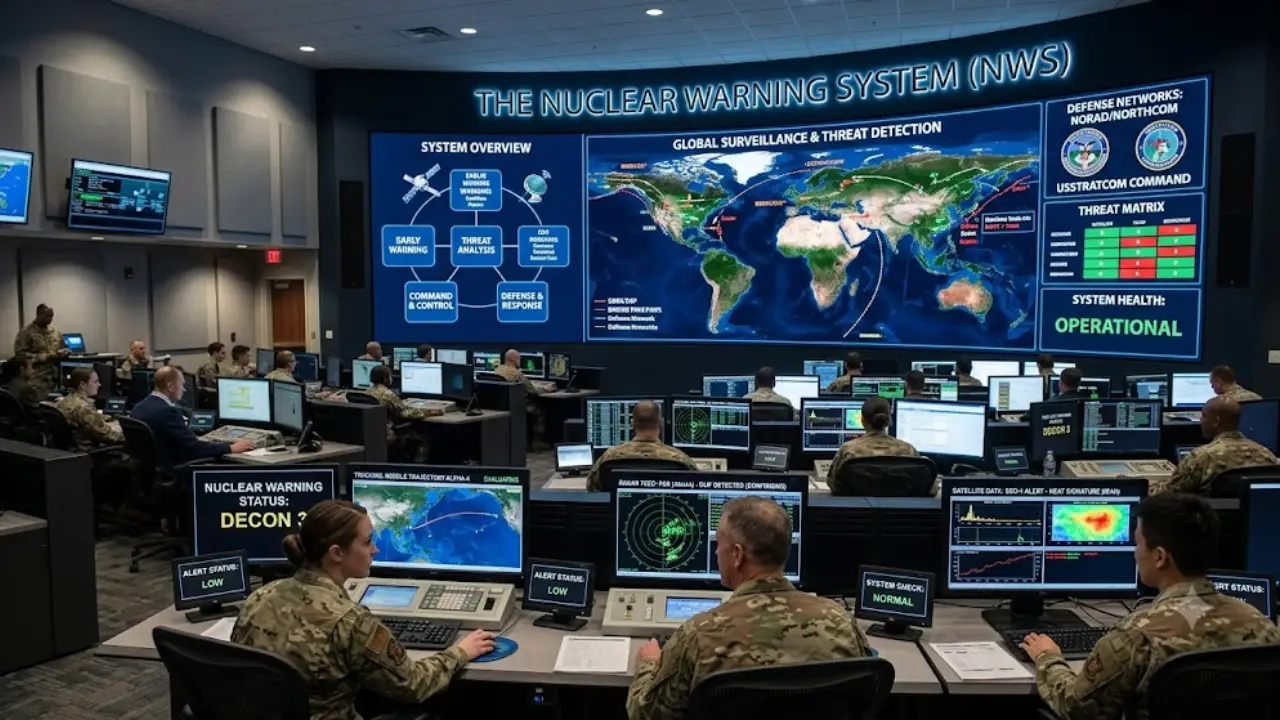
The computer said America was under attack
The telephone rang.
It was November 9, 1979.
Inside the North American Aerospace Defense Command NORAD the people watching America’s nuclear warning system were suddenly confronted with a nightmare.
The computers were reporting a massive Soviet nuclear attack.
Not one missile.
Not five.
Not a handful of suspicious signals.
The displays indicated that hundreds of Soviet missiles were apparently heading toward North America.
For people whose job was to imagine the worst possible day on Earth, this was exactly the day they had trained for.
Except there was one problem.
The attack wasn’t happening.
Somewhere inside the enormous machinery responsible for warning the United States of nuclear war, training data had entered the operational system.
A computer had effectively shown the military a war that existed only on a tape.
The reaction was immediate. Command posts were alerted. Aircraft were prepared. The National Emergency Airborne Command Post was launched. Military commanders began checking radar and satellite information.
Then something remarkable happened.
The humans stopped the machine from becoming the decision-maker.
The supposed Soviet attack was compared with independent sensors.
The radar picture did not match.
The satellites did not match.
Other warning systems did not match.
Within minutes, the nightmare collapsed.
It had been a false alarm.
But this was not the last time.
In 1980, another series of computer malfunctions produced terrifying warnings, including displays suggesting thousands of incoming missiles. On June 3, Strategic Air Command crews were alerted and engines were started. On June 6, another false display triggered a similar precautionary response.
Then, three years later, on September 26, 1983, the machine was on the other side of the nuclear divide.
A Soviet early-warning system announced that American missiles were coming.
One missile.
Then another.
Then another.
Eventually, the system reported five U.S. intercontinental ballistic missiles heading toward the Soviet Union.
A Soviet lieutenant colonel named Stanislav Petrov had to decide whether the computer was telling the truth.
He decided it wasn’t.
And that decision has become one of the most famous examples of human judgment standing between a computer warning and catastrophe.
But the deeper story is not simply about a heroic officer.
It is about something much more frightening:
What happens when civilization builds machines capable of detecting nuclear war faster than human beings can determine whether nuclear war is actually happening?
The Cold War created a machine that had to be paranoid
The nuclear age created a peculiar technological problem.
A conventional military warning system can afford to be cautious.
If a radar mistakenly reports an aircraft, nobody has to decide whether to launch thousands of nuclear weapons in response.
Nuclear early-warning systems operate under a completely different logic.
The Soviet Union and United States built systems designed to detect an attack quickly enough to allow their leaders to respond before their own nuclear forces were destroyed.
That created a dangerous equation:
More speed meant less time for human judgment.
A ballistic missile crossing the ocean does not politely wait while analysts debate its intentions.
The entire point of early-warning systems was to compress uncertainty into minutes.
Computers were therefore introduced not simply because they were convenient, but because human beings could not manually process the enormous quantity of information generated by radars, satellites, communications networks and other sensors quickly enough.
The machine’s job was essentially:
Detect → classify → communicate → warn.
But nuclear systems had another requirement:
Do not mistake a mistake for war.
That second requirement proved much harder.
The first frightening lesson: a training exercise entered the real system
The November 9, 1979 incident is particularly revealing because the computer did not necessarily “malfunction” in the ordinary sense.
A test scenario simulating a Soviet missile attack was inadvertently introduced into the operational NORAD system.
The U.S. State Department’s historical records explain that a spurious missile attack warning was inadvertently introduced into the NORAD Combat Operations Center’s computer system. The system automatically transmitted the warning to other national and regional command centres.
The result was extraordinary.
A fictional war generated a real military response.
The important distinction is subtle.
The computer was doing what it had been given data to do.
The failure occurred because training and operations had become entangled.
The solution was not simply “buy a better computer.”
Procedures had to change.
Testing had to be separated from operational systems.
The State Department’s records later noted that connecting the test computer to the operational system without advance coordination was prohibited.
That is a lesson that extends far beyond nuclear weapons.
A system can produce a perfectly accurate answer to completely wrong information.
And a computer cannot automatically know that the information it has received is fictional.
The machines were fast. The humans were the safety net.
This is where the Cold War warning system becomes intellectually fascinating.
The United States did not simply trust the computer.
The warning architecture contained multiple layers.
Radar systems looked for missiles.
Satellites provided another source of information.
Computers processed and distributed the information.
Command centres assessed it.
Human officers compared conflicting information.
The system was therefore designed around an important principle:
One warning should not automatically become one decision.
The November 1979 incident demonstrated why.
According to a State Department telegram, the false data were identified and confirmed as false by command authorities in less than six minutes. No strategic nuclear forces were activated.
Six minutes sounds like a long time when sitting in an ordinary room.
In nuclear warfare, it is terrifyingly short.
Then the computers started lying again
If November 1979 had been an isolated accident, history might have filed it away as an embarrassing technical mistake.
It wasn’t.
In 1980, false warnings appeared repeatedly.
A particularly troubling sequence occurred in late May and early June.
A secret memorandum from Defense Secretary Harold Brown to President Jimmy Carter documented three false missile-warning incidents within two weeks.
The first occurred on May 28.
A false display indicated approximately 2,020 missiles at one warning centre, while another display briefly showed approximately 9,000 missiles.
The display lasted only about six seconds.
No alert action followed.
But the system had just shown the military something horrifying: a computer could manufacture the appearance of an enormous nuclear attack.
Then came June 3.
This time, the false indication lasted approximately 30 minutes.
The number of supposed incoming missiles increased dramatically.
Strategic Air Command responded by alerting crews to move to aircraft and start engines.
Still, the independent warning sensors were not reporting an actual attack.
The discrepancy was crucial.
The computers were shouting.
The physical world was silent.
And the humans noticed.
The culprit was almost absurdly small
The investigation eventually focused on a hardware problem involving a dual-channel multiplexer within the NORAD computer system.
One official account described the suspected component as a 46-cent integrated circuit in a data communications interface.
Think about that for a moment.
The Soviet Union possessed thousands of nuclear weapons.
The United States possessed thousands more.
The two superpowers had constructed enormous command-and-control systems to prevent surprise attack.
And one of the components contributing to a terrifying false warning was worth less than a dollar.
This is not to suggest that one cheap chip alone brought the world to the edge of nuclear war.
It didn’t.
The broader warning architecture contained multiple safeguards.
But the incident exposed something fundamental about complex technological systems:
The strategic importance of a component has nothing to do with its price.
A tiny failure inside a communications chain can produce an enormous consequence if the information eventually reaches the wrong decision-maker.
June 6 was even more uncomfortable
Engineers attempted to correct the problem after the June 3 incident.
A software modification was installed to help identify a recurrence.
Then the system produced another false warning on June 6.
The correction did not immediately catch it.
Strategic Air Command again alerted aircraft crews and started engines.
The alert was terminated after the system’s broader information failed to confirm an attack.
The lesson was becoming uncomfortable.
A computer problem had been discovered.
A fix had been installed.
The problem appeared again.
The fix did not immediately solve it.
That is exactly the kind of situation software engineers still fear today.
A correction to a complex system can interact with another part of the system in an unexpected way.
In nuclear command and control, however, the consequences are not a crashed application.
They can be geopolitical.
The machines were not the only danger
There is an important misconception about these incidents.
It is tempting to tell the story as:
Computer makes mistake → humans almost launch nuclear weapons.
The historical record is more complicated.
The safeguards worked.
The humans did not simply accept the computer’s warning.
In the June 1980 incidents, independent sensors did not confirm the supposed attacks. The U.S. State Department explicitly emphasized that the actual missile-warning sensors radars and satellites did not indicate an attack.
This redundancy was enormously important.
Imagine two people telling you your house is burning.
One has smelled smoke.
The other has watched a fire start.
You would take the warning seriously.
Now imagine a computer suddenly announcing that your house is burning while every smoke detector, camera and neighbour says nothing is happening.
You investigate before evacuating the entire neighbourhood.
Nuclear warning systems needed the same logic.
Except their “neighbourhood” was the planet.
Then came September 1983
Now the story crosses the Iron Curtain.
At a secret Soviet facility known as Serpukhov-15, Soviet officers monitored an early-warning system designed to detect a possible American missile attack.
The date was September 26, 1983.
The Cold War was already dangerously tense.
Just weeks earlier, Soviet forces had shot down Korean Air Lines Flight 007 after it entered Soviet airspace, killing all 269 people aboard.
Relations between Washington and Moscow were deteriorating.
The Soviet leadership was deeply concerned about the possibility of a surprise American nuclear attack.
Then the alarm sounded.
The computer reported a U.S. missile launch.
One missile.
Then another.
Then more.
Eventually, the system reported five Minuteman missiles heading toward the Soviet Union.
The duty officer was Lieutenant Colonel Stanislav Petrov.
He had a problem.
The machine said attack.
Reality had not yet confirmed it.
Petrov noticed something the machine could not understand
Petrov’s reasoning was surprisingly simple.
If the United States were beginning a nuclear war, why would it launch only a handful of missiles?
A genuine first strike would be expected to involve a much larger attack.
The warning therefore looked suspicious.
Petrov chose to classify it as a false alarm rather than immediately passing the warning upward as a confirmed attack.
Later investigation traced the problem to the Soviet satellite system.
The satellite had mistaken sunlight reflected from high-altitude clouds for the infrared signature of missile launches. The computer interpreted the sensor data as evidence of an American attack.
The machine had not “gone crazy.”
It had detected something real.
It had simply interpreted the real thing incorrectly.
That distinction is enormously important.
The sun was real.
The clouds were real.
The reflected light was real.
The missile attack was not.
This is the terrifying weakness of automated detection
A machine does not experience doubt in the way a human does.
A human officer might say:
“Something about this doesn’t make sense.”
A computer is more likely to say:
“The pattern matches condition X.”
That difference becomes dangerous when the system is trained to identify extremely rare events.
Nuclear-warning systems face a peculiar statistical problem.
The event they are trying to detect an actual nuclear launch is extraordinarily consequential but, fortunately, extraordinarily rare.
The system therefore spends most of its existence in a world where:
No nuclear attack is happening.
Yet it must remain sensitive enough to detect the one time an attack really does happen.
Increase sensitivity and false positives rise.
Decrease sensitivity and a genuine attack might be missed.
This is the classic detection problem.
But with nuclear weapons, the cost of getting either side wrong is enormous.
The most dangerous machine is sometimes the one that is too fast
Human beings are slow.
That is usually considered a weakness.
In nuclear command systems, it can sometimes be a safety feature.
A computer can process millions of pieces of information far faster than a person.
That is precisely why computers became indispensable to early-warning systems.
But speed creates a paradox.
The faster an automated system produces a warning, the less time human beings may have to challenge it.
A false warning that takes an hour to evaluate is inconvenient.
A false warning that gives leaders only minutes is potentially catastrophic.
This creates what could be called the speed paradox of nuclear warning:
The technology designed to give leaders more time to respond can simultaneously reduce the time available to question the warning.
That is one of the most important lessons of Cold War nuclear history.
And then there was Able Archer
There is another episode that must not be confused with Petrov’s incident.
In November 1983, NATO conducted Able Archer 83, a major command-post exercise simulating the escalation of a conventional conflict into nuclear war.
It was not a computer falsely displaying missiles.
It was not a sensor malfunction.
It was a military exercise that looked unusually realistic to Soviet observers.
The exercise ran from November 7 to November 11, 1983.
It included nuclear-capable aircraft, communications procedures and simulated nuclear escalation.
Declassified material indicates that Soviet leaders and military officials were sufficiently concerned that some Soviet nuclear forces took heightened precautions. A later President’s Foreign Intelligence Advisory Board assessment concluded that the Soviet leadership genuinely feared that the exercise could conceal preparations for a real attack.
This is important because it reveals a second kind of false alarm.
The first kind is:
The machine says an attack is happening when it isn’t.
The second is:
One side interprets the other side’s perfectly real actions as preparation for an attack.
Both can produce the same dangerous result:
fear creates action, action creates more fear.
The four incidents were different—but they tell one story
| Incident | Year | Trigger | Human response | Main lesson |
| NORAD training-data incident | 1979 | Test scenario entered operational system | Independent verification | Keep exercises isolated |
| NORAD false alerts | 1980 | Computer hardware/data-processing failures | Cross-checking sensors | Redundancy matters |
| Petrov incident | 1983 | Satellite misinterpreted sunlight/clouds | Human judgment | Sensor data can be misleading |
| Able Archer | 1983 | Real military exercise misread as possible attack | Restraint and observation | Intent can be misinterpreted |
The incidents were not one continuous malfunction.
But together they reveal a common vulnerability:
Nuclear systems operate under uncertainty, and technology cannot eliminate uncertainty.
It can only process it faster.
The human being was not the weakness
Modern technology culture often assumes that humans should be removed from difficult decisions.
Humans are slow.
Humans get tired.
Humans make mistakes.
Algorithms are fast.
Algorithms are consistent.
Algorithms can process enormous amounts of data.
All of that is true.
But the Cold War nuclear-warning experience reveals the other side.
A machine can be spectacularly fast and spectacularly wrong.
The human advantage is not always computational power.
It is context.
Petrov could ask:
“Does this make sense?”
A computer could only evaluate whether the sensor pattern met its programmed criteria.
That distinction remains important in modern artificial intelligence.
An AI system can identify a pattern with astonishing confidence.
That does not mean the underlying interpretation is correct.
The deeper problem: false alarms can become normal
There is another danger that is less dramatic but perhaps even more important.
If a system produces too many false alarms, humans can become desensitized.
The first alarm causes panic.
The tenth causes suspicion.
The hundredth produces irritation.
Eventually someone thinks:
“It’s probably another false alarm.”
That creates the opposite danger.
A system designed to prevent surprise attack can eventually train its operators to ignore the warning.
This is sometimes called alarm fatigue.
The 1980 experience worried U.S. officials for precisely this reason.
Secretary of Defense Harold Brown wrote that repeated false alarms could weaken confidence in the system and potentially cause people to ignore a real warning.
That is a remarkable paradox:
Too few warnings can be dangerous. Too many warnings can also be dangerous.
The perfect warning system would have to be both sensitive and trustworthy.
That is an extraordinarily difficult engineering problem.
Why redundancy saved the system
The most important lesson from these incidents may not be “never trust computers.”
It is:
Never let one information channel have the final word.
The Cold War warning architecture used multiple sources:
- satellites;
- radar;
- communications networks;
- computer processing;
- command centres;
- human assessment.
When one system disagreed with another, humans could investigate.
That redundancy created friction.
And in ordinary technology, friction is often considered inefficient.
In nuclear command and control, friction can be a survival mechanism.
A system that requires confirmation before an irreversible action may appear slower.
But if the alternative is acting on a false signal, slower can be safer.
The uncomfortable mathematics of nuclear false alarms
Suppose a warning system were extremely sensitive.
It detects almost every genuine attack.
That sounds excellent.
But imagine that because it is so sensitive, it also generates false warnings.
Now suppose the actual probability of a nuclear attack on any given minute is extremely small.
Even a highly accurate detector can then produce a surprising number of false positives relative to genuine attacks.
This is a fundamental principle of statistical detection.
The rarer the real event, the more carefully false positives must be controlled.
Nuclear-warning systems therefore face an unusually severe version of the base-rate problem.
The system must distinguish an event that is:
rare but catastrophic
from events that are:
ordinary, ambiguous or erroneous but superficially similar.
A cloud reflecting sunlight.
A training tape.
A faulty circuit.
A software error.
A military exercise.
A sensor anomaly.
Each can produce information that resembles the beginning of nuclear war.
The machine sees the signal.
The human must decide what the signal means.
What these Cold War incidents changed
The false alarms led to technical and procedural improvements.
After the November 1979 incident, test procedures were changed so that training systems would not be connected to operational warning networks without proper coordination.
Following the 1980 incidents, NORAD moved to a backup computer system using different hardware and software while broader technical investigations were undertaken. Special communications arrangements were also strengthened to allow warning information to be checked rapidly.
The broader principle became clear:
Critical warning systems require independence, redundancy, monitoring and human verification.
That principle has only become more important as computer systems have become more powerful.
Why this matters in the age of artificial intelligence
The Cold War problem has acquired a modern disguise.
Today we speak about artificial intelligence, autonomous systems and algorithmic decision-making.
But the underlying question is ancient:
What happens when a machine confidently tells a human that something catastrophic is happening?
The danger is not that computers are malicious.
It is that computers are literal.
They process the information they receive.
If the sensor is wrong, the computer can be wrong.
If the model is wrong, the computer can be wrong.
If the data are misleading, the computer can be wrong.
And if the machine operates at extreme speed, there may be very little time to discover the mistake.
That is why nuclear warning systems remain one of the clearest historical demonstrations of a principle now relevant to AI:
Automation can reduce human error while simultaneously creating new forms of error that humans may not detect quickly enough.
The machines were never actually the final decision-makers
There is a popular version of Cold War history in which a computer almost started World War III.
That is dramatic.
But it is incomplete.
The computers generated warnings.
People evaluated them.
The safeguards worked.
The systems were designed precisely because computer information could be wrong.
In 1979, humans compared the supposed attack against independent sensors.
In 1980, humans noticed the mismatch between computer-generated information and actual warning sensors.
In 1983, Petrov questioned a computer-generated warning because it did not make strategic sense.
The machines were powerful.
But they did not possess judgment.
And that distinction may have been the most important safety feature of all.
The final warning
The most frightening lesson from the Cold War is not that computers nearly started nuclear war.
It is that computers did exactly what they were designed to do and humans had to determine whether the answer made sense.
The 1979 training incident showed that false information could enter a real warning network.
The 1980 failures showed that hardware and software problems could generate frightening attack displays.
Petrov’s 1983 experience showed that sophisticated satellite systems could misinterpret natural phenomena as missile launches.
Able Archer demonstrated that even genuine military activity could be interpreted as preparation for war.
Different mechanisms.
Different countries.
Different years.
One underlying problem.
Uncertainty.
The nuclear age did not eliminate uncertainty.
It merely gave uncertainty a computer.
And then it gave the computer a clock.
That is the real danger.
A machine can make a mistake in milliseconds.
A human may need minutes to discover it.
A nuclear missile does not care which one comes first.
Key Unfoldings
- The Cold War produced several serious nuclear false alarms; they were different incidents, not one single event.
- On November 9, 1979, simulated Soviet attack data were accidentally introduced into the NORAD operational system.
- The false warning was identified through independent verification in less than six minutes.
- In May and June 1980, computer failures produced repeated false missile displays.
- One 1980 incident showed roughly 2,020 missiles, while another display briefly showed about 9,000.
- On June 3, Strategic Air Command alerted crews and started aircraft engines, but no aircraft were launched.
- The technical investigation focused on failures involving a communications/multiplexer component.
- On September 26, 1983, the Soviet early-warning system falsely reported U.S. missile launches.
- The system ultimately reported five incoming U.S. missiles.
- Stanislav Petrov judged the warning to be false rather than immediately escalating it.
- The Soviet satellite system had mistaken sunlight reflected from clouds for missile-launch signatures.
- Able Archer 83 was a separate NATO exercise whose realism contributed to Soviet fears of a possible Western attack.
- The central lesson is not “never trust computers.” It is never allow an automated warning to become an irreversible decision without independent confirmation and meaningful human judgment.
Frequently Asked Questions
Did a computer actually almost start a nuclear war?
Not by itself. Computers generated false indications that triggered real military responses and created situations in which human decision-makers had very little time to assess the information. The historical record shows that human safeguards prevented the false warnings from producing an irreversible nuclear launch.
Was the 1979 incident caused by a computer malfunction?
The famous November 9 incident was caused by simulated attack data being inadvertently introduced into the operational system, rather than the same type of hardware failure seen in 1980.
How many false alarms occurred?
There was no single universally agreed number because different records count different types of anomalies and incidents. During the Carter administration, several significant false missile-warning events were documented, including the November 1979 incident and the repeated May–June 1980 computer incidents.
Did the United States actually prepare nuclear weapons for launch?
The false alarms caused precautionary military actions, including alerting crews and starting bomber engines, but the documented incidents did not result in a U.S. nuclear launch.
What happened to Stanislav Petrov?
Petrov remained in the Soviet military for some years and later retired. His role became widely known internationally only much later. He died in 2017.
Did Petrov literally “save the world”?
That phrase is useful journalism but should be treated cautiously. We cannot know with certainty what Soviet leaders would have done if Petrov had reported the warning differently. What can be established is that he was in a critical position, received a false missile warning and judged it to be false rather than escalating it as a confirmed attack.
Was Able Archer a computer false alarm?
No. Able Archer 83 was a real NATO military exercise that simulated nuclear escalation. The danger came from Soviet interpretation of the exercise, not a computer mistakenly generating an attack warning.
What is the biggest lesson for modern AI?
Never confuse fast information processing with reliable judgment. Automated systems can identify patterns much faster than humans, but humans still need to question whether the underlying signal, data and interpretation make sense.
Authentic sources and references
U.S. Department of State — Office of the Historian
The State Department’s declassified Foreign Relations of the United States records provide some of the most valuable primary evidence on the 1979 and 1980 incidents. They include memoranda from Defense Secretary Harold Brown to President Jimmy Carter and contemporary assessments of the warning-system failures.
National Archives / U.S. government records
Declassified records document the technical failures, command responses and corrective actions surrounding the NORAD incidents. The records show that human verification and independent warning sensors played a decisive role in preventing false information from producing irreversible action.
National Security Archive
The George Washington University’s National Security Archive has published extensive declassified documentation concerning the NORAD false alerts, including the 1979 training-data incident and the 1980 computer failures.
U.S. Government Publishing Office
The Congressional Record contains contemporary and later discussions of nuclear false alarms and Stanislav Petrov’s role in the 1983 Soviet warning incident.
Historical documentation on Petrov
Declassified and archival accounts identify the 1983 warning as a false alarm caused by the Soviet satellite system interpreting reflected sunlight from clouds as evidence of missile launches.
Able Archer documentation
Declassified historical analysis indicates that Able Archer 83 generated genuine Soviet concern and that some Soviet forces took heightened precautions during the exercise.
The warning was never the war
The Cold War produced an extraordinary technological experiment.
Human beings built machines to watch for the end of civilization.
Those machines became faster, more sensitive and more sophisticated.
But sophistication did not make them infallible.
A training tape became a false attack.
A tiny electronic component produced thousands of imaginary missiles.
Sunlight became a missile launch.
A military exercise looked like preparation for war.
And every time, humans stood between information and action.
That distinction is more important today than it was during the Cold War.
Modern artificial intelligence can recognize patterns faster than any human being. Modern sensors can monitor more information than an entire room of Cold War analysts. Modern communications can move a warning around the world almost instantly.
That sounds like progress.
It is progress.
But speed has a shadow.
The faster a machine can turn uncertainty into a warning, the faster a human being may have to decide whether the warning is true.
The most important safeguard in the Cold War was therefore not the computer.
It was the pause.
The second opinion.
The independent sensor.
The officer who asked whether the story made sense.
And the person willing to say:
“The machine says it is happening. But I don’t believe it yet.”
That may be the most important sentence ever spoken in the age of automated warfare.
You may also like to read:
- The Soviet Space Mission That Ended With a Door Problem — how a tiny mechanical failure became a fatal spacecraft emergency.
- The First Computer Bug Was Almost Exactly What Its Name Suggests — the 1947 Harvard Mark II moth and the surprising origins of “debugging.”








Leave a Reply