
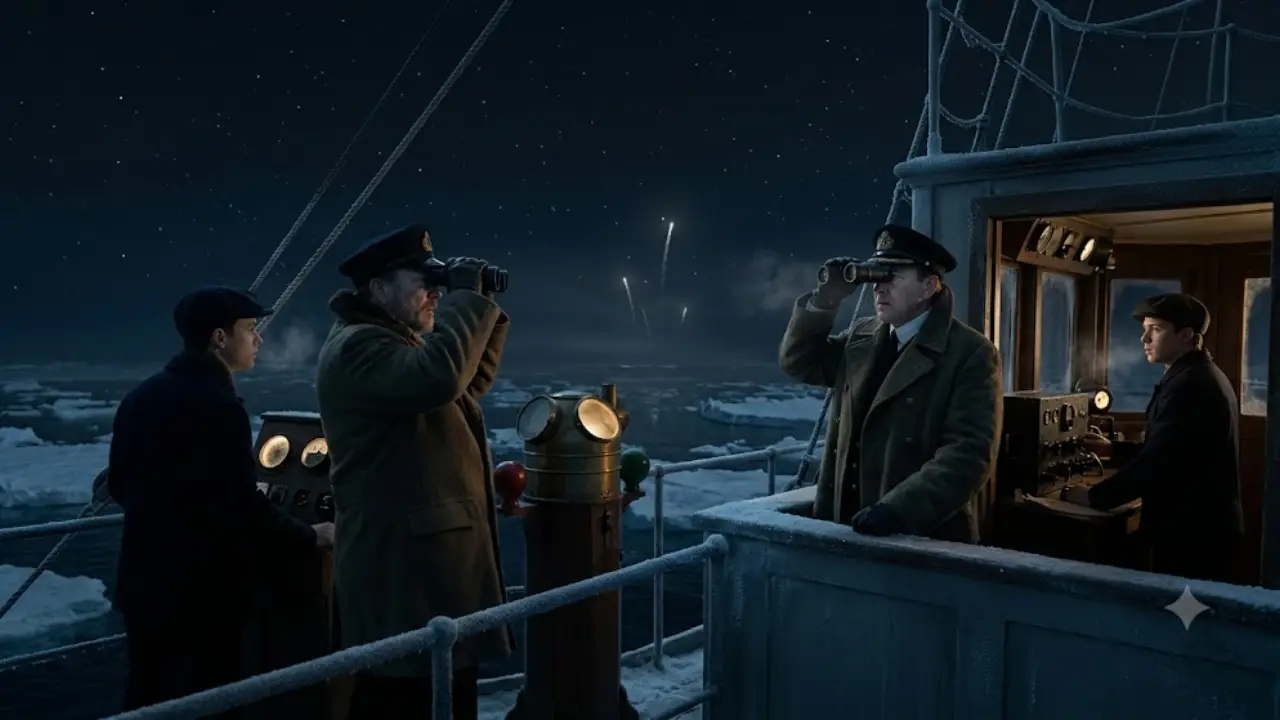
At 12:45 a.m., eight white rockets rose into the black Atlantic sky. A ship was watching. Someone on that ship knew something was wrong. But for nearly another 90 minutes, nobody came.
The lights nobody could explain
There is a moment in the Titanic story that is stranger than the collision itself.
It happens after the iceberg has already won.
The great ship is dying.
Her wireless operators are calling for help. Lifeboats are sliding into the freezing Atlantic. On the deck, officers are firing rockets into the night one after another, white stars exploding above the ocean.
And somewhere out there, another ship is watching.
The people aboard that ship can see the rockets.
They can see the strange vessel nearby.
They try to signal it.
Nothing happens.
The ship does not come.
For more than a century, that ship has carried a name almost as famous as Titanic:
SS Californian.
Her captain was Stanley Lord.
And the mystery surrounding him is considerably more complicated than the popular version suggests.
The easy story is that Lord saw Titanic’s distress signals, ignored them and allowed more than a thousand people to die.
The official British inquiry came frighteningly close to that interpretation in 1912.
But then the Titanic wreck was found.
The geography changed.
The atmosphere changed.
The distances changed.
And suddenly the story of the man who supposedly watched Titanic die became something much more unsettling:
Perhaps Lord made a terrible mistake. Perhaps he misunderstood what he was seeing. Perhaps the night itself was deceiving him. And perhaps the most dangerous thing on the ocean that night was not the iceberg, but uncertainty.
That is where the real Titanic mystery begins.
Before Titanic disappeared, Californian had already warned her
On April 14, 1912, Californian was heading west across the North Atlantic.
She was no tiny fishing boat.
She was a substantial 6,223-ton vessel with a maximum speed of about 12½–13 knots. She belonged to the same International Mercantile Marine group that owned Titanic, although she was operated by the Leyland Line.
Her destination was Boston.
Her voyage was proceeding normally until the ice appeared.
At about 6:30 p.m., three large icebergs were seen roughly five miles south of Californian.
Captain Lord did something entirely sensible.
He sent a wireless warning.
The message reported the three bergs.
That warning eventually reached Titanic.
So before Titanic struck anything, before the famous rockets, before the lifeboats, before the panic, the danger had already been communicated.
This is one of the great ironies of the disaster.
Titanic did not enter an entirely unknown ocean.
The ocean had already spoken.
The problem was that warnings are remarkably cheap.
Acting on them is not.
Then Californian stopped
As the evening progressed, Californian entered a dangerous area of field ice.
At approximately 10:20 p.m., Lord ordered the engines stopped.
This decision deserves to be separated from everything that happened later.
Stopping in heavy ice was not obviously cowardly or incompetent.
It was prudent.
Californian could not simply charge through a frozen obstacle at full speed because another ship happened to be nearby.
For Lord, the calculation was straightforward:
There is ice ahead. I cannot safely see through it. Stop. Wait for daylight.
That sounds reasonable.
And this is exactly how complicated disasters are born.
The first decision was reasonable.
The next decision was reasonable.
Then another.
And another.
Until eventually the reasonable decisions form an unreasonable outcome.
11:40 p.m.: something happens in the darkness
At approximately 11:40 p.m., Titanic hit the iceberg.
Californian was already stopped.
This coincidence became the foundation of the mystery.
From Californian, officers observed another vessel.
The ship appeared to be a passenger steamer.
It seemed close.
It stopped.
Its lights behaved strangely.
Then came the rockets.
The Titanic’s distress rockets began being fired at about 12:45 a.m. and continued until approximately 1:45 a.m. British inquiry evidence records roughly eight rockets.
Californian’s officers saw them.
Not one.
Not two.
Several.
And now comes the sentence that has haunted the ship ever since.
A senior officer effectively recognised the absurdity of the situation:
A ship does not fire rockets at sea for nothing.
He was right.
But knowing that something is wrong is not the same as knowing what to do next.
Captain Lord was told
This is where the story stops being comfortable.
Second Officer Herbert Stone reported the rockets to Captain Lord.
According to the testimony recorded in the British inquiry, Lord asked whether they were company signals.
Stone said he did not know.
Lord instructed him to continue using the Morse lamp.
The apprentice James Gibson was involved in the attempts to communicate with the distant ship.
No response came.
More rockets appeared.
The officers continued watching.
Eventually Gibson was sent to wake Lord again.
By then, the ship they had been watching appeared to be disappearing.
It was around 2 a.m.
Titanic would founder at approximately 2:20 a.m.
The timing is almost unbearably cruel.
For roughly an hour and a half, there had been an opportunity to ask the most important question in the Atlantic:
“Are you in trouble?”
And nobody got an answer.
But why didn’t Californian use its wireless?
This is where the story acquires an almost surreal quality.
Californian had wireless.
But her wireless operator, Cyril Evans, had gone off duty.
That was normal practice at the time.
There was no modern requirement for a ship’s wireless station to remain continuously staffed.
Evans had already transmitted the ice warning.
He had done his job.
He went to bed.
Meanwhile Titanic was transmitting distress messages.
Californian did not hear them.
The ship therefore had two different information systems operating at the same time:
eyes on deck—and silence in the wireless room.
The men on deck could see something.
The man with the technology capable of asking the question was asleep.
This was not yet the modern world of 24-hour control rooms, automatic alarms and satellite communications.
The Titanic disaster exposed that gap brutally.
The wireless operator on Carpathia was awake and received Titanic’s calls.
Californian’s operator was not.
A technological revolution was sitting inside the ship, but the revolution had office hours.
The rockets should have changed everything
This is probably the strongest criticism of Californian.
Not the distance.
Not the iceberg.
Not even the mysterious ship.
The rockets.
The British inquiry accepted that the rockets seen by Californian were Titanic’s distress signals.
The court’s conclusion was severe: Californian had seen distress signals and should have gone to Titanic’s assistance.
The inquiry’s logic was devastatingly simple.
There was a ship nearby.
That ship had stopped.
White rockets were rising repeatedly.
Californian was stopped because of ice.
Therefore, the possibility that another ship was in trouble should have been treated seriously.
The inquiry concluded that Californian could have pushed through the ice and might have saved many—or even all—of the lives lost.
But there was a problem with this conclusion.
How far away was Californian really?
And that question would remain alive for generations.
The first map made Lord look terrible
In 1912, the official investigation worked with positions supplied by the ships and with testimony from survivors and officers.
The British inquiry concluded that Titanic and Californian were not more than about eight to ten miles apart and considered roughly five miles plausible.
If that was correct, the case against Lord was devastating.
Five miles is not another ocean.
Five miles is a decision.
If Californian had immediately gone ahead, she could potentially have reached the scene while Titanic was still afloat.
The inquiry therefore treated Lord’s failure to act as extraordinarily serious.
The American Senate investigation was also investigating the failure of nearby ships to respond, among many other causes of the disaster. Its hearings involved 82 witnesses and more than 1,100 pages of testimony.
Lord’s reputation was damaged.
His career suffered.
And the phrase “the ship that stood by” became part of Titanic’s mythology.
Then, 73 years after Titanic sank, the ocean gave historians a new piece of evidence.
1985: the wreck was found and the mystery moved
In September 1985, Robert Ballard’s expedition located Titanic’s wreck.
For the first time, historians possessed something the 1912 investigators could never have had:
the actual wreck site.
And that mattered enormously.
The 1992 British reappraisal of the Californian evidence examined the wreck’s location and the navigational evidence surrounding the two ships.
The report accepted the wreck position as a major new piece of evidence.
But here is where the story becomes fascinating rather than tidy.
The reappraisal did not simply produce one universally accepted new distance.
Its investigator argued that the ships were probably about 18 miles apart.
The Inspector’s assessment was considerably closer roughly 5–10 miles, probably nearer five.
The disagreement was explicitly recorded in the report.
That means the famous “Californian was only five miles away” story cannot simply be replaced with “Californian was 18 miles away.”
The evidence is more awkward than either version.
And awkward evidence is usually better evidence.
The ocean itself became a suspect
There is another extraordinary possibility.
The atmosphere.
Some later researchers proposed that unusual atmospheric conditions created super-refraction—a phenomenon in which layers of air with different temperatures and densities bend light.
Under the right conditions, objects can appear displaced vertically or horizontally.
The horizon can become deceptive.
Ships can appear where they are not.
Distances can become difficult to judge.
And the sea can acquire a strange optical architecture in which a ship appears unnaturally high, unnaturally small or apparently closer than it really is.
Research discussed by Smithsonian explored whether thermal inversion and super-refraction could have contributed to the visual confusion around Titanic and Californian. The 1992 British reappraisal had also considered unusual atmospheric refraction as a possible factor.
Now imagine being Stanley Lord.
It is the middle of the night.
There is ice around you.
There is a strange vessel on the horizon.
Its lights look wrong.
You see rockets.
You cannot establish wireless contact.
You do not know precisely where the other ship is.
And the atmosphere itself may be distorting what your eyes are telling you.
Suddenly, “Why didn’t he simply go?” becomes a much harder question.
The ship that Titanic saw may not have been Californian or vice versa
This is one of the most deliciously strange parts of the story.
Titanic’s officers also reported seeing a ship.
Californian’s officers reported seeing a ship.
For the 1912 inquiry, it was tempting to conclude:
They must have been seeing each other.
And the British inquiry essentially accepted that interpretation.
But once the wreck’s position became available, the geometry became troublesome.
If the two ships were much farther apart, another possibility emerged:
What if Californian and Titanic were not looking at each other at all?
The possibility of another unidentified vessel has therefore persisted in historical analysis.
This is not a minor detail.
It changes the entire psychology of the night.
If Lord was looking at Titanic, his failure to respond becomes harder to defend.
If he was looking at another ship, his decisions appear very different.
If atmospheric refraction distorted the scene, both groups of officers may have been operating with radically misleading visual information.
And if several of these things happened simultaneously, the Titanic mystery becomes less like a courtroom case and more like a systems failure.
The most important question is not “Who was the villain?”
This is where many Titanic stories go wrong.
They want a villain.
The iceberg is convenient.
Captain Smith can be criticised for speed.
The White Star Line can be criticised for lifeboats.
Bruce Ismay can be turned into a symbol.
And Stanley Lord can become the man who watched Titanic die.
But history rarely works that neatly.
The evidence suggests something more disturbing.
Titanic was surrounded by information.
Ice warnings existed.
Wireless existed.
Lookouts existed.
Distress rockets existed.
Nearby ships existed.
Experienced captains existed.
Yet none of those safeguards worked perfectly together.
That is the real story.
The Titanic disaster was not an information failure.
It was an information-to-action failure.
A warning is not a rescue
This distinction is easy to miss.
Californian warned Titanic about ice.
That was useful.
But a warning does not guarantee behaviour.
Titanic knew there was ice.
Yet she continued at high speed.
Californian knew there was ice.
So she stopped.
Titanic then became the ship in distress.
Californian saw signals.
But the signals did not trigger an immediate rescue.
Each ship responded to its own interpretation of the situation.
There was no central command.
No radar.
No GPS.
No satellite imagery.
No automatic distress beacon.
No continuous bridge-to-bridge communication.
No modern emergency-management doctrine.
The ocean was enormous.
The information was fragmented.
And every decision had to be made by people.
At 2:20 a.m., the argument became irrelevant
Titanic sank at approximately 2:20 a.m.
By then, the argument over what the rockets meant was almost meaningless.
The ship was gone.
More than 1,500 people had died.
But the tragedy still had one final irony.
At about 6 a.m., Californian received word from another vessel that Titanic had struck an iceberg and that passengers were in boats.
Lord immediately ordered the ship through the ice toward the reported position.
He did not refuse to enter the ice forever.
He went.
But by then, the rescue window had collapsed.
Carpathia had already begun the work that Californian might have attempted earlier.
This is the cruel mathematics of disaster:
an action can be completely appropriate at 6 a.m. and completely inadequate at 1 a.m.
Timing is not a detail in an emergency.
Timing is the emergency.
So was Stanley Lord guilty?
The most honest answer is:
He was neither the monster of the popular story nor completely exonerated by later evidence.
The 1912 British inquiry believed Californian had been close enough to assist and found Lord’s handling of the situation seriously wanting.
The later British reappraisal challenged the assumptions behind the original distance calculation and argued that Californian may have been substantially farther away—around 18 miles in the investigator’s reconstruction. But even that report did not turn the episode into a clean exoneration.
The crucial criticism remained:
the rockets were seen, and the response was inadequate.
That distinction matters.
Lord may not have been able to save Titanic.
But he may still have been able to do more.
And sometimes history’s most uncomfortable verdict is not:
“You could have prevented the catastrophe.”
It is:
“You could have tried harder.”
The strange legacy of the Californian
Titanic’s greatest legacy was not the myth of the unsinkable ship.
It was the realisation that maritime safety could not depend on individual judgement alone.
The disaster helped drive reforms in:
lifeboat capacity;
emergency procedures;
wireless communications;
continuous radio watches;
crew training;
international maritime safety;
iceberg monitoring.
The U.S. Senate investigation explicitly recommended reforms to lifeboats, crew training, radiotelegraphy and passenger-ship safety. It also helped lead to the creation of the International Ice Patrol.
That is why the story of Californian matters beyond Titanic.
Modern safety engineering is essentially an attempt to prevent the same kind of night from happening again.
Instead of trusting one person to notice the danger, systems now create layers:
detect → alert → confirm → escalate → respond → record.
The principle is simple.
If one person misunderstands the warning, another system should catch it.
If one person is asleep, another should be awake.
If the horizon is deceptive, instruments should compensate.
If a distress signal is ambiguous, the safest assumption should win.
Titanic helped teach the world that safety cannot depend entirely upon everyone making the perfect decision at exactly the right moment.
And that brings us back to the rockets
Picture the Atlantic again.
No moon.
No radar.
No GPS.
No satellites.
Just black water, ice and an unfamiliar ship.
Then:
one white rocket.
Then another.
Then another.
Someone watches.
Someone asks what they mean.
Someone says he does not know.
More rockets rise.
Still nothing.
The ship remains still.
At approximately 2:20 a.m., Titanic disappears.
For decades, historians thought they understood what happened.
Then the wreck was found.
The coordinates changed.
The distance became uncertain.
The atmosphere became a suspect.
The identity of the distant ship became debatable.
And Stanley Lord’s role moved from apparently simple guilt into a much darker historical grey zone.
Perhaps he misjudged the distance.
Perhaps he misunderstood the signals.
Perhaps the officers did not communicate the urgency clearly enough.
Perhaps atmospheric conditions distorted what everyone saw.
Perhaps several of these explanations were true at once.
But one fact refuses to disappear.
The rockets were there.
And someone was watching.
The lesson: disasters rarely announce themselves as disasters
This may be the most useful lesson hidden inside the Californian mystery.
People imagine disasters as moments when everybody suddenly knows that something terrible is happening.
Usually they do not.
The warning arrives first.
It looks ordinary.
Then another warning arrives.
It seems ambiguous.
Then something unusual happens.
Someone says, “We should check.”
Someone else says, “Probably nothing.”
The situation changes.
But nobody has yet received enough information to feel completely justified in declaring an emergency.
That is how danger survives.
Not because nobody sees it.
But because nobody sees enough of it at the same time.
Titanic was not destroyed by one mistake.
She was destroyed by a chain.
And Californian became part of that chain because the final link decisive rescue action never formed in time.
The verdict that history should probably keep
Stanley Lord deserves neither easy absolution nor easy condemnation.
The 1912 investigators were working without the wreck’s actual position.
The later reappraisal had better geographical evidence but still faced contradictions.
The atmospheric explanation is intriguing but cannot magically solve every inconsistency.
And the claim that Californian could certainly have saved hundreds before Titanic sank is stronger than the evidence permits.
But the opposite claim—that Californian was entirely irrelevant—is equally misleading.
She was close enough to become part of the story.
Her officers saw the rockets.
Her captain knew something unusual was happening.
And her wireless operator was not awake when Titanic’s desperate radio messages were being transmitted.
That combination of circumstances is what makes Californian so haunting.
Not because it proves that one man deliberately allowed Titanic to die.
But because it demonstrates something far more human.
A catastrophe can unfold in full view of people who do not yet understand that they are watching a catastrophe.
At 12:45 a.m., the sky above the Atlantic filled with white stars.
Nobody knew exactly what they meant.
By 2:20, there was nothing left to interpret.
That is the mystery of the Californian.
And perhaps the most frightening part of it is that the same kind of mistake is still possible today—only now, instead of rockets in a black ocean, we have alerts flashing on screens.
The technology has changed.
The human problem has not.
The Unfoldings
Californian knew about dangerous ice before Titanic sank.
Captain Stanley Lord stopped his ship because of the ice—a decision not inherently unreasonable.
Titanic struck the iceberg at about 11:40 p.m.
Titanic began firing distress rockets at approximately 12:45 a.m.
Californian’s officers saw repeated white rockets.
The ship’s wireless operator was off duty and therefore did not hear Titanic’s distress traffic.
The 1912 British inquiry concluded that the rockets were Titanic’s and severely criticised Californian’s response.
The discovery of Titanic’s wreck in 1985 forced historians to reconsider the geometry of the encounter.
The 1992 British reappraisal records a major disagreement over the ships’ distance: the investigator argued for roughly 18 miles, while the Inspector’s assessment was substantially closer.
Atmospheric refraction may have contributed to the extraordinary visual conditions, but it remains an interpretive part of the mystery rather than a complete solution.
There is no sound basis for claiming that Californian certainly could have prevented Titanic’s sinking.
There is, however, strong historical evidence that Californian saw distress rockets and should have treated them more urgently.
The deeper failure was systemic: warnings existed, but information did not become coordinated action quickly enough.
Sources and evidence trail
Primary evidence
- British Wreck Commissioner’s Inquiry into the loss of Titanic, including testimony concerning Californian, the rockets and the relative positions of the ships.
- United States Senate’s 1912 Titanic Disaster Investigation.
- 1992 UK Marine Accident Investigation Branch reappraisal of the evidence relating to SS Californian.
- Contemporary testimony of Stanley Lord, Herbert Stone, Charles Groves, James Gibson and other Californian witnesses.
Government and institutional sources
- UK Marine Accident Investigation Branch — Reappraisal of Evidence Relating to SS Californian/Titanic.
- U.S. Senate Historical Office — official Titanic investigation records.
- U.S. Coast Guard — International Ice Patrol history.
- NOAA — Titanic history and maritime-safety information.
Later historical/scientific analysis
- Research concerning atmospheric refraction, thermal inversion and the possibility of optical distortion on the night of April 14–15, 1912.
- Robert Ballard’s 1985 discovery of Titanic’s wreck and subsequent navigational reassessment.








Leave a Reply