
The first clue was not an explosion.
There was no fireball lighting up the sky over the Soviet Union. No rocket broke apart. No parachute failed. No desperate voice crackled over the radio.
The spacecraft simply stopped talking.
That, by itself, was strange.
On June 30, 1971, a small Soyuz capsule was falling back toward Earth after one of the most important missions in the short history of human spaceflight. Inside were three Soviet cosmonauts Georgi Dobrovolski, Vladislav Volkov and Viktor Patsayev returning from the world’s first space station, Salyut 1.
They had spent almost 24 days in orbit.
They had lived where no human being had lived before.
They had carried out experiments, observed Earth, studied the effects of weightlessness and helped prove that a space station could actually become a workplace rather than merely a machine passing overhead.
Now they were coming home.
The spacecraft’s descent system was working.
Its parachutes would eventually open.
The capsule would land.
From the outside, almost everything would look normal.
But somewhere high above Earth, something incredibly small had already gone wrong.
A valve had opened.
And the air was leaving.
There was no rescue coming.
There was no second spacecraft.
There was barely enough time to understand what was happening.
Within seconds, the three men would be unconscious.
Within minutes, they would be dead.
The most unsettling part of Soyuz 11 is that the spacecraft itself survived.
Before the silence, there was a triumph
To understand the tragedy, we have to go back to April 1971.
The Soviet Union launched Salyut 1, the world’s first experimental space station, on April 19. It was an extraordinary machine for its time, designed to remain in orbit for roughly six months and demonstrate whether humans could actually live and work in space for extended periods.
The first attempt to send astronauts there, Soyuz 10, failed to achieve the full objective because of docking problems.
Then came Soyuz 11.
On June 6, 1971, Dobrovolski, Volkov and Patsayev launched into orbit.
The following day they successfully docked with Salyut 1.
For the first time, human beings were living aboard an orbital space station.
And almost immediately, space reminded them that it was not a friendly place.
When the crew entered Salyut, they noticed a strong smell. Several of the station’s air-regeneration fans had failed. The cosmonauts worked on the problem, repaired the system and eventually moved into their new orbital home.
There was even a small electrical fire during their stay an incident that was not publicly disclosed at the time.
But the mission continued.
Day after day, the three men worked.
They exercised.
They conducted scientific experiments.
They observed Earth.
They communicated with people on the ground.
They even became the first humans to vote from space.
The mission was becoming a spectacular success.
And that is precisely what makes what happened next so difficult to imagine.
The last evening
By late June, the experiment was coming to an end.
The crew had spent more than three weeks aboard Salyut 1.
Their spacecraft was waiting for them.
They packed their film, scientific samples and equipment. Then they prepared Soyuz 11 for the return journey.
But there was an ominous little detail.
A warning light suggested that a hatch had not sealed correctly.
Imagine that moment.
You are preparing to return from space.
A light says something is wrong with the door.
The ground controllers talk you through the procedure.
The hatch is reopened.
The seals are checked.
The crew works through the problem.
Eventually, the spacecraft appears to be sealed.
The warning is resolved sufficiently for the mission to continue.
The spacecraft undocks.
Soyuz 11 slowly moves away from the station.
The cosmonauts look back at Salyut 1.
They photograph the station that has been their home.
Then they begin the journey home.
Nothing appears catastrophically wrong.
And yet, somewhere inside the spacecraft, the most important boundary in their universe is about to fail.
The boundary between air and vacuum.
The final descent begins
After several orbits, Soyuz 11 turns around.
The spacecraft fires its retrorocket.
The engines burn for 187 seconds, slowing the spacecraft enough to begin its descent toward Earth.
Everything appears routine.
The three cosmonauts are strapped into their seats inside the descent module.
There is no dramatic emergency.
No warning from mission control that they are about to die.
Then, roughly nine minutes after the retrofire, at an altitude of about 168 kilometres, the spacecraft begins separating into its different sections.
This is a normal part of a Soyuz return.
The orbital module separates.
The service module separates.
The descent module remains with the crew.
Explosive bolts are involved in this process.
And that is where the invisible disaster begins.
The separation shock is stronger than expected.
Something moves.
A pressure-equalization valve opens.
It should not have opened there.
It should have remained closed until the spacecraft was deep inside Earth’s atmosphere, at roughly a few kilometres altitude.
Instead, it opens while the capsule is still essentially in space.
Outside is vacuum.
Inside is air.
And now there is a passage between the two.
The universe has found a hole.
The door that was never supposed to open
The valve sounds almost ridiculously insignificant compared with the machines surrounding it.
The Soyuz spacecraft contains engines, fuel tanks, electronics, navigation systems, parachutes and life-support equipment.
But this tiny valve becomes more important than all of them.
Its purpose was perfectly reasonable.
A spacecraft eventually needs to equalize its pressure with the atmosphere before landing. The valve was designed to help perform that function.
The problem wasn’t necessarily that the valve existed.
The problem was when it opened.
NASA’s reconstruction concluded that vibrations associated with the separation of the spacecraft’s modules caused the valve’s seal to release at approximately 168 kilometres altitude instead of its intended low-altitude opening point.
That distinction was everything.
At the correct altitude, opening the valve was harmless.
At 168 kilometres, it was catastrophic.
The cabin began bleeding its atmosphere into space.
There was no wind.
No visible plume.
No sound travelling through the vacuum outside.
Just pressure disappearing.
And inside the capsule, the three men were suddenly trapped inside a room that was becoming unbreathable.
They probably understood what was happening
This is where the story becomes especially painful.
The crew was not simply sitting there unaware.
NASA’s historical reconstruction indicates that the cosmonauts recognized the emergency and attempted to respond. Evidence suggests that Viktor Patsayev moved to deal with the valve, while the crew tried to locate the source of the leak.
But the valve was in a terrible location.
It was behind the control panel.
It was not equipped with a simple emergency handle that could instantly shut it.
And the procedure required considerably more time than the crew possessed.
NASA’s historical safety analysis estimates that the cabin could lose its atmosphere in about 30 seconds, while manually closing the valve could take around 60 seconds.
Think about the cruelty of that equation.
The spacecraft gave the crew a task that required approximately a minute.
The atmosphere gave them approximately half that time.
It was not a fair fight.
Thirty seconds against the human body
At normal atmospheric pressure, the human body functions because the surrounding pressure allows oxygen to enter the bloodstream through the lungs.
Remove that pressure suddenly and the body does not simply experience ordinary suffocation.
It enters a violent physiological emergency.
Oxygen becomes unavailable.
Consciousness rapidly disappears.
The body can also suffer decompression sickness and ebullism, in which bodily fluids can begin forming vapour under sufficiently low pressure. NASA describes the Soyuz 11 crew as suffering the effects of near-vacuum exposure, including hypoxia, decompression sickness and ebullism.
The frightening part is the speed.
There is no long countdown.
There is no comfortable moment in which a person thinks:
I have an hour to solve this.
There may be only seconds of useful consciousness.
The men were trying to solve a mechanical problem while their brains were simultaneously being deprived of oxygen.
This is one of the most important facts about Soyuz 11:
The emergency was not merely a hardware failure. It was a race between machinery and human physiology.
And the machinery won.
The spacecraft continued flying
Then came the strangest part.
Soyuz 11 kept going.
The capsule’s automated systems continued the return sequence.
The spacecraft did not suddenly tumble into space.
It did not disintegrate.
It followed its programmed descent.
From the ground, controllers knew something was wrong because communications with the crew had disappeared.
But they did not immediately know that the cabin had become a vacuum.
That distinction matters.
The spacecraft could tell the ground very little about what had happened to the humans inside.
There was no modern flood of diagnostic information.
No video feed.
No instant health telemetry capable of explaining the emergency.
The capsule was still behaving like a machine completing its mission.
The people inside it were dying.
Then the parachutes opened
This is the scene that makes Soyuz 11 almost feel like a horror story.
The capsule descended.
The parachute system deployed.
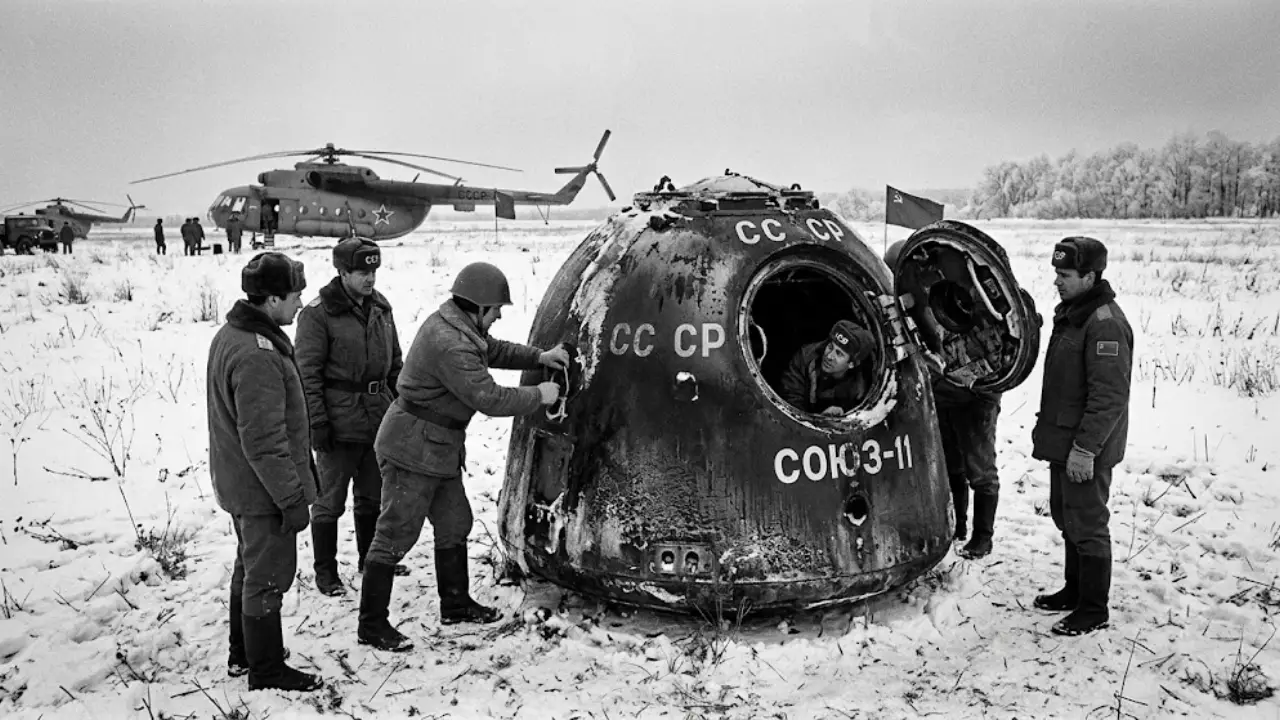
The spacecraft landed normally in Soviet Kazakhstan.
Recovery crews approached expecting to meet three returning heroes.
The mission had been historic.
The men had spent nearly 24 days aboard the first space station.
They had broken the previous human endurance record.
They had come home.
But when the recovery team opened the capsule, the men were motionless.
Still strapped into their seats.
Dead.
NASA records that attempts were made to resuscitate them, but they were unsuccessful.
The spacecraft had landed.
The mission had technically completed its final sequence.
The parachutes had worked.
The capsule was intact.
And yet the mission was a disaster.
That was the terrible discovery.
The machine had survived the journey better than the people it was designed to carry.
The investigation: how could one little valve do this?
The investigation eventually reconstructed the sequence.
The spacecraft’s module separation created a mechanical shock.
That shock caused the pressure-equalization valve to open prematurely.
The valve was exposed to vacuum.
The cabin rapidly lost its atmosphere.
The crew was not wearing pressure suits.
The valve was difficult to reach.
There was no effective emergency mechanism that allowed them to close it quickly enough.
And the spacecraft continued its automated descent.
One failure had collided with several design decisions.
This is why calling Soyuz 11 simply “a valve failure” misses the deeper lesson.
The valve was only the visible end of the chain.
Behind it were assumptions.
Assumption one: the valve would not open prematurely.
Assumption two: the cabin itself would remain a sufficient pressure boundary.
Assumption three: if something did go wrong, the crew would have enough time to fix it.
Assumption four: three people could safely operate without pressure suits during launch and return.
Every assumption seemed manageable.
Together, they became fatal.
Why weren’t the cosmonauts wearing spacesuits?
This question became unavoidable after the accident.
The three cosmonauts had not been wearing pressure suits during the critical return phase.
At the time, the Soyuz was configured for three people, and the cabin was extremely cramped. Providing pressure suits and the necessary equipment would have imposed significant space and operational constraints.
The Soviet system had therefore accepted the idea that the pressurized spacecraft cabin itself would protect the crew.
Soyuz 11 proved the danger of that assumption.
A spacecraft can be pressurized.
A spacecraft can be structurally sound.
A spacecraft can be flying perfectly.
And still, one opening can turn the entire cabin into a vacuum.
After the accident, Soviet engineers redesigned Soyuz.
The crew capacity was reduced to two for a period so the cosmonauts could wear pressure suits during critical phases. Human spaceflight was temporarily halted while the spacecraft was modified. NASA records that pressure suits subsequently became standard for Soyuz launches and landings.
The redesign was more than a technical correction.
It represented a change in philosophy.
The spacecraft would no longer be treated as the crew’s only pressure barrier.
The lesson NASA still carries today
More than half a century later, the fundamental lesson has not disappeared.
NASA’s current spacesuit requirements explicitly recognize sudden cabin depressurization as a serious threat. Modern pressure suits used for launch, entry and other high-risk phases are intended to provide an independent habitable atmosphere if the spacecraft loses pressure.
That is the extraordinary legacy of Soyuz 11.
A spacesuit is not merely clothing.
It is an emergency spacecraft wrapped around a human being.
If the cabin fails, the suit becomes the last remaining pressure boundary between the astronaut and vacuum.
That philosophy now extends beyond simple launch and landing. NASA identifies situations such as docking, complex manoeuvres and periods of elevated micrometeoroid and orbital-debris risk as circumstances in which protection against depressurization can become critical.
In other words, engineers eventually learned what Soyuz 11 had demonstrated in the most brutal possible way:
You do not design safety around the assumption that the room will remain a room.
You design it around the possibility that the room might suddenly stop being one.
The mystery of the silent capsule
Perhaps that is why Soyuz 11 remains one of the most haunting stories in spaceflight.
There was no spectacular final transmission.
No famous final sentence.
No giant explosion for the world to watch.
The spacecraft simply went quiet.
And while the capsule descended toward Earth, the people inside were already gone.
For the recovery teams waiting below, the landing must initially have looked reassuring.
A parachute was visible.
The capsule was where it was supposed to be.
The spacecraft had survived.
But spaceflight has always contained a cruel paradox:
A successful trajectory does not necessarily mean a successful mission.
The rocket can work.
The navigation can work.
The parachutes can work.
The capsule can land precisely where planned.
And still, three human beings can die because a component smaller than a person’s hand behaved differently for a few seconds.
What Soyuz 11 changed forever
After Soyuz 11, spacecraft designers had to think differently about failure.
It was no longer enough to ask:
“Can this component fail?”
They had to ask:
“If it fails, how long does the crew have?”
Then another question:
“Can the crew actually reach it?”
Then:
“Will the crew still be conscious when they get there?”
And finally:
“What happens if the crew cannot fix it?”
Those questions sound obvious today.
They were purchased with three lives.
The resulting design philosophy can be summarized in one sentence:
A catastrophic failure must not depend on a heroic human response occurring in a few seconds.
The system itself must provide time, warning, redundancy and a path to survival.
The most frightening thing about Soyuz 11 was how ordinary the beginning was
There is something almost unbearable about the sequence.
Three men launch into space.
They reach the first space station.
They live there for weeks.
They work.
They repair equipment.
They conduct experiments.
They watch Earth.
They prepare to return.
They close the hatch.
They undock.
They fire the engines.
Everything appears normal.
Then a tiny valve opens.
That’s all.
Not a monster.
Not a meteor.
Not an explosion.
Just a small mechanical movement in a spacecraft travelling through the darkness.
And suddenly the atmosphere the invisible ocean on which human life depends is escaping into nothing.
The cosmos does not need to attack you.
It only needs you to lose the thing that protects you from it.
The final lesson is not about a valve
The story of Soyuz 11 is often remembered as the story of a valve.
It should be remembered as something much larger.
It is a story about assumptions.
About engineering confidence.
About the difference between possible and survivable.
A component can have a legitimate purpose and still become lethal if it operates at the wrong moment.
A spacecraft can have a successful mission and still contain a fatal vulnerability.
A trained crew can respond correctly and still have no chance if the system gives them less time than the human body allows.
And perhaps most importantly, safety is not measured by how rarely something goes wrong.
It is measured by what happens when it does.
Soyuz 11 changed spacecraft design because three men discovered that distinction the hardest possible way.
Georgi Dobrovolski, Vladislav Volkov and Viktor Patsayev went into space as pioneers of a new era.
They became the first humans to live aboard an orbital space station.
They died not because space destroyed their spacecraft, but because for a few seconds, their spacecraft failed to keep space out.
That is the uncomfortable truth hidden inside Soyuz 11.
Space does not always kill with fire.
Sometimes it kills with silence.
Sometimes it kills with a pressure gauge falling.
Sometimes it kills with a valve opening exactly as designed only at the wrong moment.
And sometimes, when the capsule finally lands safely on Earth, the most terrifying discovery is waiting behind a perfectly closed door.








Leave a Reply