
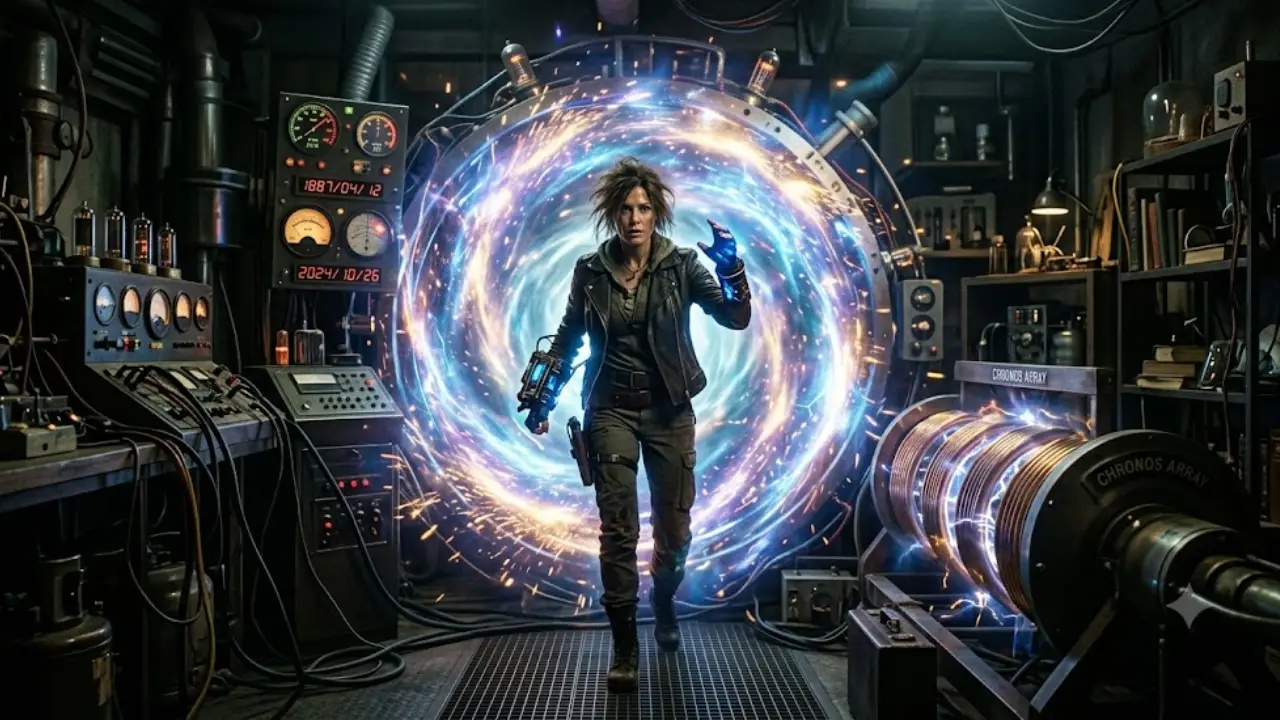
Imagine two people leaving Earth on the same morning.
They begin with identical watches, identical birthdays and, for the sake of the experiment, identical impatience with airport security.
One stays home.
The other climbs aboard a spacecraft and accelerates to a speed so close to the speed of light that ordinary human intuition quietly resigns and leaves the room.
When the traveller eventually returns, something extraordinary has happened.
The traveller’s clock says only a few years have passed.
Earth’s clocks say decades have passed.
Children have become grandparents. Buildings have disappeared. Political arguments that once seemed eternal are now museum material.
The traveller has not pressed a button marked FAST-FORWARD TO 2087.
Nothing supernatural happened.
No glowing portal opened.
No DeLorean appeared.
The traveller simply experienced less elapsed time than the people who stayed behind.
And this is where the story of time travel becomes considerably stranger than science fiction.
Because physics already permits travel into the future.
Not metaphorically.
Not philosophically.
Not in a “maybe someday” sense.
Relativistic time dilation has been measured with atomic clocks, incorporated into satellite navigation and tested with extraordinary precision. GPS satellites, for example, experience competing relativistic effects that amount to a net clock-rate difference of roughly 38 microseconds per day relative to clocks on Earth. Without relativistic corrections, GPS would not work properly.
So the first uncomfortable fact is this:
You do not need a time machine to travel through time differently from somebody else.
You need motion.
Or gravity.
The real mystery begins when we ask for something much more ambitious:
Can we travel backward?
That is where the universe stops being cooperative.
The Great Mistake: Treating “Time Travel” as One Thing
A surprising amount of confusion begins with the phrase itself.
“Time travel” sounds like one technological problem.
It isn’t.
Physics separates the subject into several different ideas:
| Question | Status |
| Can clocks run at different rates? | Yes — experimentally established |
| Can motion make a traveller age less than someone on Earth? | Yes |
| Can gravity change the rate at which time passes? | Yes |
| Can a traveller reach Earth’s future while experiencing less time? | Yes, in principle |
| Can spacetime contain paths that return to an earlier event? | Some mathematical solutions permit this |
| Can humans build such a machine? | No known method |
| Can we travel into our own past? | No evidence |
| Can we change history? | Purely hypothetical |
| Does quantum mechanics provide a working time machine? | No |
| Does entanglement send messages into the past? | No established mechanism |
This distinction matters enormously.
Some statements about time travel are experimental facts.
Some are solutions to equations.
Some are speculative interpretations.
And some belong almost entirely to Hollywood.
The trouble begins when all four are reported with the same sentence:
“Scientists say time travel is possible.”
That sentence is technically seductive and scientifically useless.
The strongest explainers on the subject tend to succeed because they make the same crucial distinction: they begin with experimentally established relativity, then move toward the far more speculative territory of wormholes, closed timelike curves and chronology protection. Current coverage, including recent Scientific American treatment, still frames backward travel as a theoretical problem rather than an engineering achievement.
So let’s start where the evidence is strongest.
Your Clock and My Clock Can Disagree
For centuries, time was treated almost like the universe’s master clock.
Imagine a gigantic invisible clock floating above reality.
Everyone’s second was the same second.
Everywhere.
Forever.
Newtonian physics was extraordinarily successful with this picture.
Then Einstein came along and effectively asked:
What if the universe never agreed to use the same clock?
Special relativity says that the elapsed time measured along different paths through spacetime can differ.
Move sufficiently fast relative to someone else and your clock runs slower relative to theirs.
This is not a philosophical argument.
It has been measured.
Atomic clocks have been compared at different speeds and elevations. NIST experiments have directly observed relativistic effects, including gravitational time dilation at remarkably small height differences.
Einstein’s theory does not merely say:
“Time feels slower.”
It predicts a measurable difference in elapsed time.
That difference is called proper time.
And suddenly the first time machine appears.
It has no door.
It has no glowing control panel.
It is a clock.
The Twin Paradox Is Not Really a Paradox
Now meet the twins.
One stays on Earth.
The other flies away at extreme speed, turns around and returns.
When they meet again, the travelling twin is younger.
This is the famous twin paradox.
But there is no genuine contradiction.
The twins did not experience the same journey through spacetime.
The travelling twin changed inertial frames during the trip, while the stay-at-home twin followed a different spacetime path. The difference in accumulated proper time produces the age difference. Einstein Online explains the effect using precisely this distinction.
The important point is almost comically simple:
Neither twin’s clock is “wrong.”
Each clock correctly records the time experienced along its own path.
When they reunite, their accumulated times can differ.
That is the first major crack in our everyday idea of time.
There is no universal stopwatch sitting behind the universe.
There are clocks following paths.
So Have Humans Already Travelled Into the Future?
In the modest physical sense, yes.
Humans and instruments have experienced tiny relativistic differences in elapsed time.
Particles do this routinely at speeds extremely close to light speed.
And the effect becomes technologically unavoidable in satellite navigation.
GPS satellites carry atomic clocks. Their orbital speed tends to make their clocks run slower relative to Earth clocks by about 7 microseconds per day, while their weaker gravitational environment makes them run faster by about 45 microseconds per day.
The combined effect is approximately 38 microseconds per day faster than corresponding clocks on Earth’s surface.
That sounds ridiculously small.
It isn’t.
Navigation systems depend on precise timing.
NIST notes that relativistic effects have to be included for GPS to function correctly.
In other words:
Your phone’s ability to locate you is quietly dependent on the fact that time does not pass at exactly the same rate everywhere.
Einstein’s “strange” theory is not sitting inside a textbook.
It is helping your blue location dot find you.
Gravity Is Another Time Machine
Special relativity gives us motion.
General relativity adds gravity.
And gravity does something even more unsettling.
A clock deeper in a gravitational field runs more slowly relative to a clock higher up.
Put one clock on a mountain and another lower down.
They do not accumulate exactly the same amount of time.
NIST’s optical-clock experiments have measured gravitational time dilation at increasingly tiny scales. In a landmark JILA experiment, clocks separated by roughly one millimetre ticked at measurably different rates.
More recent clock technology is pushing gravitational measurements into even finer territory.
This means something profound:
Time is sensitive to geography.
Not just your timezone.
Your altitude.
Your gravitational potential.
The difference between the basement and the rooftop is tiny, but real.
So when somebody says:
“Time passes.”
Physics replies:
For whom? Where? And along which path?
That is a much more dangerous question.
The First Big Revelation: Future Travel Is Not the Difficult Part
Suppose we could build a spacecraft capable of travelling extremely close to the speed of light.
The occupants could experience years while much more time passes for people who remain on Earth.
The travellers would not be “stopping time.”
They would not be moving backward.
They would simply be following a path through spacetime on which less proper time elapses.
That is why calling relativistic travel a “time machine” can be both useful and misleading.
Useful because the result resembles future travel.
Misleading—because nothing locally violates the traveller’s normal experience.
Inside the spacecraft:
one second still feels like one second.
One hour still feels like one hour.
One birthday still arrives after roughly one year of personal elapsed time.
The strange part appears only when the traveller compares clocks with people who followed another path.
This distinction is essential.
You do not experience time running backward.
You experience less elapsed time.
And Then We Reach the Past
Now imagine something different.
You want to arrive on Earth yesterday.
Not metaphorically.
Not by remembering yesterday.
You want to physically appear at an earlier event.
This is where general relativity becomes almost mischievous.
Einstein’s equations do not simply describe a universe in which every possible spacetime history must have ordinary global cause-and-effect ordering.
Certain mathematical solutions contain structures called closed timelike curves, or CTCs.
A timelike curve is a path through spacetime that a physical observer could, locally, follow without exceeding the speed of light.
A closed timelike curve loops back to an earlier point in spacetime.
Imagine walking forward every step and somehow ending up behind your original starting time.
You never locally travelled faster than light.
You never turned your watch backward.
The geometry of spacetime itself did the strange part.
That is one of the most unsettling discoveries in relativistic physics.
Some equations can describe a universe where the road itself loops through time.
Gödel Found the Monster Before Science Fiction Did
In 1949, mathematician and logician Kurt Gödel discovered a solution to Einstein’s equations describing a rotating universe.
It was not a proposal for a practical time machine.
But the mathematics contained closed timelike curves.
In such a universe, an observer could in principle follow a path that eventually returns to an earlier event.
This was not science fiction.
It emerged from Einstein’s own field equations.
The result forced physicists to confront an uncomfortable possibility:
Maybe general relativity does not automatically protect causality.
Modern reviews of closed timelike curves trace much of the subject back to Gödel’s solution and the subsequent attempts to determine whether such mathematical structures could exist in a physically realistic universe.
And that distinction mathematically allowed versus physically achievable will haunt almost every serious discussion of time travel.
The Wormhole Shortcut
Then comes the celebrity of time-travel physics:
the wormhole.
Forget the science-fiction tunnel floating in space.
A wormhole, in its simplest conceptual form, is a proposed connection between distant regions of spacetime.
Instead of travelling the long way around, you take a shortcut through the geometry.
Imagine drawing two points on a sheet of paper.
The ordinary route goes across the page.
Now fold the paper so the points touch.
Punch a hole through both.
That is the popular analogy.
It is not a complete representation of real spacetime, but it helps.
The crucial point is this:
A wormhole would connect regions of spacetime, not merely locations in space.
And that opens the door to something much stranger.
Time.
The Wormhole Trick That Turns a Tunnel Into a Time Machine
Suppose, purely hypothetically, that you have a traversable wormhole with two mouths.
Call them A and B.
Now accelerate one mouth to near-light speed and bring it back.
Because of relativistic time dilation, the two mouths can experience different amounts of elapsed time.
Alternatively, place one mouth in a significantly different gravitational environment.
Again, the clocks associated with the two mouths can become desynchronised.
Now the wormhole provides a shortcut between them.
Depending on the geometry, travelling through it could connect events that are separated in time as well as space.
This is not merely science-fiction invention. Wormhole-based time-machine constructions were seriously analysed in theoretical physics, including the influential work of Morris, Thorne and Yurtsever.
But now the universe sends us the bill.
The Wormhole Bill: Exotic Matter
A traversable wormhole is not something you simply manufacture with steel, engines and a sufficiently enthusiastic engineering department.
Theoretical wormhole models generally require unusual stress-energy conditions.
In many familiar constructions, the throat requires violations of standard energy conditions often described loosely as needing negative energy or “exotic matter.”
That phrase causes enormous confusion.
Negative energy is not the same thing as finding a mysterious chunk of anti-gravity rock.
Quantum field theory can produce situations involving negative energy densities relative to a chosen reference, but that does not mean we have a warehouse full of material capable of holding open a human-sized wormhole.
The physical problem is much deeper.
Can the required energy distribution exist in the necessary amount, configuration and stability?
Can it remain stable?
Can a macroscopic wormhole survive disturbances?
Can it be built?
Can anything pass through?
We do not know.
And this is where the sentence
“The equations permit wormholes.”
must never be confused with
“We can build one.”
Those are separated by an enormous canyon of unknown physics.
The Strange 2022 “Wormhole” Experiment
Here the story gets genuinely interesting.
In 2022, researchers used a quantum processor to investigate dynamics associated with a theoretical traversable-wormhole model.
Headlines around the world announced that scientists had created a wormhole.
That description was irresistible.
It was also dangerously easy to misunderstand.
The experiment did not create a tunnel through ordinary spacetime that humans could enter.
The researchers implemented a quantum system whose behaviour was designed to reproduce features of a theoretical gravitational model involving a traversable wormhole. Caltech’s description explicitly frames the work as a testbed for probing ideas in quantum gravity, not as the creation of a physical cosmic tunnel.
This distinction is exactly the kind of detail that separates science from science-flavoured clickbait.
The experiment was fascinating.
The headline was even more fascinating.
But they are not the same thing.
The Wormhole Idea Has Not Died
In fact, theoretical wormhole research remains active.
Recent 2026 papers continue to investigate traversable wormhole geometries using modified theories of gravity, exotic matter models and alternative energy conditions. Some explore whether unusual matter distributions could support wormhole-like structures while satisfying different subsets of physical constraints.
But notice the wording.
Models.
Solutions.
Energy conditions.
Theoretical constructions.
None of those words means:
We found a wormhole.
The distinction is not pedantry.
It is the entire story.
Then Physics Produces Its Most Famous Time-Travel Problem
Suppose backward time travel becomes possible.
You travel into the past.
You meet your grandfather before your parent is born.
You prevent your grandfather from ever having children.
Now you are never born.
But if you are never born, who travelled back to prevent your grandfather from having children?
This is the grandfather paradox.
It is not merely a storytelling problem.
It exposes a fundamental issue:
Can a physical theory allow an event that prevents the conditions required for that event to occur?
The paradox is really about causality.
Cause produces effect.
But backward time travel seems capable of making an effect interfere with its own cause.
The universe suddenly resembles a badly edited television series.
The episode requires the character to exist.
The character goes back and deletes the episode.
And yet the episode has already been watched.
Perhaps You Cannot Change the Past
One proposed solution is surprisingly conservative.
Maybe the past is self-consistent.
You can travel backward, but you cannot create a contradiction.
Everything you do in the past was always part of history.
You try to prevent your grandfather’s meeting with your grandmother.
Something goes wrong.
Perhaps the train is delayed.
Perhaps you accidentally introduce the two people.
Perhaps you discover that the “mysterious stranger” mentioned in an old family story was you.
You do not change history.
You become part of it.
This idea is related to the Novikov self-consistency principle.
It does not prove that time travel exists.
It simply explores what a logically consistent universe containing closed timelike curves might look like.
That distinction matters.
A consistency rule is not evidence that nature actually permits time machines.
The Bootstrap Paradox Is Even More Disturbing
Now imagine you travel to 1920 carrying a book.
You give the book to a young writer.
The writer eventually publishes it.
Decades later, you buy that famous book, take it back to 1920 and give it to the writer.
Question:
Who actually wrote the book?
The information appears to have no origin.
It exists because it exists.
This is the bootstrap paradox, or ontological paradox.
Unlike the grandfather paradox, the problem is not necessarily that something contradicts itself.
The problem is that an object or piece of information seems to exist inside a causal loop without a clear point of creation.
The universe has effectively misplaced the receipt.
Another Escape: Parallel Timelines
Science fiction often solves the problem with branching universes.
You travel into the past.
You change something.
Instead of rewriting your own history, you create or enter a different branch.
Your original timeline remains intact.
This neatly avoids the grandfather paradox.
But there is a catch.
There is no established experimental evidence that macroscopic backward time travel creates accessible alternate timelines.
Quantum mechanics does contain interpretations involving branching worlds, but that does not automatically turn those branches into science-fiction universes that a time traveller can visit.
This is an important recurring lesson:
A mathematical interpretation of quantum mechanics is not automatically a travel itinerary.
Could the Universe Simply Forbid the Whole Thing?
Stephen Hawking had a particularly elegant suspicion.
Perhaps nature protects causality.
He called the idea the chronology protection conjecture.
The basic intuition is beautifully simple:
If physics allows you to construct a machine that creates closed timelike curves, perhaps quantum effects become so violent near the moment chronology would break that the machine destroys itself or becomes impossible to form.
In his 1992 paper, Hawking argued that quantum backreaction could become large enough near the formation of closed timelike curves to prevent them from appearing. He concluded that the results strongly supported the idea that the laws of physics prevent such curves.
But there is an important warning.
Chronology protection is a conjecture, not an experimentally demonstrated cosmic law.
We have no laboratory in which someone builds a time machine, activates it and watches the universe politely confiscate it.
The proposal remains part of a deep theoretical problem at the boundary between general relativity and quantum theory.
And researchers are still probing the idea.
A 2026 European Physical Journal C study, for example, investigates possible signatures related to chronology protection using scalar-field quasiresonances. That does not prove Hawking’s conjecture, but it shows the question remains an active theoretical subject.
The time machine has not been convicted.
The investigation is still open.
Why Quantum Physics Does Not Simply Rescue the Time Traveller
Whenever classical physics becomes strange, quantum mechanics is usually summoned like the final character in a superhero movie.
Perhaps quantum mechanics allows time travel.
Perhaps particles can go backward.
Perhaps entanglement connects past and future.
Perhaps reality branches.
Some of these ideas are genuinely fascinating.
But one popular misunderstanding needs to be buried immediately.
Entanglement is not a telephone to yesterday.
Two quantum systems can become entangled so that their measurement outcomes display correlations that classical physics cannot reproduce.
But that does not allow someone to use entanglement alone to send an arbitrary message faster than light or backwards through time.
Quantum teleportation also requires classical communication.
So the phrase:
“Quantum entanglement lets information travel instantly.”
is not a licence to send:
“PLEASE BUY MILK”
to yourself yesterday.
Quantum mechanics is strange.
It is not a messaging service for ghosts.
The More Interesting Question: Is Information More Important Than Matter?
This is where the subject becomes deeper.
Physics does not merely worry about whether a person can travel through time.
It worries about whether information can violate causality.
Suppose you cannot send a human backwards.
Can you send one bit?
A message?
A measurement?
A mathematical instruction?
If even information could be sent into its own causal past, paradoxes would emerge.
A stock-market message from tomorrow could make its own transmission possible.
A scientific result could arrive before the experiment that produces it.
A warning could prevent the event that generated the warning.
Causality begins to fold in on itself.
That is why the question of time travel is ultimately not about building a faster spacecraft.
It is about the architecture of cause and effect.
And Then There Is the Arrow of Time
Here we encounter a different mystery.
The equations of fundamental physics often do not care about the direction of time in the simple way our everyday experience does.
Yet our lives clearly do.
A glass falls and shatters.
We never watch the fragments spontaneously leap upward, reconnect and land neatly on the table.
We remember yesterday.
We do not remember tomorrow.
You can scramble an egg.
You do not normally watch the scrambled egg spontaneously reconstruct itself.
Why?
One major answer involves entropy.
The second law of thermodynamics tells us that entropy tends to increase in isolated macroscopic systems.
This gives us a powerful physical arrow of time.
But notice the subtlety.
Increasing entropy does not mean:
“Time itself is moving forward because entropy increases.”
That is too simplistic.
Rather, thermodynamic processes give us a direction in which macroscopic events overwhelmingly evolve.
The microscopic laws can exhibit time-reversal symmetries while macroscopic behaviour develops a strong arrow.
This is one of the deepest reasons time travel becomes philosophically dangerous.
Maybe we are asking two different questions:
What is time?
and
Why does time have a direction in our experience?
Those may not have the same answer.
Reversing Entropy Would Not Necessarily Reverse Time
This is another common misunderstanding.
Suppose a sufficiently brilliant civilization could manipulate entropy.
Would that mean it had reversed time?
Not necessarily.
You could theoretically engineer a system into a low-entropy state without sending its inhabitants into yesterday.
A broken glass becoming unbroken is extraordinary.
But even that would not automatically mean the universe itself had reversed its temporal orientation.
The arrow of time is a much deeper concept than simply making a mess disappear.
Why Do Memories Point Backward?
Here is a surprisingly powerful clue.
Your brain contains records of previous states.
You remember breakfast.
You remember yesterday.
You do not possess equally detailed memories of tomorrow.
That sounds trivial until you ask why.
Memory itself is a physical process.
Creating a stable memory involves physical changes in a system.
Those processes occur within the thermodynamic arrow of time.
So our psychological sense of a flowing past may be tied to the physical processes that create records.
This does not prove that time “flows.”
It tells us something more subtle:
Our experience of time is itself a physical phenomenon.
The sensation that time moves from yesterday toward tomorrow is not necessarily a fundamental feature painted across the universe.
It may emerge from how physical systems store information.
The Block Universe: Perhaps the Past Has Not “Gone” Anywhere
Relativity introduces another unsettling possibility.
If spacetime is treated as a four-dimensional structure, then events are not necessarily best imagined as being created one moment at a time.
In a philosophical interpretation often called the block universe, past, present and future can be viewed as different locations within spacetime rather than as objects that successively pop into existence.
That does not mean physicists have proved that the future already exists in the same sense that your kitchen exists.
It is an interpretation of what spacetime and relativity might imply.
And it raises a terrifyingly simple question:
If tomorrow is already part of spacetime, why can’t we visit it?
The answer is:
Because existing in the mathematical description is not the same as having an accessible route through spacetime.
A mountain exists.
That does not mean you can teleport to its summit.
What About Free Will?
Now physics has wandered into philosophy wearing muddy boots.
If the future is already part of a four-dimensional spacetime structure, are our choices already “written”?
Not necessarily.
Relativity by itself does not settle the philosophical question of free will.
Nor does a block-universe interpretation automatically imply fatalism.
A description of spacetime does not tell us whether conscious decisions are meaningful, predetermined or emergent.
This is one of those places where physics can sharpen a question without answering it.
And that distinction should be respected.
A physicist saying:
“Spacetime can be represented as a four-dimensional structure”
is not necessarily saying:
“Your life is predetermined.”
Those are two very different claims.
What About Black Holes?
Black holes naturally enter every time-travel discussion because their spacetime geometry is extreme.
Some mathematical descriptions of rotating black holes contain unusual internal structures and closed timelike curves.
This has inspired decades of speculation about whether black holes could somehow become gateways through spacetime.
But the phrase “mathematical possibility” again does enormous work.
Real astrophysical black holes are not clean textbook objects.
They rotate.
They interact with matter.
They experience perturbations.
Their interiors involve gravitational physics we do not fully understand.
And travelling into a black hole is not equivalent to entering a convenient cosmic subway station.
The theoretical geometry of an idealised solution cannot simply be converted into a practical spacecraft design.
The Difference Between an Equation and a Machine
This may be the most important sentence in the entire article:
A solution to Einstein’s equations is not an engineering blueprint.
General relativity can contain mathematically valid spacetimes with strange causal structures.
That tells us something important about what the equations permit.
It does not tell us that nature can create those structures from ordinary matter.
It does not tell us they are stable.
It does not tell us quantum effects will permit them.
It does not tell us an observer can enter them.
And it certainly does not tell us that somebody in 2146 has a machine hidden in their garage.
The distinction between “time travel is mathematically allowed” and “a time machine can actually be operated” has been emphasised in serious philosophical and physical analyses of the subject.
This is where many popular articles become too enthusiastic.
The equations open the door.
Physics has not yet demonstrated that there is a floor on the other side.
Could Future Humans Visit Us?
Now we reach one of the most deliciously unsettling possibilities.
Suppose humanity eventually discovers a practical method of travelling backward through time.
Why haven’t we met anyone from the future?
This resembles a time-travel version of the Fermi paradox.
If future visitors exist, where are they?
Where are their footprints?
Their photographs?
Their artifacts?
Their messages?
Their suspiciously modern coffee machines sitting inside ancient archaeological sites?
There are countless possible answers.
Perhaps backward travel is impossible.
Perhaps it is possible only after a certain point in history.
Perhaps visitors cannot travel to times before the machine was created.
Perhaps travel creates branching histories.
Perhaps visiting the past is possible but enormously expensive.
Perhaps civilizations destroy themselves before mastering it.
Perhaps visitors deliberately remain hidden.
Or perhaps the simplest explanation is the least exciting:
Nobody from the future has ever visited us.
At present, there is no verified evidence that they have.
And that matters.
Absence of evidence is not proof of impossibility.
But extraordinary claims require extraordinary evidence.
What Evidence Would Actually Convince Physicists?
This question is far more useful than asking:
“Is time travel possible?”
Suppose tomorrow someone announced:
“We have built a time machine.”
What would scientists need?
Not a blurry photograph.
Not a viral video.
Not a person claiming to remember 2087.
A serious demonstration would need to establish something extraordinary:
1. A precisely defined temporal displacement
The experiment must show that an object or information reaches an event earlier than the relevant causal structure permits.
2. Independent clocks
Multiple independent precision clocks would need to verify the temporal ordering.
3. Controlled conditions
The effect would need to be reproducible and isolated from ordinary relativistic time dilation.
4. Information transfer
If the claim involves backward communication, the experiment must demonstrate actual controllable information transfer—not merely quantum correlations.
5. Causal violation
The experiment would need to establish that the information genuinely arrives before its source event in the relevant frame or spacetime structure.
6. Reproducibility
Other laboratories would need to reproduce it.
7. A theoretical explanation
Ideally, the effect should fit into a consistent physical framework rather than simply announcing that physics has been surprised.
That would be revolutionary.
A functioning backward-time experiment would probably be more significant than almost any discovery in modern physics.
What Science Fiction Gets Surprisingly Right
Science fiction is often mocked for getting physics wrong.
But some of its instincts are remarkably good.
It understands that:
- time and space are connected;
- high-speed travel changes elapsed time;
- gravity affects clocks;
- wormholes can be thought of as spacetime shortcuts;
- backward travel creates causal problems;
- changing history creates logical paradoxes;
- information can be more important than physical objects;
- different observers can disagree about temporal ordering.
The problem is not imagination.
The problem is engineering.
Science fiction often takes a mathematically interesting possibility and skips the inconvenient middle 400 years of physics required to build it.
And What Science Fiction Gets Spectacularly Wrong
The classic time machine usually works like an elevator.
You enter.
Press:
1857
The doors open.
You step out.
Physics does not give us such a mechanism.
Even theoretical wormhole travel would not necessarily involve “stopping time” or teleporting a person’s body into another year.
The traveller’s own clock would still advance normally.
The exotic part would be the geometry connecting events.
That distinction sounds small.
It is not.
It is the difference between:
“I travelled through time.”
and
“My worldline connected two events that ordinary observers regarded as separated in time.”
The second sentence is much closer to the language of relativity.
And considerably less useful for Hollywood marketing.
The Most Dangerous Phrase in Time-Travel Journalism
It is:
“Scientists say time travel is possible.”
The phrase should immediately trigger a follow-up question:
Which kind?
Because there are at least three radically different statements hiding inside it.
Statement A
“Relativity permits observers to experience different amounts of elapsed time.”
Established.
Statement B
“General relativity has mathematical solutions containing closed timelike curves.”
Established mathematically.
Statement C
“Humans can build a machine that sends people into yesterday.”
Not established.
Treating A, B and C as equivalent is how scientific reporting turns a fascinating subject into a circus.
The 2026 Question: Is Physics Quietly Closing the Door?
Current research does not give us a definitive “no.”
But it increasingly reveals how many obstacles lie between mathematical possibility and physical reality.
The problems include:
maintaining traversable wormholes;
satisfying or bypassing energy-condition constraints;
quantum backreaction;
stability;
singularities;
causality;
quantum gravity;
information consistency;
the absence of experimental evidence for closed timelike curves.
Recent theoretical work continues to test these boundaries rather than announcing a working time machine.
That is actually more interesting than a simple “time travel is impossible” headline.
Because physics has not slammed the door.
It has built a hallway full of locked doors.
Perhaps Nature Does Not Forbid Time Travel
Here is where the story becomes genuinely philosophical.
Maybe backward time travel is impossible.
Maybe it is possible but inaccessible.
Maybe it requires a theory of quantum gravity we have not yet discovered.
Maybe closed timelike curves can exist only under conditions that never occur in our universe.
Maybe causality emerges from deeper laws and cannot be violated.
Maybe the universe permits microscopic causal oddities but suppresses macroscopic ones.
Or perhaps our present theories are simply incomplete.
We should be careful here.
There is no evidence for these possibilities as established facts.
They are research questions.
And that is exactly why the subject remains alive.
The Real Mystery May Not Be Time Travel
Perhaps we have been asking the wrong question.
Instead of:
“Can humans build a time machine?”
physics may eventually ask:
“Why does spacetime have the causal structure it does?”
Why is there a distinction between past and future?
Why does causality appear so robust?
Why does entropy increase?
Why do quantum processes and gravity fit together so awkwardly?
Why does spacetime appear smooth on large scales but quantum on sufficiently small scales?
And most importantly:
Is time fundamental—or does it emerge from something deeper?
Those questions are much bigger than the time machine.
The Universe Already Contains a Tiny Time Machine
Return to the traveller.
The spacecraft accelerates.
Its clock runs differently from Earth’s.
It turns around.
It returns.
The traveller has aged less.
Nothing exploded.
No paradox occurred.
No wormhole opened.
No law of physics was broken.
Yet the traveller has effectively arrived further into Earth’s future than their own biological clock would suggest.
That is real physics.
Atomic clocks confirm it.
GPS depends on it.
Relativity predicts it.
The future, in this limited sense, is not forbidden.
The past is the difficult direction.
And that distinction changes everything.
So Can You Travel Into the Future?
Yes, if by “travel into the future” you mean experiencing less elapsed time than people who remain elsewhere.
Relativity permits this.
It has been measured.
The effect becomes larger as relative speed approaches the speed of light and also depends on gravitational potential.
A hypothetical traveller moving sufficiently close to light speed could return to Earth having experienced far less time than those who stayed behind.
The practical problem is engineering.
We do not currently possess spacecraft capable of carrying humans to anything remotely close to light speed.
But the physics itself is not the obstacle.
Can You Travel Into the Past?
That answer is radically different.
There is no experimental evidence that humans, information or ordinary objects can be sent into the past.
General relativity contains mathematical constructions involving closed timelike curves.
Wormhole-based time machines can be described under certain assumptions.
Rotating spacetimes can contain exotic causal structures.
But the physical requirements, stability problems and quantum effects remain unresolved.
Hawking’s chronology protection conjecture suggests that nature may prevent the formation of closed timelike curves altogether, but this has not been established as an experimentally verified law.
So the scientifically honest answer is:
Backward time travel remains a theoretical possibility in some mathematical models, not an observed physical phenomenon.
The Time Machine May Already Be Telling Us “No”
There is something almost beautiful about the way this story has unfolded.
Every time physicists push the idea further, the universe seems to respond with another complication.
Wormhole?
You need exotic energy.
Exotic energy?
Quantum theory complicates it.
Closed timelike curve?
Causality breaks.
Causality breaks?
Quantum backreaction may become enormous.
Parallel timelines?
No experimental evidence that travellers can move between them.
Entanglement?
No controllable faster-than-light signalling.
Black holes?
Their realistic interiors are vastly more complicated than the idealised equations.
So perhaps the universe is not saying:
“Time travel is impossible.”
Perhaps it is saying something more subtle:
“You have not yet understood the rules deeply enough to know.”
The Final Paradox
There is one final twist.
Suppose future travel is easy in principle.
Suppose backward travel is impossible.
Then time travel was never really about moving through time like moving through a corridor.
It was about the geometry of your path through spacetime.
You are already moving through spacetime.
Your clock already measures your own path.
Gravity already changes that path’s rate relative to other clocks.
Velocity already changes it.
Atomic clocks can detect the difference.
GPS engineers correct for it.
The universe has already demonstrated the mechanism.
What it has not demonstrated is the reverse gear.
And perhaps that is the most revealing clue of all.
Physics does not appear to treat yesterday and tomorrow as identical destinations.
One direction is built into ordinary relativity.
The other requires spacetime to perform extraordinary tricks—and every proposed trick comes with a terrifyingly large footnote.
So the real question is no longer:
“Can we build a time machine?”
It is:
“What would the universe have to allow for a past to become reachable?”
That question takes us straight to the frontier where general relativity, quantum mechanics, thermodynamics and the nature of causality collide.
And there, remarkably, we still do not have the final answer.
Perhaps one day we will.
Perhaps the universe will finally reveal a hidden door.
Or perhaps the strangest thing about time travel will turn out to be that the door was never locked.
There was simply never a door.
Time Travel in Physics: The Evidence Ladder
| Claim | Scientific status | Why it matters |
| Moving clocks can tick at different rates | Experimentally established | Special relativity |
| Gravity changes clock rates | Experimentally established | General relativity |
| GPS requires relativistic corrections | Technologically established | Relativity is operational |
| Humans could experience less elapsed time during extreme-speed travel | Physically permitted | Future-directed relativistic travel |
| Closed timelike curves exist in some GR solutions | Mathematically established | Equations permit unusual causal structures |
| Traversable wormholes can be modelled | Theoretical | Requires difficult physical assumptions |
| Wormholes can potentially create time-machine geometries | Theoretical | Depends on traversability and other conditions |
| Quantum effects prevent time machines | Proposed, not proven | Chronology protection |
| Parallel timelines can be visited | Speculative | No demonstrated mechanism |
| Entanglement sends messages into the past | No | Violates established no-signalling principles |
| Humans have travelled backward in time | No evidence | Extraordinary claim |
| A working macroscopic time machine exists | No evidence | No verified demonstration |
Five Questions That Expose Most Time-Travel Myths
1. Does relativity prove time travel is possible?
It proves that different observers can accumulate different amounts of elapsed time. It does not prove that a person can travel backward into history.
2. Has anyone travelled into the future?
In the relativistic sense, different clocks and travellers can experience different amounts of elapsed time. The effect has been experimentally measured and is essential to technologies such as GPS.
3. Are wormholes real?
Wormholes are legitimate solutions or concepts within theoretical gravitational physics, but no traversable wormhole has been observed.
4. Did scientists create a wormhole on a quantum computer?
No physical spacetime tunnel was created for people to enter. The 2022 experiment studied quantum dynamics associated with a theoretical traversable-wormhole model.
5. Has Hawking’s chronology protection conjecture been proved?
No. It remains a theoretical conjecture supported by arguments about quantum effects and backreaction, with ongoing research investigating related questions.
What the Best Time-Travel Explainers Get Right and Where This Article Goes Further
The strongest widely surfaced explainers tend to share several useful characteristics: they begin with the experimentally secure time-dilation story, use the twin paradox to make relativity intuitive, introduce wormholes only after establishing spacetime, and then confront the causal problems rather than pretending that a wormhole automatically equals a working time machine.
But the deeper story is often lost when everything is compressed into the headline:
“Einstein says time travel is possible.”
This article separates the subject into four layers:
Experiment → Mathematical possibility → Physical feasibility → Speculation.
That hierarchy is crucial.
It also explains why the apparently simple question “Can we travel through time?” contains several completely different questions about clocks, worldlines, causality, entropy, information, quantum theory and spacetime geometry.
The result is less cinematic.
And considerably more astonishing.
Key Unfoldings
Time does not pass at exactly the same rate for every observer.
Motion changes elapsed time through special relativity.
Gravity changes elapsed time through general relativity.
Atomic clocks have directly measured these effects.
GPS works only because engineers account for relativity.
Future-directed relativistic time travel is physically allowed in principle.
Backward time travel is fundamentally different.
General relativity contains mathematical solutions with closed timelike curves.
Wormholes can theoretically connect different regions of spacetime.
Turning a wormhole into a time machine introduces enormous physical problems.
Quantum mechanics has not provided a demonstrated route into the past.
Entanglement cannot be used as a controllable telephone to yesterday.
Hawking’s chronology protection conjecture remains unproven.
No verified evidence exists for human travel into the past.
The deepest mystery may not be time travel at all but why spacetime has the causal structure it does.
The Unfolding Shelf Verdict
Time travel is neither simply possible nor simply impossible.
That answer is too crude.
The scientifically honest picture is far more interesting.
Travel into the future through relativistic time dilation is established physics.
Travel into the past appears in certain mathematical constructions of spacetime.
Building a machine capable of doing it is an entirely different question.
And that question remains unanswered.
For now, Einstein has given us something that looks suspiciously like a time machine but only in one direction.
The universe lets clocks disagree.
It lets gravity stretch time.
It lets motion change how much time a traveller experiences.
It allows equations in which spacetime can become so strange that a path may loop toward its own past.
But whenever we try to turn that mathematical possibility into a machine, physics produces another obstacle.
Perhaps those obstacles are temporary.
Perhaps they are clues to a deeper theory.
Or perhaps they are the universe’s way of telling us that causality is not merely a rule humans invented to keep stories coherent.
Perhaps it is one of the foundations holding reality together.
And if that is true, then the ultimate time machine may not be the machine that sends us into yesterday.
It may be the experiment that finally tells us why yesterday cannot be reached.
A mathematical spacetime containing closed timelike curves is not evidence that a physical time machine exists. Likewise, the existence of relativistic time dilation does not imply that humans can currently build a spacecraft capable of dramatic future travel.
The most exciting part of time-travel physics is therefore not the claim that somebody has discovered a machine.
Nobody has.
The exciting part is that the universe has already shown us that our ordinary idea of time was wrong.
And we are still trying to understand just how wrong.
Reliable Sources & Further Reading
- NIST — Putting Einstein to the Test: experimental tests of special and general relativity, atomic clocks and the relativistic effects relevant to GPS. NIST: Putting Einstein to the Test
- NIST — Relativity and Optical Clocks: detailed discussion of the twin paradox, gravitational time dilation and precision-clock tests. NIST: Relativity and Optical Clocks
- NIST/JILA — Millimeter-scale gravitational time dilation: precision measurement of general relativity with clocks separated by about a millimetre. NIST: JILA Atomic Clocks Measure Einstein’s General Relativity at Millimeter Scale
- Einstein Online — The Case of the Travelling Twins: an accessible explanation of relativistic time dilation and the twin paradox. Einstein Online: The Case of the Travelling Twins
- Physical Review D — Hawking’s Chronology Protection Conjecture: the original 1992 theoretical treatment of chronology protection. Physical Review D: Chronology Protection Conjecture
- Morris, Thorne & Yurtsever — Wormholes, Time Machines and the Weak Energy Condition: foundational work connecting traversable wormholes with possible time-machine constructions. CaltechAUTHORS: Wormholes, Time Machines and the Weak Energy Condition
- Scientific American — Wormholes Could Be the Key to Time Travel: a current 2026 overview of wormholes, closed timelike curves and chronology protection. Scientific American: Wormholes Could Be the Key to Time Travel
- Caltech — Traversable Wormhole Dynamics on a Quantum Processor: explanation of the 2022 quantum-processor experiment and why it was not a physical human-scale wormhole. Caltech: Traversable Wormhole Dynamics on a Quantum Processor
- European Physical Journal C — Probing the Chronology Protection Conjecture via Scalar Quasiresonance: a 2026 theoretical investigation related to chronology protection. EPJ C: Probing the Chronology Protection Conjecture








Leave a Reply