
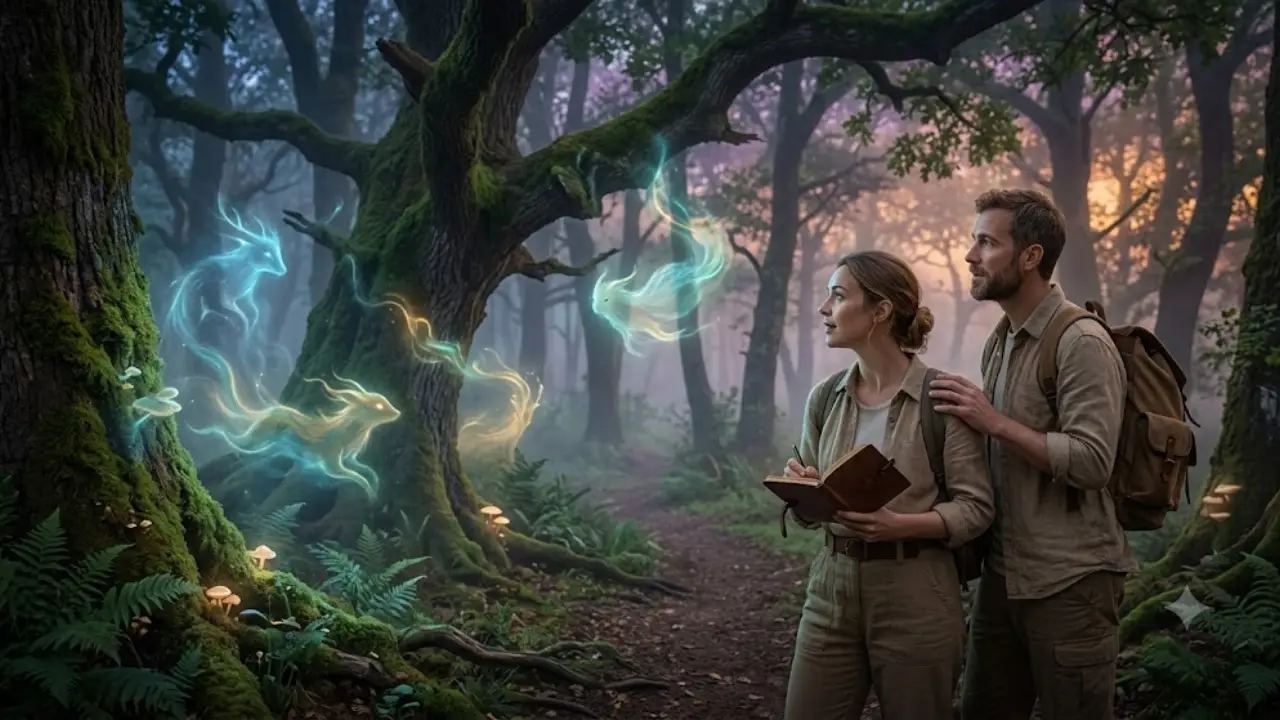
“A widow in Japan speaks to her dead husband through a disconnected telephone. A mountaineer in Antarctica feels an invisible companion walking beside him. A child in Nigeria dreams of an ancestor giving advice. A grieving father in Brazil hears his daughter’s voice in an empty room. An exhausted sailor in the Arctic sees a figure standing on the ice.”
Different continents.
Different religions.
Different centuries.
Yet the stories sound strangely alike.
For as long as humans have buried their dead, they have reported encounters with those who are no longer here.
Ghosts.
Ancestors.
Spirits.
Shadows.
Protectors.
Visitors.
Modern people often imagine belief in spirits as an ancient idea, left behind by science. But the evidence tells a different story. Surveys suggest that belief in spirits, ancestors, angels, unseen forces or life after death remains common across much of the world. In the United States, for example, Pew Research found that 65% of adults believe spirits or unseen spiritual forces exist, while many report personal experiences involving deceased loved ones.
This creates one of humanity’s oldest and strangest questions:
When people meet spirits, what exactly is happening?
Science does not yet have one answer.
Anthropology has another.
Religion has thousands.
And the human brain may be stranger than all of them.
The World’s Oldest Shared Story
Long before writing, governments or cities, humans told stories about the dead.
Ancient Egypt spoke of the Ka.
China honoured ancestors.
Indigenous cultures in Australia described Dreamtime beings.
Japanese tradition speaks of Yūrei.
West African traditions describe ancestral presences.
Europe created ghost stories.
India developed rich traditions involving ancestors, spirits and ritual remembrance.
The details differ.
But one pattern repeats across cultures:
The dead are gone physically, yet people continue to feel that they remain socially present.
Anthropologists increasingly view this not as an odd exception, but as a deeply human tendency.
Humans do not merely remember people.
We continue relationships with them.
A dead mother can remain emotionally active in a daughter’s life.
A deceased teacher can still influence decisions.
A lost spouse can still feel psychologically present.
Perhaps the real mystery is not why people see spirits.
Perhaps it is why relationships survive death inside the human mind.
The Brain Never Learned That Someone Is Gone
Here is an astonishing fact.
Your brain does not store people like photographs in an album.
It stores them as living networks.
Voice.
Smell.
Touch.
Habits.
Conversations.
Predictions.
For decades, your brain learns:
“This person enters the room at 6 p.m.”
“This voice says my name.”
“This hand touches my shoulder.”
Death removes the external person.
But the internal model remains.
Modern bereavement research shows that experiences of sensing deceased loved ones are surprisingly common and are not automatically signs of illness. Reviews suggest that post-bereavement experiences—including sensing, hearing or briefly seeing a deceased person—occur frequently across cultures.
This creates a fascinating possibility:
The brain continues predicting a person’s presence even after physical absence.
Sometimes that prediction becomes vivid.
And a memory becomes a presence.
Why Ghosts Appear In Similar Places Everywhere
Look at ghost stories across the world.
They appear in:
bedrooms,
mountains,
battlefields,
hospitals,
forests,
old houses,
lonely roads,
places of grief.
This is not random.
These are often places involving:
uncertainty,
darkness,
isolation,
fear,
exhaustion,
transition,
emotional intensity.
Modern neuroscience suggests that the brain is not a camera recording reality.
It is a prediction machine.
It constantly asks:
What is happening?
Who is nearby?
Am I safe?
Sometimes, under unusual conditions, these predictions become unusually powerful.
The result may be:
A feeling that somebody is there when nobody is physically present.
Researchers now call this phenomenon felt presence, and it has been documented in healthy people, spiritual practitioners, endurance athletes, neurological patients and those experiencing sleep disturbances.
The Third Man: Spirits On Mountains And Ice
One of the strangest global patterns comes from explorers.
Polar explorers.
Sailors.
Mountaineers.
Desert travellers.
Astronauts.
Many report an invisible companion.
Sir Ernest Shackleton famously described feeling an extra presence during Antarctic survival.
Climbers on Everest have reported unseen companions.
Extreme athletes sometimes experience the same phenomenon.
Scientists think isolation, stress, exhaustion and altered body-awareness may contribute. Yet the experience often feels completely real to the person involved.
Imagine this irony:
Humans travelled to Earth’s most remote places and repeatedly discovered…
another person who was not there.
Sleep: Humanity’s Greatest Ghost-Making Machine
If spirits have favourite working hours, folklore suggests they prefer midnight.
Science notices something else.
Many experiences happen:
while falling asleep,
while waking,
during sleep deprivation,
after emotional stress.
Sleep paralysis provides a striking example.
A person wakes.
Cannot move.
Feels an intruder.
Sees a figure.
Hears footsteps.
Feels pressure.
Across cultures this has become:
demons,
witches,
spirits,
ghosts,
shadow people.
The experience changes.
The interpretation changes.
The underlying human experience remains surprisingly similar.
The Evolutionary Theory Of Ghosts
Imagine your ancestors walking through a forest.
A rustle in the bushes could mean:
A predator.
An enemy.
Or nothing.
Which mistake is safer?
Mistakenly assuming someone is there?
Or failing to detect real danger?
Evolution may have favoured brains that occasionally over-detect agency.
This idea is called hyperactive agency detection.
Humans are exceptionally good at seeing:
faces in clouds,
people in shadows,
intention in randomness,
voices in noise.
Sometimes this ability protects us.
Sometimes it creates mysteries.
Ghosts, Religion And The Need For Meaning
A purely neurological explanation is incomplete.
Because spirit experiences are not only sensory.
They are emotional.
A grieving woman may say:
“I felt my husband beside me.”
Science can investigate the experience.
Religion asks:
“What does this mean?”
This distinction matters.
Science studies mechanisms.
Humans seek meaning.
And meaning has always been one of humanity’s strongest psychological needs.
The Global Comparison
| Culture | Common Interpretation |
| Japan | Ancestor or Yūrei |
| India | Ancestors, spirits, ritual presence |
| Mexico | Continuing bonds with the dead |
| Africa | Ancestor guidance |
| Europe | Ghosts |
| Indigenous traditions | Spirit beings |
| Modern science | Felt presence, memory, prediction |
Perhaps the most interesting possibility is not that one explanation replaces all others.
It is that:
Different cultures may be describing overlapping human experiences using different languages.
The Great Distinction
This may be the most important sentence in the article:
An experience can be completely real without proving that its interpretation is correct.
Feeling a deceased parent nearby is real.
Seeing a figure during sleep paralysis is real.
Hearing footsteps in an empty house is real.
The experience exists.
The cause remains the question.
Science investigates causes.
Culture creates meanings.
Religion provides interpretations.
Humans live with all three.
What We Know
Humans across cultures report remarkably similar experiences.
Grief, sleep, stress, isolation and sensory conditions can influence perception.
Felt-presence experiences occur in both healthy and clinical populations.
The brain actively constructs experience rather than simply recording reality.
What We Still Don’t Know
Why some people have these experiences while others never do.
Why certain experiences feel more real than ordinary perception.
Whether all experiences can eventually be explained through known mechanisms.
Whether human consciousness contains aspects not yet understood.
The Deepest Question
Perhaps humanity has been asking the wrong question for thousands of years.
Not:
“Do spirits exist?”
But:
“Why does the human brain, in grief, fear, love, memory and hope, become capable of making absent people feel present?”
That question takes us into neuroscience.
Anthropology.
Religion.
Memory.
Dreams.
Evolution.
Love.
Death.
And perhaps into mysteries that science has not fully mapped.
Because the most extraordinary fact may not be that people claim to meet spirits.
It may be this:
Billions of human beings, across every culture in history, have independently reported experiences suggesting that relationships do not end as abruptly in the mind as they do in the physical world.
And perhaps that is why ghost stories never disappear.
They are not merely stories about the dead.
They are stories about memory.
Attachment.
Loss.
Identity.
And the strange architecture of being human.








Leave a Reply