
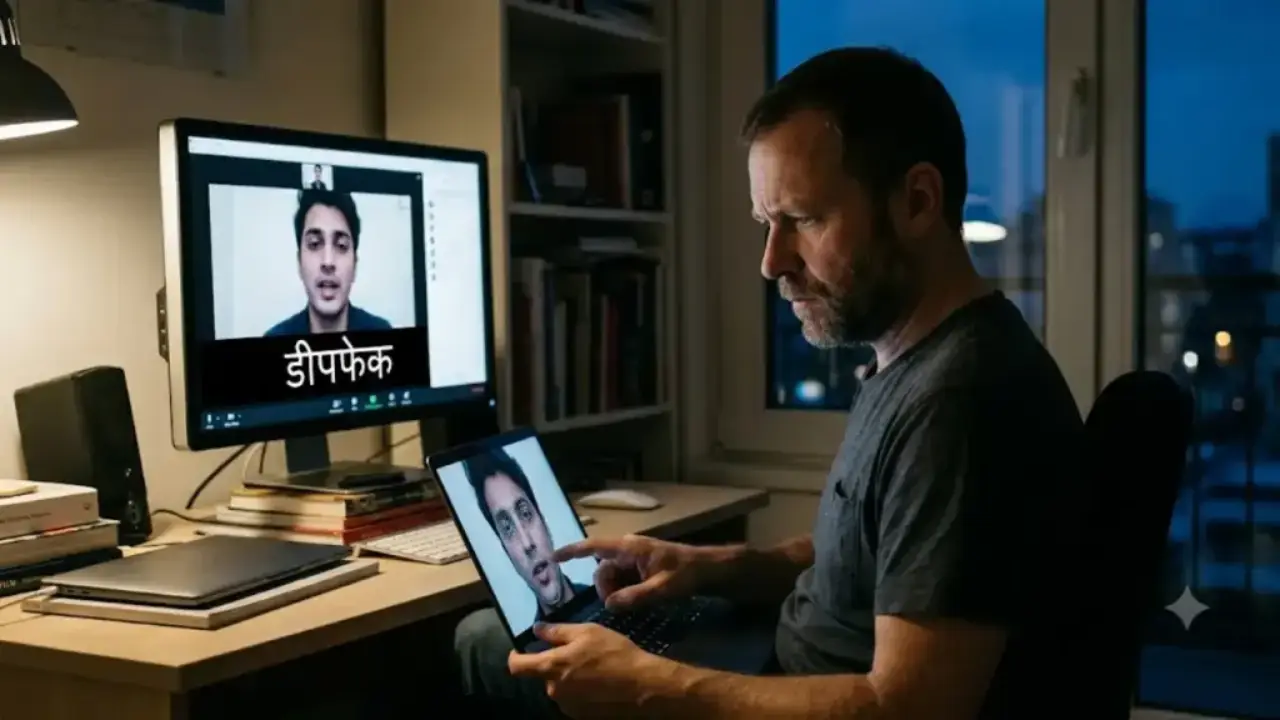
The Video Nobody Could Prove Was Real
At 9:17 on a Tuesday morning, a video appeared on thousands of phones.
There was nothing obviously strange about it.
A familiar public figure was speaking directly into a camera. The face looked right. The voice sounded right. The expressions seemed natural. The background looked ordinary. There were no cartoonish glitches, no floating teeth, no mysterious extra fingers the sort of visual mistakes that once made fake AI images easy to spot.
People watched it.
Then they forwarded it.
Then they argued about it.
Some became angry. Others frightened. A few celebrated.
Within hours, the question was no longer what the person had said.
The question became:
Had the person said it at all?
And that is where the story becomes uncomfortable.
Because if the video was fake, somebody had manufactured a reality that millions of people briefly accepted.
But suppose the video was genuine.
Then something even more disturbing had happened.
People could now dismiss real evidence simply by saying:
“It is probably AI.”
That is the strange territory we are entering.
For centuries, seeing something was among our strongest shortcuts to believing it.
AI is quietly breaking that shortcut.
And when our eyes and ears can no longer settle the argument, civilisation needs another referee.
That referee may be authentication.
We Have Entered the Age of the Convincing Lie
The old internet had a peculiar weakness.
There was too much information, but the information usually came with clues about its origin.
A newspaper had a masthead.
A photograph came from a camera.
A government document had an issuing authority.
A television broadcast came from a known channel.
A person’s voice generally required a person.
Generative AI has begun dismantling those assumptions.
Today, a machine can generate a face that never existed, manufacture a voice that belongs to nobody, construct a photograph of an event that never happened and manipulate a genuine recording into telling a completely different story.
The frightening part is not that machines can create fake material.
Humans have been creating fake material for thousands of years.
The frightening part is scale.
The production of convincing deception is becoming cheaper, faster and more accessible.
And this creates an economic imbalance.
Creating information is becoming cheap. Establishing its credibility may become expensive.
That difference could create an entirely new industry.
The First Clue Is Hidden Inside the File
Imagine taking a photograph with your phone.
You see only the finished picture.
But behind that picture is a history.
A camera captured it.
A device processed it.
Software may have compressed it.
You may have cropped it.
Someone may have adjusted the brightness.
Another application may have removed an object.
An AI system may have changed the background.
The photograph that eventually reaches the internet could therefore be very different from the photograph that was originally captured.
So what if the file could carry some of that history with it?
Not a caption.
Not a social-media claim.
Not somebody saying, “Trust me.”
A cryptographically verifiable record of provenance.
That is the idea behind the C2PA standard and its Content Credentials system.
C2PA describes its purpose as establishing standards for the source and history of digital media. Its technical specifications bind provenance information into a verifiable structure rather than treating it as ordinary text that anyone can casually edit.
The movement is already substantial.
In February 2026, C2PA reported that more than 6,000 members and affiliates had live applications of Content Credentials.
That number tells us something important.
This is no longer merely a scientist’s experiment.
The machinery for recording digital provenance is beginning to become part of the internet itself.
But there is a catch.
And it is a very important one.
Authentic Does Not Always Mean True
Suppose a photographer genuinely captures a photograph.
The file is authentic.
Its provenance is intact.
Its history can be verified.
Now imagine that the photograph shows a crowd outside a building.
Someone posts:
“This crowd was protesting against the government.”
The photograph may be completely genuine.
The caption may still be completely false.
This distinction is the heart of the authentication problem.
A verified file does not automatically verify the story told about the file.
Provenance can help answer:
Where did this content come from?
What happened to it?
Was it altered?
Who or what created it?
But another investigation is still required:
What does the content actually prove?
That means the future will not eliminate human judgement.
It may make good judgement even more valuable.
The Journalist’s Job Is About to Become a Digital Detective Story
A journalist once receiving a dramatic video might have asked:
“Is this old?”
“Where was it recorded?”
“Who uploaded it?”
Tomorrow, the questions may multiply.
Where is the original file?
Who captured it?
What device was used?
Can its provenance be verified?
Was it edited?
When did the editing occur?
Does the claimed location match the physical environment?
Does the weather correspond with the claimed date?
Are there other recordings from the same event?
Can witnesses independently confirm it?
Does satellite imagery support the location?
Does the audio match the environment?
Does the digital history contradict the story?
The job begins to resemble detective work.
And the timing is significant.
The Reuters Institute’s Digital News Report 2026 found global trust in news at 37%, while online video has become a major source of news consumption. The report also found that weekly use of AI chatbots for news increased from 7% to 10%.
In other words, people are simultaneously becoming more dependent on digital information and more uncertain about whether they should trust it.
That is a perfect environment for an authentication industry.
Then the Mystery Walks Into the Courtroom
Now imagine the same problem inside a courtroom.
A lawyer produces a video.
“This is what happened,” the lawyer says.
The opposing lawyer does not necessarily need to prove that the video is fake.
The lawyer can simply ask:
“How do you know?”
That small question changes everything.
Where did the file come from?
Who possessed it?
Was it copied?
Was it edited?
Can the original be produced?
Was its integrity maintained?
Can the chain of custody be demonstrated?
Was it forensically examined?
Can other evidence independently support it?
India’s Bharatiya Sakshya Adhiniyam, 2023 contains provisions dealing with electronic and digital records, including electronic records and electronic signatures.
This means the legal system is already dealing with a world in which digital material is evidence.
The emerging challenge is that digital evidence can be extraordinarily persuasive while being extraordinarily easy to manipulate.
The courtroom of the future may therefore contain an invisible battle over something most people never notice:
the history of a file.
The Strange Day Your Voice Stops Belonging Only to You
There is another scene.
Your phone rings.
You answer.
It is your brother.
His voice is unmistakable.
He sounds frightened.
“Please send me money. I have a problem.”
You know that voice.
You trust it.
You act.
Except it wasn’t your brother.
It was an AI-generated imitation.
The technological trick is relatively simple in principle: machine-learning systems can be trained or prompted to reproduce characteristics of a person’s voice.
Now consider the consequences.
The attacker does not necessarily need your password.
The attacker may attempt to imitate you.
Your face.
Your voice.
Your writing.
Your behaviour.
Your documents.
Your digital identity.
This is why authentication is likely to become more complicated than a password.
A bank may increasingly need to consider several signals simultaneously:
Who is requesting the transaction?
Which device is being used?
Does the behaviour match previous activity?
Is the transaction authorised?
Is additional verification necessary?
The future security system may therefore look less like a lock and more like a jury.
One piece of evidence may not be enough.
Several independent signals together may create confidence.
And Then Comes the Resume Nobody Can Trust
The same problem will eventually reach the office.
A company receives an impressive resume.
The degree looks genuine.
The certificates look genuine.
The candidate attends a video interview.
Everything appears perfect.
But then somebody asks:
“Are we certain the person we interviewed was actually the person who applied?”
That question sounds strange today.
It may not sound strange for long.
AI can already manipulate faces and voices.
Synthetic identities can combine fragments of real information into convincing fictional identities.
That creates a new requirement:
credential authenticity.
Instead of simply presenting a certificate, a person could eventually present a digitally verifiable credential.
Instead of asking an employer to trust a PDF, the credential itself could carry cryptographically verifiable information about its issuer and integrity.
The same concept could apply to educational qualifications, professional licences, training certificates and government documents.
The resume of the future may therefore contain fewer claims that say:
“Believe me.”
And more credentials that say:
“Verify me.”
The Internet May Soon Ask a Stranger Question
There is an even deeper problem coming.
Suppose you receive a message online.
You assume a human wrote it.
But what if it came from an AI agent?
Perhaps it is legitimate.
Perhaps a person authorised the AI to act for them.
Perhaps it is an automated customer-service system.
Perhaps it is a scam.
The question changes from:
“Who is this person?”
to:
“What exactly is acting here?”
A human?
An AI?
An AI authorised by a human?
An unauthorised agent pretending to represent somebody?
This creates a future requirement for proof of agency as well as proof of identity.
And this is where authentication becomes much more interesting than deepfake detection.
Deepfake detection asks:
“Is this fake?”
Authentication asks a larger set of questions:
Who created this?
Who authorised it?
What happened to it?
What does it prove?
Can its history be independently verified?
That is a much bigger market.
Europe Has Already Started Writing the Rules
This future is no longer entirely theoretical.
The European Union’s AI Act transparency obligations under Article 50 became applicable on 2 August 2026.
The framework includes transparency requirements for certain AI systems and obligations concerning AI-generated and manipulated content, including deepfakes. The European Commission also says AI-generated or manipulated content covered by the rules must be appropriately marked or labelled, with machine-readable marking playing an important role.
This is a significant change in philosophy.
AI transparency is no longer merely a matter of corporate goodwill.
It has entered the territory of regulation.
The European approach effectively acknowledges a new reality:
People need to know when the thing they are seeing has been synthetically generated or manipulated.
But labelling is only one side of the problem.
The next question is:
Can people verify the label?
And that brings us back to authentication.
India Is Moving Into the Same Battlefield
India is facing the same technological challenge at enormous scale.
In February 2026, India’s Ministry of Electronics and Information Technology amended the Information Technology Rules in relation to synthetically generated information (SGI). The government subsequently published FAQs explaining the changes and their application.
This is significant because the regulatory conversation is shifting from the narrow word “deepfake” towards the broader concept of synthetically generated information.
That matters.
Because tomorrow’s deception may not look like the classic deepfake everyone imagines.
It could be:
A synthetic photograph.
A fabricated voice call.
An AI-generated news report.
A manipulated document.
A fictional witness.
A synthetic social-media account.
A fake customer review.
A generated video of a supposedly real event.
The problem is no longer one technology.
It is an entire synthetic information ecosystem.
But Here Is the Most Dangerous Twist
Imagine a genuine video appearing online.
It is authentic.
The metadata is intact.
The provenance is strong.
Independent evidence supports it.
Yet somebody says:
“It’s AI-generated.”
People hesitate.
Others believe the accusation.
The evidence becomes politically inconvenient.
The original truth begins to look suspicious.
This is the paradox of the deepfake age.
AI can make fake evidence believable.
But it can also make real evidence easier to deny.
This phenomenon is often called the liar’s dividend.
The liar does not have to create a convincing fake.
Sometimes it is enough to make people believe that any evidence could have been faked.
That creates two simultaneous dangers:
A fake may be accepted as real.
A real recording may be rejected as fake.
A successful authentication system must therefore defend against both.
The Business Opportunity Is Hiding in That Gap
Now the mystery becomes economic.
Imagine a company offering a service to a newspaper:
“Send us the photograph. We will examine its provenance, metadata, editing history and supporting evidence.”
Another company offers insurers:
“Send us the accident video. We will assess whether the evidence is consistent with the claimed event.”
Another offers employers:
“Send us the applicant’s credentials. We will verify their issuing authority and integrity.”
Another works with banks:
“We will evaluate whether this identity and transaction appear genuinely authorised.”
Another works with courts:
“We will preserve and analyse the history of digital evidence.”
Another helps governments:
“We will issue digitally verifiable documents.”
Suddenly, authentication is no longer a technical feature.
It becomes a service.
And services become industries.
The Authentication Economy Could Look Like This
| Problem | Future authentication layer |
| Is the photograph original? | Provenance |
| Was the file altered? | Integrity verification |
| Who created it? | Creator identity |
| Was AI used? | AI disclosure |
| Is the person genuine? | Identity assurance |
| Is the certificate genuine? | Credential verification |
| Was the transaction authorised? | Multi-factor authentication |
| Is the evidence trustworthy? | Digital forensics |
| Is the online account human-operated? | Human/agent verification |
| Is the claim actually true? | Independent corroboration |
Notice something important.
There is no single technology in this table that solves everything.
That is precisely why the opportunity is so large.
The future may not belong to a single “deepfake detector.”
It may belong to systems that combine multiple forms of evidence into a trustworthy assessment.
But What If Trust Becomes a Luxury?
There is an uncomfortable possibility.
A multinational corporation can afford sophisticated authentication.
A major television network can employ forensic specialists.
A government can build enormous verification infrastructure.
But what about a small newspaper?
A local journalist?
A school?
A small business?
An ordinary citizen?
If verification becomes expensive, the internet could divide into two worlds:
The Verified Internet
and
The Trust-Me Internet.
That would be a serious problem.
Authentication must therefore become interoperable and affordable.
Open standards such as C2PA are important precisely because they attempt to create common technical infrastructure rather than proprietary islands of verification. C2PA describes itself as a project focused on open, global technical standards for content provenance.
The future of digital trust may depend as much on accessibility as on technical sophistication.
And Then There Is Privacy
There is another trap.
Suppose websites become extremely good at proving who you are.
Wonderful.
Now suppose every website demands your face.
Then your fingerprints.
Then your voice.
Then your government identity.
Then your location.
Then your entire behavioural history.
Authentication has solved one problem while creating another.
Privacy has disappeared.
The best authentication system of the future may therefore be one that proves the smallest necessary fact.
Not:
“Here is everything about me.”
But:
“I am authorised to do this.”
That distinction could become fundamental.
The future of trust may depend not simply on proving identity, but on proving identity without unnecessarily exposing identity.
What Happens When AI Becomes Better Than Human Verification?
There is one final possibility.
Today, humans verify machines.
Tomorrow, machines may verify machines.
An AI system may inspect a photograph.
Another system may check its provenance.
A third may compare the claim with satellite imagery.
A fourth may examine the audio.
A fifth may search independent sources.
The result could be a machine-generated confidence assessment.
But this creates a philosophical problem.
Who verifies the verifier?
If we eventually trust an AI system to tell us whether another AI system is trustworthy, we have created a hall of mirrors.
The answer cannot simply be “use more AI.”
We will still need accountable institutions, transparent standards, independent evidence and human oversight where the stakes are high.
Technology can strengthen trust.
It cannot magically manufacture truth.
The Five-Question Test for the Ordinary Person
Until these systems become commonplace, there is a surprisingly simple defence.
When a video, photograph or voice message makes you immediately angry, frightened or excited, stop.
Ask:
Who published this first?
Where is the original?
When and where was it actually created?
Can an independent source confirm the event?
Is there any reliable provenance or authentication evidence?
You do not need a forensic laboratory.
You need a few seconds of doubt.
That may become one of the most valuable digital skills of the coming decade.
Because emotional speed is precisely what misinformation exploits.
The Future Internet May Have Two Layers
For much of the internet’s history, there has essentially been one layer:
Information.
Text.
Photographs.
Videos.
Documents.
Messages.
But AI may force the internet to develop another layer above it:
Evidence about the information.
Where did it come from?
Who created it?
Was it modified?
Was AI involved?
Who authorised it?
Can its history be verified?
What independent evidence supports the claim?
That second layer could become enormously valuable.
A photograph without provenance might still be useful.
A photograph with strong provenance may be more valuable.
A government document with a verifiable digital signature may be more valuable than a screenshot.
A verified professional credential may be more valuable than a PDF.
A news report connected to traceable evidence may be more valuable than an anonymous viral post.
In this world, trust becomes metadata.
And metadata becomes infrastructure.
The Strange New Currency Will Not Be Information
For thousands of years, scarcity created value.
Gold was valuable because it was difficult to obtain.
Land was valuable because it was limited.
Energy became valuable because civilisation needed enormous quantities of it.
Information was once valuable because it was difficult to acquire.
The internet destroyed much of that scarcity.
Now AI is taking the next step.
It is making the production of information extraordinarily cheap.
So what becomes scarce?
Reliable information.
Not information.
Not content.
Not photographs.
Not videos.
Not words.
Confidence that the information deserves belief.
That is why the Authentication Economy may become much larger than the deepfake industry itself.
It can touch journalism, banking, courts, insurance, recruitment, government, education, research, advertising, social media and eventually almost every digital transaction.
The Final Question Is Not “Is This Fake?”
The most important change may happen inside our own heads.
Yesterday, a person could watch a video and say:
“I saw it, so it must be true.”
Tomorrow, a more careful person may say:
“I saw it. Now show me where it came from.”
That is a profound change.
It means the image itself is no longer the complete evidence.
The voice is no longer the complete evidence.
The document is no longer the complete evidence.
The video is no longer the complete evidence.
The evidence begins to include the history surrounding the thing we are seeing.
And perhaps that is the strange future AI is quietly building for us.
A world where reality needs a receipt.
Where photographs carry histories.
Where documents carry cryptographic proof.
Where credentials can be verified without trusting a PDF.
Where news organisations investigate provenance as carefully as events.
Where courts examine not only what a video shows, but how that video travelled through the digital world.
And where businesses can sell something that sounds almost absurdly simple:
“We can help you prove that this is genuine.”
That is the beginning of the Authentication Economy.
But there is an even deeper lesson hiding underneath it.
The future may not belong to whoever creates the most convincing reality.
It may belong to whoever can provide the most convincing evidence that reality is what it claims to be.
And the question that once began with:
“Is this true?”
may slowly become something far more important:
“How do you know?”
That six-word question may become one of the most valuable pieces of technology humanity has ever invented.
Authentic sources and government references
- Reuters Institute — Digital News Report 2026 — global trust, misinformation, platform use and AI-news consumption data.
- Reuters Institute — AI Chatbots and the Future of Journalism — detailed 2026 research on AI chatbot use and trust.
- C2PA — Content Credentials 2.3 and 6,000+ live applications — provenance and Content Credentials developments.
- European Commission — AI Act transparency guidelines — Article 50 transparency obligations.
- European Commission — AI Act transparency enforcement from 2 August 2026 — deepfake labelling and machine-readable marking.
- European Commission — Article 50 FAQs — detailed requirements for deepfakes, AI systems and disclosure.
- MeitY, Government of India — IT Rules 2021, updated February 2026 — official Indian framework concerning synthetically generated information.
- India Code — Bharatiya Sakshya Adhiniyam, 2023 — official legal provisions concerning electronic and digital records.
- IndiaAI — Ethics and Human Rights in AI — India








Leave a Reply