
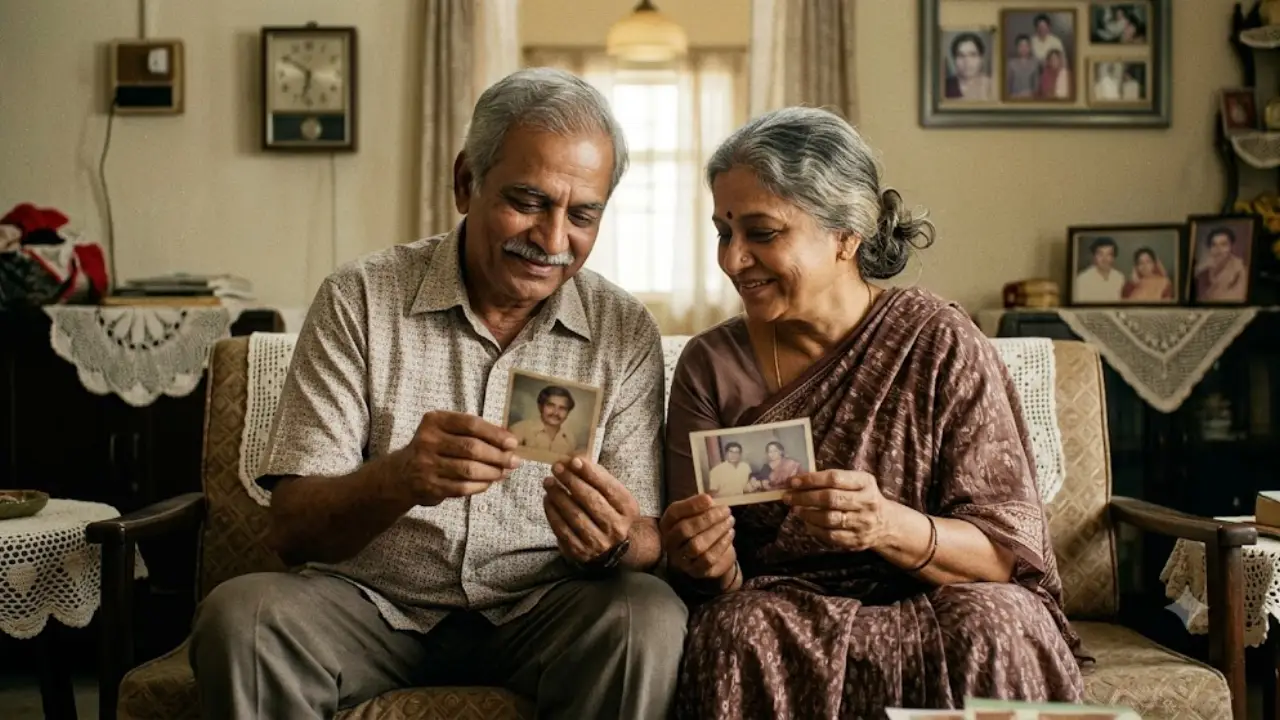
Imagine finding an old photograph in a family album.
The paper is slightly yellowed. The colours have softened with age. Someone is standing beside a scooter. A child is looking away from the camera. There is a television in the corner of the room. The lighting is imperfect, the framing is slightly awkward, and nobody appears to have been posing for Instagram.
You stare at it for a few seconds.
Something happens.
It feels real.
Then you notice something impossible.
The photograph was generated yesterday.
No camera took it. No family stood together that afternoon. No photographer waited for the right moment. The room never existed exactly as shown.
Yet your brain accepts it with surprising ease.
That is the strange power behind the current explosion of AI-generated 1980s photos. In September 2026, social media users across India and elsewhere have been turning modern photographs into imagined 1980s portraits, complete with period clothing, hairstyles, colours, backgrounds and film-like textures. The trend has spread far beyond ordinary users, with public figures joining in. Shashi Tharoor provided an especially revealing counterpoint by sharing an actual photograph from the 1980s rather than an AI recreation.
At first glance, this looks like another harmless internet trend.
It isn’t quite that simple.
The fascinating question is not why people like old-fashioned clothes.
It is why a machine can manufacture the feeling of having lived through a time you may never have experienced.
And that takes us somewhere much more interesting than nostalgia.
The 1980s Never Looked Like One Photograph
There is an important trick hidden inside the trend.
Ask an AI to create “an authentic 1980s photograph” and it does not retrieve one universal 1980s.
There was no such thing.
The 1980s looked different in Delhi, Mumbai, Kolkata, London, Tokyo and New York. They looked different in wealthy households and working-class neighbourhoods. A wedding album did not look like a school photograph. A journalist’s camera did not produce the same image as a cheap consumer camera.
The decade was messy.
AI makes it coherent.
That is part of the illusion.
It has learned that certain visual ingredients are strongly associated with “the 1980s”: particular hairstyles, clothing, colours, furniture, cars, televisions, lighting, photographic imperfections and poses.
Give the system a modern face and ask for an 1980s transformation, and it does not travel backward through time.
It constructs a statistically convincing idea of the past.
That distinction matters.
A genuine historical photograph says:
This happened.
An AI reconstruction may only be saying:
This looks like something that could have happened.
Those are radically different claims.
Why Imperfections Make AI Images More Convincing
Here is the delicious irony.
For decades, photography tried to eliminate imperfections.
Sharper lenses. Better film. Better sensors. Better autofocus. Better colour reproduction.
Now AI is deliberately putting the imperfections back.
Film grain.
Soft focus.
Uneven exposure.
Slight motion blur.
Faded colours.
Flash hotspots.
Awkward framing.
These flaws have become visual shorthand for authenticity.
A perfectly clean digital photograph screams now.
A slightly damaged-looking image whispers then.
But the machine has learned the whisper.
Current coverage of the viral trend shows exactly this formula: retro clothing, hairstyles, vintage settings and film-like textures are being used to make contemporary photographs appear decades older. Yet even trend coverage acknowledges a problem: basic prompts can introduce objects and details that did not belong in the period, making an image look like a costume rather than a genuine historical photograph.
That is the first great weakness of synthetic nostalgia.
AI can reproduce the surface grammar of an era much more easily than its historical reality.
The “Vibe Test” Is Easy. The Timeline Test Is Hard.
Look at an AI-generated 1980s photograph casually and you may think:
“Absolutely believable.”
Now inspect it like a historian.
What television is visible?
What telephone?
What car?
What type of road?
What advertising?
What logo?
What hairstyle?
What building materials?
What camera?
What clothing?
What typography?
Were these things actually available in that country at that time?
Suddenly the photograph becomes a crime scene.
The problem is that AI does not necessarily understand chronology in the way historians do.
It understands relationships between visual patterns.
So a generated photograph can combine a hairstyle strongly associated with the early 1980s, furniture associated with the 1970s, a vehicle that became common later, and a technological object from the 1990s—and make the whole thing look wonderfully nostalgic.
It is visually fluent.
Historically, it may be nonsense.
That is why the best way to judge an AI historical image is not simply:
“Does it look old?”
The better question is:
“Could all of these details have existed together in this place at this moment?”
That is the timeline test.
And it is much harder.
Why People Who Never Lived Through the 1980s Still Miss Them
This is where the psychology becomes more interesting than the technology.
A person cannot literally remember an event that happened before they were born.
But they can still feel nostalgic about it.
Researchers increasingly distinguish this phenomenon as historical nostalgia: emotional attachment to periods or experiences that are not part of someone’s own autobiographical memory.
A 2026 study in the Journal of Consumer Marketing examined historical nostalgia among young adults aged 18–24 who were too young to have personally experienced much of the twentieth century. The researchers found that media, visual cues and idealised representations of earlier periods could create emotional attachment to those eras.
That explains something peculiar about today’s retro culture.
People are not necessarily nostalgic for their own memories.
They may be nostalgic for a story they have inherited.
A parent’s photographs.
A grandparent’s stories.
Old films.
Television shows.
Music.
Fashion.
Family objects.
Instagram posts.
TikTok edits.
And now AI-generated photographs.
The past has become something you can emotionally visit without ever having lived there.
AI simply makes the visit much more personal.
Instead of watching somebody else’s 1980s story, you can put your own face inside it.
That is a profound change.
AI Has Turned Nostalgia Into Participation
Old nostalgia was mostly observational.
You watched an old film.
You found an old photograph.
You listened to an old song.
The new version is interactive.
You upload your face.
You choose the setting.
You choose the clothes.
You choose the imagined age.
You create the family photograph you never had.
You can even manufacture the photograph that history failed to preserve.
This explains why the trend spreads so quickly.
It is not merely content.
It is a template.
Everyone can participate.
And participation is social media’s favourite fuel.
Current Indian coverage shows the trend moving rapidly through Instagram and other platforms, with AI-created retro portraits being shared by ordinary users, celebrities and politicians. It has even become material for political memes and online banter.
The photograph is no longer simply something you look at.
It becomes something you perform.
The More Personal the Fake Past Becomes, the More Powerful It Feels
Consider two images.
The first shows an imaginary 1980s street in Mumbai.
Interesting.
The second shows you, aged 20, standing beside your imaginary friend outside a cinema in 1987.
Suddenly it matters.
The emotional difference comes from personalisation.
AI can attach an invented historical setting to a real identity.
And that creates something unusual:
synthetic autobiography.
You can now generate visual records of experiences you never had.
A childhood bedroom that never existed.
A graduation ceremony that never happened.
A holiday your family never took.
A photograph of yourself wearing clothes you never owned.
A family gathering involving people who were never in the same room.
None of these are necessarily harmful.
In fact, they can be playful, creative and emotionally meaningful.
But they create a new category of image that traditional photography never had to deal with.
The photograph used to be evidence first and art second.
AI reverses the relationship.
Now an image can look like evidence while being entirely imaginative.
This Is Where “Synthetic Memory” Enters the Conversation
There is an important distinction here.
AI-generated images do not automatically create false memories.
Human memory is already reconstructive, influenced by suggestion, social information and imagination. Research has demonstrated that people can develop false recollections under certain experimental conditions.
But something new is happening when a generated image gives imagination a visual anchor.
Instead of merely thinking:
“Maybe my parents looked like this when they were young,”
you can now see the image.
And images are powerful.
They give imagination a shape.
Repeated exposure can make an imagined scenario feel familiar. Familiarity, however, is not proof that something happened.
This is why a generated family photograph should never silently migrate into a family archive as though it were documentary evidence.
The danger is not that everyone will suddenly forget reality.
The danger is quieter.
The boundary between remembered, reconstructed and imagined can become visually indistinguishable.
The Most Dangerous AI Historical Image May Not Be the Obviously Fake One
A ridiculous AI image is easy.
Six fingers.
Impossible architecture.
Nonsensical text.
A car from the wrong decade.
We laugh and move on.
The difficult image is the boring one.
A normal street.
A normal family.
A normal school.
A normal office.
Nothing spectacular.
Nothing obviously wrong.
That is precisely what makes it dangerous.
An invented photograph of a famous historical event attracts scrutiny.
An invented photograph labelled “my grandfather in 1984” may not.
The emotional context becomes its credibility.
This is why professional journalism organisations increasingly treat generative AI output as unverified material rather than evidence. The Associated Press, for example, says AI-generated images depicting reality should not be used as ordinary news photographs and recommends verification of source and origin. AI-generated illustrations may be used when clearly labelled as such.
The lesson extends beyond journalism.
If the image matters, where it came from matters.
The New Three-Step Test for Historical AI Images
When an image claims to show the past, there are really three different questions.
| Test | Question | What it tells you |
| Vibe test | Does it look like the era? | Visual plausibility |
| Timeline test | Could all details coexist then? | Historical plausibility |
| Provenance test | Where did the image actually come from? | Documentary credibility |
Most social media users stop at the first.
Historians and journalists cannot.
And increasingly, neither should ordinary internet users.
Provenance May Become More Important Than AI Detection
There is another fascinating shift underway.
For years, the internet’s response to synthetic images was:
“Build a detector that tells us whether AI made this.”
That approach has obvious problems because generation technology keeps improving.
A different philosophy is emerging:
Don’t only ask whether an image looks real. Ask what happened to it.
The C2PA standard is built around this idea. Its Content Credentials system can record information about an asset’s creation and subsequent modifications in a cryptographically verifiable provenance structure. Importantly, C2PA itself warns that provenance is not the same thing as truth: it can help establish an image’s history, but it cannot by itself prove that the depicted event is factually true.
That distinction may become crucial.
Imagine a future historical archive containing four labels:
Photographed — documented original
Restored — original photograph digitally repaired
Reconstructed — AI-generated interpretation based on evidence
Speculative — imaginative visualisation
That would be far more useful than simply stamping everything “AI.”
Because not every synthetic historical image is bad.
Some may be extraordinarily useful.
AI Could Also Become a New Historical Tool
Suppose archaeologists know the dimensions of a destroyed building.
They have excavation records.
Old maps.
Written descriptions.
Fragments.
Paintings.
Photographs.
Architectural drawings.
AI could help produce a visual reconstruction.
That does not make the reconstruction a photograph.
But it could make an otherwise abstract historical explanation understandable.
Museums, educators and researchers are already exploring generative technologies for reconstructing lost heritage and creating immersive historical experiences. Research on digital museums also highlights the same fundamental problem: when evidence is incomplete, generated details can introduce historical inconsistencies and should therefore remain interpretable as reconstruction rather than fact.
So the real issue isn’t:
AI historical images: good or bad?
That is far too crude.
The better question is:
How clearly do we distinguish evidence from interpretation?
There Is Also a Copyright Question
If someone generates an 1980s portrait with an AI system, who owns it?
The answer is more complicated than “the person who wrote the prompt.”
The U.S. Copyright Office concluded in its January 2025 report that AI-assisted works can receive copyright protection where sufficient human creative expression determines the protectable elements. But merely supplying prompts to a generative AI system does not, by itself, establish the necessary human authorship.
That matters as AI nostalgia evolves from a meme into commercial photography, advertising, publishing and design.
The more humans creatively arrange, modify and control the final work, the more interesting the legal question becomes.
The machine may generate the pixels.
But copyright law still asks:
Who actually made the creative decisions?
Why the 1980s, Specifically?
Because the decade is almost perfectly engineered for digital nostalgia.
It has strong visual signals.
Large silhouettes.
Distinctive hairstyles.
Bold colours.
Analog cameras.
Physical media.
Iconic consumer electronics.
Printed advertising.
Recognisable cars.
Television culture.
And, perhaps most importantly, enough distance to feel exotic without becoming completely alien.
The 1950s are historically distant.
The 1990s are still familiar.
The 1980s sit in an unusually attractive middle zone.
They feel close enough to recognise and far enough away to romanticise.
That is exactly where nostalgia thrives.
The Real Product Is Not the Photograph
This may be the biggest insight hiding inside the trend.
People think they are generating an old photograph.
They aren’t.
They are generating a relationship with the past.
The image is simply the delivery mechanism.
For one person, it means imagining youth.
For another, childhood.
For another, a parent before adulthood.
For a younger user, it may mean experiencing a decade through borrowed cultural memory.
And for social media, it means something even simpler:
a familiar face placed inside an emotionally loaded visual world.
That is highly shareable.
The algorithm does not need you to have lived through the 1980s.
It only needs you to recognise them.
The Future May Be Full of Photographs That Never Happened
This is where the innocent retro trend becomes historically significant.
Today, someone generates an imaginary 1985 photograph because it looks cool.
Tomorrow, AI could generate an entire fictional family archive.
Then a fictional childhood.
Then a fictional town.
Then a fictional history of a real place.
Eventually, we may live in a world where the internet contains millions of images showing things that could have happened but didn’t.
That is not necessarily the end of photography.
It is the end of photography’s old monopoly on visual evidence.
The photograph once answered:
“What did this moment look like?”
AI can now answer:
“What might this moment have looked like?”
Those questions sound similar.
They are not.
And the difference may become one of the most important distinctions in the visual internet.
AI Nostalgia vs Historical Photography
| AI-generated nostalgic image | Authentic historical photograph |
| Created from learned visual patterns | Captured from a physical event |
| Can depict an invented event | Documents an actual photographic exposure |
| May combine details from different periods | Has a specific historical context |
| Can personalise the past | Records what the camera encountered |
| Useful for interpretation and imagination | Useful as primary visual evidence |
| Should be labelled as generated/reconstructed | Still requires provenance and contextual verification |
| Can look authentic without being authentic | Authenticity depends on origin and evidence |
Neither is inherently more valuable in every situation.
A historian may need the original photograph.
A teacher may benefit from a carefully labelled reconstruction.
An artist may want the impossible image.
A journalist needs evidence.
The mistake is not generating the image.
The mistake is allowing the viewer to confuse the purpose of the image.
The 1980s AI Trend Is Really a Test of How We Understand Reality
That is why this seemingly silly internet fashion is more interesting than it first appears.
We are entering an era in which visual realism is becoming cheap.
A convincing photograph is no longer necessarily evidence that something happened.
It may simply be evidence that an AI model has become very good at predicting what something should look like.
That changes the psychology of images.
It changes journalism.
It changes archives.
It changes education.
It changes family history.
It changes advertising.
And eventually, it may change memory itself not because machines can simply rewrite everyone’s minds, but because the visual material surrounding our memories is becoming increasingly synthetic.
Perhaps that is why an actual old photograph suddenly feels so precious.
It contains something AI cannot manufacture merely by copying the appearance of age:
a real moment that once existed.
The most remarkable thing about the current 1980s trend, then, is not that AI can make you look younger.
It is that AI can make you look as though you once lived a life you never lived.
And if we are not careful, the question of the future may no longer be:
“Is this photograph old?”
It may be:
“Did this moment ever happen?”
Key Unfoldings
AI can reproduce the visual language of the 1980s without reproducing its historical reality.
Film grain, faded colour and imperfect framing can create a powerful illusion of authenticity.
Younger people can experience genuine historical nostalgia for periods they never personally lived through.
The most convincing AI historical images can be more problematic than obviously fake ones.
A realistic appearance is not historical evidence.
Provenance systems such as C2PA may become increasingly important for establishing how digital images were created and modified.
AI reconstructions can be valuable in education, museums and historical interpretation when clearly identified as reconstructions.
For serious historical claims, viewers should examine the image’s visual plausibility, chronological plausibility and provenance.
The deeper cultural shift is from nostalgia based on memory to nostalgia based on simulation.
The best AI-generated 1980s photograph may be the one that makes you pause and wonder whether you have seen it before. The important question is what you do after that feeling arrives.
Because nostalgia says, “I remember this.”
History asks, “Can you prove it?”
FAQs
Can AI really create convincing 1980s photographs?
Yes. Current image-generation systems can transform modern photographs into highly convincing retro scenes using period-specific clothing, environments, lighting and photographic characteristics.
Why do AI-generated old photographs feel authentic?
Because they reproduce many of the visual signals people associate with older photography, including grain, colour shifts, soft focus, flash and imperfect framing.
Can someone be nostalgic for a decade they never lived through?
Yes. Researchers describe this as historical nostalgia: emotional attachment to periods outside a person’s direct autobiographical experience.
Are AI-generated historical images fake photographs?
If they are presented as photographs of events that never happened, they are fabricated representations rather than documentary photographs. They can still have legitimate artistic or educational uses when properly labelled.
Can C2PA prove that an image is true?
No. C2PA can provide verifiable provenance information about an asset’s creation and modifications, but provenance alone cannot establish whether the depicted event itself is factually true.
Can an AI-generated image be copyrighted?
Potentially, depending on the amount and nature of human creative contribution. The U.S. Copyright Office has stated that prompts alone generally do not provide sufficient human authorship, while meaningful human creative expression may be protectable.
Sources and Further Reading
- U.S. Copyright Office — Copyright and Artificial Intelligence
- C2PA — Content Credentials and Provenance Standards
- Associated Press — Standards Around Generative AI
- Journal of Consumer Marketing — Historical Nostalgia Among Young Consumers








Leave a Reply