
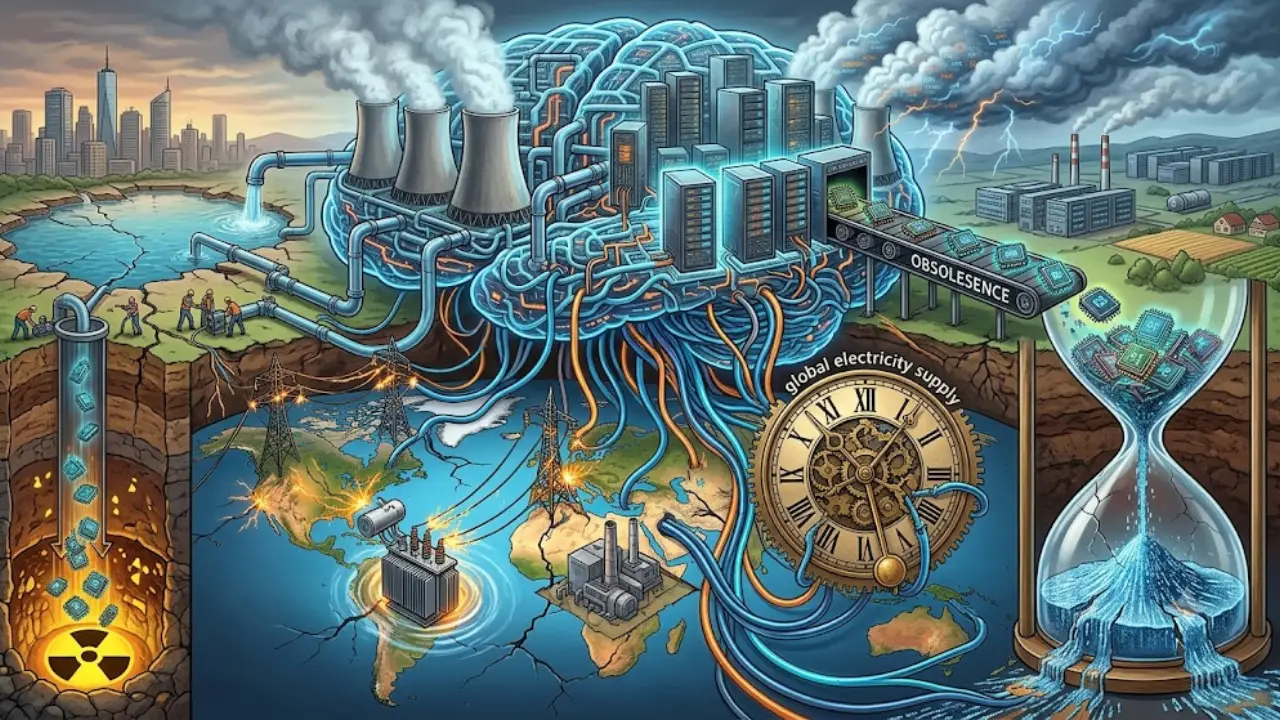
The machine that looks like software
Imagine asking an AI model a question.
A sentence appears.
Instantly.
No factory opens. No truck moves. No chimney smokes. Nothing seems to happen except a few words appearing on a screen.
That is the illusion.
Somewhere else, perhaps hundreds or thousands of kilometres away, machines are working inside a building that may consume as much electricity as a small city.
There are processors.
Cooling systems.
Backup power.
Transformers.
Transmission lines.
Fibre connections.
Water systems.
Land.
Engineers.
And increasingly, enormous amounts of money.
The strange thing about artificial intelligence is therefore not simply that it is becoming powerful.
It is that one of the most weightless technologies ever invented is creating an increasingly physical economy.
That is the story behind the numbers.
And the numbers have changed quickly.
The International Energy Agency estimates that global data-centre electricity consumption reached about 485 TWh in 2025, up 17% in one year. Electricity consumption from AI-focused data centres rose even faster, by about 50%. The IEA now expects total data-centre electricity consumption to approach 950 TWh by 2030, roughly double the 2025 level and about 3% of global electricity demand.
But that headline hides the more interesting question:
If AI is becoming dramatically more energy-efficient, why is its electricity demand still rising?
The answer is where the real story begins.
The AI energy paradox
There are two apparently contradictory facts.
Fact one: AI is becoming much more efficient.
The IEA says energy consumption per AI task has fallen by at least an order of magnitude annually in recent years. A simple text-based AI query can now use less electricity than running a television for the same period.
Fact two: the electricity consumed by AI infrastructure is rising rapidly.
AI-focused data-centre electricity use grew about 50% in 2025.
These statements are not contradictory.
They describe a classic efficiency problem.
If each task becomes cheaper, people tend to perform more tasks.
A faster car can encourage more driving.
A cheaper flight can create more travel.
A more efficient computer can encourage more computing.
AI may be following the same pattern.
And the next generation of AI is not limited to answering questions.
It is increasingly being used for reasoning, image generation, video generation, coding and autonomous or “agentic” tasks.
Those workloads can be dramatically more demanding.
The IEA estimates that some video-generation, reasoning and agentic applications can consume hundreds or even thousands of times more energy per task than simple text generation.
So the important measurement is not:
“How much electricity does one AI question use?”
It is:
How much computation will humanity decide is worth doing because computation has become cheap?
That is a much harder question.
The global number is enormous but the local number matters more
Around 950 TWh sounds frightening.
But there is an important piece of context.
The IEA expects data centres to represent around 3% of global electricity consumption by 2030. That means AI and data centres are not going to consume most of the world’s electricity. Industry, buildings, transport, cooling and other sectors remain larger sources of demand.
So why are governments and utilities worried?
Because electricity grids do not operate as one giant global swimming pool.
Electricity must be generated and delivered where and when it is required.
A data centre cannot simply say:
“Don’t worry, there is enough electricity somewhere on Earth.”
A 500-MW facility needs power near its physical location.
That changes everything.
The IEA notes that data centres accounted for a relatively modest share of global electricity demand growth, but their consumption is unusually concentrated geographically. Nearly half of US data-centre capacity is concentrated in five regional clusters.
This produces the great AI-energy paradox:
Globally, the problem may look manageable. Locally, it can become enormous.
A country can have plenty of electricity while a particular city, transmission corridor or substation does not have enough capacity for another giant data centre.
That distinction is increasingly shaping the industry.
A data centre is becoming an industrial facility
The old image of a data centre was a warehouse full of computers.
AI is changing that.
Modern AI facilities increasingly resemble industrial power consumers.
The IEA estimates that servers account for around 60% of electricity use in modern data centres, with cooling and other infrastructure making up much of the remainder.
But power density is changing even faster.
Between 2020 and 2025, the power density of AI servers increased roughly 11-fold, according to the IEA. By 2027, the power density of AI servers is expected to rise another fourfold. An advanced server rack could have peak power demand equivalent to around 65 households.
That means the problem is no longer simply:
“How much electricity does a building consume?”
It becomes:
Can the electrical equipment physically deliver that much power to thousands of machines simultaneously?
Transformers matter.
Switchgear matters.
Transmission lines matter.
Substations matter.
Backup generation matters.
Cooling matters.
Even the shape of the electricity demand matters.
AI workloads can produce rapid changes in power consumption, making storage and sophisticated grid management increasingly important. The IEA estimates that 20–25 GW of battery storage could potentially be installed at data centres globally by 2030, potentially allowing some facilities to become grid assets rather than merely grid consumers.
That is an intriguing possibility.
The AI data centre of the future might not simply take electricity from the grid.
It could sometimes help manage it.
The world’s newest AI bottleneck may be something very old
Not chips.
Not algorithms.
Transformers.
The AI boom is running into the physical speed of infrastructure.
The IEA identifies bottlenecks involving transformers, gas turbines, advanced chips, IT components, grid connections and planning systems.
This creates a peculiar mismatch.
A technology company can announce a new AI campus quickly.
But a transmission project may take years.
A new power plant takes time.
A substation takes time.
Environmental approvals take time.
Land acquisition takes time.
Supply chains take time.
Electricity infrastructure therefore operates on a different clock from software.
Software thinks in months.
Electricity infrastructure often thinks in years.
That difference may become one of the defining constraints of the AI boom.
The IEA estimates that around 20% of planned data-centre projects could face delays if grid constraints are not addressed.
Britain offers a revealing example.
Ofgem reported in July 2026 that demand-connection applications had surged from 41 GW to 125 GW in less than a year, with data centres accounting for at least 80 GW of that demand. The regulator proposed new measures partly because speculative projects could occupy scarce connection capacity.
The queue itself had become a problem.
That is an extraordinary sentence for an industry built around speed.
The geography of AI is becoming the geography of electricity
The next AI map will not simply show where companies have offices.
It will show:
power + fibre + land + cooling + chips + capital + regulation.
That is why the location of a data centre matters so much.
A region may offer cheap land but weak transmission.
Another may offer abundant electricity but expensive fibre connections.
Another may have renewable energy but inadequate water infrastructure.
Another may have excellent connectivity but severe planning restrictions.
The best location is therefore not necessarily the place with the cheapest electricity.
It is the place where several infrastructure systems intersect.
A recent Nature study illustrates this concentration. Researchers estimate that AI-oriented data-centre electricity consumption could rise from around 118 TWh in 2024 to 239–295 TWh by 2030 in their scenarios, with more than 90% of projected computing capacity concentrated across North America, Western Europe and Asia-Pacific.
That concentration matters because a national average can hide a regional emergency.
A gigawatt added to a huge electricity system is one thing.
A gigawatt added to a smaller regional grid is something else entirely.
This is why the future of AI may increasingly be decided by geography.
Then there is water
Electricity is the obvious resource.
Water is the quieter one.
Computers produce heat.
Heat has to go somewhere.
Depending on the cooling technology and local conditions, data centres can require water directly or indirectly.
India’s government has explicitly acknowledged that water requirements depend on the cooling technology used. It cites technologies including direct-to-chip liquid cooling, adiabatic cooling, immersion cooling and closed-loop systems as the industry moves toward higher-density computing.
This is important because there is no universal answer called “water-efficient data centre.”
A cooling technology can reduce water consumption but increase electricity consumption, or change the carbon footprint of the facility.
A 2026 review in Nature Reviews Clean Technology highlights precisely this trade-off: reducing water use can sometimes increase carbon emissions, meaning that energy, water and emissions cannot always be optimised independently.
That is a much more useful way to discuss the issue than simply declaring:
“AI wastes water.”
The real question is:
What combination of electricity, water and cooling produces the lowest overall local and system-wide cost?
There may not be one universal answer.
India: the AI infrastructure story is already here
India is particularly interesting because its electricity system is growing rapidly even without AI.
The IEA expects India’s electricity demand to grow by an average 6.4% annually through 2030, adding more than 570 TWh to annual consumption over five years. Industry is expected to contribute about one-third of this increase, while cooling alone is expected to account for more than 20% of demand growth.
AI is therefore arriving in a country that already needs enormous amounts of additional electricity.
And the data-centre industry is expanding quickly.
Government figures show India’s installed data-centre capacity rising from about 375 MW in 2020 to 1.57 GW by August 2026, with nearly 8 GW projected by 2030.
The Central Electricity Authority estimates that data centres could require around 17 GW of power by 2031–32.
That is not a trivial addition.
It is also important to avoid a common mistake: comparing 17 GW directly with India’s entire annual electricity consumption.
GW measures power capacity. TWh measures energy consumed over time.
They are related, but they are not interchangeable.
That distinction matters enormously when discussing AI infrastructure.
India’s second problem is timing
India’s electricity challenge is not simply how much power it produces.
It is when the power is needed.
The country is adding large quantities of solar generation, but electricity demand does not disappear when the sun goes down.
The IEA notes that India’s summer net load can remain very high through the night. On 21 May 2026, peak electricity demand reached about 270 GW, while cooling can account for as much as one-third of electricity consumption during hot summer nights.
Now place a giant AI facility into that system.
It does not politely switch off at sunset.
AI workloads can run around the clock.
That makes storage, firm generation, transmission and demand management increasingly important.
It also explains why India’s data-centre debate cannot be separated from the country’s wider electricity transition.
Solar matters.
Storage matters.
Transmission matters.
Gas may matter.
Hydropower matters.
Nuclear may matter.
Efficiency matters.
And the location of demand matters.
There is no single magic technology.
The Andhra Pradesh question: what happens when AI meets a village?
The infrastructure debate becomes much more tangible when a giant data centre arrives in a real landscape.
Recent reporting from Andhra Pradesh illustrates the scale of the conflict surrounding a proposed Google-linked hyperscale AI development near Visakhapatnam. The Guardian reported that environmental clearances associated with the project allow a capacity of about 2.51 GW, while local residents and activists have raised concerns over land, water, heat and environmental impacts. Google and government authorities have disputed or rejected several of those concerns. Legal challenges have also been reported.
This is exactly where simplistic AI-energy stories fail.
The question is not simply:
“Is AI good or bad?”
It is:
Who receives the economic benefits, who provides the land and infrastructure, who pays for the grid expansion, and who bears the local environmental costs?
Those are infrastructure questions.
They cannot be answered by an algorithm.
The hidden financial problem
There is another layer that receives less attention.
AI infrastructure is extraordinarily expensive.
The IEA says capital expenditure by five major technology companies exceeded $400 billion in 2025 and was expected to rise by another 75% in 2026.
That means the AI infrastructure boom is increasingly connected to financial markets.
A data centre is not merely a building.
It may require billions of dollars in:
land
buildings
GPUs
networking equipment
transformers
power infrastructure
cooling systems
transmission connections
backup systems
fibre networks
And increasingly, these projects depend on long-term contracts and external financing.
The recent Oracle dispute surrounding the Project Jupiter data centre in New Mexico illustrates the vulnerability. Reuters reported that power delays became significant enough for Oracle to invoke a contractual force-majeure provision, highlighting how infrastructure delays can become financing problems.
This introduces an uncomfortable possibility.
The AI boom does not require only enough electricity.
It requires investors to believe that future AI revenues will justify today’s enormous infrastructure bills.
If that assumption weakens, projects can be delayed, redesigned or cancelled.
The energy story is therefore also an economic story.
What the headlines often miss
A useful way to understand the subject is to separate three different questions.
| Question | What the evidence says |
| Is AI becoming more energy-efficient? | Yes. Energy per AI task has fallen dramatically. |
| Is total AI/data-centre electricity use rising? | Yes. Rapidly. |
| Will AI consume most of the world’s electricity? | No. Even the IEA’s 2030 projection puts data centres at about 3% of global electricity demand. |
| Can AI still create serious local grid problems? | Yes. Concentrated loads can be much harder to accommodate. |
| Is water automatically the biggest problem? | No. Impacts depend heavily on cooling technology and location. |
| Can renewable energy solve everything? | Not by itself. Timing, transmission, storage and firm capacity still matter. |
| Could AI help the energy system? | Potentially. AI can improve forecasting, optimisation and grid management. |
| Is the future projection certain? | No. AI adoption, efficiency, financing and infrastructure bottlenecks remain uncertain. |
That last point deserves emphasis.
Forecasts are not facts.
The IEA’s current central projection is around 950 TWh by 2030, but it explicitly notes that efficiency improvements, AI adoption and infrastructure bottlenecks could push the trajectory higher or lower.
A September 2026 Nature Communications Sustainability study similarly produces a range rather than a single inevitable future.
The responsible conclusion is therefore not:
“AI will consume X electricity.”
It is:
Here is the range of plausible demand, here are the physical constraints, and here are the variables that could move the outcome.
The strange possibility: AI could become part of the solution
There is an irony hiding underneath the energy problem.
AI consumes electricity.
But AI can also help electricity systems operate more intelligently.
Better forecasting can help utilities predict renewable generation.
Better demand forecasting can improve grid planning.
AI can potentially optimise industrial processes, building energy use, storage and electricity dispatch.
The question is whether those efficiency gains are large enough to offset the additional demand created by AI itself.
That remains an empirical question.
And it should be tested sector by sector rather than turned into a slogan.
What the next five years will actually tell us
Forget the grand predictions for a moment.
Watch these indicators.
1. Data-centre electricity demand
Does global demand continue toward the IEA’s roughly 950-TWh 2030 trajectory?
2. AI workload intensity
Do users mostly perform cheap text tasks, or does reasoning, video and agentic AI become dominant?
3. Power density
How quickly do GPU racks become more demanding?
4. Grid connection times
Do electricity networks begin connecting projects faster, or do queues become a structural constraint?
5. Storage
Do data centres become flexible electricity consumers equipped with batteries?
6. Cooling
Does liquid cooling materially reduce water and energy requirements?
7. Location
Do companies increasingly move AI campuses toward places with abundant power rather than simply cheap land?
8. Financing
Can the expected economic value of AI justify the enormous infrastructure investment?
9. Local regulation
Will governments demand more transparency over electricity, water, land and infrastructure costs?
10. India
Can India expand AI infrastructure while simultaneously meeting rapidly rising demand from industry, households, transport and cooling?
Those questions will tell us far more than another viral infographic showing the electricity used by one chatbot query.
The real AI race is not between chatbots
For years, the AI race was described as a competition between models.
Who has the best model?
Who has the most GPUs?
Who releases the next breakthrough?
That description is becoming incomplete.
The deeper competition is increasingly about infrastructure.
Who can secure electricity?
Who can build transmission?
Who can obtain transformers?
Who can cool high-density computing?
Who can finance gigantic facilities?
Who can secure land?
Who can obtain planning permission?
Who can connect quickly?
Who can do all of this without creating unacceptable costs for everyone around the facility?
That changes the meaning of technological power.
The future may belong not simply to whoever invents the smartest algorithm, but to whoever can build the physical system that allows millions of people to use it.
And that system is remarkably old-fashioned.
It needs wires.
It needs machines.
It needs concrete.
It needs water.
It needs engineers.
It needs money.
It needs time.
The final enigma
AI looks like the ultimate dematerialization of human work.
Ask a question and receive an answer.
Generate an image without a camera.
Write software without sitting in a library.
Translate a language without a dictionary.
Everything happens inside a screen.
But behind that screen is an increasingly enormous physical machine.
The global data-centre industry consumed roughly 485 TWh of electricity in 2025. The IEA expects that figure to approach 950 TWh by 2030.
At the same time, individual AI tasks are becoming dramatically more efficient.
Both things can be true.
That is the part worth remembering.
The AI energy debate should therefore move beyond two equally lazy stories:
“AI is going to destroy the planet.”
and
“AI is becoming efficient, so there is nothing to worry about.”
Neither captures the real problem.
The interesting question is somewhere between them.
Can human infrastructure expand faster than human demand for computation?
If the answer is yes, AI could become one of the most productive technologies ever deployed.
If the answer is no, the bottleneck may not be intelligence at all.
It may be the humble transformer sitting outside the data centre.
And that would be a wonderfully human ending to the most futuristic technological revolution we have ever built.
Key Unfoldings
Global data-centre electricity consumption reached about 485 TWh in 2025 and is projected by the IEA to approach 950 TWh by 2030.
AI-focused data-centre electricity use grew about 50% in 2025.
Energy use per individual AI task is falling rapidly, but total demand is rising because usage and computational intensity are expanding.
Local grid pressure can be much greater than the global percentage suggests.
India expects electricity demand to grow about 6.4% annually through 2030.
India’s data-centre capacity reached about 1.57 GW in August 2026, with nearly 8 GW projected by 2030.
India’s Central Electricity Authority estimates data-centre power demand could reach around 17 GW by 2031–32.
Cooling, water, transmission, storage and land are becoming as important as computing hardware.
AI’s environmental impact cannot be reduced to a single number because electricity, water, carbon and embodied emissions can move in different directions.
The future of AI is therefore partly a question of algorithms but increasingly, it is a question of infrastructure.
Frequently Asked Questions
Will AI consume most of the world’s electricity?
No. The IEA’s current central projection puts total data-centre electricity consumption at around 3% of global electricity demand by 2030. The bigger concern is the concentration of that demand in particular regions.
Does every AI query consume a huge amount of electricity?
No. Simple text queries can use relatively little electricity, and efficiency has improved rapidly. More complex reasoning, video-generation and agentic workloads can be dramatically more energy-intensive.
Why does AI still increase electricity demand if AI becomes more efficient?
Because efficiency reduces the energy required per task while increasing the number and complexity of tasks that become economically attractive.
Is India prepared for AI’s electricity demand?
India is expanding generation, transmission, storage and data-centre infrastructure, but electricity demand is simultaneously growing rapidly because of industrialisation, cooling, agriculture, transport and wider electrification. The scale of future AI demand therefore has to be considered alongside these existing needs.
Are data centres bad for the environment?
That question is too broad to have one useful answer. Their impact depends on electricity sources, cooling systems, water availability, construction materials, hardware, location and operating practices. Some impacts can also trade off against each other.
Authentic sources and further reading
- International Energy Agency — Key Questions on Energy and AI (2026) — the principal source for the latest global AI/data-centre electricity estimates and efficiency analysis.
- International Energy Agency — Energy and AI (2025) — detailed baseline data on data-centre electricity, servers, cooling and regional demand.
- International Energy Agency — Electricity 2026 — India’s electricity-demand outlook and wider global electricity trends.
- Government of India / PIB — Data Centres in India Infrastructure for the Digital Age — current Indian capacity and investment figures.
- Ministry of Electronics & IT / PIB — Sustainable Growth of Data Centres — Indian electricity, cooling, water-efficiency and standards information.
- Nature Communications Sustainability — Artificial intelligence data centers could reach one percent of global electricity demand by 2030 — recent peer-reviewed scenario analysis.
- Nature Reviews Clean Technology — Strategies and design for increasing AI sustainability — analysis of energy, water, carbon and hardware trade-offs.
- Ofgem — Data-centre grid connection reforms — evidence of the growing grid-connection bottleneck in Britain.
. Related reading on THE UNFOLDED SHELF
Hidden Geography of Power: How Small Places Stop the World — why infrastructure chokepoints can matter more than national size.
India’s Reservoirs After the Monsoon: Why Rain Does Not Always Become Water Security — useful background on the relationship between infrastructure, water and resource security.








Leave a Reply