
The Face in the Wall
There is a face looking at you.
It is probably not a person.
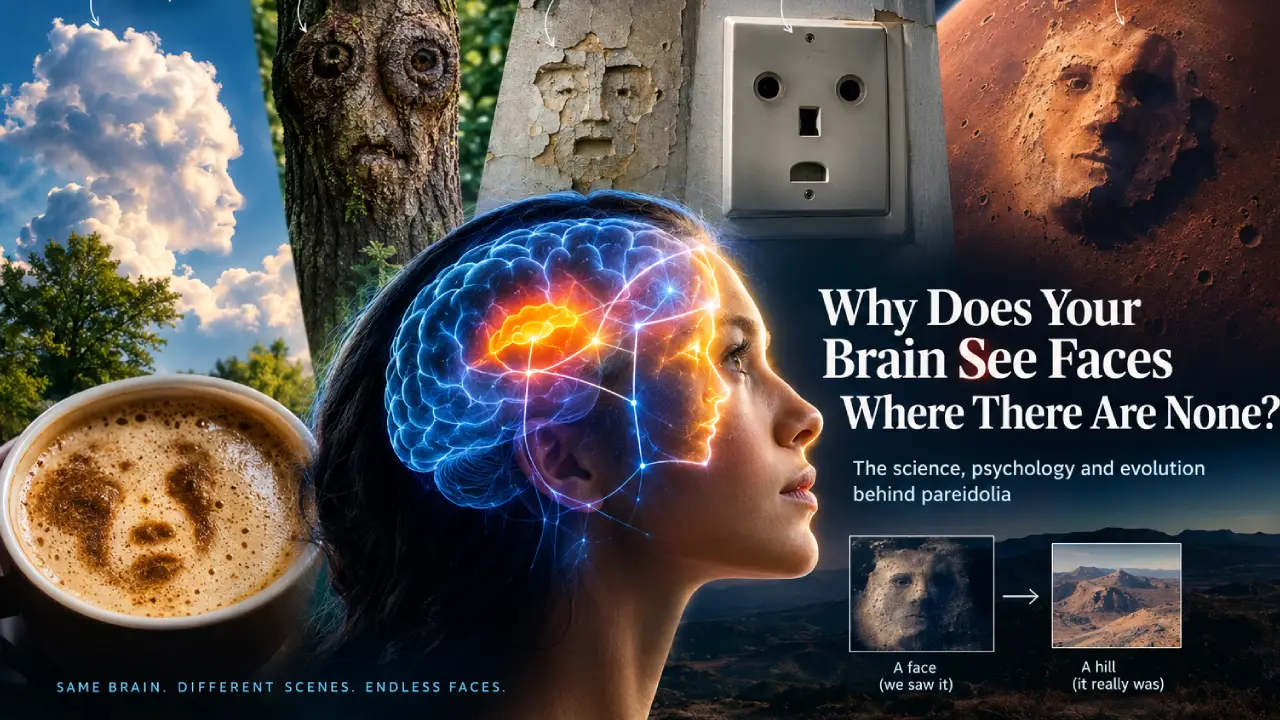
Perhaps it is the electrical socket beside your desk: two dark holes for eyes, a small switch beneath them, and a rectangular “head” surrounding everything.
Or perhaps it is a cloud.
Yesterday it looked like nothing. Today it looks unmistakably like an old man.
A tree trunk may have two knots that resemble eyes. A patch of peeling paint may acquire a crooked smile. A coffee foam may briefly become an animal. And if you stare at certain photographs of Mars, a rocky hill can look disturbingly like a human face.
The strange part is not that these objects resemble faces.
The strange part is how quickly the resemblance becomes meaningful.
You do not consciously measure the distance between the “eyes.” You do not calculate whether the “mouth” is anatomically plausible. Your brain simply announces:
Face.
Then, a fraction later, another part of your mind catches up:
Wait. That’s a socket.
This ordinary little mistake has a scientific name: pareidolia.
And face pareidolia turns out to be much more than a curiosity. It offers a rare glimpse into how the brain sees the world not as a passive camera, but as an extraordinarily fast prediction machine.
Pareidolia: When Meaning Appears Where None Was Intended
Pareidolia occurs when the brain perceives a recognizable pattern or meaningful object in an ambiguous stimulus.
A face in a cloud is the classic example.
But faces are special.
Humans are extraordinarily sensitive to them because faces carry enormous amounts of social information. A face can tell us who someone is, where they are looking, whether they appear friendly or angry, and whether they are paying attention to us.
So the visual system has evolved and developed mechanisms that give faces unusually rapid processing.
That creates an interesting trade-off.
A system designed to detect faces quickly does not necessarily wait for perfect evidence.
It can sometimes say:
“That might be a face.”
before it has enough information to say:
“That is definitely a face.”
That difference is the doorway into pareidolia.
Your Brain Does Not Simply “See” the World
We tend to imagine vision as a simple chain:
Eyes → image → brain → perception.
Reality is messier.
Light reaches the retina. Neural signals are extracted from that information. The brain then combines sensory evidence with previously learned patterns, context and expectations.
In other words, perception involves interpretation.
Imagine walking through a forest at dusk.
Something moves behind a bush.
You cannot see enough to identify it.
Your brain nevertheless has to make a decision.
Is it:
a person?
an animal?
a branch?
nothing?
Waiting for perfect information is not always practical.
The visual system therefore works with probabilities.
And that creates a fundamental possibility:
A brain that is very good at finding meaningful patterns will occasionally find one that isn’t actually there.
Pareidolia is one of those false positives.
Why Faces Beat Almost Everything Else
You do not usually look at a random wall and immediately see a detailed bicycle.
But faces appear everywhere.
Why?
Because the visual system is particularly sensitive to facial configurations.
A crude arrangement such as:
● ●
** —**
can be enough.
There is no nose.
There are no real eyes.
There is no mouth.
Yet the arrangement activates a familiar interpretation.
This is why an electrical socket can look like a little creature.
The two holes supply something eye-like. A switch, screw or lower opening can provide another facial feature. The surrounding geometry supplies a rough boundary.
The socket itself has done nothing.
Your brain has supplied the missing structure.
And recent neuroscience suggests that this is not merely a poetic way of describing what happens.
It is literally reflected in brain activity.
The 2025 Brain Experiment That Changed the Story
One of the most revealing recent studies was published in Imaging Neuroscience in 2025.
Researchers studied 44 people undergoing clinical monitoring with intracerebral electrodes. Across those participants, researchers examined 2,695 recording contacts in the ventral occipito-temporal cortex, an area deeply involved in visual recognition.
They identified 773 contacts with category-selective responses.
Of those:
591 contacts (76.5%) responded selectively to human faces;
162 contacts (20.9%) responded to both human faces and face-like objects;
20 contacts (2.6%) responded selectively to face-like objects.
But one number is particularly striking.
Among the contacts that responded selectively to face-like objects, 89% also responded to real human faces.
That does not mean your brain literally believes a socket is a human being.
The responses to genuine faces were substantially stronger.
Instead, the finding suggests something subtler:
The brain’s machinery for processing real faces is also recruited when an ordinary object contains enough facial structure to trigger face perception.
In other words, the “face” in the socket is not merely an intellectual joke.
Something real is happening inside the visual system.
And the Brain Does It Very Quickly
Earlier electrophysiological research had already shown that face-like objects can trigger rapid neural responses.
One study reported face-like neural activity with stimuli presented for as little as 17 milliseconds.
Seventeen milliseconds is almost absurdly fast from the perspective of conscious experience.
You are not sitting there thinking:
“Let me carefully inspect this pattern and determine whether the arrangement satisfies the minimum conditions for faciality.”
Your visual system is already working before conscious reasoning enters the conversation.
This helps explain a familiar experience.
You walk past something.
You see a face.
You look again.
It is a pipe fitting.
The conscious correction is slower than the initial impression.
The brain has already made its guess.
The Face on Mars: When a Guess Became a Story
Few examples demonstrate this better than the famous Face on Mars.
In 1976, NASA’s Viking spacecraft photographed a mesa in the Cydonia region of Mars.
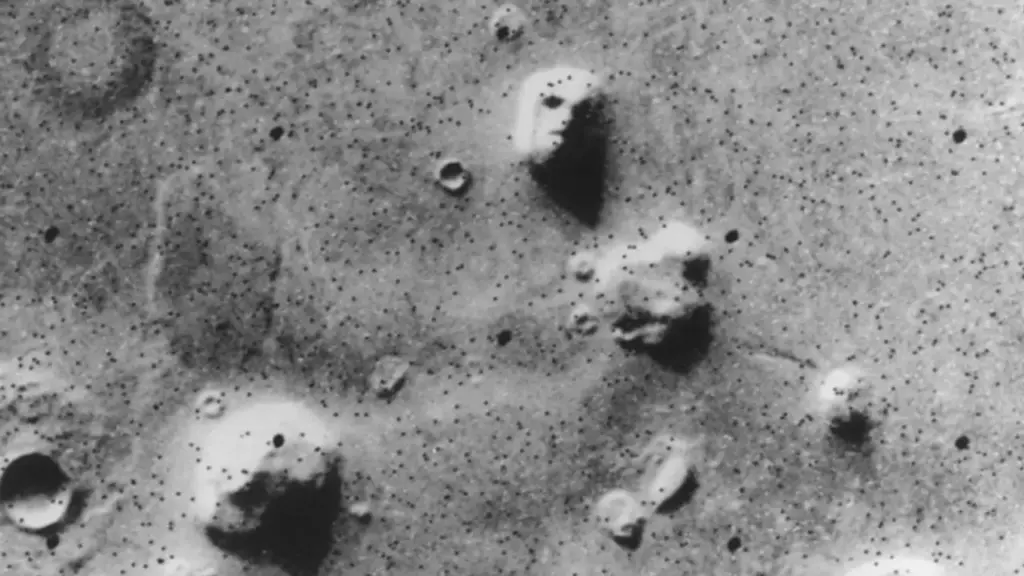
Under the particular lighting conditions and resolution of the image, the formation appeared to have:
two dark eye-like areas,
a nose-like ridge,
and a mouth-like shadow.
Humans did what humans do remarkably well.
We recognized a face.
Then came the stories.
Some people suggested that the formation might be artificial. Others connected it to hypothetical ancient civilizations.
But there was a problem with the argument.
The evidence consisted largely of one low-resolution image viewed under a particular combination of lighting and angle.
NASA later obtained a much sharper image using the Mars Global Surveyor’s Mars Orbiter Camera.
The resolution was approximately 4.3 metres per pixel about ten times better than the best previous Viking image.
The monument became a hill.
The eyes became slopes.
The mouth became a shadow.
The mystery became geology.
NASA’s later analysis found that the Cydonia region contains numerous eroded knobs and mesas with similarly varied shapes. The feature popularly called the “face” is a roughly 3-kilometre-long geological formation shaped by erosion and gravity.
That is an important lesson.
Better evidence did not reveal the face more clearly. It revealed why there had never been a face to begin with.
Why Mars Was So Convincing
The Mars example also exposes a psychological trap.
Once someone tells you:
“Look at this. It looks like a face.”
you no longer inspect the image neutrally.
Your brain searches for facial evidence.
This is a broader feature of human perception: expectations can influence what we notice and how ambiguous information is interpreted.
The effect is particularly powerful when the stimulus is:
low resolution,
poorly illuminated,
partially obscured,
irregular,
or visually noisy.
Mars supplied almost the perfect laboratory.
The original photograph contained just enough information to support a facial interpretation but not enough detail to immediately destroy it.
The brain filled the gap.
Why Clouds Are Perfect Face Factories
Clouds are even better.
They contain enormous numbers of irregular edges and constantly changing shapes.
That gives the visual system plenty of opportunities to discover accidental configurations.
A cloud can become:
a face,
a dragon,
a dog,
a ship,
a mountain,
or a cartoon character.
But the interpretation changes when the cloud moves.
That is the clue.
The cloud has not become a dragon.
Your brain has found a temporary pattern in moving information.
This is why pareidolia is not evidence that the object itself contains a hidden meaning.
It is evidence that the observer’s visual system is exceptionally good at extracting structure from ambiguity.
The Evolutionary Explanation Useful, but Not the Whole Story
A popular explanation says that humans evolved to detect faces because missing a person or a predator could have been costly.
Imagine an ancestral human seeing a vaguely human shape in the darkness.
If the brain mistakenly interprets a tree as a person, the cost may be a few seconds of caution.
If it interprets a person or dangerous animal as a tree, the consequences could be much worse.
This is an example of a signal-detection problem.
But there is an important scientific caution here.
It is tempting to tell the story as though evolution deliberately installed a “better safe than sorry” face detector.
The evidence is not that simple.
Face pareidolia may be partly related to evolutionary pressures, but current research suggests that it can emerge naturally from the way a visual system learns to recognize both faces and objects.
That distinction matters.
The 2025 AI Experiment Offers a Surprising Alternative
A 2025 PLOS Computational Biology study approached the problem from an entirely different direction.
Researchers trained deep convolutional neural networks on different combinations of face-recognition and object-recognition tasks.
The networks were not specifically trained to recognize pareidolic faces.
Yet human-like face pareidolia emerged under particular combinations of training objectives.
The most interesting result came from a network trained for both:
face identification + object categorization.
That system developed representations that resembled human responses to pareidolic images.
Interpretability analysis also found that the network could rely on facial features such as eyes and mouths when classifying face-like objects.
This suggests an intriguing possibility.
Perhaps the brain does not need a special “pareidolia module.”
Perhaps pareidolia is what happens when you build a system that is extremely good at recognizing faces while simultaneously navigating a world full of objects.
The false positives may be a side effect of the success.
The Machine and the Human Make a Similar Mistake
This is where pareidolia suddenly becomes a story about artificial intelligence.
Imagine building a machine whose job is to recognize faces.
You train it on millions of examples.
Eventually it becomes extraordinarily sensitive to facial features.
Now show it an object containing two dark spots and a curved line.
If the machine has learned that certain arrangements strongly predict faces, it may produce a false positive.
That does not mean the machine is “seeing” exactly as a human does.
But the computational parallel is revealing.
Pattern recognition creates both recognition and error.
You cannot make a system exquisitely sensitive to meaningful patterns without confronting the possibility that meaningless patterns will sometimes cross its detection threshold.
Humans did not invent this problem.
We are one of its most sophisticated examples.
But Is Pareidolia Really an Evolutionary Accident?
Here the story becomes more interesting than the usual internet explanation.
There are at least three plausible layers.
1. Evolution gave faces unusual importance
Humans depend heavily on social interaction.
Faces carry information about individuals and social states.
That provides a strong reason for highly sensitive face-processing systems.
2. Development fine-tunes the system
Face perception is not simply a switch that appears fully formed at birth.
Research in infants suggests that sensitivity to face-like arrangements develops during the first year of life.
This indicates an interaction between early biological predispositions and developing visual experience.
3. Pattern recognition inevitably creates false positives
Even an excellent classifier operates with imperfect information.
If the threshold for detecting a face is sufficiently sensitive, some non-faces will cross it.
The three explanations are not mutually exclusive.
Evolution may create the architecture.
Development may tune it.
Experience may shape it.
And ambiguous environments may supply endless opportunities for mistakes.
The Most Important Distinction: Seeing Is Not Believing
Here is where popular explanations of pareidolia often go wrong.
Seeing a face in a tree does not mean you genuinely believe the tree contains a human face.
Most people immediately know the difference.
You can simultaneously experience:
“That looks exactly like a face.”
and
“Obviously it isn’t a face.”
That distinction is central.
Pareidolia is generally a perceptual experience, not a failure of reality testing.
Your visual system produces an interpretation, while your higher-level reasoning can reject that interpretation as literally false.
In fact, the ability to notice the illusion may reveal how flexible perception is.
Why Some Faces Feel More “Real” Than Others
Not every accidental face produces the same reaction.
A few dots may look vaguely face-like.
But a pattern with:
two horizontally aligned eyes,
a central nose,
a mouth-like horizontal line,
approximate symmetry,
and a head-like boundary
can feel astonishingly convincing.
This is because facial perception is not based simply on the presence of individual features.
Relationships matter.
The arrangement of features can be more informative than the features themselves.
Two holes are not enough.
Two holes positioned like eyes are different.
Add a mouth.
Now the interpretation becomes stronger.
Add symmetry.
The effect becomes stronger again.
This is why the electrical socket is such a reliable little face factory.
Why We See Faces in Trees but Rarely in Random Numbers
Consider this:
37 82 14 91
You probably do not see a face.
Now look at:
8 : 8
Your brain may begin to perceive eyes.
Add:
8 : 8
** —**
Suddenly, the arrangement starts becoming social.
This tells us something important.
Pareidolia is not simply about randomness.
It is about randomness containing fragments of a pattern that the brain considers highly meaningful.
The more closely those fragments resemble the statistical structure of a face, the more likely the interpretation becomes.
The Hidden Cost of Being a Pattern-Recognition Machine
There is a deeper lesson here.
Human civilization depends on our ability to find patterns.
We find:
mathematical relationships,
causes and effects,
grammatical rules,
animal tracks,
faces,
social signals,
trends,
and regularities in nature.
Without pattern recognition, science itself would be impossible.
But pattern recognition has a dark little companion:
false pattern recognition.
The brain can find connections that are not there.
Pareidolia is the harmless end of that spectrum.
Seeing a face in a socket is amusing.
But the same general cognitive tendency finding structure in ambiguous information can become more consequential when people interpret uncertain evidence, coincidences or noisy data.
That is why pareidolia matters beyond clouds.
It is a tiny, visible example of a much larger property of human cognition.
The Face Test: Try This Yourself
The next time an object suddenly looks human, do not immediately dismiss the experience.
Turn it into a small experiment.
Step 1: Look at it naturally
Record your first impression.
Did you see the face immediately?
Step 2: Change the lighting
Move the object or alter your viewing angle.
Does the face survive?
Step 3: Rotate it
Turn the image upside down.
Does the interpretation collapse?
Step 4: Identify the evidence
Ask:
Where are the “eyes”?
Where is the “mouth”?
Is there actual symmetry?
Which parts are shadows?
Which parts are physical structures?
Step 5: Look at the whole object
This is the Mars lesson.
Do not inspect only the strange feature.
Look at everything around it.
Are there dozens of similar formations?
If yes, your supposedly extraordinary object may simply be one member of a very ordinary geological family.
This is a powerful general rule:
When something looks astonishing, inspect the background before explaining the object.
What the Mars Face Really Taught Us
The story of the Mars face is often told as a simple triumph of science over superstition.
That is too easy.
The more interesting lesson is about information.
The original photograph was not fraudulent.
The face-like appearance was genuinely present.
People genuinely saw a face.
Their mistake was not seeing something imaginary.
Their mistake was assigning the wrong cause to a real perceptual experience.
That distinction is important.
Your brain did not invent the pixels.
It interpreted them.
The same principle applies to the cloud, the tree, the wall and the socket.
The stimulus is real.
The face is the interpretation.
The Strange Future of Pareidolia
As cameras, satellites and AI systems become more powerful, we might expect pareidolia to disappear.
Instead, there may simply be more opportunities for it.
Humanity now receives enormous streams of visual information from:
Mars orbiters,
Earth-observation satellites,
medical scanners,
microscopes,
security cameras,
telescopes,
drones,
and artificial-intelligence systems.
More images mean more ambiguous structures.
More algorithms mean more pattern detection.
And more pattern detection means more opportunities for false positives.
The challenge of the future may therefore not be teaching machines or humans to see patterns.
It may be teaching them to know when a pattern deserves belief.That is a much harder problem.
The Bigger Question Is Not “Why Do We See Faces?”
It is:
Why does the brain prefer a meaningful mistake to an unresolved mystery?
There is no single final answer.
The evidence points toward an interaction between specialized face-processing mechanisms, visual learning, object recognition, expectations and the statistical structure of the world.
Evolution likely matters.
Development matters.
Experience matters.
And the mathematics of pattern recognition matters.
The 2025 brain-recording research shows that face-like objects genuinely engage the human face-processing network. The 2025 computational research shows that human-like pareidolia can emerge in artificial networks trained for face and object recognition.
Put together, these findings suggest something more interesting than the familiar claim that “our ancestors saw predators everywhere.”
The brain may be doing exactly what a powerful recognition system should do: extracting useful structure quickly, even when the available evidence is incomplete.
Sometimes it gets the answer right.
Sometimes it sees a face in a cloud.
And sometimes, on Mars, it turns an eroded hill into an ancient monument.
The hill was never trying to fool us.
Our brains simply arrived before the evidence did.
Frequently Asked Questions
Is face pareidolia normal?
Yes. Seeing an occasional face in a cloud, tree, wall or household object is a normal perceptual experience.
Is pareidolia the same as hallucination?
No. In pareidolia, there is an actual external stimulus—such as a cloud, stain or object that is interpreted as meaningful. That differs from perceiving an object or person without an external visual stimulus.
Why do we see faces more easily than other objects?
Faces carry unusually important social information, and the human visual system is highly sensitive to facial structure. This makes face-like arrangements particularly effective at triggering recognition.
Why did the Face on Mars look so convincing?
The original Viking image had limited resolution and was captured under lighting conditions that emphasized shadows across the formation. Later, much higher-resolution imagery showed the structure to be a natural geological feature. NASA reports that the 1998 image had approximately ten times the resolution of the best previous Viking image.
Does science know exactly why pareidolia evolved?
No. Evolutionary explanations are plausible, particularly given the importance of faces and threat detection, but current research supports a more complicated interaction between face recognition, object recognition, learning and visual inference.
Can artificial intelligence develop pareidolia?
Research published in 2025 found that certain deep neural networks developed human-like face-pareidolia patterns without being specifically trained to recognize pareidolic images.
Why does a face sometimes disappear when I look again?
Changing the viewing angle, lighting, scale or context can remove the visual relationships that initially triggered the face interpretation. The object has not changed its identity; the evidence supporting the brain’s interpretation has changed.
Unfolded Thought
The next time a cloud looks like a face, don’t be too quick to laugh at your brain.
It has just performed one of its oldest tricks.
It took incomplete information, searched an enormous library of learned patterns, detected something socially important, and produced an interpretation almost instantly.
The interpretation happened to be wrong.
But the machinery that produced it is one of the reasons humans can recognize a friend across a crowded room, identify an animal hiding in the grass, read an expression from a glance—and perhaps one day build machines capable of doing something similar.
So the face in the wall is not really a story about a wall.
It is a story about the extraordinary and occasionally mischievous—machine behind your eyes.
Sources & Further Reading
Primary scientific research
Cerrahoğlu et al. (2025), Imaging Neuroscience — The neural basis of face pareidolia with human intracerebral recordings. The study provides direct intracerebral evidence about how face-like objects engage the human ventral occipito-temporal face network.
Gupta & Dobs (2025), PLOS Computational Biology — Human-like face pareidolia emerges in deep neural networks optimized for face and object recognition. This is particularly valuable for understanding the relationship between face recognition, object recognition and artificial neural networks.
NASA / government scientific sources
NASA Science — Face on Mars: The original NASA account and high-resolution imagery of the Cydonia formation. NASA Science — Face on Mars
NASA Science — The So-Called “Face on Mars” in Infrared: Explains the wider geological context and shows that Cydonia contains numerous similarly shaped knobs and mesas. NASA Science — The So-Called “Face on Mars”
NASA/JPL — Mars Orbiter Camera comparison: Documents the dramatically improved resolution of the 1998 observation. NASA/JPL — Mars Orbiter Camera Views the “Face on Mars”








Leave a Reply