
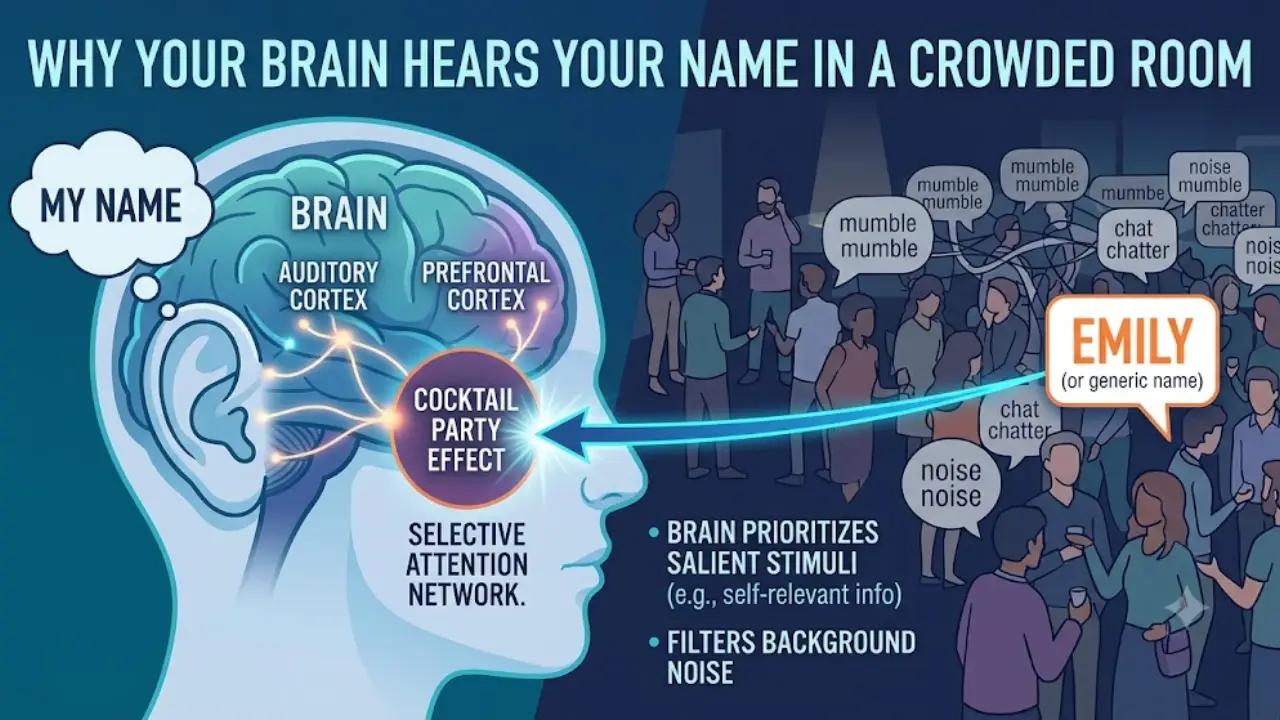
There is a strange thing that happens in crowded places.
You may be standing in a railway station, walking through a market, sitting in a busy restaurant or scrolling through your phone while several people talk around you. Hundreds of sounds are arriving at your ears every second.
You are not listening to them.
At least, you don’t think you are.
Then someone says something.
You stop.
For a fraction of a second, the noise around you seems to disappear.
You look behind you.
Nobody is there.
Nobody called you.
Yet you could have sworn you heard your own name.
That tiny experience seems almost trivial. It happens so often that most of us never investigate it.
But it hides a surprisingly deep question.
If you were not listening to the conversation, how did your brain know that something sounding like your name had appeared inside it?
And there is an even stranger possibility.
Perhaps the brain did not wait for you to consciously hear the word at all.
Perhaps it was already searching.
Somewhere Inside the Noise, Your Name Is Different
Imagine that ten people are talking around you.
One says, “The train is late.”
Another is discussing dinner.
Someone nearby is laughing.
A child is crying.
A loudspeaker is announcing something you cannot quite understand.
Your ears receive all of it.
But your conscious mind cannot possibly follow every voice simultaneously.
The brain therefore has a problem.
What should matter?
It cannot give equal attention to everything.
So it begins sorting.
Some sounds are boring.
Some are predictable.
Some are irrelevant.
Others are potentially important.
And one sound has an extraordinary advantage:
your own name.
Your name is not just another word you learned at school. It is attached to your identity, memories, relationships and social history. You have heard it thousands of times, spoken by parents, friends, teachers, colleagues, strangers and sometimes by people who wanted your immediate attention.
Over time, the brain learns that particular sound pattern extremely well.
Research using brain imaging has found distinctive neural responses when people hear their own names, even when those names are not the focus of the task. The response involves several brain regions associated with auditory processing, attention and awareness.
The important word here is response.
It does not mean that you consciously heard every occurrence.
It means something inside the brain may have recognised that the sound was worth investigating.
Your name has effectively acquired a privileged position in your mental dictionary.
But Here Is Where the Story Gets Strange
For decades, the popular explanation was simple.
The brain filters out irrelevant conversations.
Your own name somehow slips through.
It sounds sensible.
But experiments have repeatedly shown that the brain’s filtering system is not a simple on/off switch.
Information that you are not consciously attending to can sometimes still be processed.
The classic example came from selective-listening experiments in which people concentrated on one auditory message while another played simultaneously.
Participants were asked to ignore one channel.
Then researchers quietly inserted their own names into the unattended message.
And something remarkable happened.
Some people noticed.
Not everyone.
Not even most people.
But enough did to make psychologists take the phenomenon seriously.
In a 1995 study, only 34.6% of participants reported noticing their own names in the unattended speech.
That number is important because it destroys one of the most popular myths surrounding the phenomenon.
There is no evidence that every human automatically hears their name in every crowd.
The brain is powerful.
It is not magic.
The Name Is Not Always Waiting at the Door
A much more revealing question is this:
What happens to everything else?
Suppose somebody says an unusual word in the conversation you are ignoring.
Should that word attract your attention?
Apparently, not necessarily.
A preregistered replication published in 2021 found that approximately 29% of participants reported noticing their own names in the unattended auditory stream. Participants who noticed their names also showed greater disruption of the task they were performing.
The researchers also examined unusual words.
And this produced a fascinating result.
The brain did not simply treat every strange or unexpected word as equally important.
Your own name had a special advantage.
That tells us something fundamental.
The brain may not merely be asking:
“Was that unusual?”
It may be asking:
“Could that be about me?”
That is a much more sophisticated question.
The 150-Millisecond Mystery
Now imagine your name being spoken while you are concentrating on something else.
You do not consciously decide:
“I shall now stop reading and investigate the auditory environment.”
The interruption can happen almost automatically.
Modern neuroscience suggests that auditory information can influence attention before it becomes a fully conscious experience.
This distinction is crucial.
There may be a difference between:
detecting something
and
knowing that you detected it.
The brain can respond to a signal without producing a clear conscious memory of the event.
This is why researchers increasingly measure brain activity and physiological responses rather than relying only on people’s reports.
In a 2023 experiment designed to resemble a realistic café, 50 participants—32 women and 18 men—listened to conversations while irrelevant speech containing personally relevant or unusual information occurred in the background.
Researchers recorded EEG, skin conductance and eye movements.
The results showed that unattended speech could produce measurable neural and physiological responses even when it was outside the person’s main focus of attention.
The crowd, therefore, may not be silent.
It is simply quiet in consciousness.
Then Who Is Listening?
This is perhaps the most mysterious part.
When you concentrate on one conversation, another conversation does not necessarily vanish from the brain.
It becomes lower priority.
Some information may still be analysed.
Some may be discarded almost immediately.
Some may remain available long enough to trigger an attentional shift.
And a tiny fraction may suddenly become important.
Think of your attention as a person working at a desk in a noisy office.
The worker cannot listen to every conversation.
But somewhere in the background there is a monitoring system.
If someone suddenly shouts:
“Fire!”
the worker does not calmly continue typing.
The attention system changes priorities.
Your name can operate in a much smaller, quieter version of the same way.
It is a signal saying:
Something here may concern me.
But What If Nobody Said Your Name?
Now we arrive at the phenomenon that is even stranger than actually hearing your name.
The false alarm.
You are walking through a crowded street.
You suddenly hear:
“…Aee…”
You turn.
Nobody.
You wait.
Nothing.
For a moment, you are certain someone called you.
This does not necessarily mean your hearing failed.
The problem may lie somewhere deeper.
Your brain receives incomplete information constantly.
A distant voice becomes distorted.
A passing vehicle masks part of a sentence.
Two people speak simultaneously.
A fan produces a repetitive sound.
An announcement echoes across a station.
The brain must still decide what these fragments mean.
It cannot simply answer:
“Insufficient data. Please provide a clearer audio signal.”
Instead, it makes an interpretation.
Sometimes it gets it wrong.
And when the ambiguous sound resembles something highly meaningful such as your own name the brain has a particularly attractive interpretation available.
This is pattern completion.
The sound does not have to perfectly match the name.
It may only need to be sufficiently compatible with the pattern your brain already knows.
Your Brain May Be Guessing Before You Realise It
This leads to one of the most important ideas in modern perception:
we do not experience raw sensory information; we experience an interpretation of it.
Your ears deliver signals.
Your brain tries to determine what those signals mean.
Previous experience helps.
Expectation helps.
Context helps.
Memory helps.
Attention helps.
Imagine waiting for a friend in a railway station.
You know the friend may call your name.
Suddenly every vaguely familiar voice becomes interesting.
Now imagine the same station tomorrow when you are not expecting anyone.
The sounds have not changed much.
But your mental state has.
This is why expectation can influence perception.
It does not mean expectation creates a sound from nothing.
It means that when the sensory evidence is ambiguous, what you expect can influence which interpretation becomes convincing.
And that is how a meaningless fragment can sometimes become:
“Was that my name?”
Stress Changes the Question Your Brain Is Asking
Now make the situation more intense.
You are late.
You are worried.
You are waiting for an important announcement.
Suddenly every sound seems sharper.
You notice footsteps.
You notice voices.
You notice movement.
You notice announcements that you would normally ignore.
Research on anxiety and attention provides a broader clue. Large bodies of research have found relationships between anxious states and attention to potentially threatening information, although the effects vary substantially between individuals and experimental conditions.
That does not mean:
“Anxiety makes you hear your name.”
Science does not justify such a simple claim.
The more defensible conclusion is that emotional state can change what the brain considers important.
When your internal alarm system is already active, the threshold for investigating ambiguous information may change.
You become a more vigilant observer.
The crowd has not necessarily become louder.
You have become more interested in what it might contain.
The People Who Ignore More May Hear Less
There is another unexpected clue.
Not everyone is equally distractible.
Some people can concentrate through almost anything.
Others notice every little sound.
This difference may partly involve working memory.
A 2001 study found that people who detected their own names in unattended speech tended to have lower working-memory capacity than people who did not notice them.
The 2021 replication also found a relationship between working-memory capacity and noticing one’s own name.
At first glance, that sounds backwards.
Wouldn’t a “better” brain be more likely to notice an important word?
Not necessarily.
If you are extremely good at maintaining the current task and suppressing distractions, an irrelevant name may have difficulty breaking through.
Someone with weaker attentional control may be more easily interrupted.
So the ability to ignore the world can sometimes mean missing something the more distractible person notices.
There is no winner here.
The two brains are simply allocating attention differently.
Why Your Name Beats a Strange Word
This may be the strongest clue that the phenomenon is not merely about surprise.
Researchers have tested unusual words in unattended speech.
If the brain were simply searching for anything unexpected, strange words should frequently break through.
They do not appear to do so consistently.
Your own name has a special advantage because it combines two characteristics:
recognisability + personal significance.
That combination is difficult for the attention system to ignore.
A random unusual word may be interesting.
Your name may be consequential.
The distinction is tiny in sound.
It is enormous in meaning.
The Brain Does Not Always Give You the Whole Story
Here is another uncomfortable possibility.
You may have been affected by a sound without consciously knowing it.
Neuroscience increasingly distinguishes between sensory processing, attentional selection and conscious awareness.
These are related systems, but they are not identical.
A sound can influence neural activity.
It can alter physiological responses.
It can compete for attention.
Yet you may never remember hearing it.
This is why the statement “I didn’t hear it” can mean several different things.
It might mean:
The sound never reached my auditory system.
Or:
My brain processed some of it but it never became conscious.
Or:
I heard it but my attention immediately discarded it.
Or:
I detected something but could not identify it.
Those are very different experiences hidden behind one sentence.
And Then Technology Joined the Conversation
There is an amusing modern twist.
For most of human history, the crowd consisted of people.
Today, it also consists of machines.
Your phone vibrates.
A notification arrives.
A familiar ringtone plays.
A voice assistant calls your attention.
A personalised alert appears.
The principle is remarkably similar.
Technology does not need to shout constantly.
It only needs to create a signal your brain has learned to associate with something important.
That is why notification design can become so powerful.
A sound associated with a message from a loved one is not psychologically equivalent to an arbitrary beep.
The meaning has been learned.
The sound becomes a shortcut to significance.
The danger is obvious.
If every application attempts to become psychologically important, your attention becomes a battlefield.
The modern problem may therefore not be how to get the brain’s attention.
It may be learning how to stop everything else from demanding it.
The Cocktail Party Effect Has a Much Bigger Secret
The phrase “cocktail party effect” makes the phenomenon sound like a simple party trick.
It is not.
It touches one of the largest unanswered questions in neuroscience:
How does the brain decide what deserves consciousness?
Every second, sensory information arrives from the outside world.
You cannot consciously process all of it.
So the brain must select.
But selection cannot be completely rigid.
Imagine a system that perfectly blocked everything you were not currently attending to.
You could concentrate beautifully.
You might also fail to notice an approaching danger.
A useful attentional system therefore needs something paradoxical:
focus and flexibility at the same time.
It must protect your current concentration while remaining sufficiently open to information that might suddenly matter.
Your name is an unusually powerful test of that system.
The Most Popular Explanation Is Also the Simplest One
People often say:
“Your brain hears your name even when you’re not listening.”
It is a memorable sentence.
It is also too simple.
Research does not show that everyone automatically detects their name.
It does not show that the brain consciously processes every background conversation.
It does not show that every false experience of hearing your name is caused by expectation.
And it does not prove that anxiety is responsible whenever you think someone called you.
Instead, the evidence points toward an interaction between several systems:
| What is happening | What it contributes |
| Selective attention | Decides what receives priority |
| Personal relevance | Gives your name unusual importance |
| Pattern recognition | Helps identify incomplete sounds |
| Expectation | Influences interpretation of ambiguous information |
| Working memory | Helps maintain the task and suppress distraction |
| Emotional state | Can alter vigilance and attentional priorities |
| Conscious awareness | Determines what finally enters your experience |
None of these mechanisms needs to work alone.
They cooperate.
Sometimes they cooperate perfectly.
Sometimes they produce a false alarm.
So, Who Called Your Name?
Perhaps someone really did.
Perhaps somebody said a similar word.
Perhaps a distant voice contained just enough of the right sound.
Perhaps you were expecting someone to call you.
Or perhaps your brain simply found the most meaningful explanation for an ambiguous piece of noise.
And that is what makes the experience so fascinating.
You cannot always tell which explanation was responsible simply by remembering how convincing it felt.
The experience of hearing your name is evidence that your brain interpreted something.
It is not necessarily evidence that the outside world actually contained your name.
That distinction is much bigger than it sounds.
Because it means perception is not simply a recording.
It is an active process.
The world supplies fragments.
The brain supplies meaning.
Attention decides what deserves another look.
Memory supplies familiar patterns.
Expectation quietly changes the odds.
And consciousness receives the final result as though it were an objective report.
Usually, it is good enough.
Occasionally, it turns a piece of meaningless noise into the most personal word in your vocabulary.
You turn around.
Nobody is there.
And for one tiny moment, you discover something unsettling about your own mind:
you do not merely hear the world.
Your brain is constantly deciding what the world might be saying.
What We Still Don’t Know
The biggest mystery remains unresolved.
Does the brain detect your name automatically and unconsciously before attention becomes involved?
Or does expectation and attentional control account for more of the famous phenomenon than popular explanations suggest?
Current evidence points in both directions.
There is convincing evidence that personally relevant sounds can influence neural processing outside the focus of attention. But detection rates vary, experimental designs produce different results, and “neural response,” “attention capture” and “conscious awareness” are not interchangeable.
That is why the most scientifically honest answer is also the most interesting:
your brain appears to be listening beyond the narrow spotlight of consciousness but nobody has yet reduced that process to one simple mental filter.
And perhaps that is why the experience never stops being strange.
The next time you are walking through a crowd and suddenly think someone called your name, don’t immediately dismiss it as imagination.
And don’t assume somebody necessarily called you either.
For a moment, you may simply be witnessing your brain doing what it has evolved to do remarkably well:
searching an ocean of meaningless signals for something that matters.
Sometimes it finds you.
Sometimes it finds nothing.
And sometimes, mysteriously, it finds your name where no name was ever spoken.
Key Unfoldings
- Your own name receives unusually strong attentional and neural processing because it carries deep personal significance.
- Background speech is not simply switched off when you ignore it; some information can still be processed outside conscious attention.
- Experimental detection of one’s own name is far from universal. Studies have reported figures around one-third under particular laboratory conditions.
- A 2021 preregistered replication found 29% of participants noticed their own names in unattended speech.
- Working-memory capacity appears to influence susceptibility to this kind of distraction.
- False experiences of hearing your name can arise when ambiguous sounds interact with expectation, memory and pattern recognition.
- Stress and anxiety can alter attentional priorities, but there is insufficient evidence to say they directly cause people to hear their names.
- The brain may process personally relevant sounds without the person becoming consciously aware of all that processing.
- The phenomenon is therefore better understood as an interaction between attention, relevance, prediction and pattern recognition rather than a simple “brain filter.”
Sources and Further Reading
- National Library of Medicine / PubMed: research on the cocktail-party effect, selective attention and own-name processing.
- NIH / PMC: preregistered replication of the cocktail-party phenomenon.
- NIH / PMC: neurophysiological investigation of unattended speech in a realistic virtual café.
- NIH / PMC: recent research examining own-name distraction under different speech conditions.
- PubMed: research on working-memory capacity and detection of one’s own name.
- PubMed: research examining neural processing of one’s own name.
- National Institutes of Health: NIH
- U.S. National Library of Medicine: PubMed
- National Institute on Deafness and Other Communication Disorders: NIDCD
- National Institute of Mental Health: NIMH








Leave a Reply